
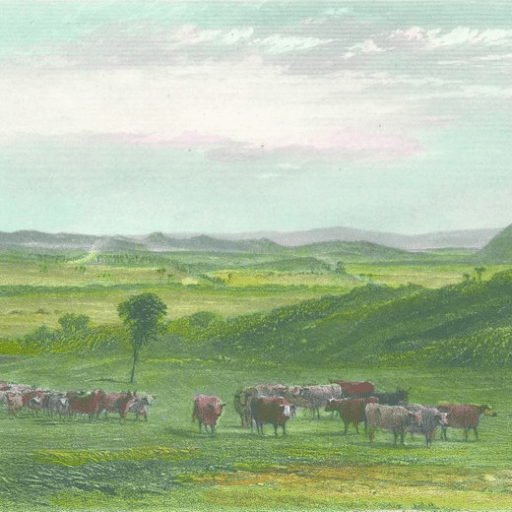
A Historiography of The Cowpastures
The aim of this historiography is to bring together resources about the Cowpastures and the region that developed between its naming by Governor Hunter in 1795 and the foundation of the private village of Camden by the Macarthur brothers at the Nepean River crossing, as well as the establishment of Camden Park Estate in 1840.
The historiography can range from books and articles to exhibitions and conferences.
Historical Overview
The cattle escaped from the Sydney colony in 1788 and occupied the land of the Dharawal people on the southern side of the Nepean River, an area known for its exceptional country in the Sydney basin.
Governor Hunter named ‘the Cow Pasture Plains’ in 1795 after a personal inspection of the Wild Cattle. Governor King established a government reserve in the area in 1803 to protect the cattle, granting it the same status as an English estate, complete with a gamekeeper to stop poaching. The hut was built at Elderslie to protect the entry point to the reserve at the river crossing.
The first land grant in the area was made in 1805 to John Macarthur to develop the wool industry.
By 1804, an estimated 3,000 cattle were present in the area, and by 1810, following Governor Macquarie’s visit, the number had grown to approximately 5,000. The reserve was declassified in 1823, and government cattle were removed in 1824. The land was sold and granted to settlers, including John Macarthur, who acquired over 10,000 acres. There were probably descendants of the cattle in the southern Blue Mountains in the 1930s.
Historical importance
The Cowpastures was the fourth site of European settlement in New South Wales and was part of the Australian colonial settler society project, driven by British colonialism. The British aimed to create an English-style landscape from the time of their arrival in the area in the 1790s. The earliest written acknowledgement of this was by Englishman John Hawdon in 1828.
The Cowpastures became a regional locality that was in common usage well into the late 19th century.
The historic site of Belgenny Farm, situated within the Cowpastures, offers three key reasons for the Cowpastures’ significance. The website states
The history of the Cowpastures is significant for several reasons. First, it provides the local context to John Macarthur’s land grants and purchases, including the political constraints on settlement imposed by the colonial and British governments in their desire to protect the wild cattle. Second, the descriptions of the countryside made by those who ventured into the Cowpastures between 1795 and 1805 to see the wild cattle provide a lens through which to view the local landscape at the very outset of European impact on the local environment. Finally, the origins, breed, conformation and description of the wild cattle of the Cowpastures are of special interest to agricultural historians.
Source: Belgenny Farm 2025, The Cowpastures and its wild cattle. NSW Government (NSW Department of Primary Industries and Regional Development), Camden. Online at https://www.belgennyfarm.com.au/history/site-history/the-cowpastures-and-its-wild-cattle (Viewed 26 July 2025)
Regional significance
The evidence enables the identification and construction of a functional region around the Cowpastures from 1795 to 1840. The Cowpastures region was a colonial administrative area, a locality, and a geographic area. It was the fourth locality of European occupation in the colony of New South Wales.
The boundaries of the Cowpastures region were both culturally derived and natural, where the landforms restricted and constrained European activity. The story of the Cowpastures region has many layers that can be peeled back to reveal its complexities and interactions over time and space.
The region’s identity waned by the late 19th century but is celebrated today for its historical legacy.
Resources
(1) Articles
Ian Willis 2016, ‘Just like England’, a colonial settler landscape ISAA Review, v15, n2, 5-18. Online at https://www.academia.edu/34163349/Just_like_England_a_colonial_settler_landscape
(2) Blog – Camden History Notes
A contested sacred site in the historic landscape of the Cowpastures
This blog post examines community concerns surrounding the sale of glebe land attached to St John’s Anglican Church in Camden, highlighting community sensitivities to the sale of church sites. This church was primarily funded by the Macarthur family and, since its foundation in 1847, has received considerable endowments from the family.
The Cowpastures Region 1795-1840
This blog post attempts to put a regional boundary on The Cowpastures for the first time and examines some of the historical evidence for this boundary.
Camden Cowpastures Bicentenary Celebrations (Blog post)
Convicts in the Cowpastures (Blog post)
Governor Macquarie in the Cowpastures 1810 (Blog post)
Governor Macquarie returns to the Cowpastures 1820 (Blog post)
Mummel and a Cowpastures Patriarch (Blog post)
The Cowpasture, just like an English landscape (Slideshare)
Viewing the landscape of the Cowpastures (Blog post)
John Hawdon of Elderslie (Blog post)
John Hawdon of Elderslie English Origins (Blog post)
John Macarthur the legend (Blog post)
Hope, heritage and a sense of place – an English village in the Cowpastures (Blog post)
This blog post looks at the historical elements that have contributed to the Camden sense of place, and ultimately its historical significance.
A walk in the meadows of the past
This blog post is about the Miss Llewella Davies Pioneers Walkway at the Camden Town Farm. The beauty of the Cowpastures landscape characterises the recently opened Miss Lewella Davies Memorial Walkway which weaves its way across the Nepean River flats on the western side of Camden’s township historic town centre.
(4) Books
A colonial diarist of the Cowpastures
This blog post is a review of Janice Johnson (ed), Camden Through a Poet’s Eyes, Charles Tompson (Jnr) (2019). Tompson was a prolific writer and observer of the Cowpastures under the byline ‘From our Correspondent – Camden’ for The Sydney Morning Herald between 1847 and 1852. In 1854, Charles Tompson described that the ‘village of Camden’ had ‘the aspect and the attributes of an English village’ (p.118) for the first time.
(5) Conferences
Cowpastures and Beyond: Conference 2016 (Camden Area Family History Society)
(6) Exhibitions
The Cowpastures at the Campbelltown Arts Centre (2017) (Exhibition)
They Came by Boat Exhibition Campbelltown Arts Centre (Exhibition Review, 2017)
(7) Memorials
MA 2014, Cowpastures Memorial, Picton. Monument Australia. Online at https://monumentaustralia.org.au/themes/landscape/settlement/display/102538-cowpastures-memorial-
(7) Presentations
Fiona Probyn-Rapsey 2023, Cattle, Cowpastures and Country. Talk, ANU, 6 March. Online at https://archanth.cass.anu.edu.au/events/cattle-cowpastures-and-country
The Cowpastures, just like a English landscape (Presentation)

