
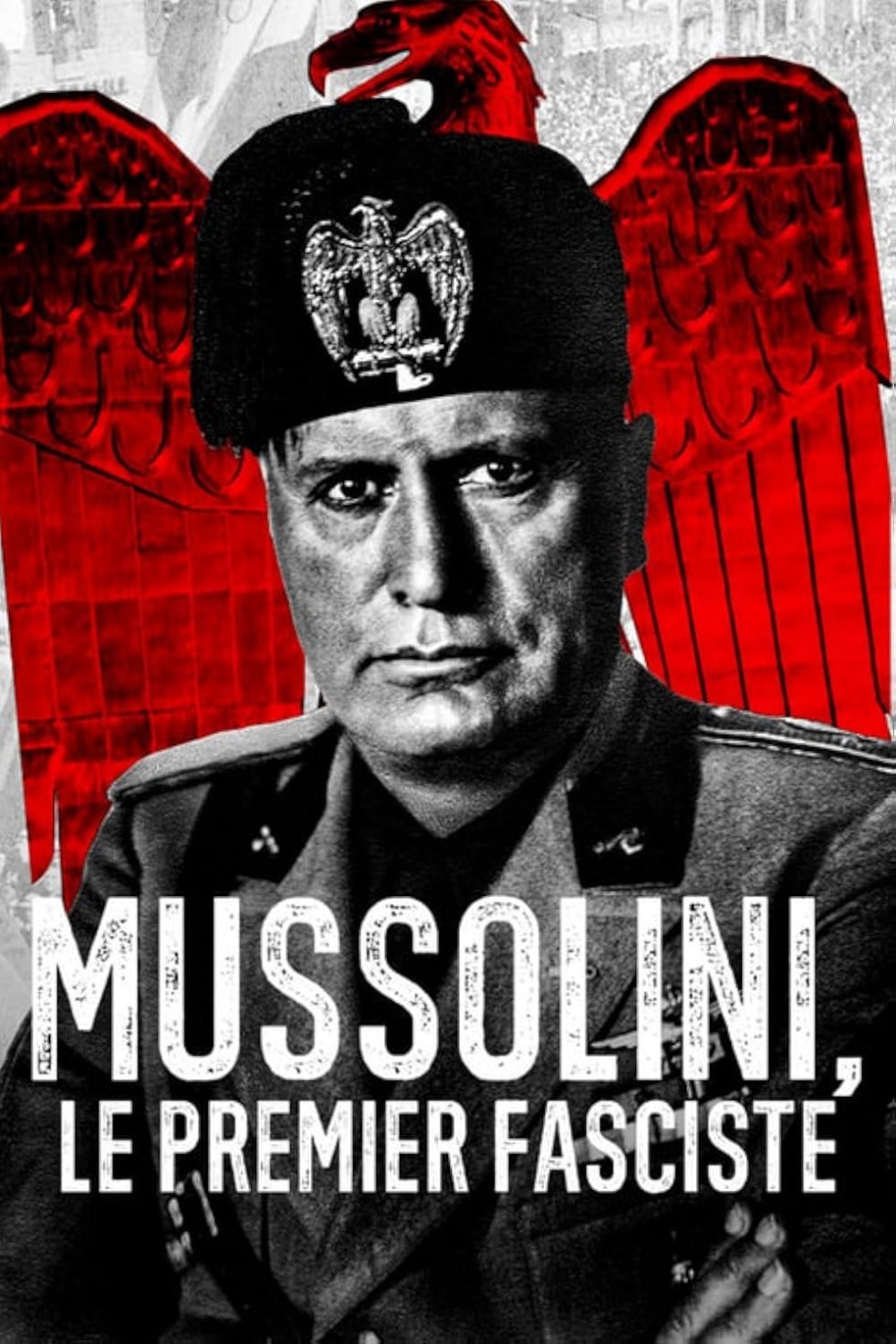
History repeating itself
In a period today of state-sponsored violence, political upheaval and collective trauma, an examination of the sources of modern fascism provides interesting insights into how history repeats itself.
Modern fascism, as we know it, originated in Italy after World War 1 under the leadership of Benito Mussolini as a form of Italian nationalism. Yet there were proto-fascists dating back to the late 18th century who opposed the ideas of the Enlightenment and the French Revolution.
Fascist ideas emerged in France, Austria, Germany and Italy in the 1800s. Some condemned the rise of progressiveness in the early 1800s and the rise of liberalism and radicalism. Others claimed the traditional dominance of religion and the elites had been compromised, and the rise of the masses. (Soucy 2026)
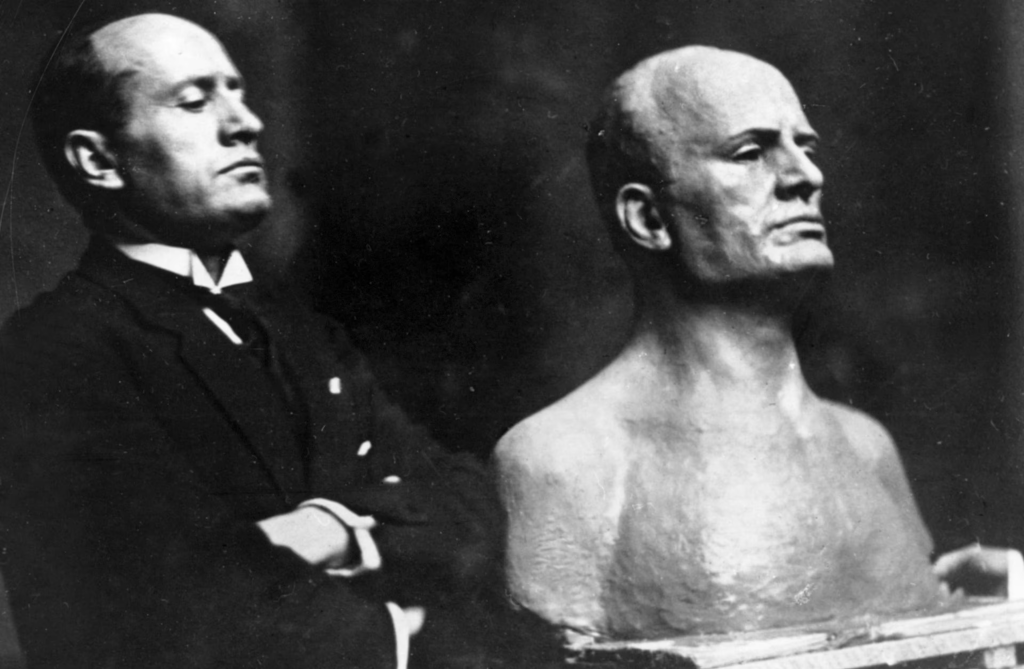
What is fascism?
Definitions of fascism are rubbery at best, complex and full of contradictions, even from Mussolini.
Fascism is typified by authoritarian charismatic leadership, a centralised government and a one-party state, ultranationalist, violent suppression of opposition, totalitarianism, belief in Social Darwinism and eugenics, a racial hierarchy, subordination of the individual to the state, contempt for democracy and parliamentary liberalism, and opposition to democracy, socialism, liberalism, pluralism, communism and Marxism.
Fascism, according to political historian Robert Paxton
obsessive preoccupation with community decline, humiliation, or victimhood and by compensatory cults of unity, energy, and purity, in which a mass-based party of committed nationalist militants, working in uneasy but effective collaboration with traditional elites, abandons democratic liberties and pursues with redemptive violence and without ethical or legal restraints goals of internal cleansing and external expansion.(Paxton 2004).
One of the key planks of fascism is nationalism.
The origins of nationalism can be isolated in the 1648 Treaty of Westphalia, which established the principles of territorial sovereignty, non-interference, and the secularisation of politics. It marked a crucial transition from medieval, religion-based, and fragmented power structures toward the sovereign, defined-territory states that provide the basis for modern national identity and self-determination. (Mack 2026).
The Westphalian system, also known as Westphalian sovereignty, is a principle in international law that each state has exclusive sovereignty over its territory. This created the framework that enabled the formation of nation-states, defined as groups of people united by language and culture. (Wikipedia contributors. (2025).
Other major influences were the American Revolution (1775-1783) and the French Revolution (1789-1799).
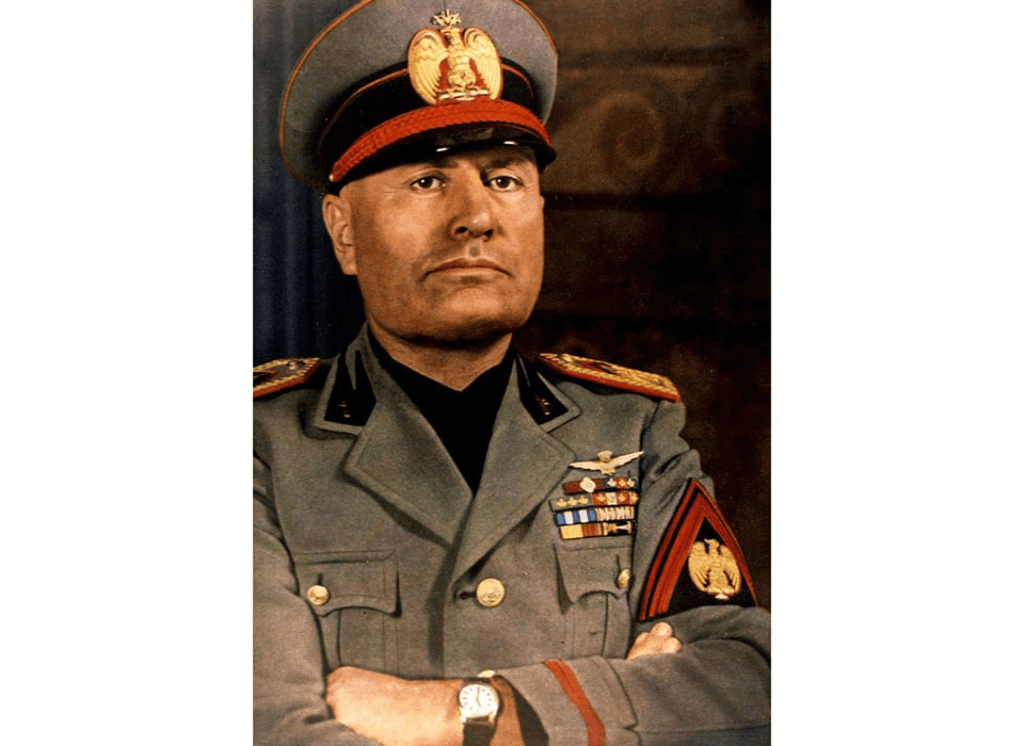
Mussolini’s version of fascism
Mussolini was a charismatic Italian leader whose version of fascism drew on a variety of movements, traditions and ideologies from the late 19th century, including Syndicalism, Futurism, Conservatism, Modernism, Revolutionary Capitalism, Social Darwinism, Moral Hygiene, Aesthetics, Violence, Opportunism, Mediterraneanism, National Rejuvenation, Ultranationalism and Otherness.
Author and academic Lauren Sweger-Hollingsworth argues that Mussolini, as a public speaker and political journalist, produced ‘propaganda advocating violence as a means to enforce demands’. He believed that social revolution typically followed a war. He had a sense of destiny and advocated for the emergence of a dictator who could resolve the political and economic crisis gripping Italy following the war. (Sweger 2018)
Sweger argues
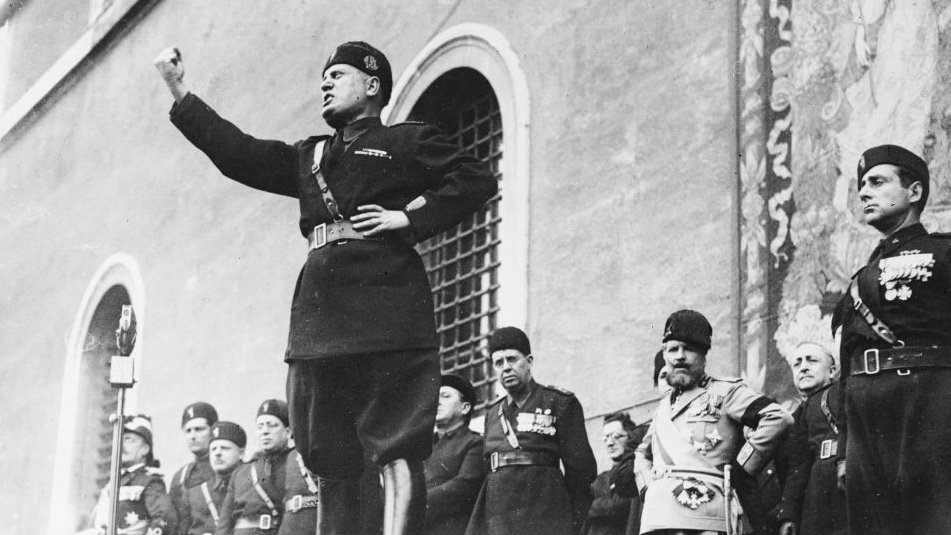
Mussolini’s style of oratory was impressive, his mannerisms where theatrical, and his metaphors were striking and relevant. Although his facts were often wrong, opinions contradictory, and rhetoric routinely misdirected and malicious, he could catch the imaginations of crowds and effectively put forth his ideas while appealing to the working-class majority. (Sweger 2018)
Mussolini’s supporters saw the war in revolutionary terms, bringing massive changes to the nature of war, society, the state, and technology. The war created a form of military citizenship in which private citizens were mobilised into the military to benefit the state in an unprecedented manner. (Wikipedia 2026)
The term fascism comes from the Italian term fascismo, which is derived from fascio, meaning a ‘bundle of sticks’, a symbol of Ancient Rome used to denote strength through unity; a single rod is easily broken, while the bundle is difficult to break. The fasces had been previously employed by earlier political movements, for example, “Marianne, symbol of the French Republic, was often seen in the 19th century carrying the fasces to represent the force of Republican solidarity against her aristocratic and clerical enemies. (Wikipedia 2026)
In the early 1920s, there was a range of views within Italian fascism. On the left were those who wanted to advance national syndicalism and workers’ interests. On the right were the paramilitary ‘Blackshirts’ who wanted a dictatorship.
Mussolini was influenced by the work of Plato
Mussolini was influenced by the political philosophy of Plato in Ancient Greece, whose ideas were similar to fascism. Plato’s work, Republic (c. 380 BC), emphasised the need for a philosopher king in an ideal state. He emphasised that individuals must adhere to the law and perform their duties, while declining to grant them the right to limit or reject state interference in their lives. He claimed that an ideal state would have an education system designed to produce able rulers and warriors.
Various historians see a link between disparate groups of influences from the 18th century, including the mass movements of the French Revolution, Napoleon III, who ran a police state, Bismarck, the Jacobean movement, and those who see it as a violent form of imperialism. (Wkpdia 2026)
Chaos in Italy
Modern fascism emerged from the economic chaos in Italy following World War One, which triggered an economic ‘crisis’ amid popular discontent, strikes, and social unrest. Socialism gained some support with partial nationalisation, while land-owners and the middle class turned to an alternative – fascism.
There was a loss of confidence in the government. Mussolini formed the Italian Fasces of Combat in Milan in 1919, which became the National Fascist Party in 1921, made up of war veterans who could return glory to Italy. Mussolini’s political aims failed at the elections. He garnered support of those opposed to the socialists, who included
industrialists and businessmen who feared strikes and slowdowns, rural landowners who feared losing their land, and members of political parties who feared socialism’s growing popularity. (Blakemore 2022).
Mussolini’s supporters funded his paramilitary, ‘the Blackshirts’, who violently attacked the socialists.
In 1921, Mussolini won a seat in parliament and was invited to form a coalition. He formed the National Fascist Party in 1921, and membership grew to over 300,000. Liberal Prime Minister Giovanni Giolitti resigned in 1921, and the Fascists promised to protect big business from nationalisation and preserve private property. Entrepreneurs hired the ‘blackshirts’ to suppress factory unrest and dissension amongst farm workers and sharecroppers. In the view of author and academic Arnd Bauerkämper, this gave ‘capitalism a new life’. (Bauerkämper 2022)
1922
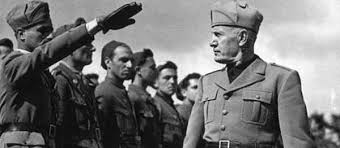
In mid-1922, the socialists called a strike, and Mussolini decided it was time to act. In October 1922, the fascists marched on Rome from Milan. The government panicked, imposed martial law, which the King refused to sign. The government resigned, and the king invited Mussolini to form a government. Mussolini assumed government in October 1922. He centralised government power, abolished cabinet government, and declared a one-party state dedicated to nationalism, militarism and totalitarianism. His attempts to restructure the Italian economy largely failed.
Known as Il Duce, (the Duke), Mussolini exercised a powerful influence over the Italian people.(Blakemore 2022). Fascism became the state ideology of Italy in 1922.
In Italy, thousands of landowners and businessmen were grateful to Mussolini’s Blackshirts for curbing the socialists in 1920–21, and many in the army and the Catholic church saw fascism as a bulwark against communism. (Soucy 2026)
Seeking the glory of Rome, Mussolini turned to foreign affairs to distract the populace by expanding its territory, especially in Ethiopia, then known as Abyssinia. The Italian army invaded Abyssinia in 1936. Mussolini provided arms and support to Franco’s forces in the Spanish Civil War in 1936 and signed a pact with Hitler called the Rome-Berlin Axis. The partnership was later called the Pact of Steel.
Conclusion
Fascism has not gone away.
Over the past five decades, the neoliberal turn – the systematic dismantling of social safety nets (Keynesian economics) and a return to so-called “free market” capitalism (Friedman and the Chicago school) – has revived interest in fascism. (Lexier 2026)
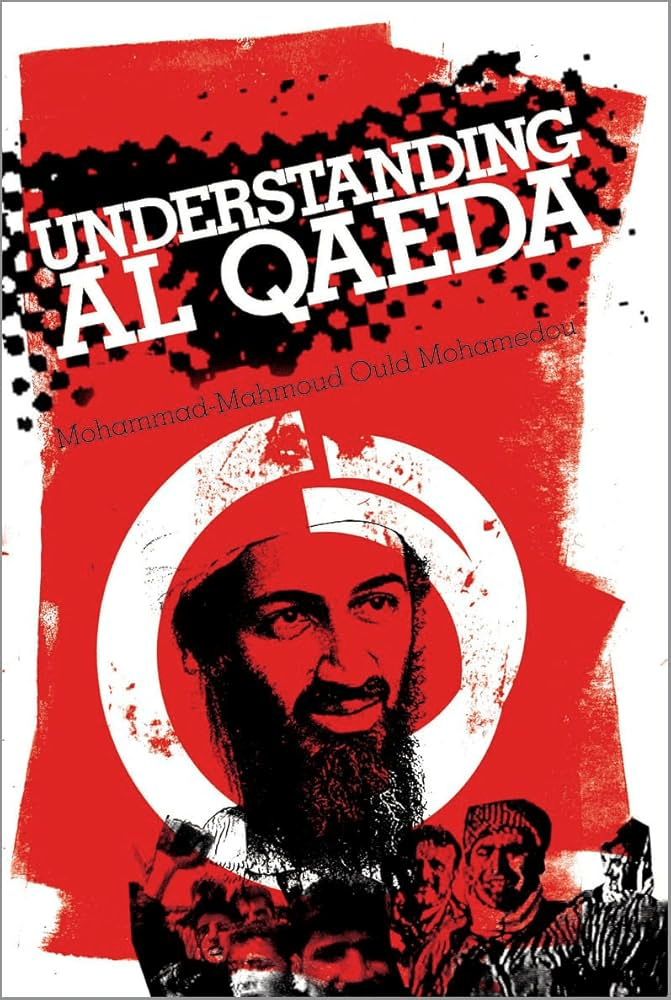
Today, there are many derivative forms of fascism. They include neo-fascism (Europe), Islamo-fascism (ISIS, Taliban, Al-Qaeda (or Al-Qa’eda), a Sunni Islamist militant), social fascism (USA), alt-right (USA), Radical Right-Wing Populism (Europe), post-modern fascism USA).
References
Bauerkämper, Arnd 2022. ‘Fascism and Capitalism’. Capitalism, Democracy and the History of Political Ideologies. Vol. 67, pp75-97. Online at https://moving-the-social.ub.rub.de/index.php/MTS/article/view/9800 (Accessed 25/3/26)
Blakemore, Erin. (2022). How Mussolini led Italy to fascism—and why his legacy looms today. [online] National Geographic. Available at: https://www.nationalgeographic.com/history/article/benito-mussolini-rise-of-fascism-in-italy [Accessed 17 Feb. 2026].
Lexier, Roberta 2026. Fascism and the Crises of Capitalism: A Tale of Two Crises. Active History, History Matters. 18 March. Online at https://activehistory.ca/blog/2026/03/18/fascism-and-the-crises-of-capitalism-a-tale-of-two-crises/ (Accessed 25/3/26)
Mack, John. (2026). Making Connections Between Ideas And Events: The Peace of Westphalia and the Rise of the Nation-State. [online] A Brief History of the World Since 1500. Available at: https://pressbooks.pub/abriefhistory/chapter/making-connections-between-events-the-peace-of-westphalia-and-the-rise-of-the-nation-state [Accessed 19 Jan. 2026].
Paxton, Robert O. (2004). The Anatomy of Fascism (First ed.). New York: Alfred A. Knopf. ISBN 978-1-4000-4094-0.
Soucy, Robert. (2026) fascism. Encyclopedia Britannica. https://www.britannica.com/topic/fascism (Viewed 19/1/26)
Sweger-Hollingsworth, Lauren, 2018. “Three Forms of Fascism, Working Paper No. 1”, Portland State University Economics Working Papers. 1. (11 December) Online https://pdxscholar.library.pdx.edu/econ_workingpapers/1/#:~:text=This%20inquiry%20seeks%20to%20establish,%2C%20racism%2C%20and%20false%20information.
Wikipedia contributors. (2025). Westphalian system. In Wikipedia, The Free Encyclopedia. Retrieved 05:31, January 19, 2026, from https://en.wikipedia.org/w/index.php?title=Westphalian_system&oldid=1321287304
Wikipedia contributors. (2026). Fascism. In Wikipedia, The Free Encyclopedia. Retrieved 04:12, January 19, 2026, from https://en.wikipedia.org/w/index.php?title=Fascism&oldid=1333542239
Discover more from Camden History Notes
Subscribe to get the latest posts sent to your email.


