
A postcard from Frederick for sister Millie
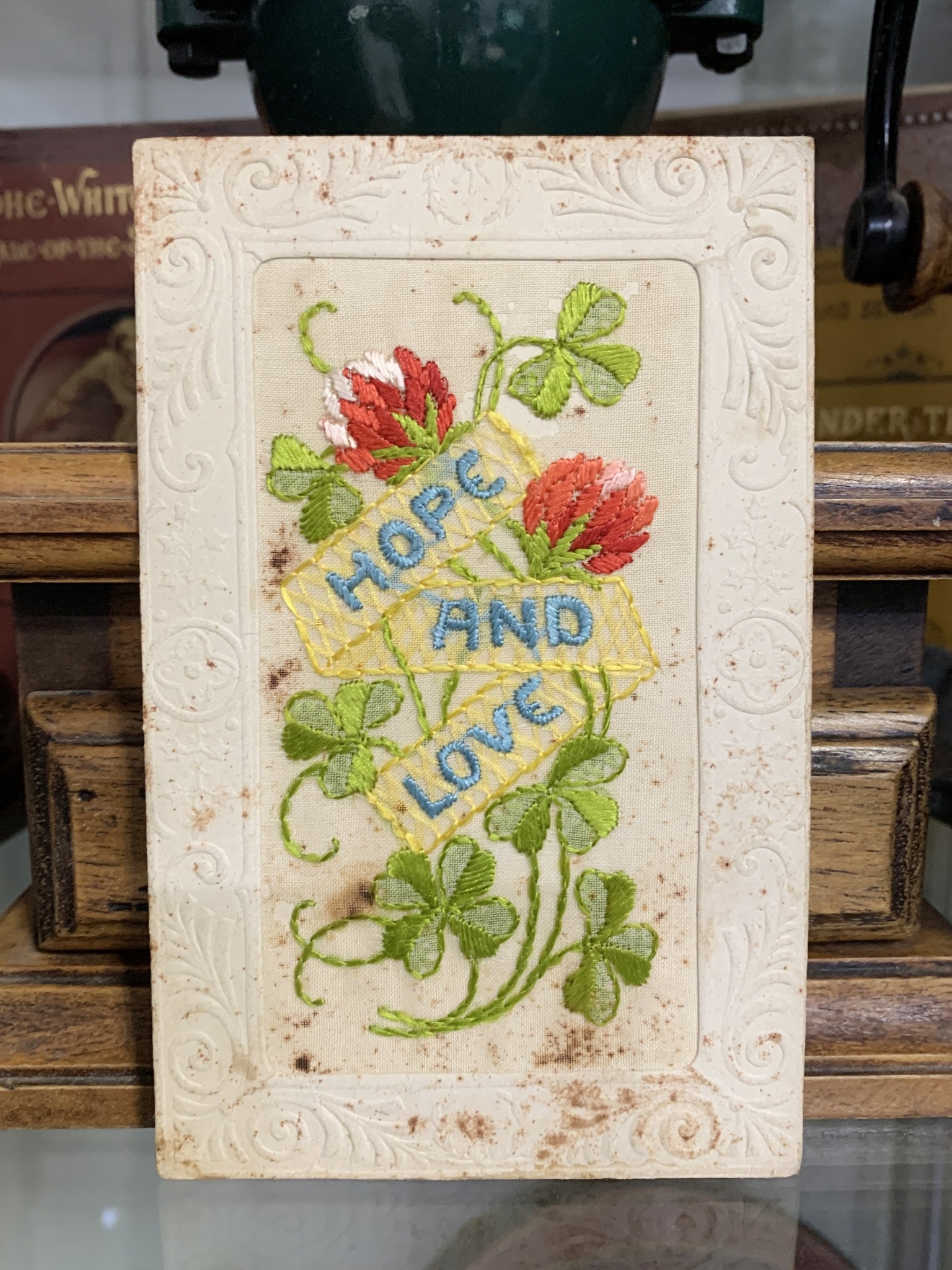
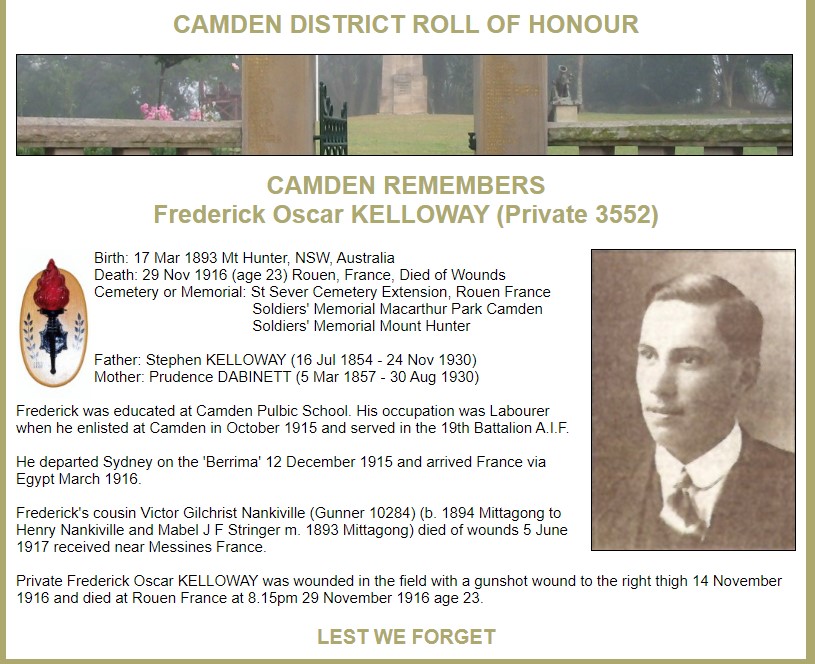
During the First World War, local soldier Frederick Kelloway sent his sister, Millie, an embroidered silk postcard to celebrate Christmas and New Year at home in 1916.
Millie’s great-granddaughter Kellee writes on Facebook that
Frederick was overseas serving his country in WWI. Sadly, by the time Millie received the Christmas wishes, Frederick had died in battle on 29th November 1916.
https://www.facebook.com/profile.php?id=100086479871666
In the early 20th century, postcards were a cheap and easy way for people to keep in touch with each other, and this especially applied in the First World War.
History of postcards
The postcard was an integral part of the global postal system.
The Philatelic Team at Australia Post states that the first postcard appeared in Austria.
The world’s first postcard is recognised as being issued 150 years ago, by Austria in 1869. This was a simple, blank, light-brown card (8.5cm x 12cm), with an area for a message, the address and an officially imprinted stamp on the other side, which was half the cost of a normal letter.
An economics professor from Vienna had written an article in the newspaper suggesting that there must be a simpler, cheaper and more practical way to send a short message than a letter, and the Austrian postal authority answered his call.
https://australiapostcollectables.com.au/articles/150-years-of-the-postcard
The first Australian postcard was issued by postal authorities in New South Wales in 1875. Postcards had been approved by postal authorities in Great Britain in 1870 and the United States in 1873.
Australia Post states that the first postcards were Post Office monopolies and that private postcard makers had to submit blank cards to postal authorities to have a stamp image printed on the card.
Unstamped pictorial postcards from private makers were not allowed to be sold in Australia until 1895 when they were approved for use in Victoria. An adhesive stamp was placed on the card, and it had to ‘measure not less than l inch x 3 inches nor more than 5 ¼ x 3 ¼ inches’.
The first pictorial postcard was introduced in Tasmania in 1894 and by the New South Wales Post Office in 1898. It had scenes on the back and space for a short message. At the time, Post Office regulations stated that only the address could be on the front of the postcard.
Postage rates were 1d within Australia and 1½d overseas with a New South Wales stamp. The postcard trade boomed in Australia, especially between 1900 and 1910, after which the letter rate dropped to 1d in 1911.
Postcards were a much easier way to contact someone than writing a letter, and they became souvenirs. Postcard collecting became popular.
Frederick Kelloway’s embroidered silk postcard
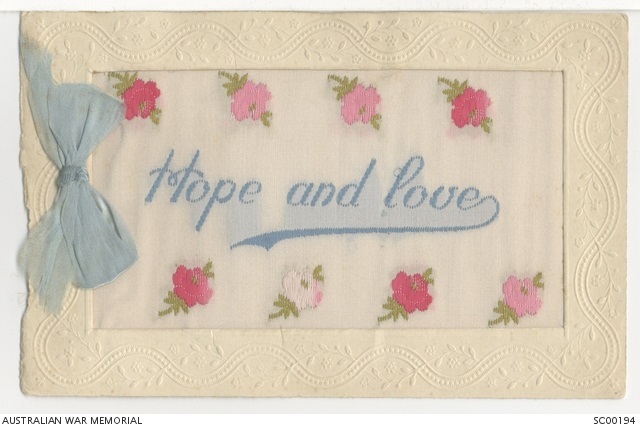
Frederick Kelloway’s card is an embroidered silk postcard that was part of a thriving trade in France during the First World War.
The Australian War Memorial has a collection of over 1000 woven, printed and embroidered silk postcards. The themes covered include
Australian Themes, woven and printed silk postcards, general greetings, greetings to relatives, silk postcards embroidered Wife / Darling or Mother, Sister, birthday greetings, Christmas and New Year, units and camps, flags, France and Belgium.
https://www.awm.gov.au/collection/RC00688
The first embroidered silk postcards were made for the Paris Exposition in 1900, and their manufacture peaked during the First World War.
By 1915, France had a thriving cottage industry of outworkers, and around 10 million postcards were made by 1919.
The embroidery was done by French women, often at home, on a strip of silk mesh with around 25 to a strip. These were then sent to factories for cutting and mounting on postcards.
The Imperial War Museum states:
The embroidered postcards were very popular with British soldiers who often sent them home. They were sold in thin paper envelopes but were seldom sent through the post in them. They were too fragile and, more particularly, they represented quite an investment – they were not cheap souvenirs. Usually, they were mailed with letters.
https://www.iwm.org.uk/history/embroidered-silk-postcards
Frederick Kelloway’s embroidered silk postcard does not have a stamp or address on the reverse of the card and would probably have been sent with a letter.
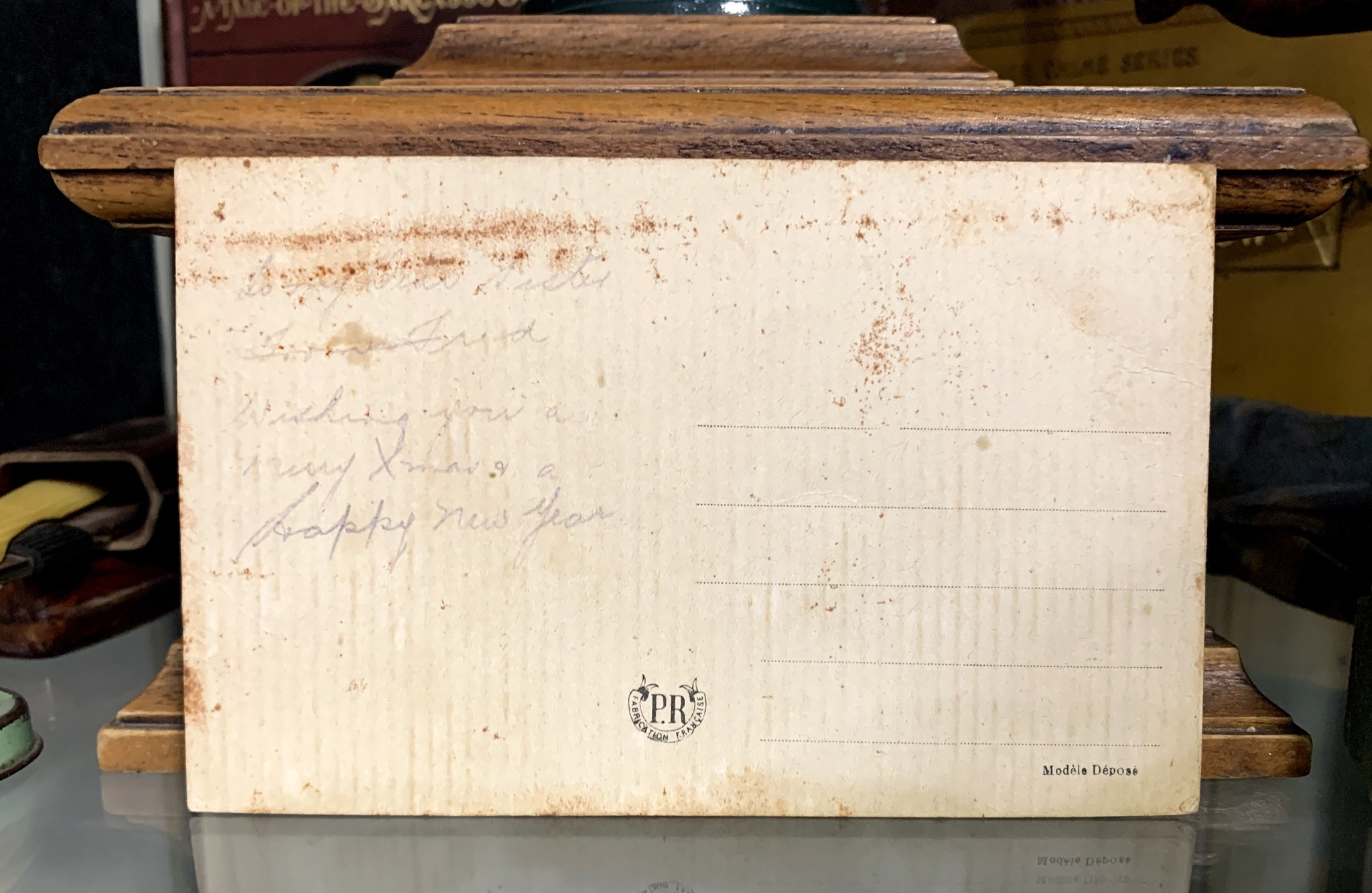
Frederick’s postcard to Millie has pansies and a four-leaf clover. The Australian War Memorial states that these have a particular meaning.
Typical images used were the swallow, the pansy (which was a very popular image in silk cards. Its popular meaning at the time was ‘you occupy my thoughts’), roses (love) and forget me nots (meaning true love, memories). Horseshoes and four-leaf clovers were also popular as symbols of good luck and remembrance.
https://www.awm.gov.au/collection/C2829356
The Australia Post Philatelic Team state
Pretty pastel-coloured flowers featured prominently – a stark contrast to the harsh conditions faced on the Western Front, as did butterflies, birthday or sentimental greetings and the flags of allied countries.
https://australiapostcollectables.com.au/articles/150-years-of-the-postcard
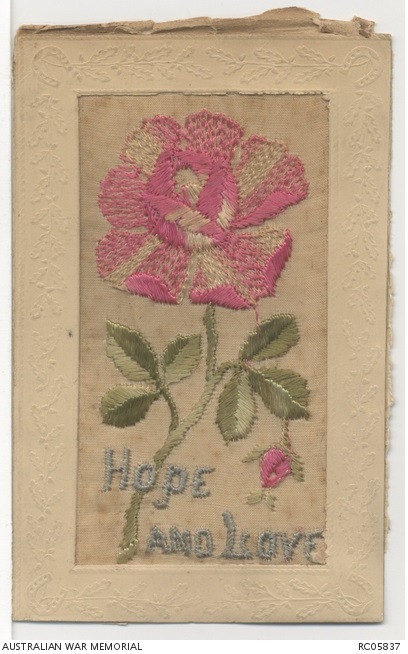
The Australian soldiers were away from home and often thought of their families, including those from Camden NSW.
Killed in action in 1916
Tragically, Frederick Kelloway was killed in action in 1916 and never made it back home to Camden.
Updated 24 April 2024. Originally posted on 29 December 2023 as ‘An embroidered silk postcard for Millie at Christmas 1916’.
Discover more from Camden History Notes
Subscribe to get the latest posts sent to your email.

