Landscape report: Camden Park Agricultural Research Station | 1985 | NSW Government
In 1985, the state government released a landscape report on the Camden Park Agricultural Research Station. The report was commissioned in the mid-1980s to examine the landscape setting of one of the important agricultural research facilities in New South Wales, before its relocation from Glenfield to Menangle.
The purpose of the report was to review the significance of the site’s natural and cultural landscape settings and how the site should be conserved during the construction of the new agricultural research station.
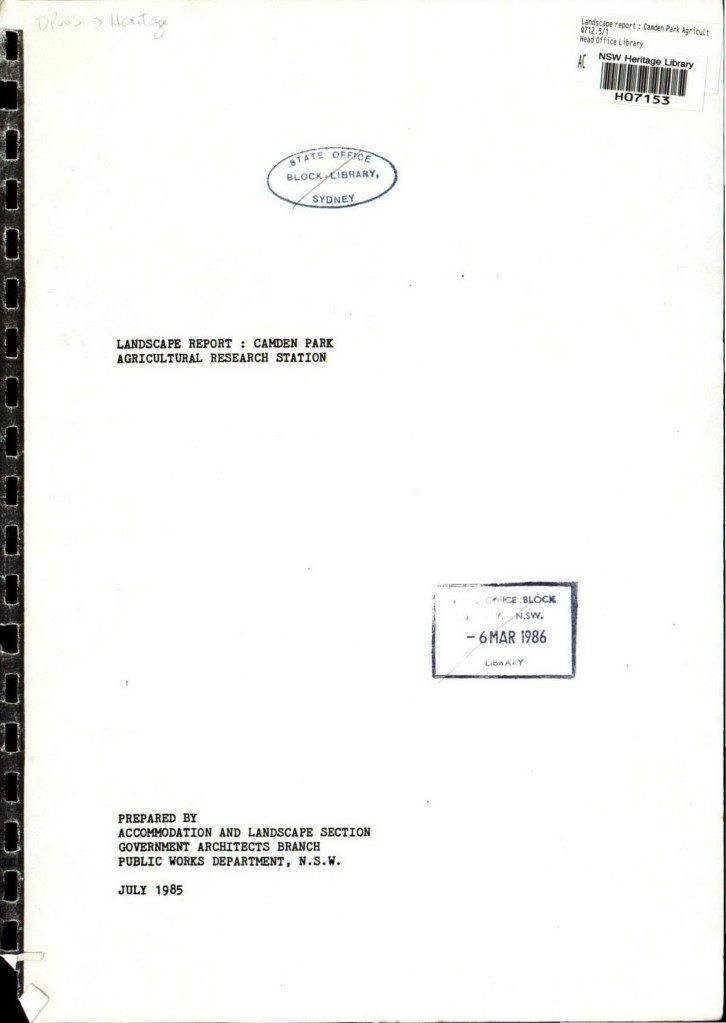
The landscape report made many interesting observations about Camden Park Estate and the surrounding area at a critical time for the Macarthur region, as Sydney’s urban growth encroached on the area. The setting at Camden Park Estate was one of the most significant natural and cultural farming landscapes in Australia.
Firstly, where was the Camden Park Agricultural Research Station?
Where was the research station?
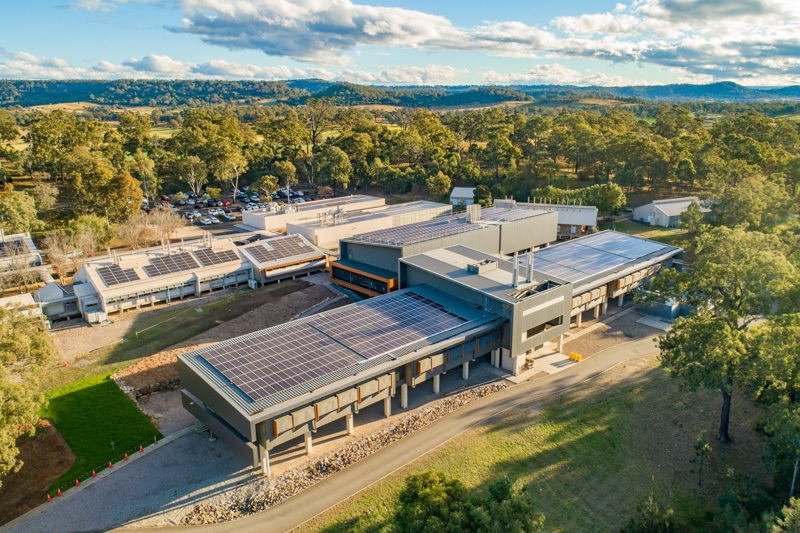
The site described in the report is now called the Elizabeth Macarthur Agricultural Institute (EMAI) and opened in 1990 with a staff of around 100. It was formerly the Glenfield Veterinary Research Station, located at Glenfield, NSW, and was relocated to the new Menangle site. (NSW Agriculture. 1999) The name of the site was changed from the Camden Park Agricultural Research Station to
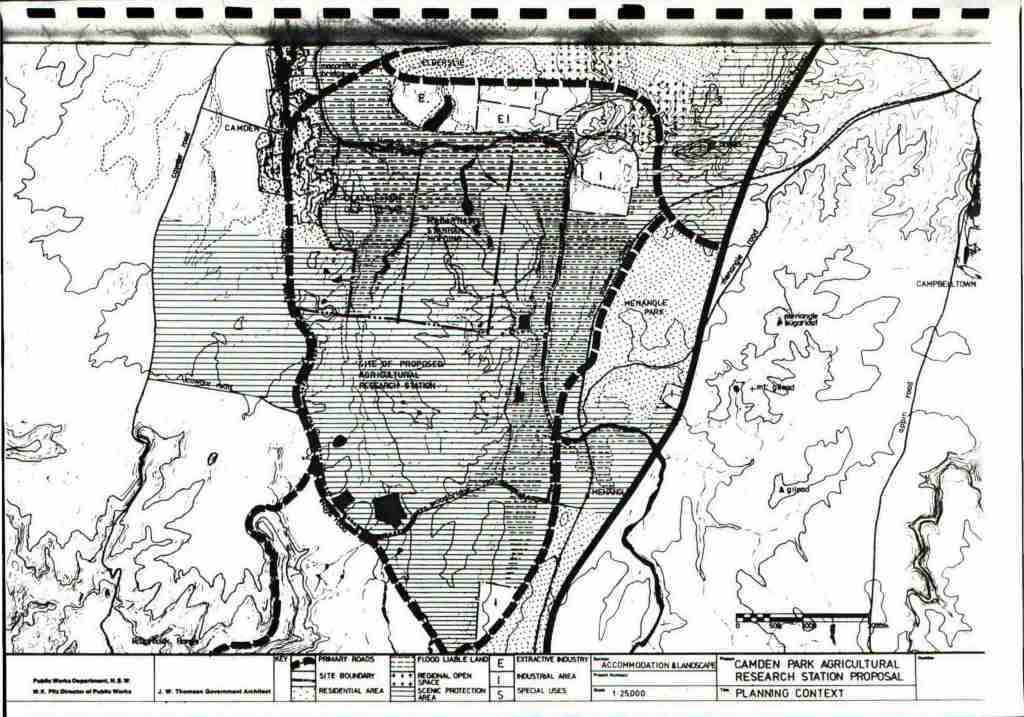
The NSW State Government acquired the 1500-hectare site for the Camden Park Agricultural Research Station in 1984 through the NSW Department of Environment and Planning. Between 1984 and the opening of the new facility in 1990, the name was changed to the Elizabeth Macarthur Agricultural Institute, likely influenced by the 1988 Australian Bicentennary and the growing recognition of the importance of European women in the settler society project. In this case, the critical role played by Elizabeth Macarthur in the Macarthur family business interests, particularly at Camden Park, an outpost of their pastoral empire, while her husband, John, was away in England.
The stated aim of the relocation to the new site was
“(to preserve) one of the Colony’s earliest pastoral holdings, which will remain intact as a living example of NSW’s development from its earliest days” (Bedford, Minister for Environment and Planning, Daily Telegraph 27.1.84). (Accommodation and Landscape Section 1985)
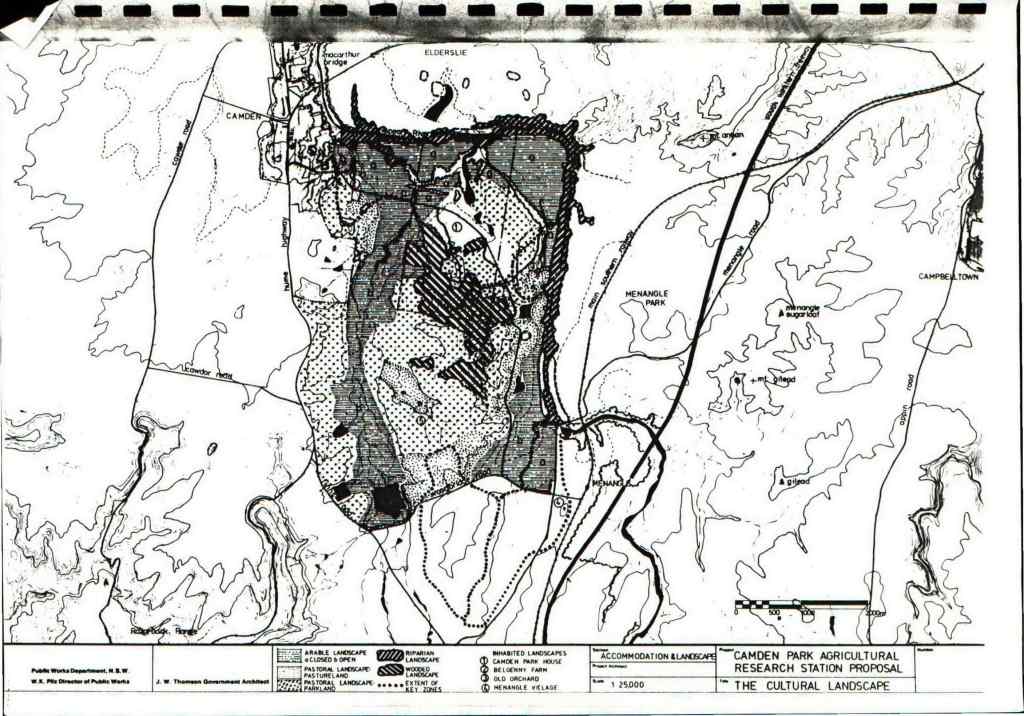
The landscape report detailed observations of the proposed site for the Camden Park Agricultural Research Station. These observations were summarised under two headings: (1) natural landscape, (2) cultural landscape.
Natural landscape
The report briefly summarises the physical landform, climate, geology, and vegetation. While detailing the area’s ecology and dominant species, the report makes no mention that these species are remnants of the Cumberland Woodland.
The site is described as situated in ‘undulating to steeply hilly terrain at the foot of the Nepean Ramp. There are three valleys surrounded by hilly ridges and contained by the wooded ridges of the Woronora Plateau’. (Accommodation and Landscape Section 1985)
Complex mosaic of the cultural landscape
The report stated that the cultural landscape of Camden Park was ‘considered one of the most significant cultural landscapes in the country’ because it has been developed by one family since the original 1805 grant to John Macarthur. (Accommodation and Landscape Section 1985)
The ‘complex mosaic of the cultural landscape’ is divided into five elements:
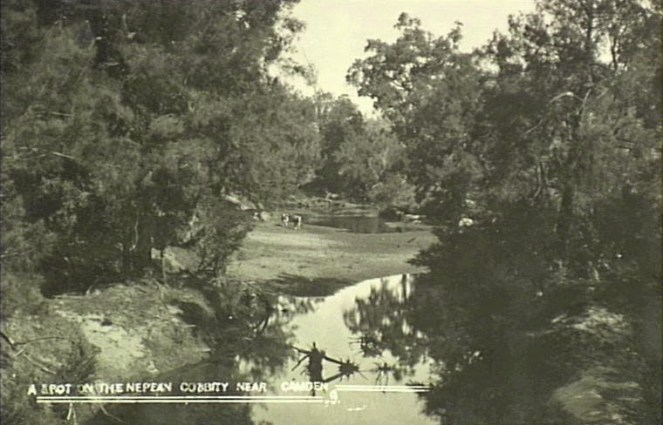
(1) the riparian landscape of the Nepean River, ‘characterised by a band of vegetation along its banks’;
(2) the arable landscape, which creates a ‘mosaic of cropped fields and/or improved pasture, imparts a neat, tended quality to the landscape’;
(3) the pastoral landscape characterised by the ‘resultant landscape of grassed slopes, interspersed with individual trees and oopses of native timber has a ‘parkland’ quality, reminiscent of the English manorial park model’;
(4) the wooded landscape characterised by the higher ridge and steeper slopes with its ‘retained woodland reinforces the main ridge in the landscape, framing and dramatising vistas relating Camden Park House to selected reference points in the surrounding country’;
(5) the inhabited landscape which is characterised by the built farm heritage comprising Camden Park House, the Belgenny or Home Farm, the Old Orchard Area and Menangle village. (Accommodation and Landscape Section 1985)
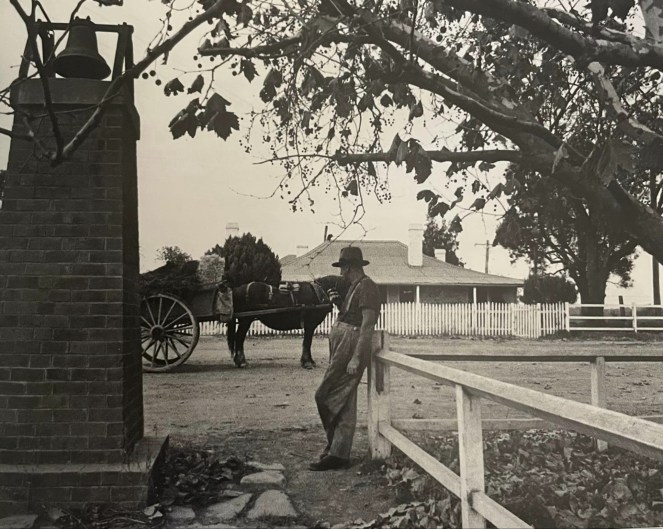
The Old Orchard area is characterised by
This inhabited landscape comprises workers’ cottages, the old orchard Site, the historic arboretum and camellia grove, together with Macquarie’s campsite, marked by a commemorative plaque. (Accommodation and Landscape Section 1985)
Menangle village was the commercial and management centre of the estate, modelled on a traditional English private estate village and providing all the necessities for the then-isolated rural farming village.(Accommodation and Landscape Section 1985)
The report states that the Menangle
village is a rare survivor of the private 19th-century agricultural estate village in NSW, and because of its association with one of the most influential colonial families, the place has a special cultural significance. (Accommodation and Landscape Section 1985)
The visibility of the estate, according to the report, has ‘two main visual catchments’, the Navigation Creek Basin and the NE section of the estate, with Camden Park House visible from both catchments with vistas to the west and Mount Annan and Mount Gilead to the east.
The report noted that the major threat to the cultural landscape was financial, and that the state government’s purchase of the Camden Park Estate removed that threat.
The report recommended
In addition to these agricultural considerations, it is necessary to develop and implement landscape conservation policies to preserve the essential qualities of this significant 19th-century Australian rural landscape. (Accommodation and Landscape Section 1985)
Glenfield Veterinary Research Station
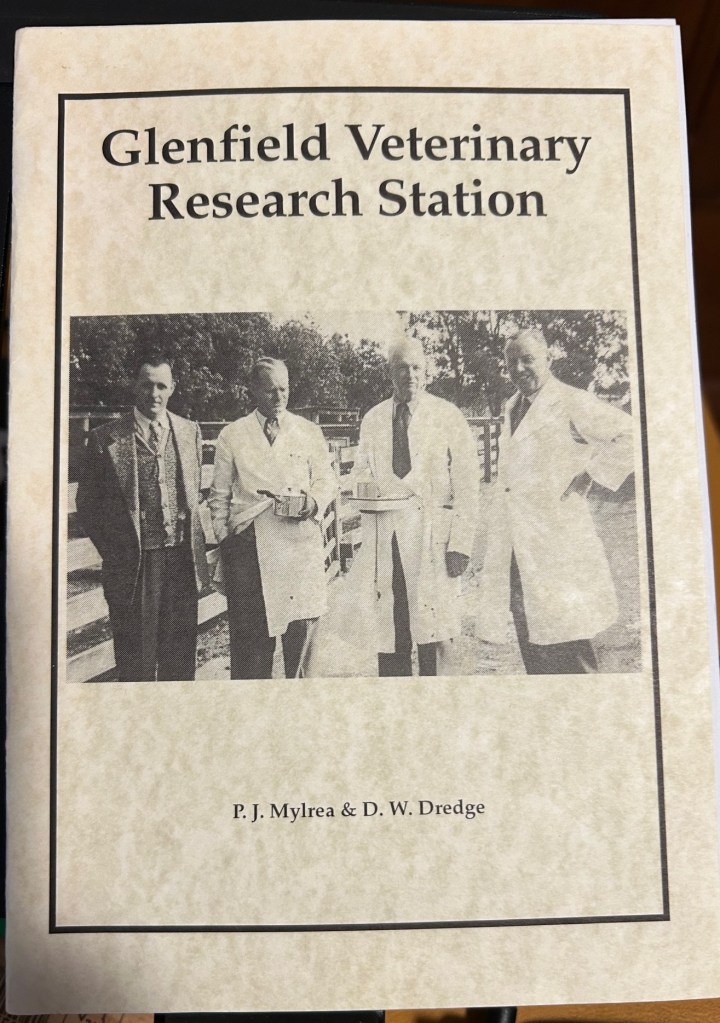
The proposed Camden Park Agricultural Research Station, and later the Elizabeth Macarthur Agricultural Institute, replaced the Glenfield Veterinary Research Station. The Glenfield station was opened by the state government in 1923 at Macquarie Fields on 243 hectares purchased from the Ross Brothers in 1916. It conducted research on livestock breeding, particularly cattle, sheep, poultry and pigs. (Stevenson 2020)
The site had become fragmented by Sydney’s urban growth due to a new freeway and a railway overpass, as well as domestic dog attacks. The Department of Environment and Planning suggested the Camden Park site, which it had originally purchased in 1976, and a second section in 1984, for a total of 1582 hectares. The Department of Agriculture and Fisheries occupied the site in 1984, with works finishing in 1990. (NSW Agriculture. 1999)
Veterinary services were originally established in NSW with the creation of the Stock Branch of NSW as a dedicated NSW Government branch in the 1860s. This led to the appointment of Chief Inspector of Stock, primarily to combat devastating livestock diseases, specifically sheep scab (scabies), which threatened the colony’s crucial wool export industry. Veterinary laboratories were established in the 1890s to assist in diagnosing stock diseases and research into animal health. The Department of Agriculture became involved in laboratory work at Glenfield in 1917, leading to the eventual opening of the research station. (Kemp 2003)
The Elizabeth Macarthur Agricultural Institute
The Elizabeth Macarthur Agricultural Institute opened in 1990 with a staff of around 100. Its primary purpose is to serve as a biosecurity and research facility. The facility focuses on diagnostic testing, high-impact plant/animal disease research, and emergency response to threats, ensuring disease-free status for trade while boosting food and fibre production.
Conclusion
In 1985, the NSW Government released a landscape report on Camden Park Agricultural Research Station, highlighting its cultural significance amid urban encroachment. It described a complex landscape, emphasising conservation needs.
The report states that the site, now the Elizabeth Macarthur Agricultural Institute, is vital to agriculture and biosecurity, preserving the region’s historical and cultural integrity.
The landscape report provided an overview of Camden Park Estate, one of the important natural and cultural landscapes in Australia. The report concluded;
the landscape development proposed for this site is seen as an enrichment of the cultural landscape, reflecting and intensifying the qualities already existing on the site. (Accommodation and Landscape Section 1985)
The New South Wales Heritage Inventory agrees and states that
The Camden Park Estate is of social, historic, scientific and aesthetic significance to NSW and Australia. (NSW Heritage Inventory 2026)
The name Camden Park Agricultural Research Station was discontinued in 1990 and replaced by the Elizabeth Agricultural Research Institute, to honour the life and times of Elizabeth Macarthur of Camden Park Estate.
The report legacy is the recognition of the significant historic farming precinct at Belgenny Farm, the intact vistas of the Camden Park House from Camden township and Mount Gilead and the delayed introduction of the Three Cities Strategy Plan in the Camden area.
References
Accommodation and Landscape Section 1985. Landscape Report: Camden Park Agricultural Research Station. Public Works Department, NSW Government. Sydney.
Kemp, JB 2003. A Short History of Stock Inspectors and Veterinarians of the Rural Lands Protection Board. Forbes Rural Lands Protection Board, 19 September. Online https://www.flockandherd.net.au/archive/pdf/stock-inspector-history.pdf. (Accessed 19/3/26)
Mylrea, Peter J. & Dredge, Doug W.. 2002, Glenfield Veterinary Research Station: the physical structure 1916-1990. Campbelltown and Airds Historical Society Inc, Campbelltown, NSW
NSW Agriculture. 1999, Elizabeth Macarthur Agricultural Institute / NSW Agriculture. NSW Agriculture [Orange, N.S.W.]
NSW Heritage Inventory 2026. Camden Park Estate and Belgenny Farm. NSW Government. Sydney. Online at https://www.hms.heritage.nsw.gov.au/App/Item/ViewItem?itemId=5051536 (Accessed 23/3/26)
Stevenson, Samantha 2020, Glenfield Veterinary Research Station, The History Buff, Campbelltown City Library. 23 October. Online at http://campbelltown-library.blogspot.com/2020/10/glenfield-veterinary-research-station.html (Accessed 19/93/26)
Updated on 23 March 2026. Originally posted on 19 March 2026 as ‘History and Impact of Camden Agricultural Research Facility’.
Discover more from Camden History Notes
Subscribe to get the latest posts sent to your email.

