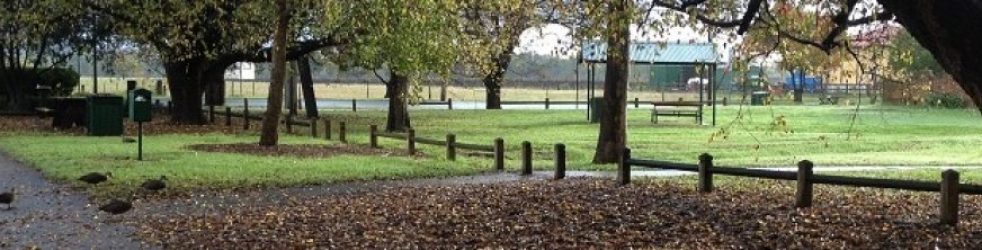

Cobbitty Sports Day on New Year’s Day, 1915
A major event on the social calendar of a number of picturesque villages in the Camden district was the annual New Year’s Day Sports Carnivals.
The New Year’s Sports Day was part of the English traditions brought to the area by colonial immigrants, and in 1915, they were held in the villages of Cobbitty and The Oaks.
Sports carnivals were wonderful community events that included all classes of villagers regardless of their station in life, and during the First World War, they held special appeal for patriotic fundraising.
These social and cultural traditions were not isolated to the Camden district and have been held in many other parts of Australia. They are still carried on today in some localities, for example, Glenlyon in Victoria (started in 1857) and Perlubic Beach in South Australia (started in 1914).
English village sports
The origins of these festivals, according to Peter Hampson Ditchfield’s Old English Sports (2007), lie in ancient Saxon customs, particularly in Devonshire and Sussex, associated with ‘wassailing’ (carousing and health-drinking) to ensure the thriving of orchard trees (mainly apples) and exchanging presents.
On New Year’s Day, village youths undertook indoor and outdoor sports to keep out the cold by ‘wholesome exercise and recreative games’. Sports included bat-and-ball, wrestling, skittles, blind-man’s-bluff, hunt the slipper, sword dancing and mumming (play-acting).
Cobbitty Sports Day started in 1866
The New Year Sports Day in the village of Cobbitty was a hallowed community event which started in 1866. The day included a variety of athletic and novelty events and finished with a gala concert in the evening.
It was one of the premier events on the social calendar, and local resident Donald Howard maintains in his Cobbitty’s Finest Hour (2010) that spectators and participants came in their ‘droves from miles around’.
Donald Howard sadly recalls that the last Cobbitty Sports Day was held in 1941 due to a combination of petrol rationing, material costs and a general preoccupation by villagers with the war effort.
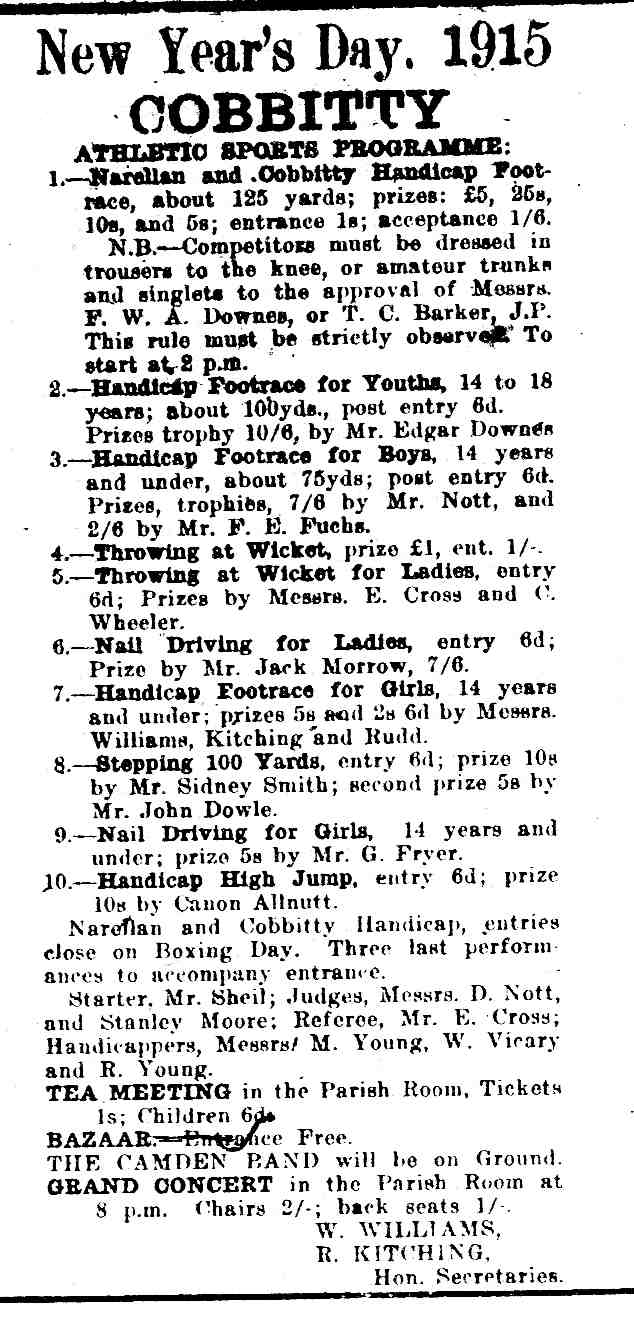
Prize purse for main event ‘Narellan and Cobbitty Handicap’
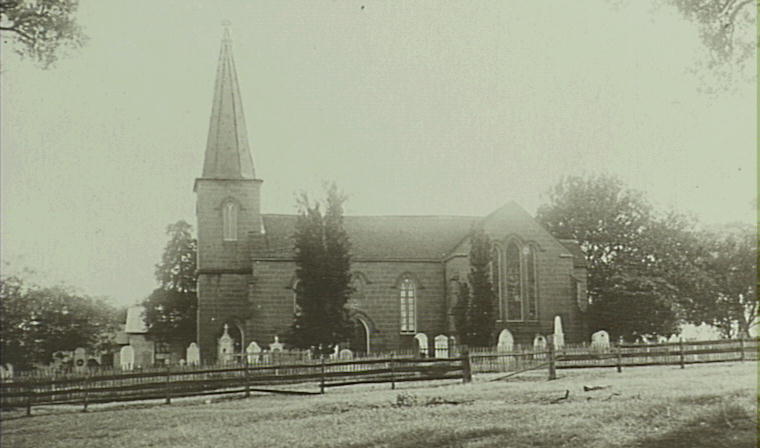
The Camden News reported a ten-event programme starting with the major event of the day, the ‘Narellan and Cobbitty Handicap Footrace’ over 125 yards for male competitors. The running track, according to Donald Howard, was on the village green between the parish hall and St Paul’s Church. Entries had to be in by Boxing Day with an entry fee of 1/- and an acceptance fee of 1/6.
There was fierce competition from the young men of the village for the handsome first prize of £5, which was twice the weekly wage for a rural labourer. Quite an amount for any villager and first place attracted quite a bit of status and prestige for the winner. The second prize was a respectable 25/- and the third prize was 5/-.
Dress regulations for competitors in the ‘Handicap’ were strictly enforced with ‘trousers to the knee, or amateur trunks and singlets’ that had to be approved by two male members of the local gentry, Mr FWA Downes of Brownlow Hill and Mr TC Barker of Maryland.
Race organizers conveniently started the programme of events after lunch for competitors, which allowed village revellers to recover from the New Year’s celebrations. The ‘Handicap’ was put in the hands of the starters at 2.00pm.
Nail driving for women
Village youth were not left out of the story and were able to get a feel for the main event by entering their own footraces, one for youths (14-18 years) and another for boys (under 14). Here, they rehearsed the tactics they might employ in the main event when they were old enough.
Other events on the programme catered for those locals not able to qualify for the footraces and included the high jump, ‘stepping’, and ‘throwing at wickets’, while the village women were allowed to take part in ‘nail driving’.
Village elders held positions of importance as starters, judges and referees and supported their social status by donating appropriate cash prizes for races.
The Camden Brass Band was located in the ‘grounds’ and provided rousing patriotic tunes throughout the day. These tunes were enjoyed by the village ladies who entertained themselves during the day with tea in the parish hall.
Red Cross support
Village women sold their cooking, sewing, knitting and other ‘fancies’ at the sports day bazaar. The bazaar raised significant money for village causes, particularly the St Paul’s Church missions.
The bazaar auxiliary was made up of village women who were good organizers but never sought the limelight that was bestowed on the male race organizers.
During the First World War, the village women’s fundraising efforts, which were considerable, were directed to patriotic purposes, including the local branches of the Red Cross.
Evening Grand Concert
The sports day festivities closed in the evening, with the grand concert in the parish hall. The concert started at 8.00pm, and the front seats were sold for 2/- while those less financially able bought seats at the back of the hall for 1/-.
Local personalities and school children performed a variety of musical items for the entertainment of the assembly, and occasionally, a ‘big name celebrity’ was hired from the city.
1915 The Oaks New Year Sports Day
Another district sports day was organized on New Year’s Day 1915 in the village of The Oaks. While not as prestigious as the sports day at Cobbitty, it did attract an enthusiastic crowd. It was organized by the Literary Institute and held in ‘Mr WS William’s paddock’, just outside the village.
There was a 15-event programme starting with the premier event, ‘The Oaks Handicap, ’ over 130 yards. Prizes were awarded to the first 4 place-getters, with the winner receiving £2.
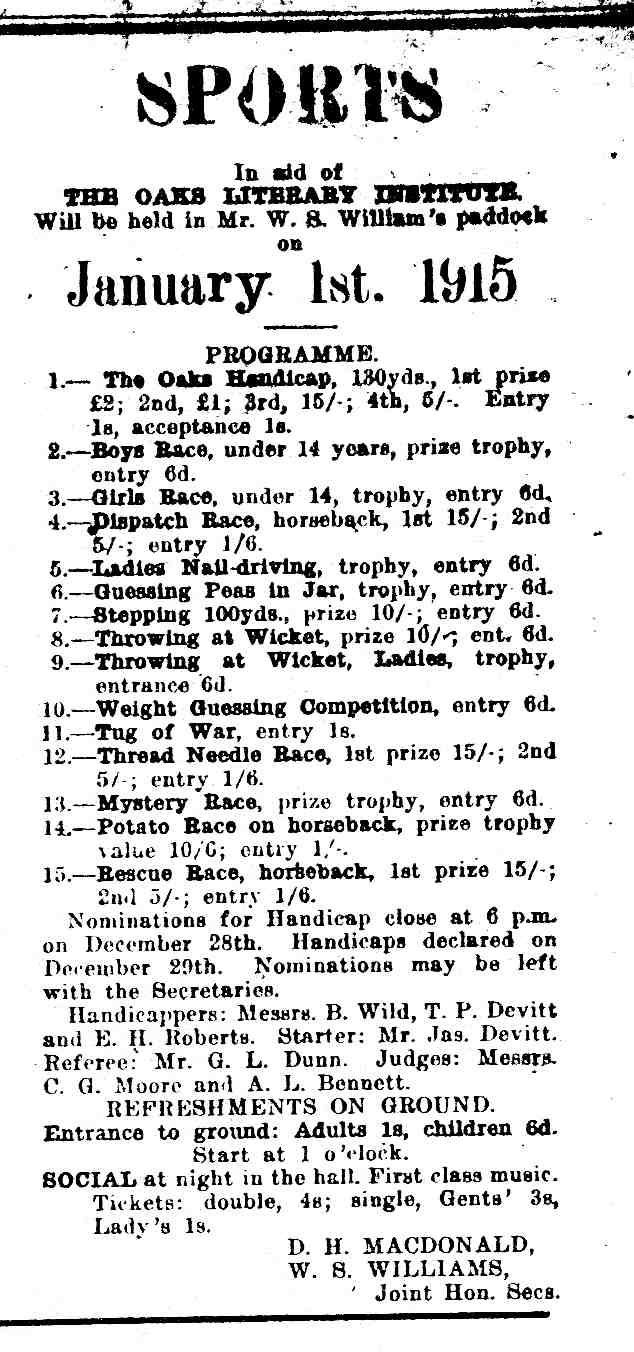
The sports day was more inclusive of the wider village community than Cobbitty and included a tug-o-war, guessing competitions and a number of horse events.
The horse events were a village speciality, and each horse had its own race track. Refreshments were sold on the grounds by local women, and the day was topped off by a night-time social which had ‘first-class music’ from a local band.
1915 Mount Hunter Boxing Day Carnival
District sports day was not confined to The Oaks and Cobbitty. The village of Mount Hunter had earlier held a sports carnival on Boxing Day 1914.
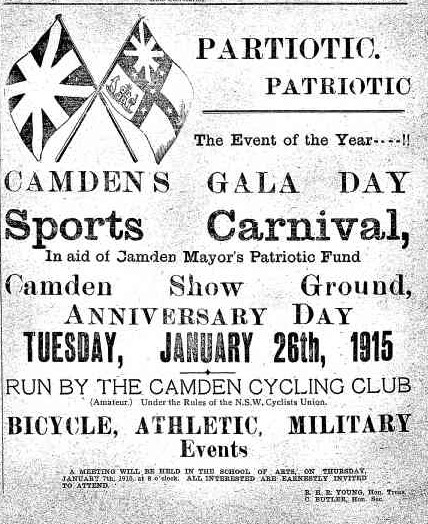
The Camden Cycling Club held a major gala on Anniversary Day (Australia Day), 26 January 1915, at the Camden Showground, with a range of ‘bicycle, athletic and military events’.
Updated on 31 December 2023. Originally posted on 8 March 2015 as ‘Cobbitty Village Sports Day Benefits War Effort’
Discover more from Camden History Notes
Subscribe to get the latest posts sent to your email.


2 thoughts on “Cobbitty New Year’s Day Village Sports Day Benefits War Effort”
Comments are closed.