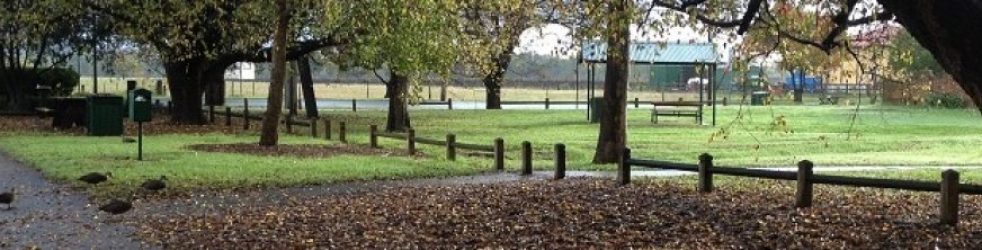
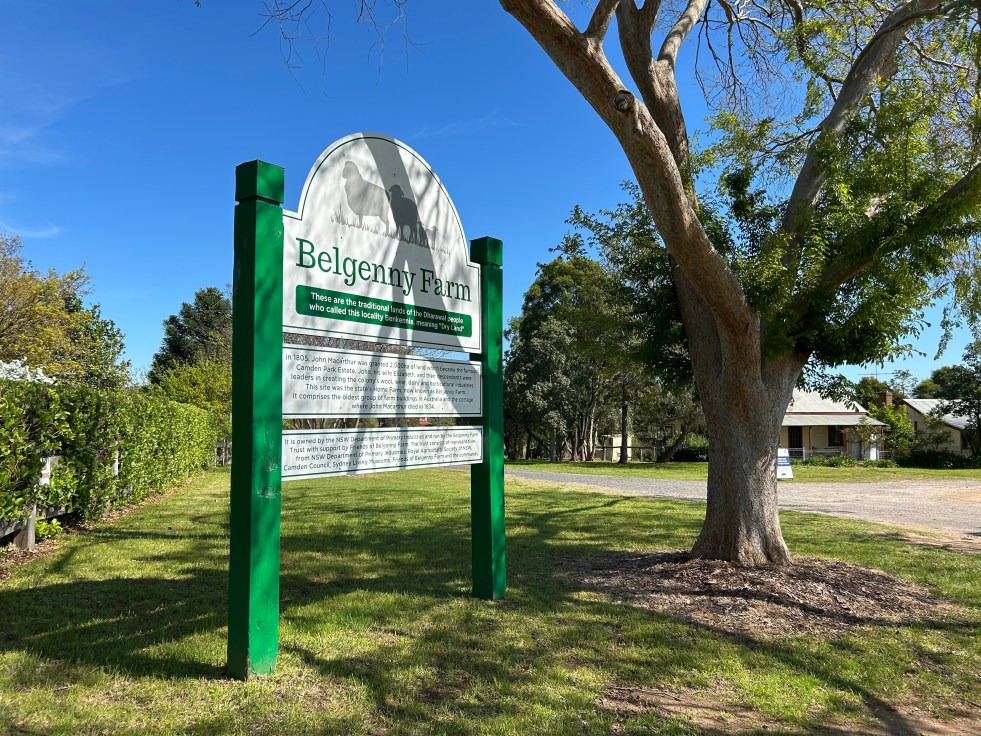
Belgenny Farm Complex
100 Elizabeth Macarthur Avenue
Camden, NSW
Lot 11, DP 658458
-34.08322199382272, 150.7040696146956
History and Description
Belgenny Farm is thought to be the oldest surviving group of farm buildings in Australia, dating back to the 1820s. (Betteridge 2000)
The main Belgenny cottage was built in several stages, with the earliest part attributed to architect Henry Kitchen in 1821.
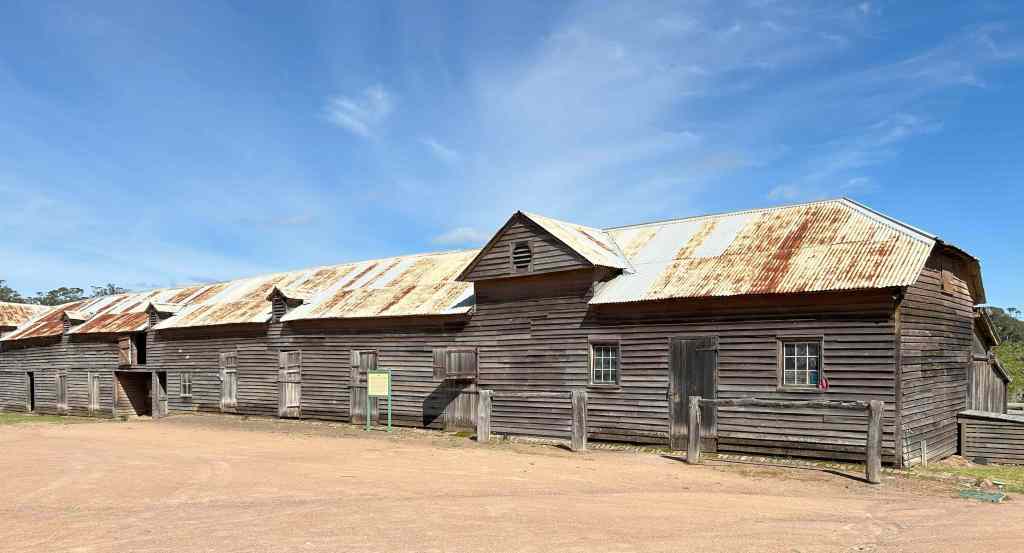
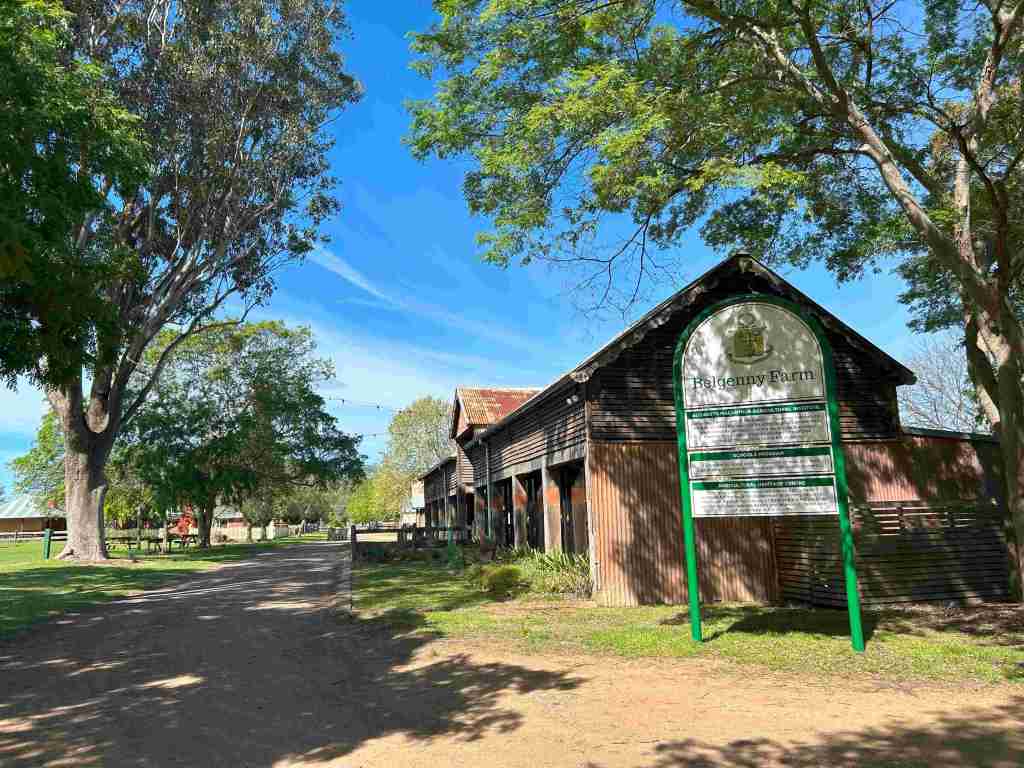
The stables complex was built in 1820, originally two separate buildings and combined in 1826 to form one long continuous structure. They are timber-framed and clad with iron bark weatherboards. Fasteners are wooden pegs and handmade nails.
The coach house was built in the 1820s and, in the 1890s, converted to a creamery, serving that purpose from 1900 to 1928.
The smokehouse was built between the 1830s and 1840s.
The granary was built after 1890, with the upper level used for dry storage of grain, the lower level for storage of machinery.
The carpenter’s shop was built around the 1890s by Herb English.
The engine room was constructed around 1900 and used steam, diesel and petrol to drive chaff cutters and other farm equipment.
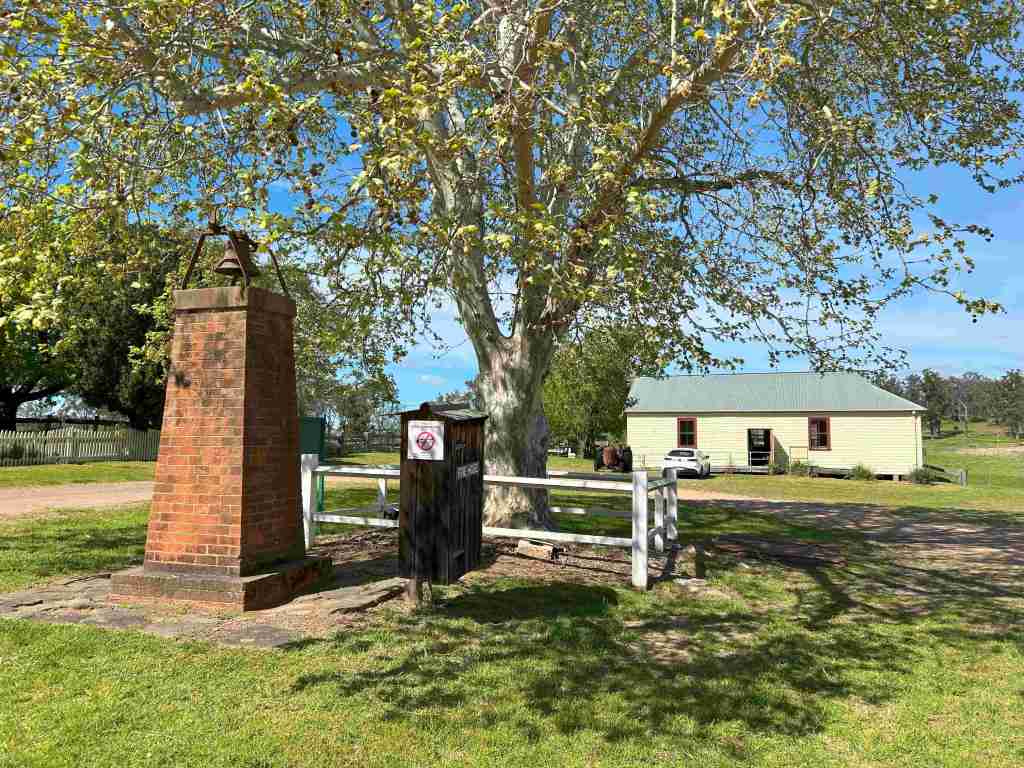
The community hall was built in 1937 for the estate workers.
The blacksmith’s shop was built in 1937. (Belgenny Farm (2025).
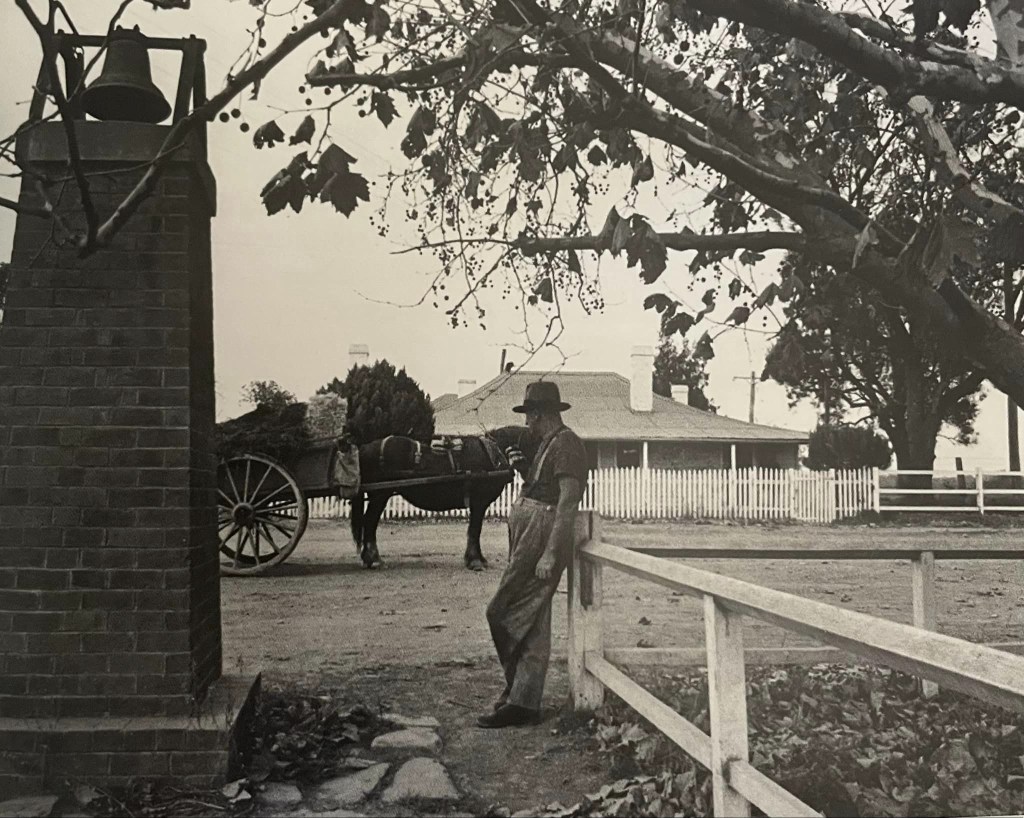
Chris and Margaret Betteridge write
Belgenny Farm is located approximately 70 kilometres southwest of Sydney, at the end of Elizabeth Macarthur Avenue, which runs off Remembrance Drive (Old Hume Highway), just south of Camden.
Belgenny Farm is the name now given to an area traditionally known as “Home Farm” or “The Farm” which, together with 1600 hectares (4000 acres) of land, a large part of the original Macarthur Camden Park estate was acquired by the New South Wales Government in 1976.
The former Department of Environment and Planning (now the Department of Urban Affairs and Planning) managed Belgenny Farm for a time and between 1986 and 1988 undertook a series of research programs and carried out extensive conservation works on the site, regarded as Australia’s oldest surviving group of farm buildings.
In 1990 management of Belgenny Farm was handed over to NSW Agriculture, which operates the Elizabeth Macarthur Agricultural Institute (EMAI) on the former Camden Park Estate lands. Since that time NSW Agriculture has continued an annual program of restoration, maintenance and enhancement works.
The Belgenny Farm Agricultural Heritage Centre Trust (The Belgenny Farm Trust) was established in May 1993 with a charter to develop Belgenny Farm as a viable tourism and education resource, whilst conserving and enhancing the heritage integrity of the site.
In November 1994 and March 1995, the Trust deed was amended to expand the area under the Trust’s management responsibility from 5 hectares to 32 hectares, including the Macarthur family cemetery, Cottages 38 and 39, and areas for car parking and animal presentation. (Betteridge 2000)
Belgenny Farm is Crown Land that is managed by the NSW Department of Primary Industries and Regional Development through the Belgenny Farm Agricultural Heritage Centre Trust. The site is now heritage-listed and managed by the NSW Department of Primary Industries and Regional Development (DPIRD). The farm generates income through events, tours, and other activities to support its ongoing maintenance and restoration.(Belgenny Farm 2025)
Statement of Cultural Significance
Chris and Marget Betteridge have written
Belgenny Farm has historical, aesthetic, social, technical and research significance at local, state and national levels as the oldest group of farm buildings in Australia, with close associations with the Macarthurs, a family instrumental and influential in the development of this country’s agricultural, pastoral, horticultural and viticultural industries. It is both representative of the evolution of many rural industrial technologies and a rare example of a place which has few intact survivors.
Belgenny Farm has important associations with key figures in the history of New South Wales, particularly John and Elizabeth Macarthur, their sons James and William, and Mrs Elizabeth Macarthur-Onslow. As an unusually intact record of farm building construction techniques and rural technological change, Belgenny Farm has enormous educational and interpretive potential for this and future generations of Australians.
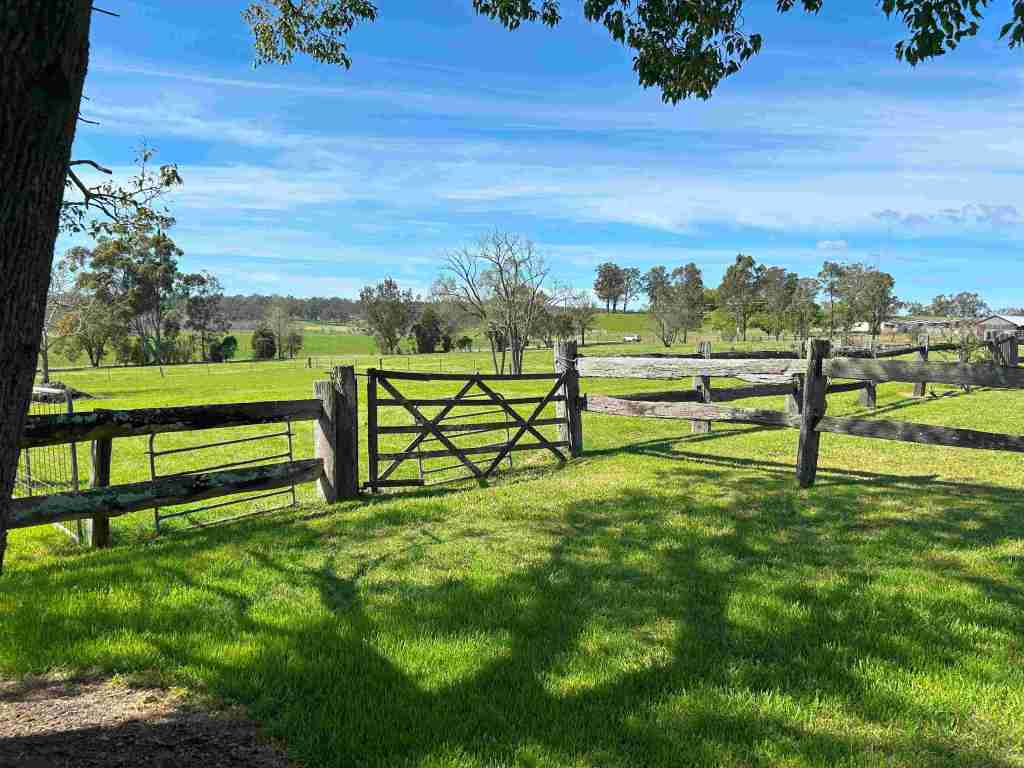
Aesthetically, Belgenny Farm demonstrates the beauty of timber vernacular buildings, in a setting of bucolic charm and with the added significance of the Macarthur family cemetery with its monuments, symbolic plantings and important vistas.
The recognition of Belgenny Farm at a local, state and federal level as an important item of our environmental heritage, together with its popularity as a venue for education programs and special events are a reflection of the community esteem for the place and a measure of its social significance. (Betteridge 2000)
Condition and Use
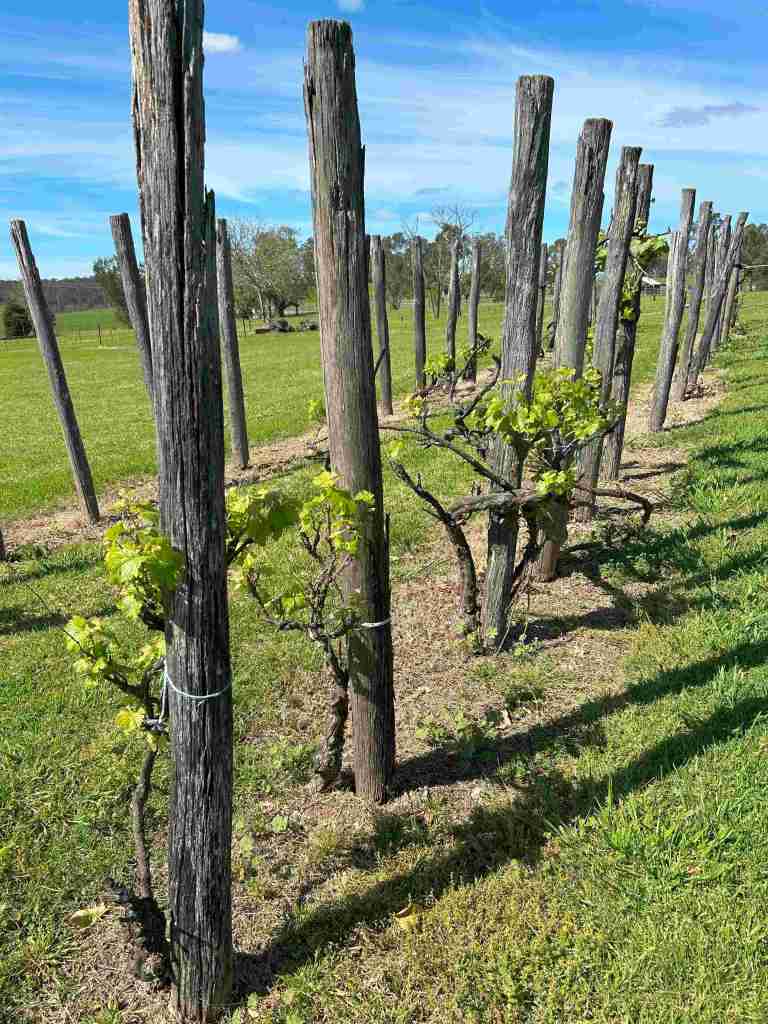
Some modifications and conservation of buildings have been undertaken. The integrity of the Belgenny Farm complex has remained intact. The site is currently used for educational purposes by schools and for events and functions.
Heritage Significance
Belgenny Farm has historical, aesthetic, social, technical, and research significance at local, state, and national levels as the oldest group of farm buildings in Australia, with close associations with the Macarthurs, a family instrumental and influential in the development of this country’s agricultural, pastoral, horticultural, and viticultural industries. It is both representative of the evolution of many rural industrial technologies and a rare example of a place which has few intact survivors. (HNSW)
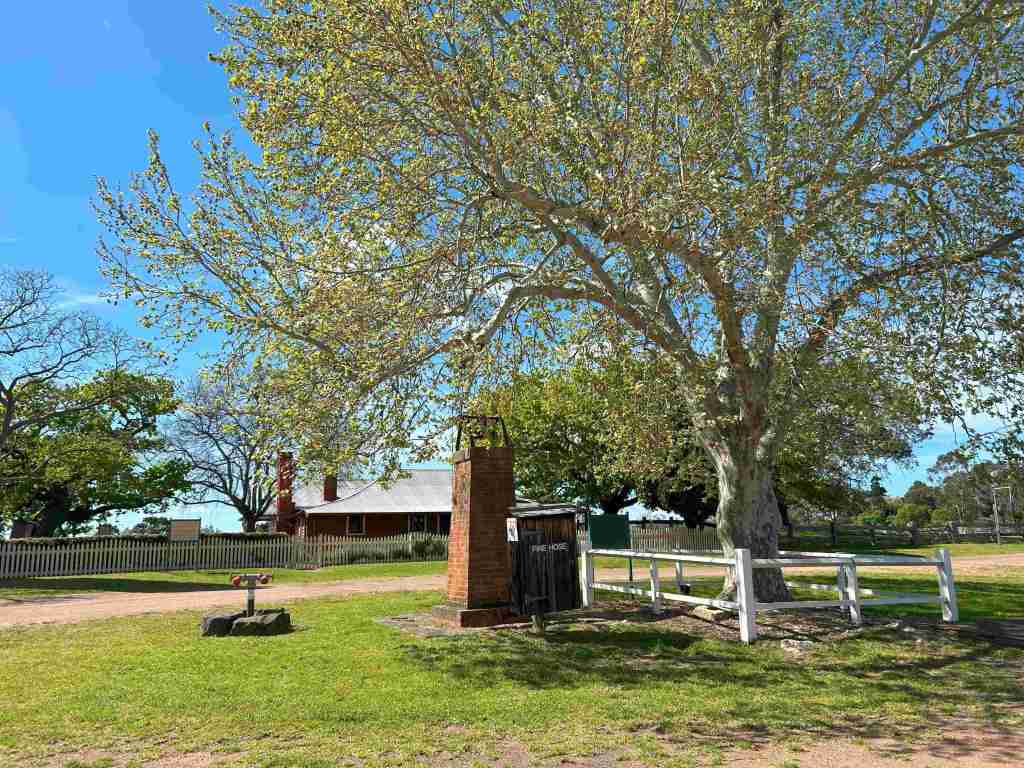
Aesthetically, Belgenny Farm demonstrates the beauty of vernacular timber buildings in a setting of bucolic charm and with the added significance of the Macarthur family cemetery with its monuments, symbolic plantings and important vistas. (HNSW)
Heritage Listing
Local Environment Plan 2010 LEP Item I-79
NSW State Heritage Register 2006 #01697
Conclusion
The Belgenny Farm Complex, located on the southern edge of the Camden township, is one of the most important agricultural, historical, and cultural sites in Australia.
The site is part of Australia’s living history and an important historical and cultural site for education, tourism and events.
In 2008 Bruce Edgar stated that
Belgenny Farm is the oldest group of farm buildingsin Australia. It is part of Camden Park Estate, founded in 1805 by John and Elizabeth Macarthur, and it has strong associations with the beginnings of the Australian wool industry. Today, the Farm is an educational and tourist destination, a wonderful retreat from the hustle and bustle of the modern world as well as being a rare example of atraditional working 19th century farm. The property is managed by the Belgenny Farm Trust, but owned by the NewSouth Wales (NSW) Government’s Department of Primary Industries (formerly Department of Agriculture). This paperprovides an overview of the issues involved in the conservation and management of the site over the last 20years to ensure its character and sense of place is preserved for future generations. (Edgar 2008)
Read more
Belgenny Farm, Camden. Click here
Other posts on the Camden History Notes blog about Belgenny Farm include
Explore History with Friends of Belgenny Farm Events
Explore Belgenny Farm: A Journey Through Time 2024
Back to Belgenny 2024, a festival of living history
References
Belgenny Farm (2025). Belgenny Farm. [online] http://www.belgennyfarm.com.au. Available at: https://www.belgennyfarm.com.au/ [Accessed 21 Sep. 2025].
Betteridge, Chris and Margaret 2000, Belgenny Farm Conservation Management Plan prepared for Belgenny Farm Trust. Musecape Pty Ltd, Randwick.
Edgar, BM, Safe Guarding the Spirit of the Place: Conservation and Management of Belgenny Farm,Camden Park Estate, New South Wales, Australia. Conference paper presented at 16th ICOMOS General Assembly and International Symposium: ‘Finding the spirit of place – between the tangible and the intangible’. Quebec, Canada, 29 sept – 4 oct 2008. Online at https://publ.icomos.org/publicomos/jlbSai?html=Pag&page=Pml/Not&base=technica&ref=E9674466A83A63E1380466ECCC08D297 (Accessed 21 September 2025)
Monument Australia 2010, William Arthur Channell. Monument Australia. Online at https://www.monumentaustralia.org/search/display/20668-william-arthur-channell (Accessed 21 September 2025)
Discover more from Camden History Notes
Subscribe to get the latest posts sent to your email.

