
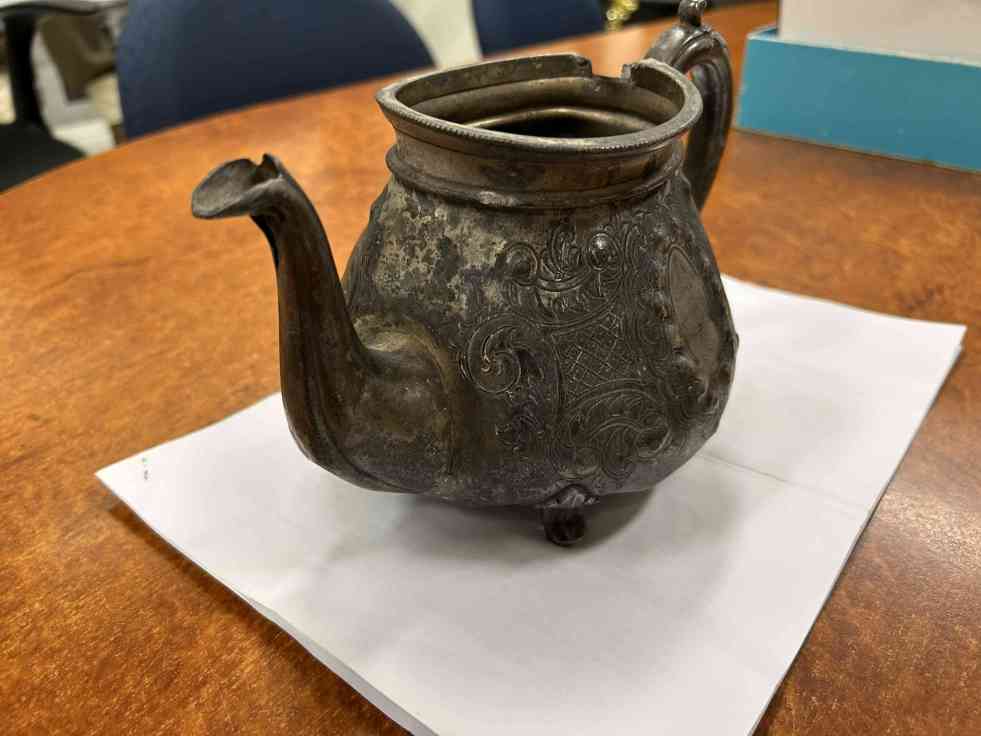
Sports Day Teapot Trophy
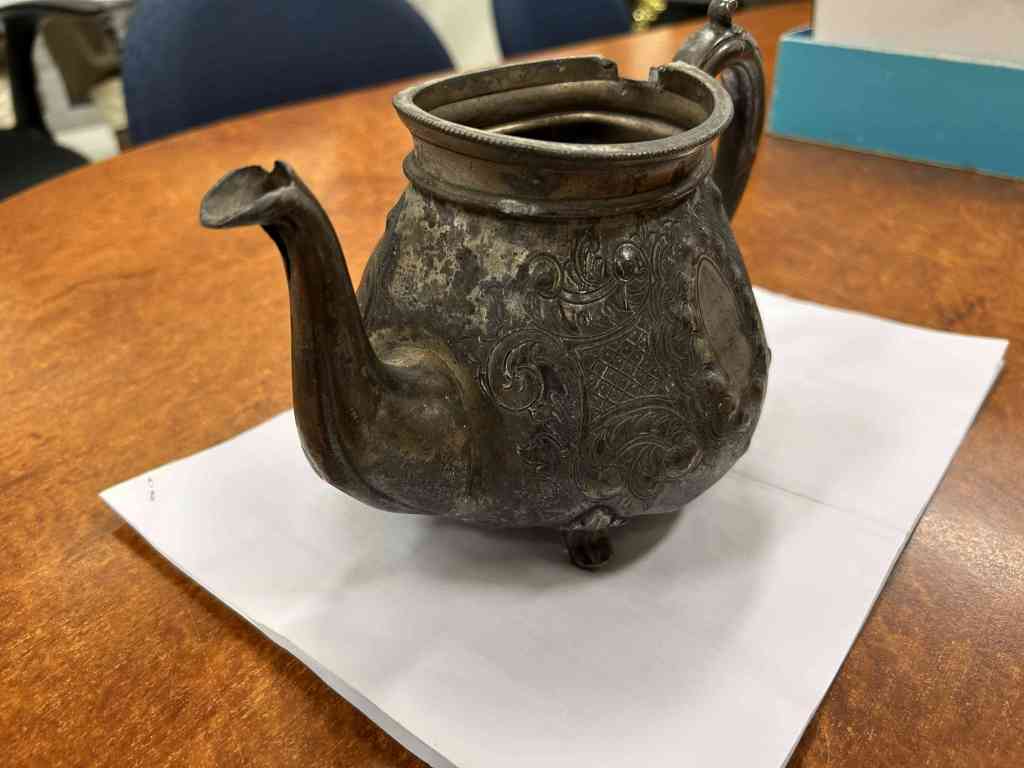
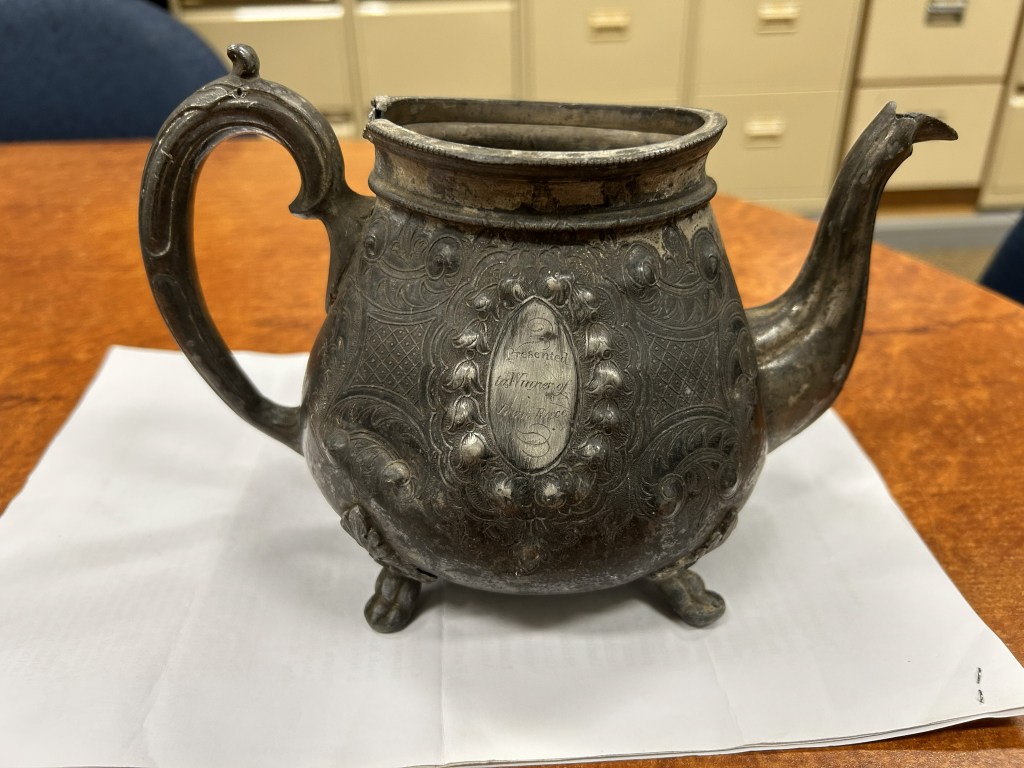
The Camden Museum has been given a 149-year-old teapot trophy from a sports day held in 1876. The trophy teapot is now the oldest sports trophy in the museum’s collection. So what happened 149 years ago in the small village of Camden to have a handsome teapot presented as a prize at a sports day?
In 1876, there was a sports day in Camden to celebrate Queen Victoria’s birthday. Similar festivities were held in other locations around the colony of New South Wales in the mid- to late 19th century. (AT&CJ, 30 September 1876) One was held at Menangle in September 1876. (AT&CJ, 30 September 1876) A similar sports day was held at Carcoar in 1879 when the townsfolk organised a ten-event programme. (Carcoar Chronicle, 31 May 1879)
The King’s Birthday
Celebrating the monarch’s birthday was a long tradition within the United Kingdom and the Empire, including the Australian colonies, and in the case of New South Wales, dating back to 1788.
After the First Fleet arrived in 1788, Arthur Philip, Governor of New South Wales, established a public holiday to celebrate the birthday of King George III in June. There was a 21-gun salute and a host of public celebrations. (Moyal 2017)
The Queen’s Birthday
Queen Victoria’s birthday on May 24 was celebrated across the British Empire with military salutes, athletic events, picnics, fireworks, and loyal cheers for the Queen. Often called Victoria Day or the Queen’s Birthday, it was renamed Empire Day in 1903, after she died in 1901. (DOS 2021)
The last Empire Day celebration in Australia took place in 1958. (DOS 2021) In Port Macquarie, the first Empire Day in 1903 was celebrated with a sports day and picnic at the local schools. (PMM 2025).
Sports days were popular community events during the colonial period and early 20th century across the Camden district, often held on New Year’s Day, or as a wartime or a hospital fundraiser.
At Camden, the Queen’s Birthday sports day received extensive coverage from the local correspondent for Sydney’s Australian Town and Country Journal. (AT&CJ, 10 June 1876)
A bright sunny day encouraged a large crowd to turn up in a Kirkham paddock across the Nepean River from the village, on the property of James White. The crowd wore ‘fashionable’ attire for the event, and no rain marred the day.
Despite recent rains, the correspondent reported that the grounds were ‘in splendid condition’. The Kirkham property was later renamed Camelot by the owners, the Faithful Andersons. (AT&CJ, 10 June 1876)
Dr Goode Trophy
Dr George Goode, a recently arrived Camden resident, supplied a silver cup for the overall performance at the sports day and also acted as the judge. Dr Goode, according to reports, was ‘an athlete of no mean repute from the old country, as several valuable trophies testify’. (AT&CJ, 10 June 1876)
The sports day card had a 16-event program and was held after a long break of similar celebrations. (AT&CJ, 10 June 1876)
Entertainment was provided by ‘Camden Fife and Drum Band, composed of small boys from the village, headed by Mr HP Reeves, which discoursed some beautiful melodies’. (AT&CJ, 10 June 1876)
At the end of the day, the Goode trophy was awarded to George Dengate from Calmsley Hill near Liverpool for winning five events: Vaulting with the Pole; Putting the Stone; Three Standing Jumps; Hop, Skip and Jump.
The sports day was highly competitive, with entrants coming from across the local area. George Dengate came from Liverpool, with others coming from Menangle, Camden Park, Razorback, Mount Hunter, and Luddenham.
Sports Day prizes
A range of other prizes were offered for 1st place in a range of events including: a silver cruet stand for the Maiden Plate of 125 yards; a writing desk for the Ladies’ Purse of 100 yards under 14 years of age; a meerschaum pipe for Vaulting with the Pole; a concertina for 80 yard Sack Race; silver cup for the 226 yard Town Plate; a pair of leggings for Putting the Stone; a silver coffee-pot for the100 yard Three-legged Race; a concertina for the Boys Race under 10 years of age; a pipe for Three Standing Jumps; a pair of spurs for Throwing The Hammer; a pipe for Hop, Skip and Jump; a silver belt for the 200 yard Flat Race; and a meerschaum pipe for Quoits. (AT&CJ, 10 June 1876)
The prizes were substantial for a small village affair. The cost of entry to the events is unknown. There was no Camden press in the 1870s, so greater details about the sports day will remain a mystery. None of the sports day trophy cups have survived.
Inscriptions
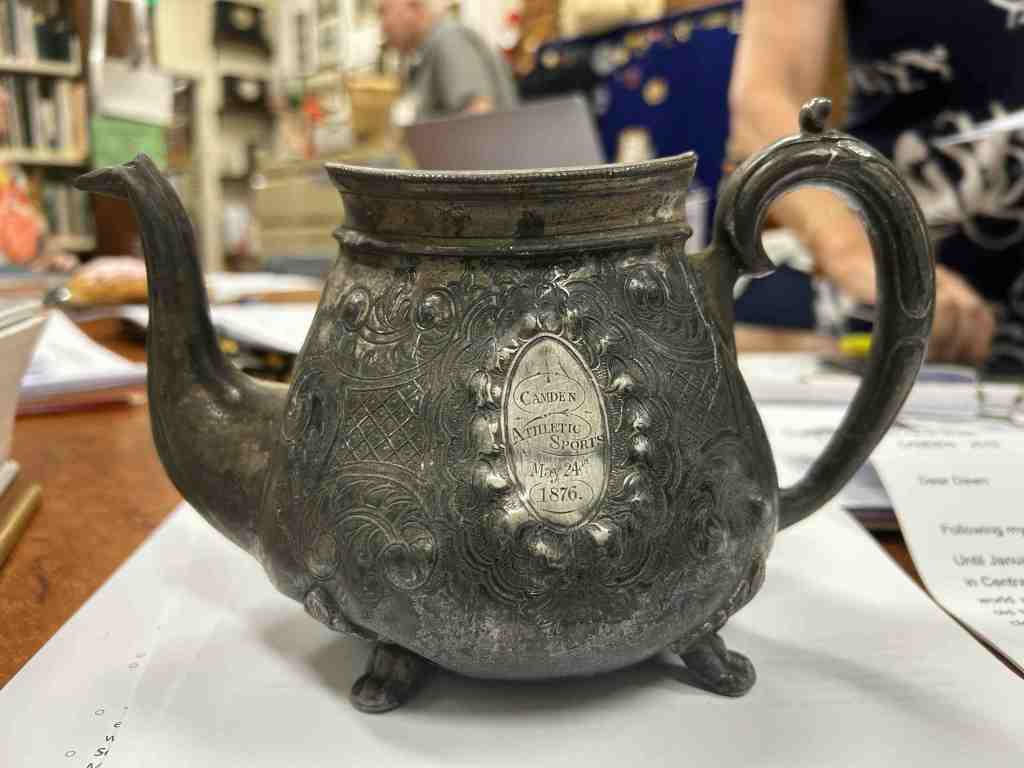
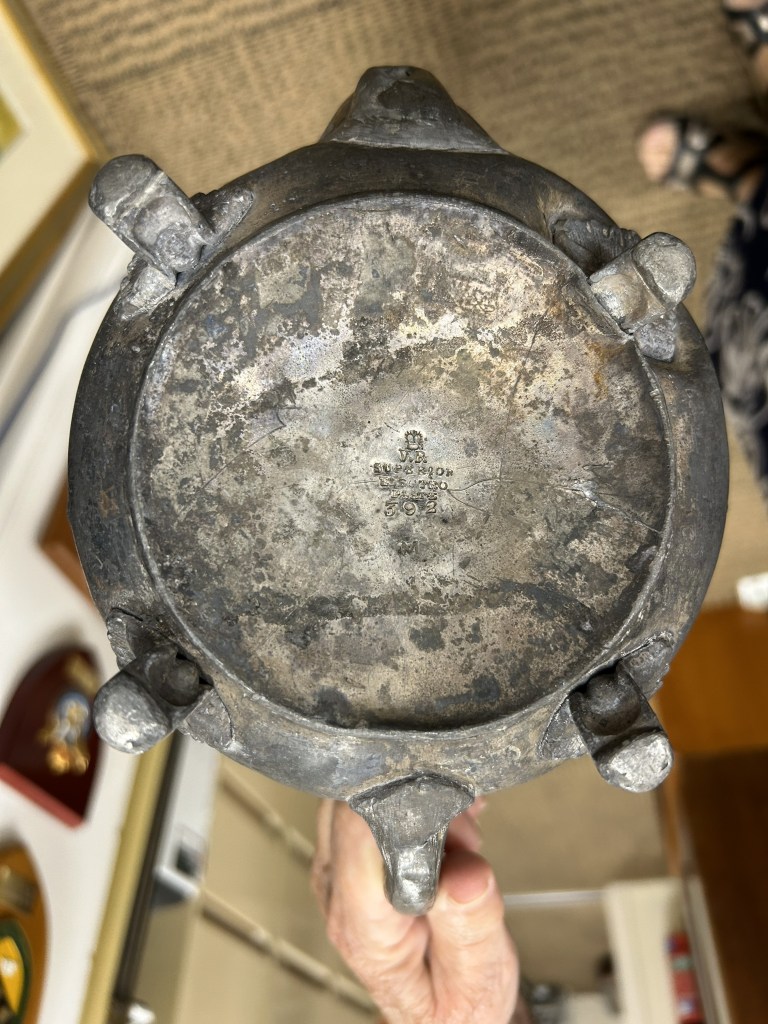
The Camden Museum teapot trophy has two inscriptions: ‘Presented to Winner of Town Race’ and ‘Camden Athletic Sports May 24th 1876′.
In the 16-event program, there was no direct mention of a silver (electroplated) teapot as a trophy. The only event that had a silver tea service as a 1st prize was the ‘walking match’, not the ‘town race’. The town race was a two-mile handicap walking match won by J Cuiden from Cobbitty. So presumably the teapot was part of the ‘silver tea service’. (AT&CJ, 10 June 1876)
The next mystery is how the teapot ended up in far western New South Wales.
Camden Museum Benefactors
The 1876 sports day teapot was donated to the Camden Museum by benefactors Alf and Sharon Cantrell from Yeoval in Central Western NSW. The Cantrells had found the teapot at a rural clearing sale with a billy can. They displayed it at the Banjo Paterson Museum in Yeoval, now permanently closed, along with a collection of other billy cans. (Cantrell 2025)
The Museum committee is grateful to the Cantrells for their generosity, and the teapot will be on display in the museum in the new year, 2026.
Reflection
Objects from the past tell a story. Without a story, they are just objects, with provenance and supporting evidence that become essential parts of Camden’s cultural heritage.
These types of objects are called moveable heritage, and while not of significant monetary value, they are of great value to the development of the Camden Story.
Resources
Cantrell, Alf & Sharon 2025, Letter to Camden Museum. Camden Museum archives.
DOS 2021, Empire Day. Dictionary of Sydney. https://dictionaryofsydney.org/event/empire_day
Moyal, Ann. (2017). Essay – Arthur Phillip: 1788. The Foundation Year – Australian Dictionary of Biography. [online] adb.anu.edu.au. Available at: https://adb.anu.edu.au/essay/21 [Accessed 9 Dec. 2025].
PMM (2025). Empire Day Nbsp | Port Macquarie Museum. [online] Portmuseum.org.au. Available at: https://portmuseum.org.au/empire-day-nbsp.html [Accessed 7 Dec. 2025].
Discover more from Camden History Notes
Subscribe to get the latest posts sent to your email.

