
Health and the Camden district
By the 1890s, the Camden district economy had grown to rely on the dairy industry, with around 700 dairymen from a district population of around 1500. (CN 28 April 1898) They supplied independent butter factories at Westbrook (Mount Hunter), Cawdor and Cobbitty, Camden Park creameries at Camden and Menangle, and raw milk sales in local towns and villages. (Willis 2015)
The 1893 drought increased concerns about public health after locals were forced to draw contaminated water from the Nepean River. Camden Municipal Council got their act together, and the town was connected to reticulated water by 1899. (Willis 2015)
Country hospitals
The Camden Cottage Hospital was far from the first country hospital in New South Wales. Gazetted for operation on 5 April 1899 (CN 20 April 1899) like other country hospitals, the local community managed it. The first of these country hospitals appeared at Goulburn (1849), Carcoar (1860-1861), and Orange (1865-1867) (Nicholson 2017).
By 1898, 66 country hospitals were registered under the Public Hospitals Act 1898 (NSW), which was mainly concerned with the election of board members and the operation of the community hospital board. These country hospitals were funded by local subscribers and supported by government subsidies.
Infectious disease outbreak
The first call for a cottage hospital came in 1897 when a letter from Amicus was published in the Camden News. There was an outbreak of scarlet fever on a local farm, and the letter writer said that the
case of a local farmer who because of illness of one of his young children is now debarred from selling his milk, thus for the time, loosing his living. The loss falls heavily upon such men and they well deserve our kindly consideration.
The writer stated that
Some time ago was suggested that a Cottage Hospital be established in this district and might not such an institution prove—the truest economy? (CN 27 May 1897)
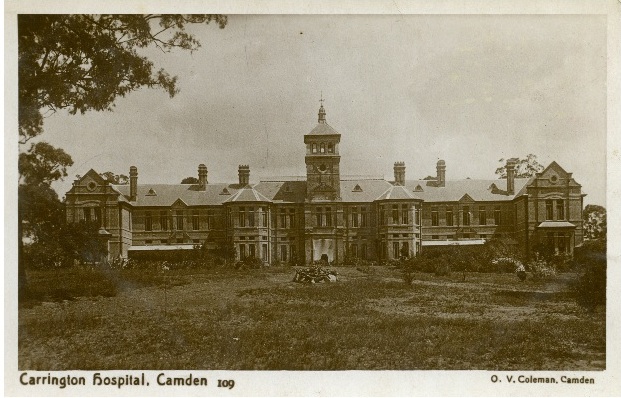
The writer was probably referring to a number of hospital cottages built within the grounds of the Carrington Centennial Hospital, which opened in 1890. (SMH 26 March 1891)
The impressive Carrington Centennial Hospital for Convalescents and Incurables had been constructed on a ridge just out of the Camden town area to treat tuberculosis patients from Sydney. The hospital was funded by philanthropist and businessman WH Paling at a cost of over £30,000 with a capacity of 89 patients. The presence of Carrington Hospital had little influence on the foundation of the cottage hospital.
Alderman Griffith takes up the matter at the council
By the end of 1897, the New South Wales government declared scarlet fever a notifiable infectious disease, along with typhoid, croup and diphtheria. (NSWGG, 17 December 1897; Aust Star, 18 December 1897)
Alderman EC Griffith, a local butcher, brought the case of scarlet fever to the mayor’s attention, and the prize giving at Camden Public School was cancelled. (CN, 30 December 1897, 16 December 1897)
Griffith raised the scarlet fever case at the first council meeting the following January and argued that the outbreak caused problems for farmers and their families. He noted that sick patients were kept in private homes or a local hotel, and neither arrangement was satisfactory. Griffith maintained that an infectious patient could isolated in a cottage hospital. (CN 13 January 1898)
In late January 1899, Griffith moved a motion at the council
That it is necessary for the benefit, health and convenience of the public that a Cottage Hospital be formed for Camden. (CN, 27 January 1898)
In supporting the motion, Griffiths outlined that if a dairyman with a large family was afflicted with one case of scarlet fever, the disease would gradually work its way through the family. Under the health regulations, the family would be quarantined, and
milk from his dairy would have to be thrown away, for he could not supply it to Sydney firms, or to local creameries (CN, 27 January 1898)
Griffith made the point that if there was a cottage hospital, the patient could be isolated at the hospital, and the cost would more than compensate the cost of the doctor having to visit the family on the farm.
In supporting the motion, Alderman Willis maintained that a hospital was ‘an absolute necessity’ in a dairying district like Camden. The motion was carried unanimously. Alderman Griffiths agreed to compile the necessary facts and figures for establishing a cottage hospital. (CN, 27 January 1898)
The scourge of scarlet fever
An outbreak of scarlet fever in a farming area caused disquiet and considerable hardship for the affected dairymen and their families. The Camden community was well aware of the issues.
Deborah Tout-Smith of the Museums Victoria states
Scarlet fever (sometimes known as scarlatina) caused repeated epidemics in Victoria and around the world during the 19th century. Known for centuries as a serious illness that particularly impacted children, it could be rapidly fatal. (Tout-Smith 2020)
The 1875-1876 scarlet fever outbreak resulted in 2000 deaths in NSW and over 3200 deaths in Victoria, with 87% under 10 years of age. (Curson 2007)
In Victoria in 1889, the Benalla North Eastern Ensign reported that
‘No more frightful disease can attack a child than scarlet fever, and as an epidemic of this disease is now among us, it behoves all, and especially those with children, to know something about it. As everybody knows, this is a disease with a rash; indeed, it owes its name to the scarlet hue of the eruption.’ (The North Eastern Ensign (Benalla, Vic), 1 March 1889)
Deborah Tout-Smith writes:
Scarlet fever is caused by the bacteria Streptococcus pyogenes, causing symptoms including a sore throat and distinctive rash, as well as swollen glands and broken blood vessels. Complications such as septicemia, pneumonia and toxic shock syndrome can lead to death. Scarlet fever readily spreads through airborne droplets, contact with skin, clothes or bedding; living in close contact is a particular risk.(Tout-Smith 2020)
Scarlet fever was particularly concerning in a dairying district. It was highly contagious and spread by airborne droplets and sometimes by contaminated food, especially milk. In the 1890s, there was no cure, and an untreated case could be contagious for several weeks. (Felman 2023)
At Singleton, a dairying area in the Hunter Valley, the local press reported to its readers that recent research showed that infected cows passed on scarlet fever with their milk. (Singleton Argus, 31 July 1897)
Matters moved slowly
Matters moved slowly in 1898, and there were concerns about the economic consequences of a scarlet fever outbreak in the local area.
In April, a letter appeared in the Camden News from A Ferris wanting to know if the matter had been shelved by the council and making the point that the Board of Health could quarantine a family with a scarlet fever outbreak and not allow the dairyman to supply milk to ‘the factories or to Sydney for a period of from six weeks to six months’. (CN 28 April 1898)
The hospital issue was raised at the July meeting of local dairymen, the United Milk Suppliers Association. Mr Veness and Mr A Ferris felt that considering the restrictions imposed by the Board of Health, establishing a cottage hospital was of great importance to the local dairy industry. (CN, 14 July 1898)
Appointment of hospital committee
By November, public interest was sufficient for a well-attended public meeting at the Camden School of Arts after a similar appeal in May collapsed due to lack of interest. A provisional hospital committee was formed to proceed with the project, which consisted of representatives from Burragorang Valley to Menangle, including AJ Macarthur Onslow of Camden Park Estate. Dr Morton suggested that the hospital should only have 3 to 4 beds, supervised by a nurse in an ‘experimental’ way in the town area. (CN, 17 November 1898, 24 November 1898)
The cottage hospital venture was a tiny project compared to Camden’s first hospital at Carrington, a city venture in a bucolic rural setting.
Edithville, a small affair
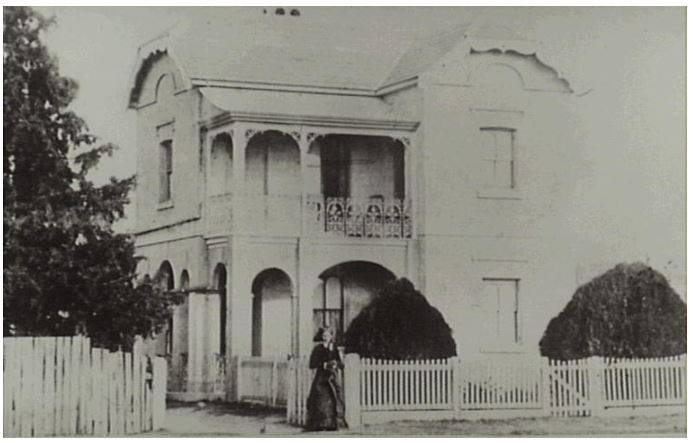
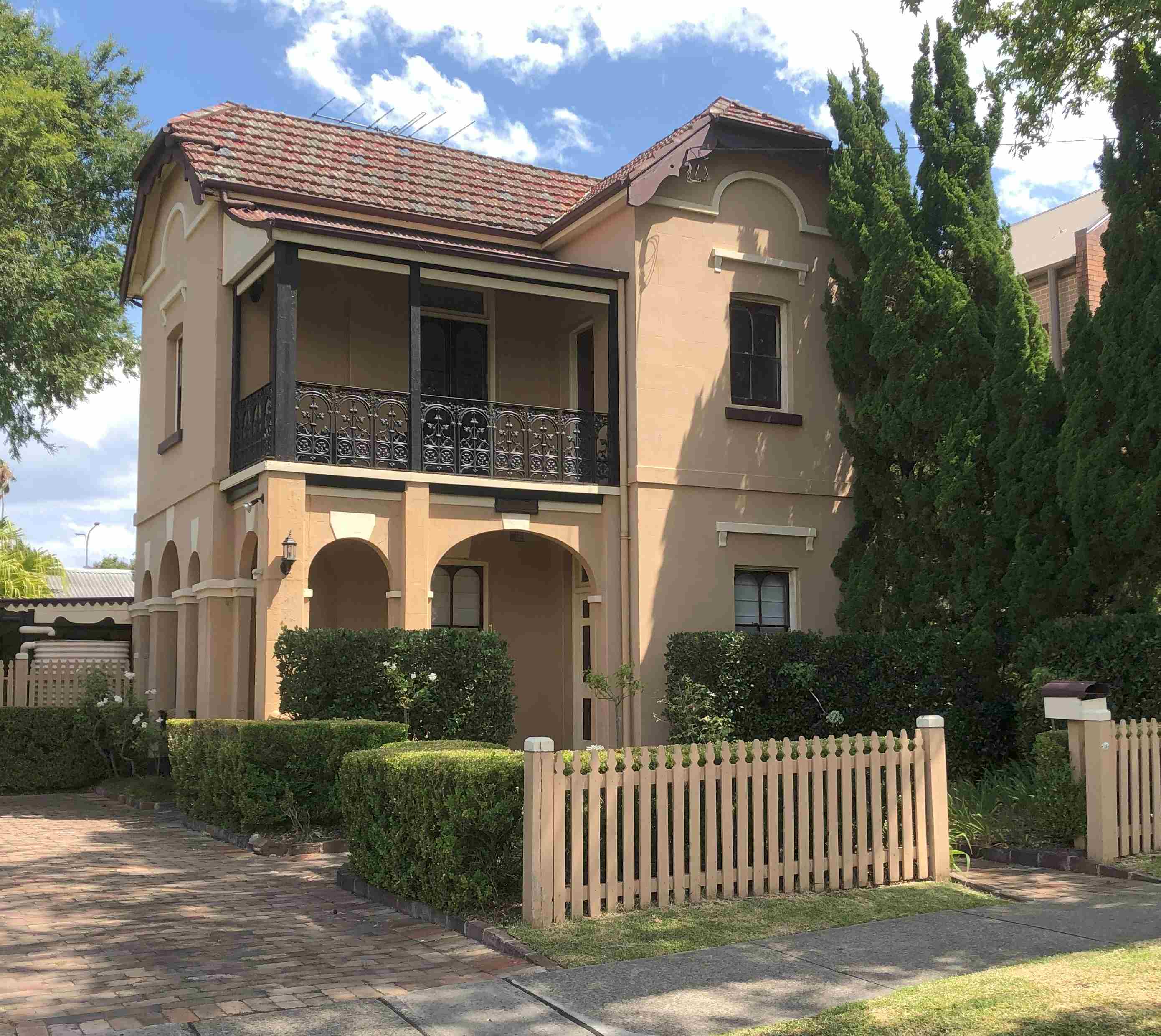
In December 1898, Charles Furner Snr, a builder, offered his Mitchell Street house, Edithville, to the hospital committee for the hospital, with an adjacent detached cottage as an isolation ward. (CN 15 December 1989)
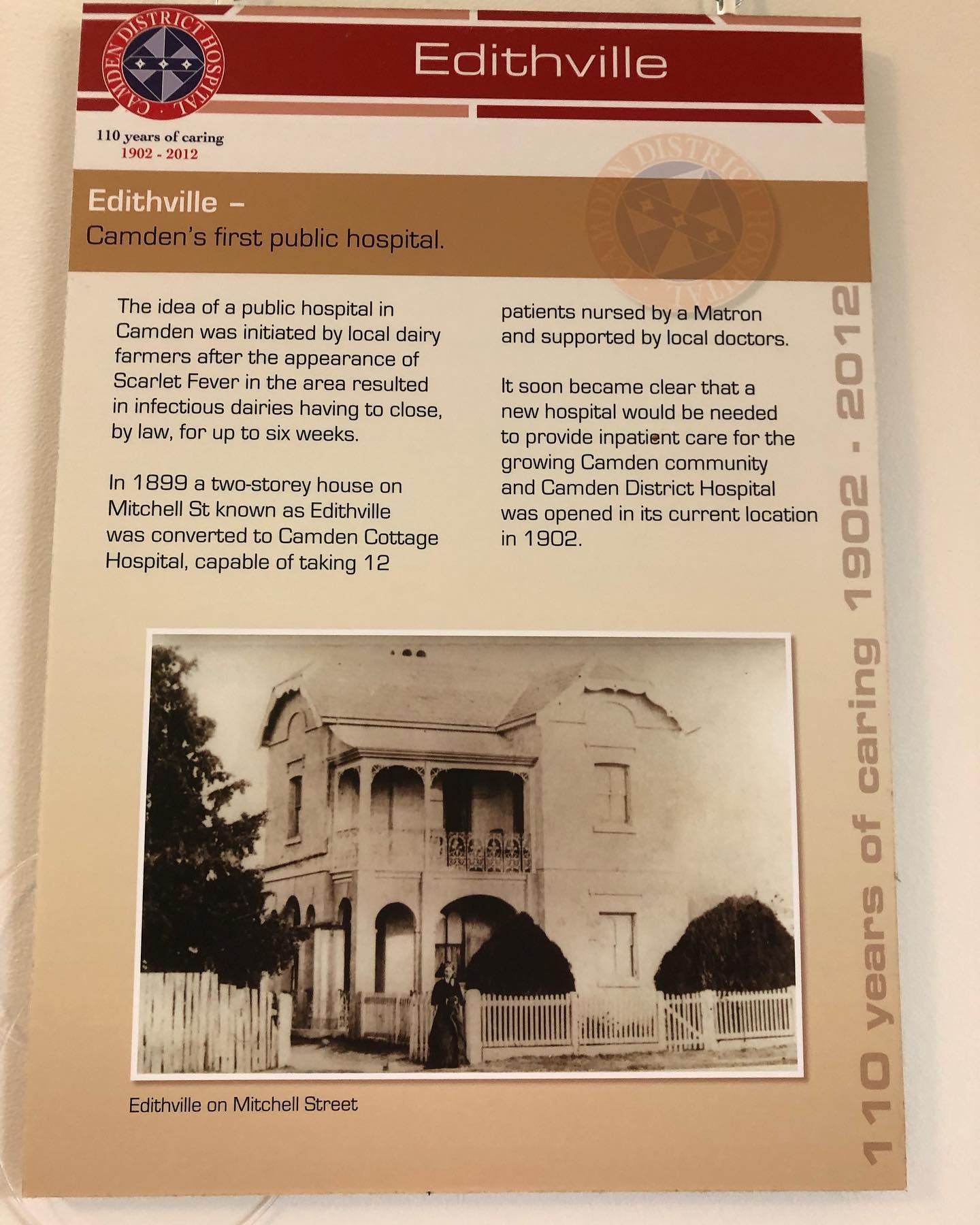
Edithville was a notable two-storey painted ashlar Victorian gentleman’s townhouse with a hipped gable tiled roof, ornate timber bargeboards and brick chimneys, and a first-floor verandah with cast-iron balustrading. The ashlar arches to the ground floor verandah have keystones over them. The house was built in the 1890s for Charles Furner and his wife, Harriet. (Edithville 2002)
By February 1899, the hospital committee had formalised a two-year lease at a weekly rental of 25/- with Charles Furner. They took possession at the beginning of March, advertised for a nurse and agreed the local doctors would be paid an honorarium. (CN 2 March 1899) Nurse Hetherington, who came from Prince Alfred Hospital, a Nightingale hospital, was appointed matron on a salary of £60 a year. (CN 23 March 1899; RPA Museum)
Furner’s house underwent renovations for £15/9/- which Mr Peters carried out. (CN 23 March 1899)
Cottage hospital opens
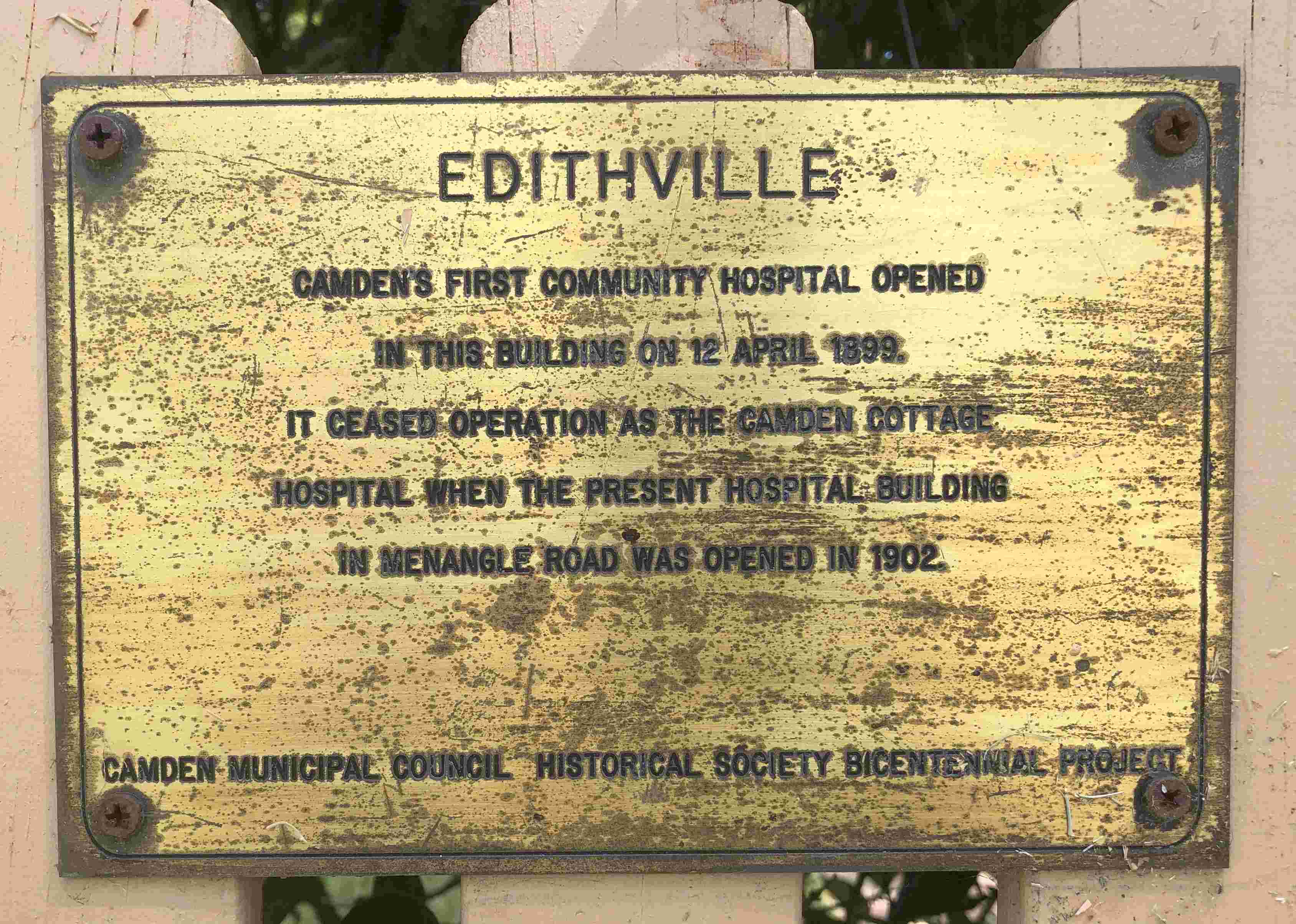
Mayor Furner officially opened the cottage hospital on 12 April in front of a crowd of 200 people. This was followed by inspections of the wards and afternoon tea on the grass provided by Camden women, who later formed a ladies’ hospital committee. (CN 13 April 1899)
The hospital started with five beds and could be expanded to take 12 patients. (Camden Hospital 2012)
First patient, first death
In April 1899, the first patient was admitted to the new Camden Cottage Hospital after being kicked by a horse, and the first death occurred a few weeks later when a 21-year-old man died of a chest complaint. (CN, 27 April 1899, 1 June 1899)
Life could be precarious in the 1890s with infectious diseases, accidents and other mishaps. The foundation of the Camden Cottage Hospital increased the sustainability of the local dairy industry, which relied on the family farm.
But Edithville was only a temporary measure.
A permanent hospital
In early 1900, planning started for the new permanent cottage hospital, which would eventually be located on Windmill Hill. (CN 18 January 1900)
References
Camden Hospital, a history 2012. Camden 110 Year Anniversary, South West Sydney Local Health District, NSW Government, Sydney. Online https://www.swslhd.health.nsw.gov.au/ccq/camden110/history.html
Curson, Peter 2007, Epidemics and Pandemics in Australia. Weber Teleclass ppt. Online at https://webbertraining.com/files/library/docs/144.pdf
Edithville 2002, State Heritage Inventory, NSW Government. Online https://www.hms.heritage.nsw.gov.au/App/Item/ViewItem?itemId=1280068
Felman, Adam 2023, What you need to know about scarlet fever. Medical News Today. Online at https://www.medicalnewstoday.com/articles/176242. (Viewed 20 December 2024)
Nicholson, James 2017, Former Orange Base Hospital, Dalton Street, Orange, Photographic Archival Record. Adaptive Architects for Orange City Council, Orange.
RPA Museum, Did you know? RPA Museum, Sydney. Online at https://slhd.health.nsw.gov.au/rpa-museum
Tout-Smith, D. (2020) Scarlet Fever Epidemics in Victoria in Museums Victoria Collections https://collections.museumsvictoria.com.au/articles/16828 Accessed 26 December 2024
Willis, Ian 2025. Pictorial History Camden and District. Kingsclear Books, Sydney.
Read more
Updated on 2 January 2025. Originally posted on 27 December 2024 as ‘History of Camden Cottage Hospital’.
Discover more from Camden History Notes
Subscribe to get the latest posts sent to your email.


One thought on “Camden Cottage Hospital – foundation and early days”
Comments are closed.