Sports Day to aid Cottage Hospital
Anniversary Day in 1901, January 26, was set for the first sports day conducted by the Combined United Friendly Societies as a fundraiser for the new Camden Cottage Hospital. Organisers promised a full day of sports, including the Sheffield Handicap, with prize money of £5. (CN 13 December 1900)
Sports days and similar events were popular community events in the late 19th and early 20th centuries. They were used to raise funds for local charities and celebrate holidays and community anniversaries. One of those days was Anniversary Day, the celebration of European settlement in the colony of New South Wales.
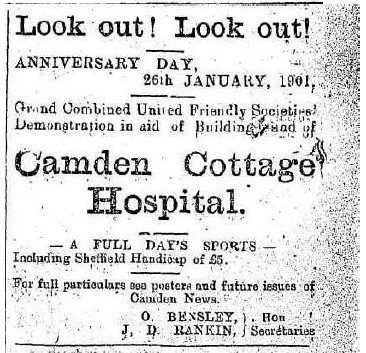
By January 1901, advertisements for the sports day were promoting it as Grand Friendly Societies’ Demonstration and Picnic Sports Day in aid of the Camden Cottage Hospital Building Fund.
The day was held on Rev King and Watson’s Paddocks and jointly organised by Sons and Daughters of Temperance and the Members of the Order of Royal Foresters.
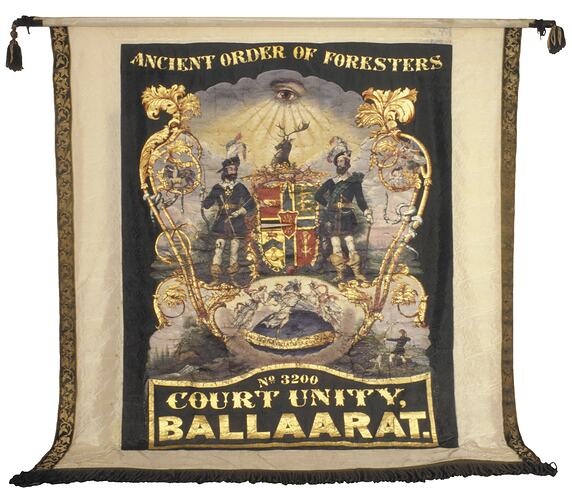
The Museum of Victoria states that friendly societies were important in Australia without social welfare benefits.
In a world without social security, working men could see the value of joining together in ‘Friendly Societies’. At the regular ‘lodge’ meeting, members would pay a small subscription, a form of insurance, which would entitle them to benefits if they became ill or unemployed, and would provide support for their dependents if they died. Lodge members took turns to assume leadership positions. Often they ran the finances of each lodge with only minimal interference from a central organisation. Members identified proudly with their society, wearing elaborate regalia at meetings, and learning complicated initiation rites and the rituals associated with membership.
(Banner, Museum of Victoria)
Sports Day Programme
The all-male sports day committee of 34 consisted of local notables to ensure the day ran smoothly. Some of the committee were also members of the hospital committee. The tournament officials and programme are below.
| Tournament officials (men) | |
| Judges | FWA Downes Esq JP and WR Cowper. |
| Referee | J Marony |
| Starter | M Young |
| Handicappers | G Young and M Young |
| Gatekeepers | A Ferris, Mr Williams, J Veness, J Chesham |
| Scouts | Mr Franzman, W Dunk, P Todd, F Boardman, |
| Master of Track | J Bruchhauser |
| Programme | ||||
| Event | Distance | Entry Fee | Prizemoney | |
| Boy’s Race | 14 years and under | 75 yards | 6d | 1st – 7/6d 2nd – 2/6d |
| Girl’s Race | 14 years and under | 50 yards | 6d | 1st – 5/- 2nd – 2/6d |
| Society’s Handicap | 1/- | 1st – £1 2nd – 10/- | ||
| Tug-of-War | Foresters v Sons of Temperance | 10 men aside | Trophy | |
| Sheffield Handicap | Handicap | 150 yards | Entry 1/- (Closes 21/1/00) Acceptance 1/- | 1st – £3/5/- 2nd – £1 3rd – 10/- |
| Old Buffer’s Race | 45 years and over | 6d | Trophy valued 10/6d | |
| Throwing at the Wicket | 1/- | £1 | ||
| Putting the Weight | 6d | Trophy value 10/6d | ||
| Cutting the Candle | 6d | 10/- | ||
| Guessing Weight | 6d | The pig | ||
| Greasy Pig | 6d | The pig | ||
| Sack Race | 6d | 5/- | ||
| Lady’s Nail Driving Competition | 6d | Trophy valued 10/- | ||
These types of events were typical of community sports days across the district, like those held on New Year’s Day at Cobbitty.
The origins of these festivals, according to Peter Hampson Ditchfield’s Old English Sports (2007), lie in ancient Saxon customs, particularly in Devonshire and Sussex, associated with ‘wassailing’ (carousing and health-drinking) to ensure the thriving of orchard trees (mainly apples) and exchanging presents.
On New Year’s Day, village youths undertook indoor and outdoor sports to keep out the cold by ‘wholesome exercise and recreative games’. Sports included bat-and-ball, wrestling, skittles, blind-man’s-bluff, hunt the slipper, sword dancing and mumming (play-acting).
Other sports day details
A procession for lodge members was to start at the Camden Mounted Rifles Drill Hall at 11.30am and finish at the sports ground.
Refreshments of all sorts were promised at reasonable prices, including light refreshments, fruit and confectionary, and hot water.
Admission to the sports ground was adult 1/-, children under 14 years of age 6d, under 6 years of age free. (CN 17 January 1901)
In the evening a ‘Grand Concert’ was to be held at the Camden School of Arts with admission at ‘usual prices’.
A good brass band has been engaged to provide on-ground entertainment and lead the parade. (CN 17 January 1901)
Mixed reports of the sports day and concert
In a local press report, Camden News editor William Sidman claimed that ‘never in the history of Camden has a more successful gathering taken place’.
The procession was led by the Camden Town Band from the Drill Hall under the ‘command’ of Bandmaster Anson.
The procession comprised male and female members of the Friendly Societies who ‘wore their several collars and sashes of their office and Order’ creating an ‘impressive’ parade.
At the head of the procession were local Chief of the Foresters, JD Rankin, and sub-Chief S Kelloway, who rode grey horses. These two men ‘looked quite gay with their plumes, clothing and orders of office’.
The Foresters had their ‘huge banner, which made an ‘impressive spectacle’ with the inscription ‘Support the Order of Royal Foresters’, and then they were followed by the Sons of Temperance.
The procession arrived at the sports ground in Rev King’s paddock, where a crowd of around 1000 people was well ‘beyond anticipation’ and created an atmosphere resembling a ‘social gathering’ or ‘garden party’.
The food provided met with a mixed reception and editor Sidman was less than impressed with the roasted pig, which he considered was ‘a complete failure’. It was covered in flies and ‘gave the appearance of a most funerial [sic] and repulsive spectacle’.
The major footrace of the day, the Sheffield Handicap, met with disapproval from editor Sidman, who felt it was not ‘quite up to the standard of the ladies and gentlemen who attended’. He wrote, ‘There is no pleasure in witnessing men racing, many unbecomingly dressed’ and bemoaned that a more attractive event might be held in future.
Other events in the sports day programme met with Sidman’s approval and provided the crowd with ‘real pleasure’.
The evening concert was ‘crowded’, according to press reports, and there were no spare seats at the School of Arts, which could hold around 250 seated people. All those who attended reportedly ‘enjoyed the excellent programme’.
Press reports did not give details of any individual performer or entertainment, contrary to standard reporting practices of community events in the Camden News. Editor Sidman justified this decision by writing that ‘we cannot individualise the excellence of the singers’, perhaps indicating his view of the evening’s entertainment.
Sidman was less than impressed that no one from any of the organisations linked to the event gave any official thanks or speeches to the organisers. These organisations included the Cottage Hospital Committee, Royal Foresters, and Sons of Temperance. (CN 1 February 1900)
Financial results
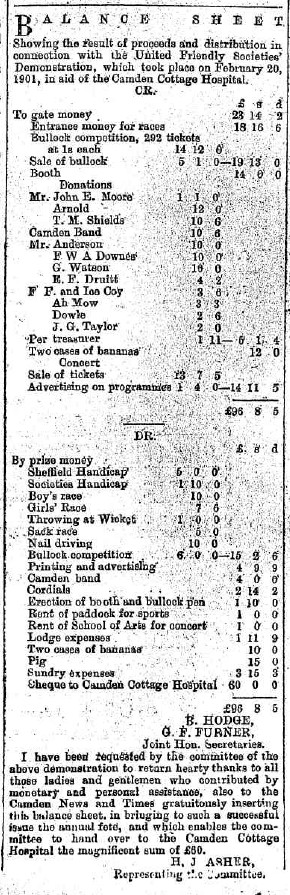
The sports day and concert raised £60 for the Camden Cottage Hospital, with income and expenses listed in the audited balance sheet of the sports day published in the Camden News.
The January 26 timeline and its evolution to Australia Day
The First Fleet dropped anchor in Sydney Cove on 26 January 1788, went ashore, raised the Union Jack, and saluted the flag, and so began European settlement in the colony of New South Wales.
Ever since, the day has gone by various names and has been cause for celebrations of different types.
By 1808, in the New South Wales colony, January 26 was used as the date by the convicts to celebrate their new land with drinking and merriment.
From 1817, the date is sometimes called ‘Foundation Day’ or ‘First Landing Day’.
In 1818, Governor Macquarie declared a public holiday on January 26.
In 1837, the first regatta races were held on Sydney Harbour for watermen, and it evolved into Regatta Day.
The second regatta was held in 1838 on 26 January, and a celebratory lunch was held on the 50th anniversary of the colony. The colony enjoyed a public holiday in Sydney on Foundation Day. (NSWGG, 23 Jan 1838)
In Victoria, January 26 was celebrated in 1871 by the members of the Australian Natives Association on ANA Day.
The first Anniversary Day was celebrated on January 26, 1888, in all colonies except South Australia.
Later in the 20th century, January 26 became Australia Day.
References
Banner – Ancient Order of Foresters, Thomas Flintoff, circa 1860. Museums Victoria Collections https://collections.museumsvictoria.com.au/items/253378 Accessed 03 January 2025
Discover more from Camden History Notes
Subscribe to get the latest posts sent to your email.


One thought on “1901 Anniversary Day sports and other amusements on January 26 in aid of the Camden Cottage Hospital.”
Comments are closed.