
Book Review
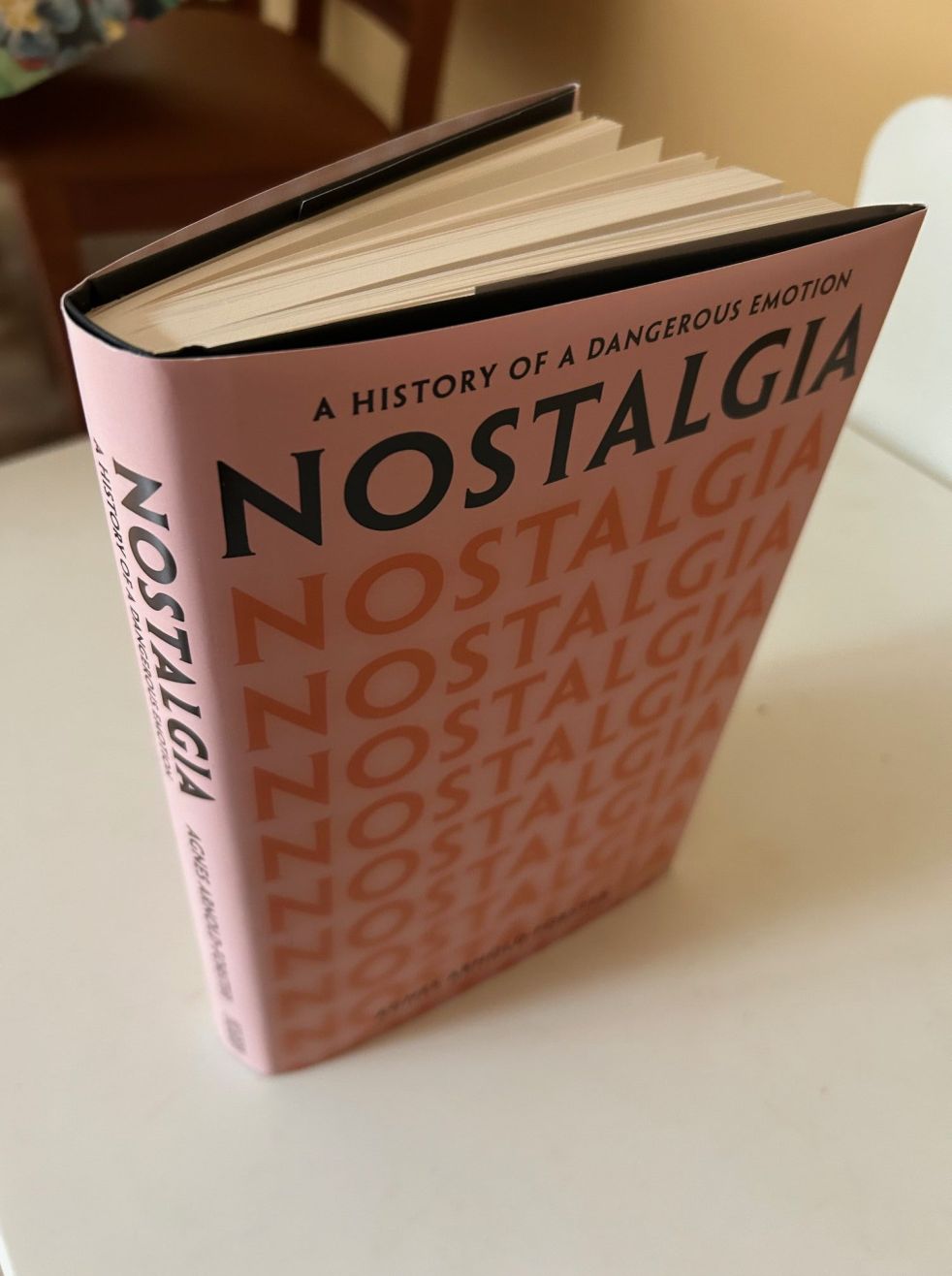
Agnes Arnold-Forster 2024, Nostalgia, A History of a Dangerous Emotion. Picador, London. 272 pages. ISBN 9781529091366
Nostalgia in a contemporary context
In reviewing this book, it was remarkably prescient that I came across two stories in the Australian media today (Thursday, 17/1/25) that mentioned nostalgia, each in a completely different context, illustrating how nostalgia is ever present with us.
Firstly, communications academic Liz Giuffre writes in a story about Triple J
Generational battles over the role and importance of Triple J continue to rage.
This is not to say older audiences should stop caring about Triple J. Nostalgia is powerful and important, shown by audiences who attended the sold out 20 year anniversary show by former breakfast hosts Adam Spencer and Wil Anderson. (Giuffre 2025)
Michael Bachelard writes in the Sydney Morning Herald:
A letter landed in my inbox last year that gave me a strong burst of nostalgia. It was a legal threat from the defamation lawyer who also represented Bruce Lehrmann and Ben Roberts-Smith. This time he was working for the leaders of a religion, the Plymouth Brethren Christian Church. (Bachelard 2025)
These stories are entirely different and illustrate that the concept of nostalgia is alive and well in Australia and Australian society.
One story relates memories of the music industry and the sentimental attachment it has for music aficionados who are past their prime.
The other story mentions how nostalgia can be dangerous in Australian society and how it can be used to threaten people’s lives.
Each of these snapshots illustrates some of the arguments that Agnes Arnold-Forster is making about nostalgia in her book, ranging from the mundane to the dangerous.
Weaponised and all around us
Nostalgia: A History of a Dangerous Emotion is a prescient book, given how nostalgia is all around us and how it has been weaponised by politicians worldwide.
One example is the American MAGA movement and the 2024 Trump presidential election campaign. (p 171)
Australian conservative politicians have used nostalgia to raise arguments on social media about Australia Day that have been circulating for many years.
Josh Taylor has reported in the Guardian that Australian politicians have weaponised nostalgic arguments around Australia Day in advertisements. (Taylor 2024)
Others have mentioned that changing the date of Australia Day was first mentioned in 1938 when the Australian Aborigines’ League held their first Day of Mourning. (Wikipedia contributors 2025)
Debate around changing the date was called for in 1999 by Tony Beddison, the then chairman of the Australia Day Committee (Victoria), in 2009 by Mick Dodson, the Australian of the Year, and in 2016, National Indigenous Television chose the name “Survival Day” as their preferred choice. (Evans 2024)
Nostalgia in Camden
The use of nostalgia in the Camden context fits a dictionary definition quoted by Arnold-Forster where she stated
It is an emotion, a wistful or excessively sentimental yearning for return to or of some past period or irrevocable condition. (p.1-2)
In the Camden example, nostalgia has been used to defend the town of Camden from Sydney’s urbanisation, which has assaulted the area’s identity and sense of place.
I have called this use of nostalgia a ‘country town idyll,’ where the idea’s promoters have used the nostalgia surrounding the notion of Camden as ‘the country town’ as a political weapon, a marketing tool, and a tourist promotion.
For many years, the Camden Show Society has promoted the annual agricultural show as ‘Still a Country Show’ to thousands of visitors yearly. (https://www.nsw.gov.au/visiting-and-exploring-nsw/nsw-events/camden-show )
Recently, nostalgia has promoted a Victorian gentleman’s townhouse as short-stay accommodation by appealing to the past as a foreign land where things were more idyllic and peaceful. The advertisement states
Originally built circa 1880s by the region’s founding family, The Macarthurs, our lovingly converted guest house on our classic Victorian-era estate whisks you away to a genteel time when life moved at a slower rhythm. (https://www.staytime.com.au/camden-dr-crookstons/ )
A slippery concept
Nostalgia is a slippery concept.
Arnold-Forster argues that nostalgia has a ‘fascinating’ history and is a ‘complex’ and ‘slippery emotion’ that has changed over time.
In her book, Agnes Arnold-Forster develops the story of nostalgia over the last 500 years with a blend of ‘neuroscience and psychology [mixed] with the history of medicine and emotions’.
According to the publisher’s notes nostalgia is described by the author as
a social and political emotion, vulnerable to misuse, and one that reflects the anxieties of the age. It is one of the many ways we communicate a desire for the past, dissatisfaction with the present and our visions for the future.
Arnold-Forster has taken a broad view of her subject and used nostalgia as
a lens through which to consider the changing pace of society, our collective feelings of regret, dislocation and belonging, the conditions of modern and contemporary work, and the politics of fear and anxiety. https://www.panmacmillan.com/authors/agnes-arnold-forster/nostalgia/9781529091366
She has
explored the evolution of nostalgia from its first identification in seventeenth-century Switzerland (when it was held to be an illness that could, quite literally, kill you) to the present day (when it is co-opted by advertising agencies and politicians alike to sell us goods and policies). https://www.panmacmillan.com/authors/agnes-arnold-forster/nostalgia/9781529091366
A social phenomenon
Nostalgia, according to Arnold-Forster, is
a social phenomenon, something that bends and flexes depending on the language we speak, the technologies we use, the social lives we live and the culture we consume. (p.212)
The biography of nostalgia reveals its shapeshifting nature and its multiple, varied forms. (p.2016)
Social theorist Svetlana Boym has suggested that nostalgia can be ‘retrospective’ and ‘prospective’, that is, ‘restorative’ nostalgia and ‘reflective’ nostalgia where ‘the second is more critical and open-ended than the first’. (p.216)
Arnold-Forster says that nostalgia can be ‘many things to many people’. (p.217)
To sum up, this is an informative addition to the literature on medical humanities. The author has examined the shifting nature of medical terminology throughout the centuries and how that is reflected by the wider society, its culture, technology and mores.
Agnes Arnold-Forster’s “Nostalgia: A History of a Dangerous Emotion” explores nostalgia’s multifaceted nature, reflecting societal anxieties and politicians’ weaponization of it. The book illustrates nostalgia’s importance in contemporary culture, as seen in varying contexts like music and Australia Day debates while offering a historical perspective on its evolution and impact.
References
Giuffre, Liz 2025, 50 years of Triple J: challenging censorship, supporting Australian artists, and ‘no dope in the studio!’ The Conversation, 16 January. Online @ https://theconversation.com/50-years-of-triple-j-challenging-censorship-supporting-australian-artists-and-no-dope-in-the-studio-246679
Bachelard, Michael 2025. ‘A decapitated doll and a prayer for my death: The many, many threats of the Exclusive Brethren’, Sydney Morning Herald 17 January. Online at https://www.smh.com.au/national/a-decapitated-doll-and-a-prayer-for-my-death-the-many-many-threats-of-the-exclusive-brethren-20241125-p5ktbp.html
Taylor, Josh 2024. Conservative politicians stoking Australia Day debate online with paid ads, analysis finds. The Guardian, 17 January. Online https://www.theguardian.com/australia-news/2024/jan/17/conservative-politicians-stoking-australia-day-debate-online-with-paid-ads-analysis-finds
Wikipedia contributors, 2025. “Australia Day debate.” Wikipedia, The Free Encyclopedia. Wikipedia, The Free Encyclopedia, 14 January. Online https://en.wikipedia.org/wiki/Australia_Day_debate
Evans, Olivia, & others, 2024. The more you know: people with better understanding of Australia’s colonial history more likely to support moving Australia Day. The Conversation, 25 January. Online at https://theconversation.com/the-more-you-know-people-with-better-understanding-of-australias-colonial-history-more-likely-to-support-moving-australia-day-220288
Discover more from Camden History Notes
Subscribe to get the latest posts sent to your email.

