Camden Museum sewing machine collection
The Camden Museum has several sewing machines in its collection, and one was highlighted in a recent blog post. (Willis 2025) The sewing machines are listed here.
Frister & Rossman Sewing Machine
(Upstairs, no case on the floor under the table)
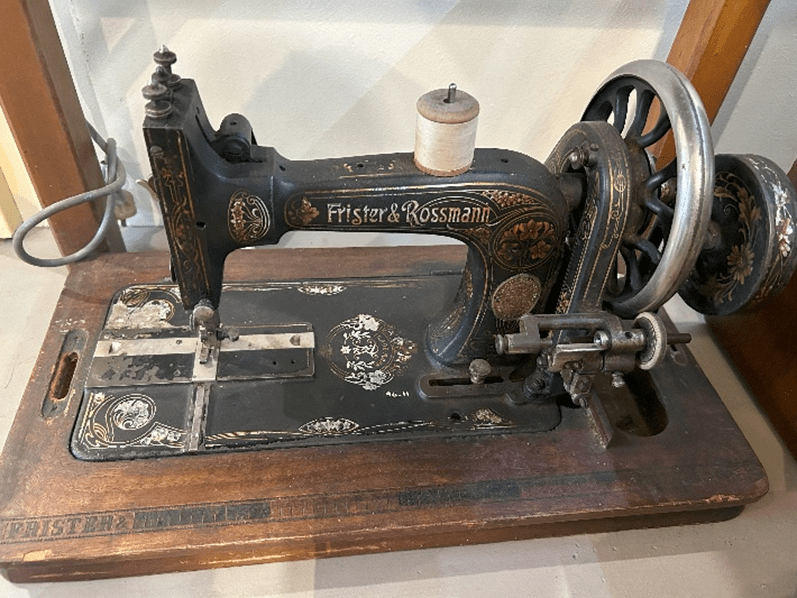
This Frister and Rossman table model sewing machine belonged to Mrs Catherine Anne Cranfield (Blow) (c1882-1973) of ‘Fernleigh’, Cawdor.
Frister and Rossmann produced a large number of sewing machines from 1864, winning medals at various international exhibitions during the 1880s. It was Germany’s largest sewing machine manufacturer until 1902. In 1903, the company produced its one-millionth machine. The company exported their sewing machines to England from around 1870. Their machines were sold through agents and at leading drapers and stores, including Harrods, and in this case, W. Pierssene of London. The machines were also sold in Australia, with Anthony Hordern & Sons Department Store the sole agent.
Sewing machines made by Frister and Rossmann were quite decorative.
Many Frister and Rossmann sewing machines were produced and used throughout the United Kingdom and Australia. (Oud 2015.)
Frister & Rossman Sewing Machine
(Upstairs in case on floor, with hand crank, with case)
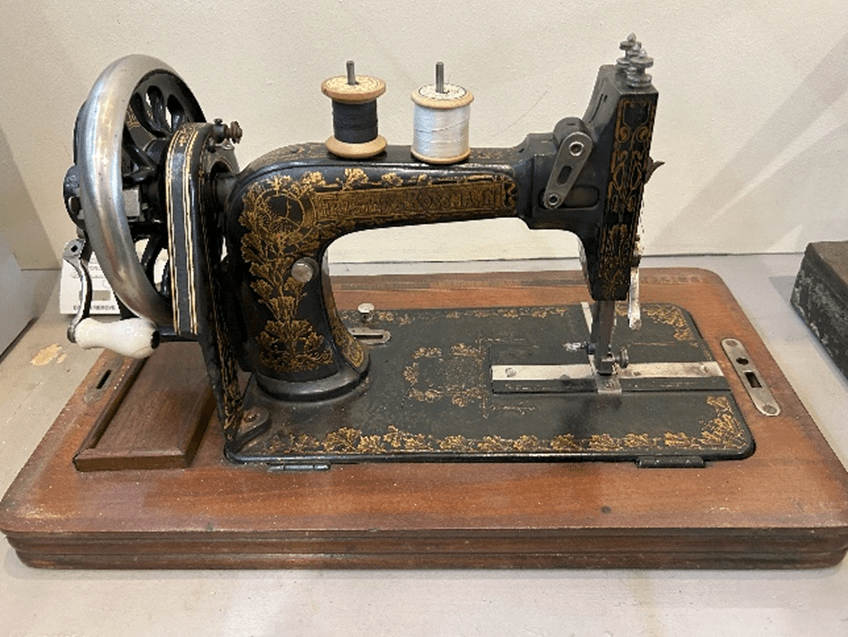
Sewing machine and accessories, portable, hand operated, metal/wood, Frister and Rossmann, Berlin, Germany, 1900-1914,
Instruction Manual

Manual sewing machine. Black metal body with silver- and bronze-coloured floral decorations all over. The machine body is hinged to a rectangular wooden box and lifts backwards to reveal a compartment that would store sewing accessories. The base is wood upon which the sewing machine and attached box sit. The needle, metal for a sewing machine (Powerhouse 1995)
Singer Treadle Fiddle Base Sewing Machine
(Upstairs)
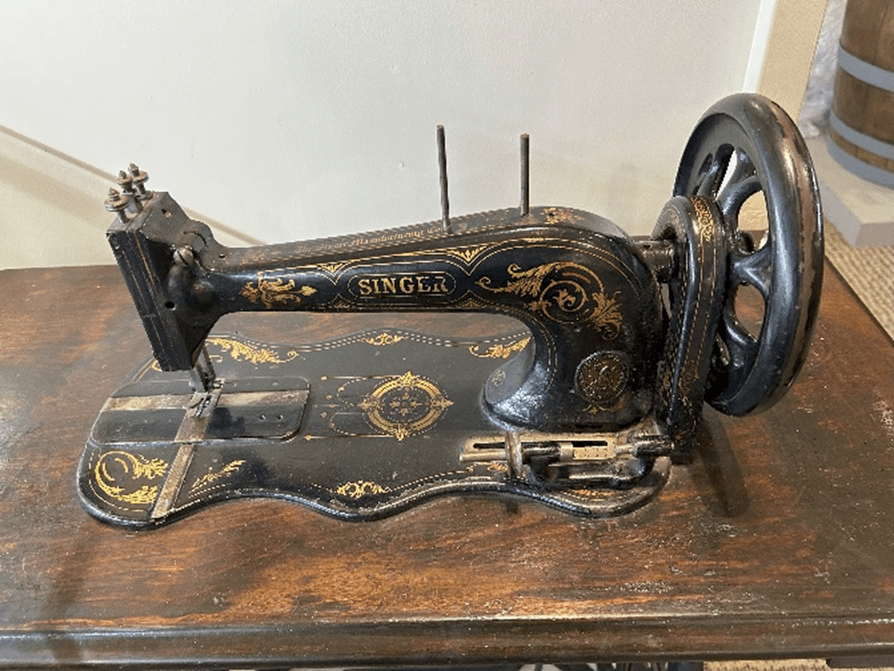
Singer Treadle Sewing Machine owned by Mrs Mary Anne Blattman (Shoobridge) of Oakdale. She purchased the machine in 1888. Mrs Blattman did all the sewing herself, and her seven children, when buying off-the-rack was virtually unknown.
1870s-1880s Singer Treadle Sewing Machine – an early model from the 1870s, most likely a Class 12 (12K) series or variant, one of the first Singer household machines with an oscillating shuttle.
These machines are highly prized by collectors, especially in working condition.
Key Features: Singer machine with a confirmed 1871 serial number; solid wood tabletop with a rich, aged patina; foot mechanism; cast iron base with the iconic SINGER logo; and decorated with elegant vintage stickers, this machine is a true sewing aristocrat. (Etsey 2025)
Willcox & Gibbs chain stitch sewing machine
(Upstairs)
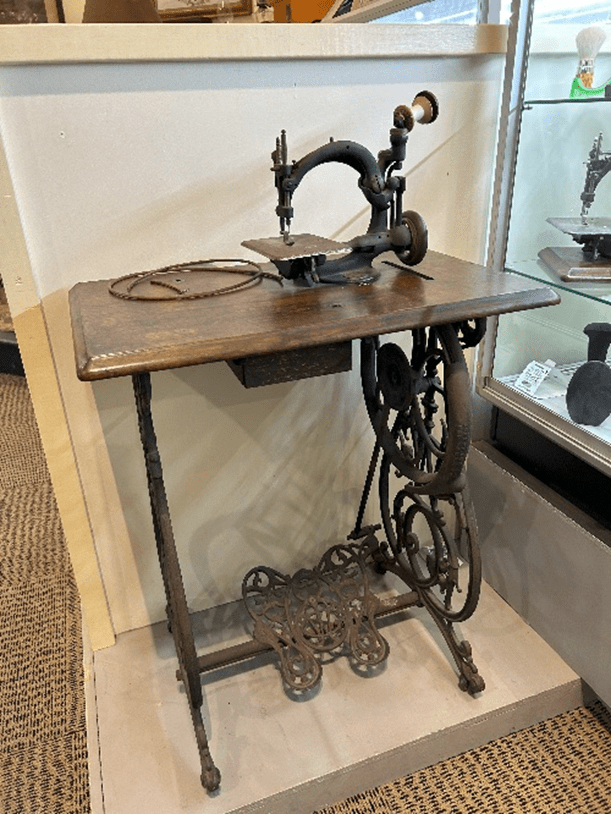
An antique Willcox & Gibbs chain stitch sewing machine, manufactured in 1906, mounted on its original cast iron treadle base.
Manufacturer: Willcox & Gibbs Sewing Machine Co., based in New York, USA.
Design: The machine uses a single thread and produces a chain stitch via a rotating hook and a straight eye-pointed needle, based on patents by James E.A. Gibbs from 1856 and 1857.
Features: This particular model features glass tension discs, standard in domestic models until 1875, and an ornate hand crank, possibly produced in Coalbrookdale, England.
Historical Significance: Willcox & Gibbs machines were known for their reliability and affordability, helping to shift the market from heavy factory machines to lighter, more accessible models for home use. (Powerhouse 2006)
Singer Treadle Sewing Machine
(Downstairs near front door)
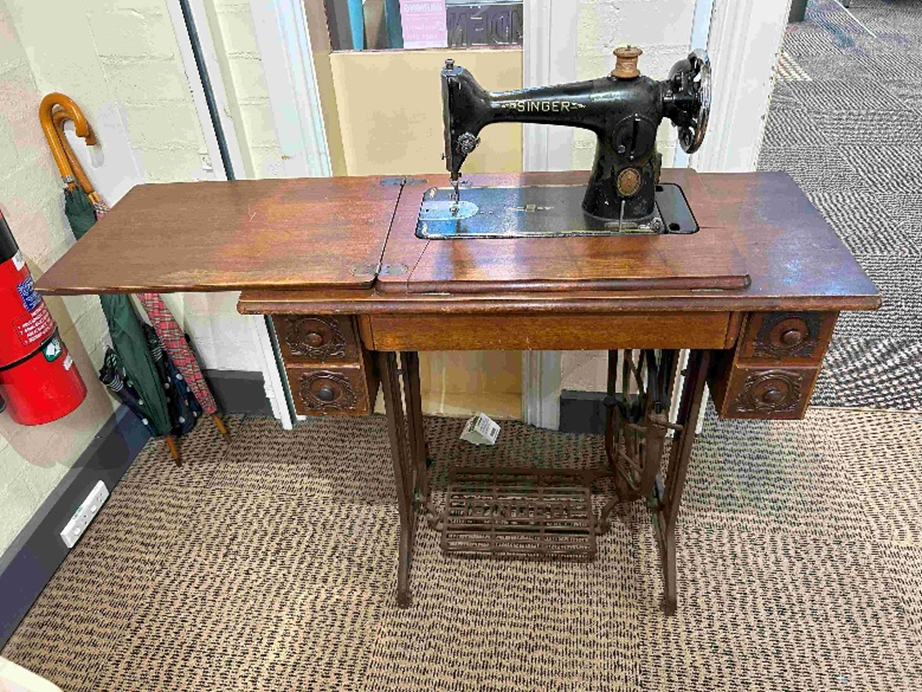
This sewing machine was purchased new by Mrs Winifred Stuckey c1940. She used the sewing machine to manufacture many of her own and her children’s clothes. In addition, she sewed many ‘beautiful’ quilts.
Ian Willis 2025 Camden’s Treadle Sewing Machine: A Revolution in Women’s Agency Camden History Notes.
Singer sewing machine, likely a Model 20 “Sewhandy” toy sewing machine c1910
(In display cabinet upstairs)
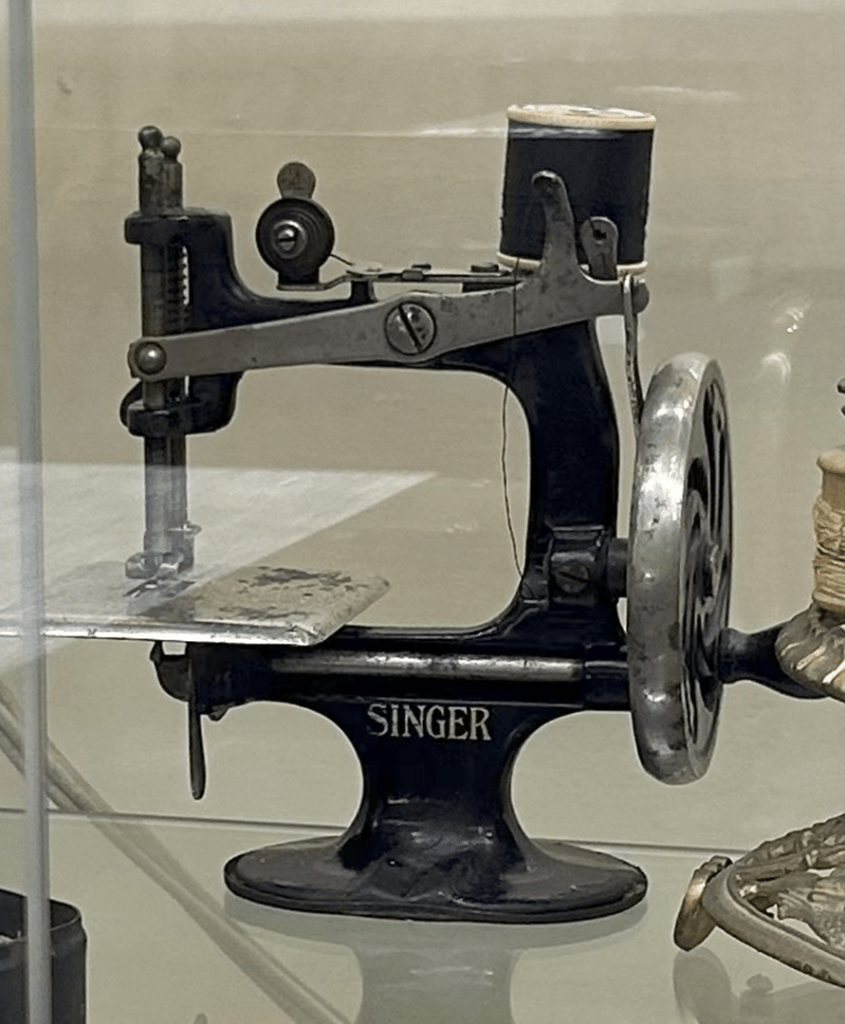
Toy Singer sewing machine with a seven-spoke hand wheel
The toy sewing machine. Allowed women of meagre circumstances to make fashionable clothes for themselves and their children. Often these clothes were hand-finished.
Isaac Merritt Singer (1811-1875) is credited with designing the first practical and efficient sewing machine. By 1860, Singer was the world’s largest producer of sewing machines.
The Singer 20 toy sewing machine, which used a simple chain stitch design, was introduced in 1910. These ‘toys’ could be used by adults as well as children, with advertisements proclaiming their portability and ease of set-up and use.
Based on its description and images, this machine is likely the 1920s Singer model. These were produced with seven-spoke hand wheels and tension discs and had numbers stamped on them to indicate the threading path.
Willcox & Gibbs hand-operated sewing machine
(In storage)
Manufactured in 1875 and owned and operated by the Davies family. Donated to the Camden Museum by Llewella Davies OAM in 1995.
Sewing machine, cast iron and steel, on a polished timber base, black-painted metal. SN A298171. Accession No 1995.435.
Frister & Rossman tabletop manual sewing machine
(In storage)
Manufactured in Germany, black enamelled metal in a wooden case with lock in good condition (48x26x30 cms)
Sewing machine owned by Mrs Elsie Lower (Crane), b.1897 at Mayfield, Tahmoor. Donated to the Camden Museum in 2005. Accession No 2005.8
Conclusion
The sewing machine collection is significant on several levels. The Camden Museum sewing machine has a complex, multi-layered history with transnational connections spanning the globe. The sewing machine exemplified the transfer of industrial technology worldwide and its infiltration into women’s private domestic space.
The introduction of the sewing machine into women’s private domestic space marked a significant milestone in the movement of industrial technology into the home.
Sewing machines revolutionised women’s agency by reducing the time it took to make garments at home by replacing hand sewing.
The Camden Museum’s treadle sewing machines symbolise the significant role of sewing in women’s lives from the 19th century onwards.
Sewing machines democratised work, enhancing women’s agency by saving time and enabling business opportunities.
Camden women had sewing machines in their homes from the late 19th century, and some used these machines to run their own dressmaking businesses. These businesses enabled women to showcase their skills and assert their agency in a small, rural community.
Women contributed immensely to the war effort through Red Cross circles, producing thousands of items during both World Wars using sewing machines in Camden and across Australia.
The sewing machine enhanced women’s agency, confidence, and independence, enabling them to utilise their time more productively and effectively for themselves, their families, and the community.
Resources
Etsey 2025 https://www.etsy.com/au/listing/4310375561/antique-1871-singer-treadle-sewing (Viewed October 2025)
Item (Object) Historical Record, 1970-2007. Mosaic Database, Camden Museum.
Oud, Anne 2015. Sewing Machine; Frister and Rossmann; c1903; 20.86 eHive, Port Macquarie Museum. Online https://ehive.com/collections/3977/objects/498001/sewing-machine (Viewed 6/1/26)
Powerhouse 1995. Frister and Rossman sewing machine, 1900-1930. Powerhouse Collection, Sydney. Online https://collection.powerhouse.com.au/object/146831 (Viewed 6/1/26)
Powerhouse 2006. Willcox and Gibbs sewing machine, 1884. Powerhouse Collection, Sydney. Online https://collection.powerhouse.com.au/object/355595 (Viewed 6/1/26)
Willis, I. (2025). Camden’s Treadle Sewing Machine: A Revolution in Women’s Agency. [online] Camden History Notes. Available at: https://camdenhistorynotes.com/2025/09/27/camdens-treadle-sewing-machine-a-revolution-in-womens-agency/ [Accessed 28 Sep. 2025].

Discover more from Camden History Notes
Subscribe to get the latest posts sent to your email.

