‘Camden Village’ is a new business group that has appeared in Camden. It uses ‘SpiritofCamden2570’ as a logo, leans into Camden’s history, and bases its marketing strategy on nostalgia. The group’s Facebook page states that Camden is
a getaway not too far away. Where our historical old village charm, pubs, dining, relaxation and activities combine for a great night out. Country charm close to Sydney. (https://www.facebook.com/lovingcamdenvillage)
Village Gathering Flyer 2025 (Camden Village)
This post will attempt to unpack this marketing campaign. The discussion will examine whether the marketing slogans are authentic by posing several questions.
Is Camden a village? Has it ever been a village?
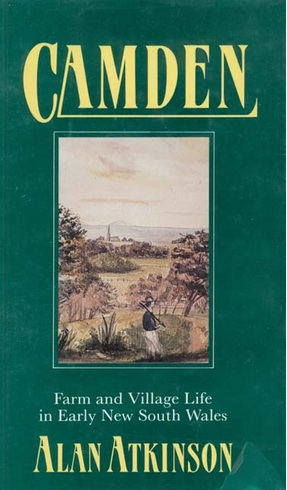
The ultimate authority on the foundation of Camden is historian Alan Atkinson. He titled his book Camden: Farm and Village Life in Early New South Wales, and Chapter 4 is titled ‘Village Life’. Atkinson writes
The Macarthurs hoped to see their village become a ‘large town’… (Atkinson, 43)
There are numerous references to the village of Camden throughout the book.
What is a village?
According to National Geographic, a village is a small settlement, usually in a rural area, with 500 to 2500 people. The village is often formed around a central point, e.g., a church, a marketplace or a public space. (Evers 2024)
These features characterised the private Camden village founded by the Macarthur brothers, James and William, in 1840. The village was at the northern entrance to their pastoral property, Camden Park, at the crossing of the Nepean River, as outlined by Alan Atkinson.
Village communities tend to be closed, inward-looking, characterised by traditional values and customs, including parochialism, paternalism, patriarchy, tight family and interpersonal networks, gender expectations, social ranking, and sectarianism, which generate trust and interdependence within the community.
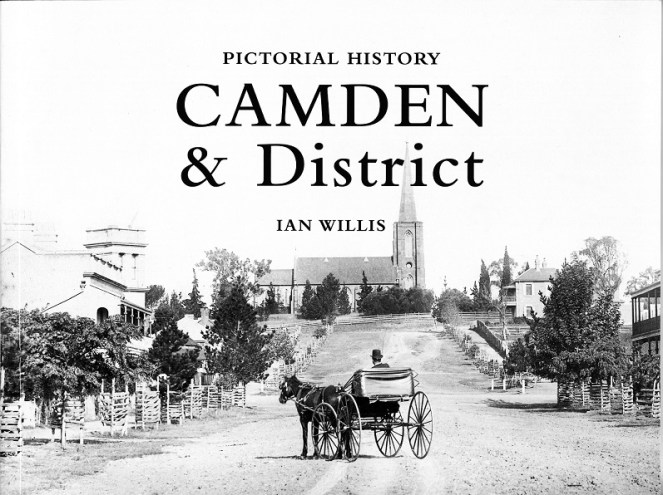
These features are typical of Camden until the 1950s, when the population began to grow as jobs were created by the Burragorang coalfields. (Willis, 2006, 2009)
Camden John Street towards church 2023 CC
Even by 2006, there was enough of the Old Camden around for Sydney architect Hector Abrahams to say that the local area’s cultural heritage makes the historic town of Camden the best-preserved country town on the Cumberland Plain (Camden Advertiser, 28 June 2006).
Over the last 25 years, Sydney’s rural-urban fringe has crept up to the fringes of the Camden township. Despite these incursions, the township has retained many identifiable features of its past (Willis 2012) and, in the process, added another layer of history to the Camden story.
Listing on the State Heritage Register
In 2023, the Camden Resident Action Group attempted to have the town centre listed on the State Heritage Register. In the submission, CRAG stated
Camden township is of state heritage significance as a rare example of a privately designed English-style rural village. (CRAG 2023)
CRAG sought support statements from notable historians.
According to historian Alan Atkinson, the sense of place was integral to the physical layout of the village designed by Surveyor-General Sir Thomas Mitchell in 1836. It ‘is still to some extent’ intact, and the township is ‘one of the best-preserved aspects’ of Mitchell’s planning. (Atkinson 2016)
According to historian Grace Karskens Camden ‘is not just a collection of historic buildings, but a living, working place with a strong sense of community and identity’. (Karskens 2016)
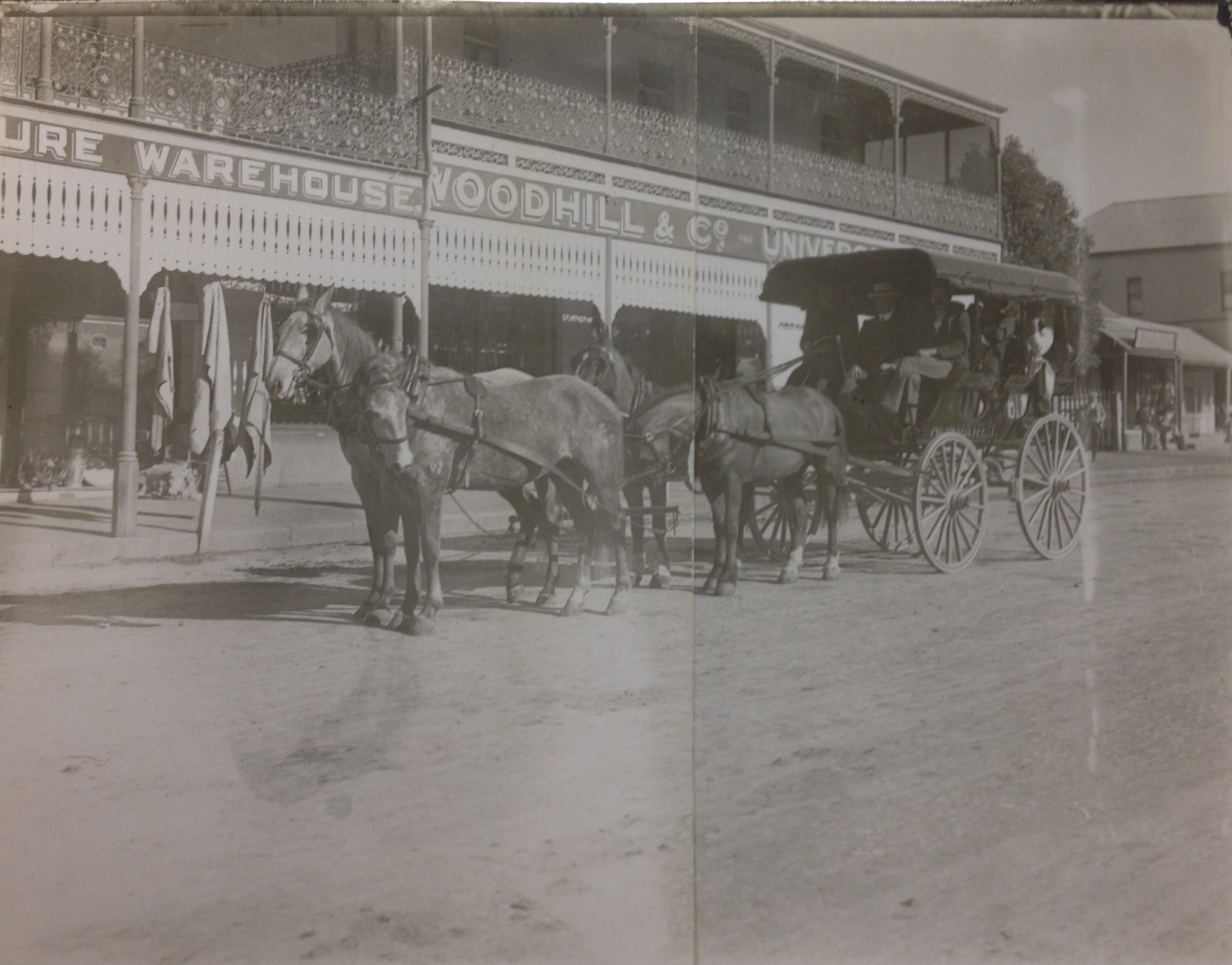
The Whiteman’s commercial building was leased by the Woodhill family as a general store for several years after Federation. A coach service like the one in the image operated a daily route between Camden and Yerranderie, departing from the corner of Argyle and John Street. (Camden Images)
According to historian Ian Willis
Since the Second World War the movement of Sydney’s rural-urban fringe across theCumberland Plain has absorbed a number of former country towns. ln recent years Sydney’surban sprawl has encroached on Camden’s fringe and threatened its sense of place. Theresponse of the Camden community, particularly in the last fifteen years, has been to defend itsrural heritage and the village like nature.
The Camden town centre is essentially unchanged in form and structure from its 19th centuryorigins as a privately developed village by the Macarthur family. Combined with Edwardian andlnter-war growth and infill the town centre has amazingly retained its integrity and ruralaesthetic, particularly given its location on the Nepean River floodplain.
Camden’s aesthetic was noted in publications as early the l88os, and re-enforced by touristjournalism of the lnter-war period which championed its Englishness and village nature. Thesecharacteristics, surprising to some, are still identifiable and have shaped the community’s sense of place and identity. (Willis 2016)
An urban village
In the past 25 years, as Sydney’s urban growth encroached on the Camden township, it has developed many of the features of an urban village, as defined by Jeannie Evers of National Geographic, where an urban village is a neighbourhood or enclave within a larger urban area. (Evers 2024)
According to sociologist Graham Crow, an urban village has a duality, or split personality, and this certainly applies to contemporary Camden, where a cosmopolitan urban setting coexists with traditional rural values. (Crow 2009)
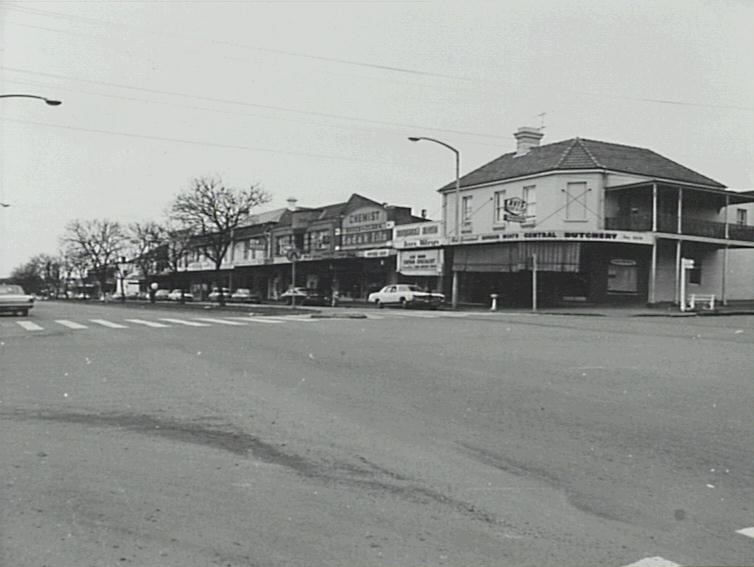
This image of Argyle Street shows 110 Argyle Street with Boardman’s Butchery at the corner of Argyle and John Street in 1973. The buildings are little changed from the 1930s. (LKernohan/CIPP)
Contemporary Camden has some of the features identified by Crow, who maintains that urban life is characterised as ‘dynamic, commercial, impersonal and transactional’, while rural life is ‘traditional, stable, and based around the family and the community’, and relies more on trust and networking.(Crow 2009)
Urban villagers appear to have one foot in the city and the other in the countryside, or one foot in modernity and the other in a past world. (Crow 2009)
Contemporary Camden has many features of the 19th-century village, including its morphology, built heritage, and cultural heritage and cultural memory.
‘Country charm close to Sydney’
The ‘Camden Village’ marketing strategy has successfully harnessed the rural-urban duality through the use of nostalgia, the sentimental longing for the past. (Psychology Staff, 2026).
Journalist Ben Lutkevich says nostalgia marketing is an effective tool because it links a product to past memories, establishing an emotional bond. The marketer will use symbols from the past, including images, icons, and other representations, to link the product to customers’ memories and shared experiences. Nostalgia marketing promises to return the customer to a happy time with fond memories. (Lutkevich 2023).
Storytelling can use nostalgia as an effective marketing strategy because it creates an emotional link between the product and its customers. (theAD (2024).
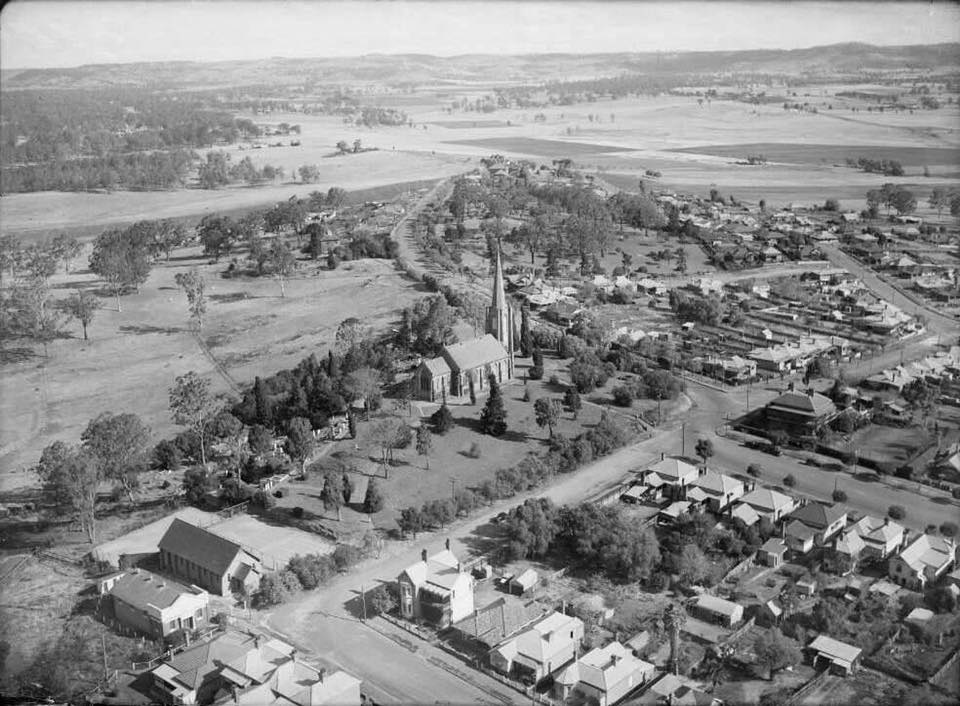
An aerial view of Camden township in 1940, taken by a plane that took off at Camden airfield. St John’s Church is at the centre of the image (Camden Images)
Part of this story is ‘Old Camden’s country charm’. So what is it?
Country charm, according to Amy Ballinger of her website Wattle and Twine, is about the alluring features of country areas and is hard to define unless you’ve experienced it. It is a slower life, closer to nature, where peace and tranquillity abound, allowing you to appreciate your surroundings. (Ballinger 2017).
In essence, it refers to the rustic, simple aesthetic associated with rural life and landscapes, often evoking feelings of warmth, comfort, and nostalgia.
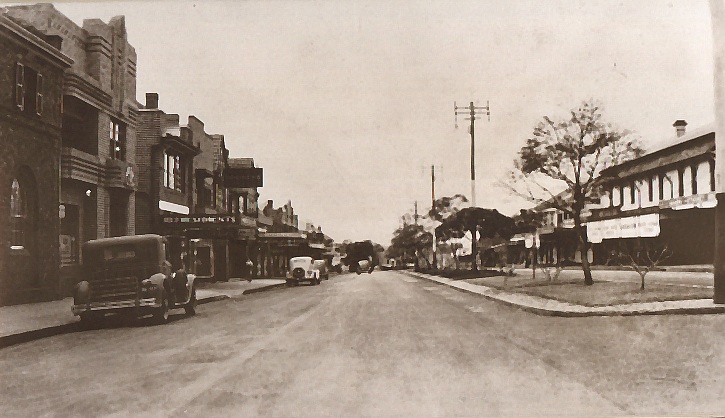
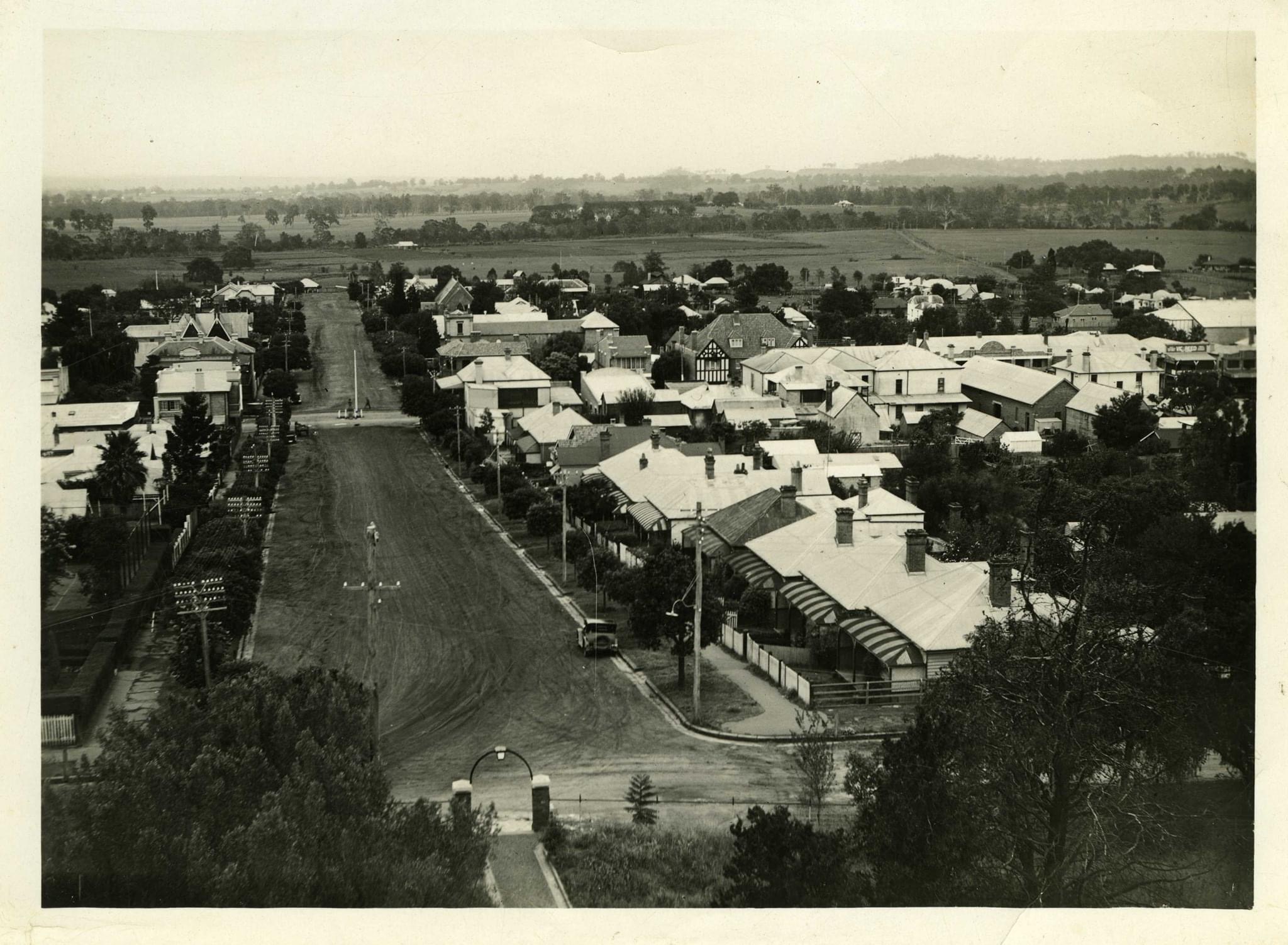
A view of John Street Camden from the steeple of St Johns Church on top of the hill in the town centre in 1937 (Camden Images)
Reflection – simpler times are an illusion
The notion of ‘Camden Village’ is a metaphor for ‘Old Camden’ and a perception by some that it was a simpler time with a rustic charm linked to farming and the landscape.
Catherine Talbot from the University of Illinois Chicago Radio writes
Romanticising the past can also be linked to the psychological need for continuity of identity. The past is where we first learned who we are, so we look back to make sense of ourselves in the present. By idealizing past experiences, we feel more grounded in our personal history and identity. It can provide a sense of continuity, even when the present feels unstable. Essentially, we hold onto past memories because they help us make sense of who we are and where we’ve come from.
Nostalgia is often a way of coping with current stress or dissatisfaction. When faced with the complexities and uncertainties of adulthood, we long for the comfort and simplicity of earlier stages of life. This feeling can be especially intense during periods of transition, like moving to a new city or reaching a point of personal growth where things feel overwhelming. Nostalgia offers a temporary escape from the challenges of the present, allowing us to feel a sense of stability and comfort. (Talbot 2025)
Psychotherapist Kamalyn Kaur argues
“It’s common for people to perceive the past as a simpler, better time, regardless of whether that perception is entirely accurate or not. This can happen when the brain forgets the challenges and complexities of the past, remembering and focusing only on the positives.” (Everett, 2024).
Historically, there were no simpler times. ‘Old Camden’ may have been a village with a smaller population, but life for its residents was complex and full of challenges. As it is for today’s residents. Life in ‘Old Camden’ was a struggle – high infant mortality, contagious disease, accidents, natural disasters, isolation, low levels of education, poverty, gender expectations, patriarchy, class and more. There were advantages of personal and family support networks, community support, social capital, community resilience, independence and self-help, and more.
An aerial view of Camden township during the 1974 flood event. The Nepean River is behind the town centre and flows from R-L. (SMH)
The past was another place. Nostalgia is a useful tool for transporting us back to an earlier time through memories, stories, music, and other media. Even if this is only in our imagination.
Interestingly, nostalgia was viewed differently in the past. Nostalgia was a notifiable mental illness related to melancholia. Coined by Swiss physician Johannes Hofer in 1688, nostalgia referred not to poetic yearning but to a diagnosable and potentially fatal condition known as homesickness. (Mussies 2025).
How things have changed. The present is shaped by the past, and the promoters of the ‘Camden Village’ are onto something. The ’Camden Village’ marketing team want to return their customers to the historic charm of ‘Old Camden’, with its old village country charm. Willis explores these concepts through his analysis of his ‘country town idyll’, which examines the rural-urban duality and Camden’s ‘old world country charm’. (Willis 2012)
The Camden Village marketing strategy appeals to nostalgia for ‘Old Camden’, even though it no longer exists and is merely an imagined construct. Yet, ‘Old Camden’ is still identifiable today in the ‘country-town idyll’ and the town’s morphology and built heritage.
2023 Camden Show promotion (Camden Show Society)
References
Atkinson, Alan 1988, Camden, Farm and Village Life in Early New South Wales. (Oxford University Press, Melbourne)
Atkinson, Alan 2016. Letter to Camden Residents Action Group. St Paul’s College, University of Sydney, Sydney, 13 April.
Willis, Ian. 2006, ‘The Gentry and the Village, Camden, NSW, 1800-1939’, AQ, Australian Quarterly, Vol. 78, Issue 4, July-August 2006, pp. 19-24. https://doi.org/10.2307/20638411
Willis, Ian, 2009 ‘Camden, The Interwar Heritage of a Country Town’. Spirit of Progress, Vol. 10, No. 3, pp. 13-15. https://doi.org/10.17613/sazt-y276