Memories of growing up in the 1930s
There are lots of exciting memories of Camden Airfield in the 1930s by local folk, especially little boys.
One of those little boys was Cec Smith.

The wonders of flight at Camden
He recalls with great excitement the airfield and everything about it. He notes, ‘As the son of a farmer, I was into anything that had an engine’.
Cec was a small boy whose family had only been in the district briefly. He was eleven years old.
The 1930s great adventure stories were ones of aviators and their aeroplanes.
Aviators were the British Empire’s heroes, like those written about in Rudyard Kipling’s Kim (1901) or EM Forster’s A Passage to India (1924). Or the real adventurers of the empire like TE Lawrence, of ‘Lawrence of Arabia’ fame.
Camden Airfield generated the stuff of a boy’s own adventure books. Aviators and aeroplanes were the dreams of all small boys in Camden.
Cec writes:
In 1936 it happened. Something different. A funny distant loaded, but relaxed, slow revving engine noise. But it was moving. Over that way. Couldn’t see anything. It was hidden by the house. When I got there, nothing. Even the sound was gone. Then within a few days that different distinctive noise again. Looking over to the northeast, could not see it. Then it appeared from my vantage point a mile or so away. It seemed to pop up out of the ground as it slowly emerged above the low ridge line running along this [Camden] side of the river.
Cec eventually found out who owned the aeroplane. It belonged to a local hero of the empire, or so it seemed to one small boy.
Air pageants at Macquarie Grove
Cec writes:
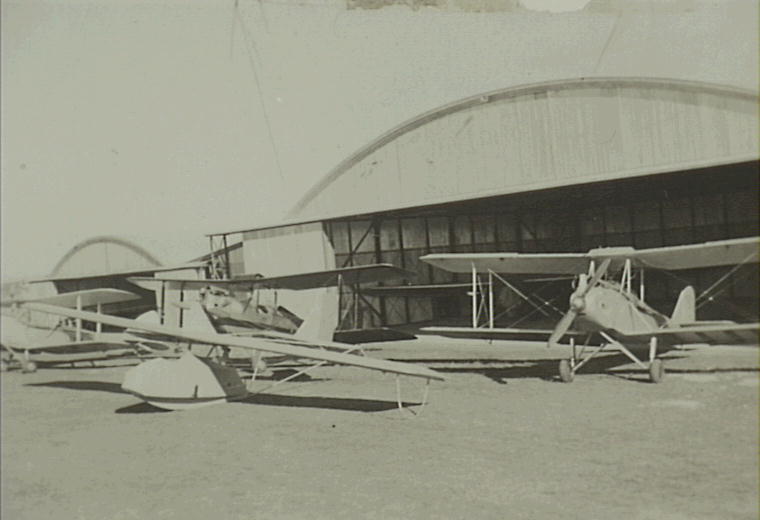
It was discovered that the plane belonged to Edward Macarthur Onslow, a local landholder. The plane was a DH.87A Hornet Moth (VH-UUW) and based on the property ‘Macquarie Grove’, where he lived. Older brother Denzil and younger brother Andrew were also qualified pilots. The brothers had taken the first steps toward developing a flying training and charter operation there, that pre-war was the Macquarie Grove Flying and Glider School Pty Ltd, and post-war became the Macquarie Grove Flying School Pty Ltd.
The flying school generated lots of excitement, especially the air pageants.
Cec recalls that the flying school put two air pageants on there in the late 1930s. The Macarthur Onslow brothers, along with local pilot/instructor Les Ray, who were the hands-on staff of the school, and other pilots, including Brian Monk (instructor from the Royal Aero Club of New South Wales)
He said,
‘all contributed to the success of what to us was a spectacular public event. This was all exciting stuff for myself and my school friends. It was a new dimension’.
Cec spent a lot of school time dreaming of flying and noted that ‘much of the flying activities were visible from the school’.

Parachute practice
He recalls that in 1937 he was intrigued to learn that parachute practice was taking place on the airfield.
He recalls that a movie called ‘Gone to the Dogs’ had a flying scene made at the airfield where a greyhound was to be delivered by parachute to a racing track.
Cec assures me that the ‘dogs’ he saw dropped by the parachute were ‘dummies’.
Everything about the airfield was pretty basic in those days.
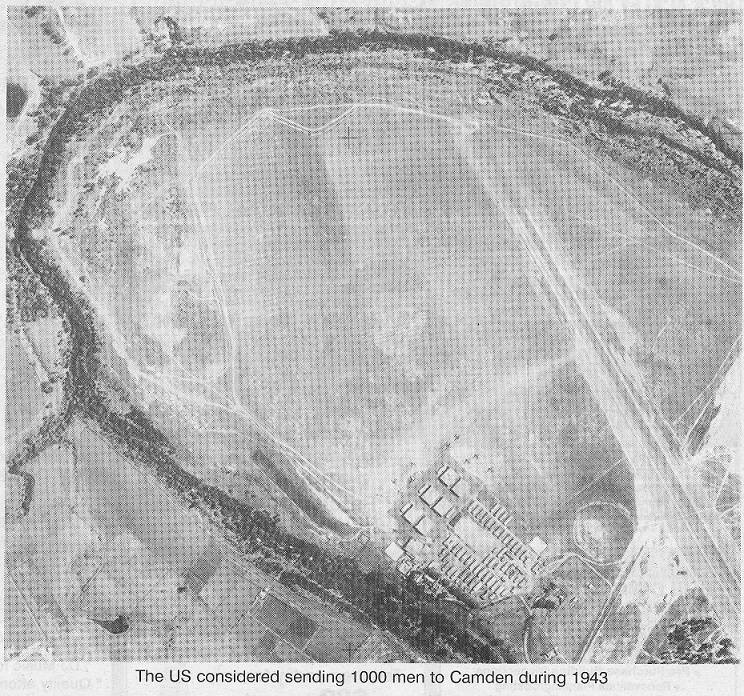
Cec, who gained his pilot’s licence after the war, recalls that the airfield was ‘an open grazing paddock cleared of most trees and shrubbery, but a fringe of trees remained on three sides of the field, adjacent to the river’.
In Cec’s view, the trees
‘did not represent a hazard except in the event of a seriously misjudged approach… having regard to the operational requirements of the aircraft of the day. The surface was the usual farm type grasses sometimes grazed by cattle’.
Schooling in the bush
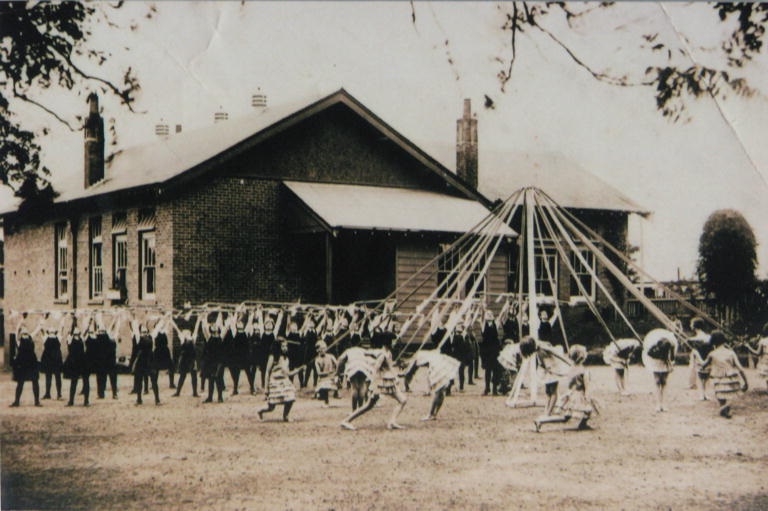
Cec attended the one-teacher school at Theresa Park Public School from 1933-1934, where he was in a composite class. The Department of Education at the time paid for the teacher and supplied books and equipment. It was quite common for parents to meet any extra costs.
Cec recalls that the school had 12 pupils. His first teacher was Mr White, and later Mr Monday. Cec rode a horse to school bare-back ‘behind a neighbour’s son’, who owned the horse, despite his family owning a saddle. He maintains that the teachers had good control of the class and, for their part, the pupils were ‘attentive’, although there were occasions ‘when some of us were disruptive’. Theresa Park Public School eventually closed in 1958.
Getting an education in town
After Cec finished with Theresa Park Public School, he travelled to Camden Public School in late 1934. Cec says that on the whole, he enjoyed school, although he was ‘only a mediocre pupil but could with some effort get into the top three’. Cec’s classes were quite small. He was a good attender and received a book prize for not missing a day in two years.
Cec notes that the other pupils at the school came from a mixture of backgrounds, including 5-6 boys who came from the boy’s home. These boys, he remembers, came to school in bare feet, and the lunches were ‘slices of stale bread spread with dripping, wrapped in newspaper and brought together collectively in a sugar bag’.
In 1940 Cec was a student in the secondary department when he finished his Intermediate Certificate. The results were published in the Sydney Morning Herald in January 1941. Cec scored a ‘B’ in Geography, Mathematics II, Business Principles, Technical Drawing, Woodwork, Music, and Agricultural Botany. Other local youths who finished with Cec were J Hayter, Elaine McEwan, John Porter, and Frederick Strahey.
Cec recalls that the headmaster at that time was Neville Holder. Holder was the school’s principal between 1937 and 1940, and Cec found him to be a good teacher and felt that he did many ‘good deeds as a person and teacher’ while at the school. Camden Public School became a central school in 1944 and reverted to a public school in 1956 when Camden High School opened on John Street.
Cec sometimes had to wait at the milk depot at the end of Argyle Street, near the railway station, for a lift home after school. His father and brother would deliver the milk from the farm at the depot twice a day.
Cec feels that:
despite all the negatives of those days… we received a good basic education across a range of subjects all for free. All that we had to do was be there. In most cases transport only cost the price of a bicycle and the physical effort of riding it… and the cost of a few books, pens and pencils.
Getting a job
During these days, Cec did temporary work at Camden Post Office for three weeks in 1938 when he was 14 years old and in 1940 for six weeks.
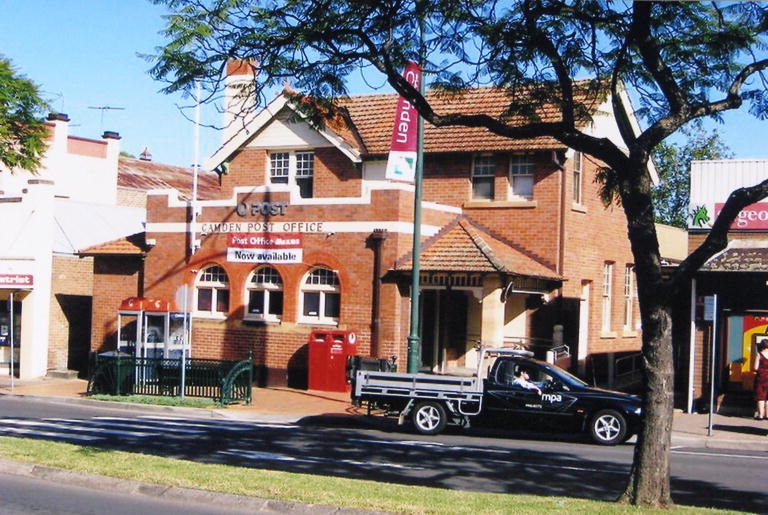
One of his jobs in 1940 was to cycle out to the Eastern Command Training School at Studley Park each week to change over the public telephone coin tins. As Cec recalls, they were officially called ‘coin receptacles’. He recalls that:
While I was there I had to make a test call back to the post office. The public phone at the airfield had not been installed at that stage of the war. The only mail contractor at the post office had the run which started at Camden, went out to Glenmore, The Oaks, Oakdale and Nattai River in the Burragorang Valley and then on to Yerrandarie Post Office.
Eventually, Cec started work in Sydney in 1941 while his family continued dairying for the next 11 years.
The war eventually caught up with the family, and Cec’s brother joined in 1940 and ‘my turn came in 1943’. He recalls that ‘for our generation much happened in the relatively short period between 1940-1945’.
Updated on 18 August 2023. Originally posted on 8 April 2017 as ‘Bare feet and the adventures of flight, memories of growing up in 1930s Camden’
Discover more from Camden History Notes
Subscribe to get the latest posts sent to your email.

