A little black dress at the hospital ball
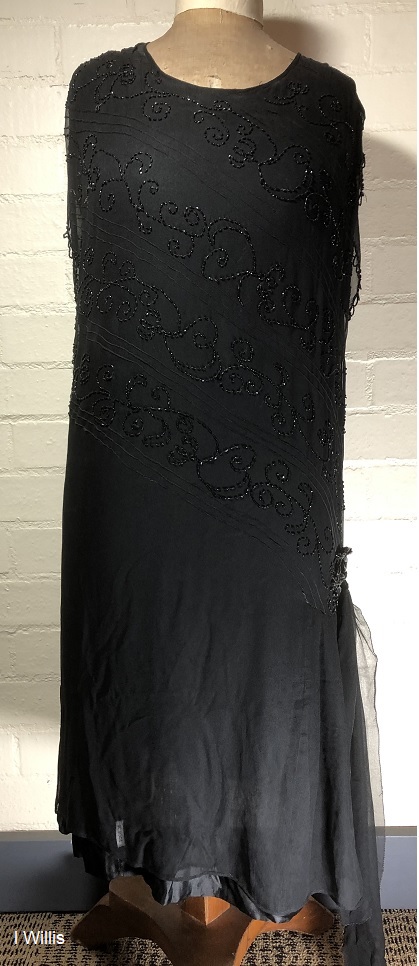
This little black dress dating from the 1920s is an attractive item from the Camden Museum dress collection.
The 1920s was a period of cultural change after the First World War destroyed the old European orders, and women discovered a new sense of freedom.
The 1920s were part of the age of modernity with jazz, the bob, and the flapper. It was a time of modern industrial design, movies and consumerism. Being ‘chic’ was made popular in Anita Loos’s book Gentlemen Prefer Blondes (1925).
Modernity expressed itself in Camden with the wireless, telephone, telegraph, motor car, newspapers, railway, refrigeration, electricity, electric light, gas, sewerage, reticulated water. All these developments came down the Great South Road (in 1923, the Hume Highway) on the way to Melbourne.
Everyone went to the movies and watched the world presented on screen. Hollywood and fashion marketing gained attention, and The Clamour Daze blogger says that
The rise of consumerism promoted the ideals of fulfillment and freedom.
The provenance of the little black dress
The little black dress illustrates the fashion style of the time and was owned by Mrs Mary Wilson, the maternal grandmother of the donor, Mrs Winifred Stuckey. Mrs Stuckey was the daughter of the Camden Methodist minister, and married into the Stuckey family of bakers. The Stuckey brothers ran a bakery in Argyle Street, Camden, for many years. Their story has been told in Frank Stuckey’s Our daily bread: the story of Stuckey Bros, bakers and pastrycooks of Camden, NSW, 1912-1960. (1968)
The little black dress is a cocktail outfit and dates from the mid-to-late 1920s and drew its inspiration from the styles of the period, including the chemise and flapper designs.
The Clamour Daze blogger says of the chemise dress style:
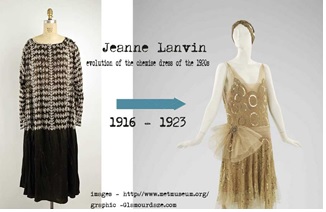
First appearing as an outerwear item in 1916 from designers such as Jeanne Lanvin , Callot Seours and Coco Chanel. By 1920, the chemise or shift dress, was to become the dominant line for day and evening wear. The dress hung from shoulder to just below the knee. Waists dropped to the hips. Back in the 1910’s, loose belts had often been worn over middy blouses and chemise dresses. It is quite possible the drop waist evolved from that style.
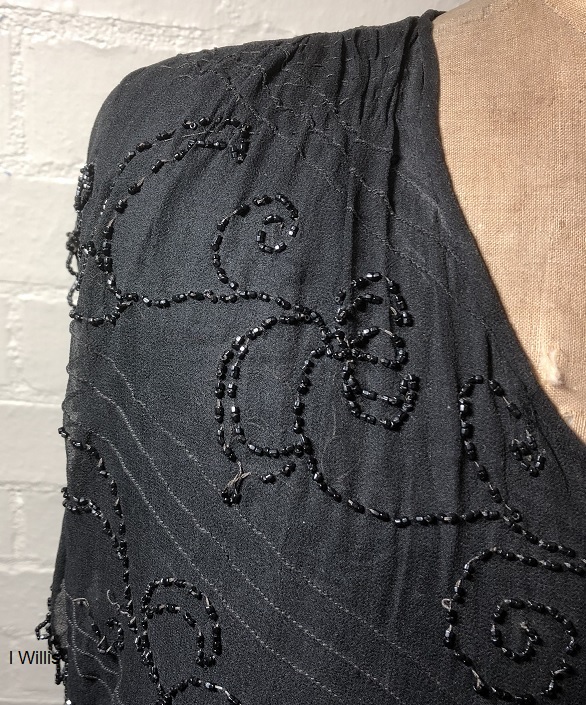
Mrs Wilson’s little black dress is black georgette with black glass or jet hand-beading on the front and back.
Georgette (from crêpe Georgette) is a sheer, lightweight, dull-finished crêpe fabric named after the early 20th century French dressmaker Georgette de la Plante. Originally made from silk, Georgette is made with highly twisted yarns. (Wikipedia)
The Vintage Dancer blog says that:
Solid colors were preferred over prints for most of the 20s. A solid color showed off beads, embroidery and ribbon decorations better than patterns.
The Clamour Daze blogger says:
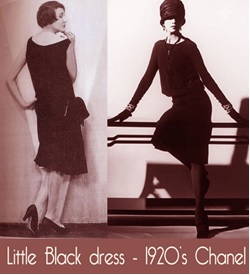
Published in Vogue on October 1st 1926 and immediately dubbed the ‘Ford Dress’ by Vogues editor – a suggestion that it would become as popular as the Ford car. Its flattering silhouette suited just about any shape of a woman and it heralded a new Parisian ‘economy style’ or ‘poverty de luxe‘ as Chanel herself described it; an expensive interpretation of a simple design made of modest materials.
Mrs Wilson’s dress has a rosette on the left hip and a sash from the lower hip on one side. There are handmade tucks with machine stitching, and the dress is cut on the bias.
The 1926 Camden District Hospital Ball
The Camden Museum’s little black dress was the type of fashion Camden women wore to the biggest social event of the year in 1926 – the Camden District Hospital Ball, attended by 750 people and held at the Camden AH&I Hall. Today’s budding fashion historians are fortunate that the local press described the dress worn by every woman at the ball.

Popular dresses at the ball included those made of georgette, velvet, satin, crepe-de-chenille, moracain and mousseline. Colours varied from peach to white, apricot and black, with many featuring beading.
Those listed that were similar to the Camden Museum’s little black dress included one worn by Mrs RC Stuckey, described as beaded marocain. Mrs S Rae wore a black crepe-de-chenille dress with silver trimmings, while Miss D Holz wore a heavily beaded black Moroccan dress. Miss L Hemmens wore a black chenille georgette dress, while Miss Gladys Rae wore a black georgette dress with bead trimming, and Miss Willmington wore a black georgette outfit.
So was the Camden Museum’s little black dress worn at the 1926 Camden District Hospital Ball? No one will really know, but it’s exciting to speculate.
Check out the Camden Museum’s little black dress upstairs in the entertainment display section or on Instagram in the outfit of the day https://www.instagram.com/p/ByMGiF3BYfk/.
Things to note about Mrs Wilson’s little black dress
There is a tear on one cape sleeve. The dress may have been lengthened, as the hem has been added. Mrs Winifred Stuckey donated the dress to the Camden Museum in 2003. (Object Record Camden Museum)
Conclusion
The little black dress from the 1920s, exhibited at Camden Museum, represents the era’s fashion evolution and women’s newfound freedom post-war. Owned by Mrs Mary Wilson, it features elegant georgette fabric and intricate beading. While it’s uncertain if it was worn at the 1926 Camden District Hospital Ball, its design captures the period’s chic aesthetic.
AI Disclaimer
AI was used to assist in auto-correcting grammar.
Updated 6 September 2026. Originally published on 7 July 2019 as ‘A little black ball dress’
Discover more from Camden History Notes
Subscribe to get the latest posts sent to your email.

