
Butter Making at Camden
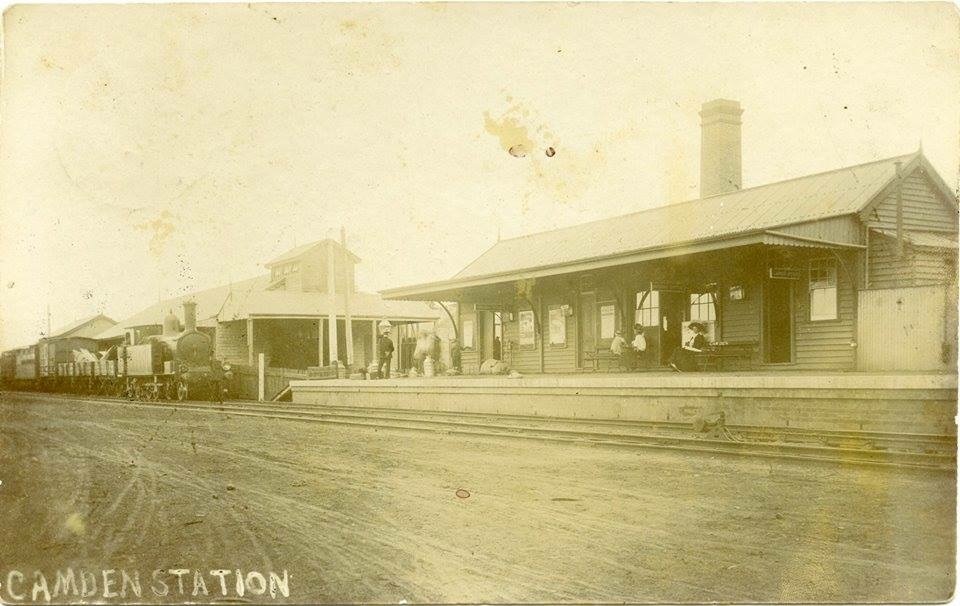
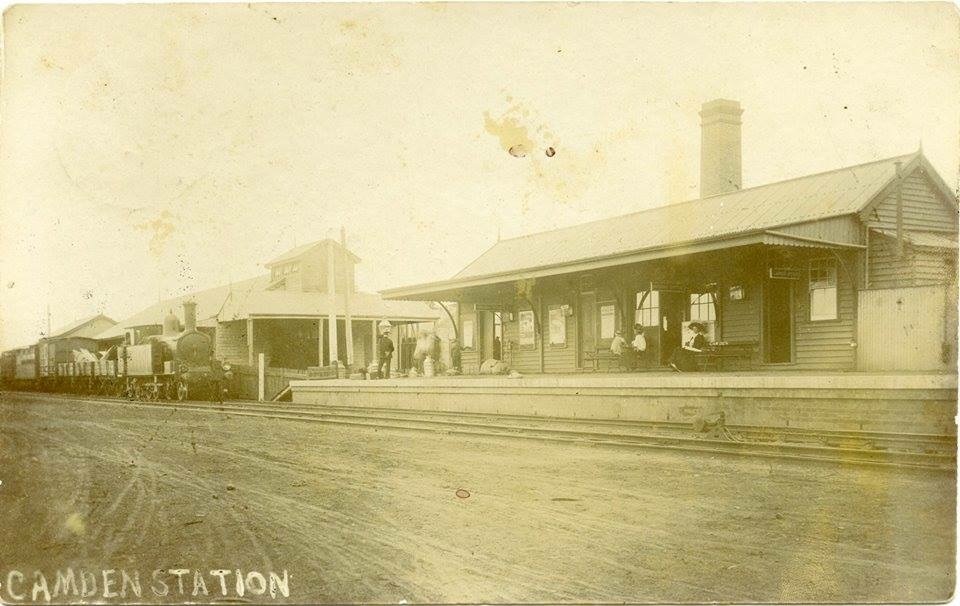
In the mid-1890s, Camden was a small market town of around 400 on the Great South Road, 43 miles southwest of Sydney, at the end of the light rail branch line from Campbelltown. At the crossing of the Nepean River, the area was the centre of a dairy region from the Burragorang Valley west to Menangle in the east, along the Main Southern Railway Line. The principals of Camden Park Estate, the largest dairy property in the area, decided to construct a butter-making, bacon-curing, and ice-making plant next to Camden Railway Station, which was the epitome of innovation and agricultural modernism. It lasted two years. So, what happened?
The 1890s were a period of growth and structural change in the New South Wales dairy industry. There was the rise of the cooperative movement with improved product consistency, processing scale and market reach; the emergence of large-scale share farming systems, for example, Camden Park Estate with increasing herd sizes; land clearing increases in whole milk and cream output, increasing exports of butter to Great Britain with improvements in refrigeration; and the introduction of innovation with the spread of creameries and separator technology.
Camden Park Estate contributed to this growth, with increasing sales of butter, cream, and whole milk in the Sydney market. The estate started exporting its premium ‘Laurel’ branded butter to Great Britain and succeeded at exhibiting at British trade shows.
The estate had supplied whole milk through its Sydney agent, Mort’s Fresh Food and Ice Company, but was constrained by supply quotas, seasonal production issues, and milk contamination. By the late 1880s, the estate’s butter sales rivalled those from whole milk, with the estate sending cream to Sydney for processing into butter through Mort’s Fresh Food and Ice Company.
By the mid-1890s, the principals at Camden Park Estate decided to take matters into their own hands and build a butter manufacturing facility next to Camden Railway Station. The new works would give the estate greater control over its supply chain and accelerate its move toward vertical integration of its dairy operations.
The new works included butter-making, bacon-curing, and ice works, ensuring the estate remained at the forefront of 19th-century agricultural modernism. The new facility centralised the estate’s butter-making, and the plant generated Camden’s first electricity and was the town’s first freezing works.
Ice manufacture in Sydney
The origins of the Camden freezing works, as it became known by 1913, lay in the development of ice manufacturing in Sydney in the 1860s, which was linked to chilling beer and exporting meat. Before this, Sydney imported natural ice from Boston in the 1840s. (Isaacs 2011)
In the Australian colonies, Scottish-Victorian inventor James Harrison improved an 1830s British invention for vapour-compression refrigeration, installed a prototype at a Bendigo brewery in 1851, and then sold ice-making machines in Melbourne, Bendigo, Adelaide and Sydney. By the end of the 1850s, the Australian colonies were exporting ice. In 1860, Harrison formed the Sydney Ice Company and began supplying ice commercially in Sydney; meanwhile, French-born engineer Eugene Nicolle was working on improving Harrison’s system. (Isaacs 2011)
According to food historian Jan O’Connell, Sydney industrialist Thomas Mort could see the advantages of commercial ice-making in Sydney and the associated freezing works for his meat and dairy operations. (O’Connell 2023) Mort invested £100,000 in the New South Wales Fresh Food and Ice Company, formerly the Sydney Ice Company, and financed Nicolle’s experiments to liquefy ammonia as a refrigerant. (Donnelly 2017)
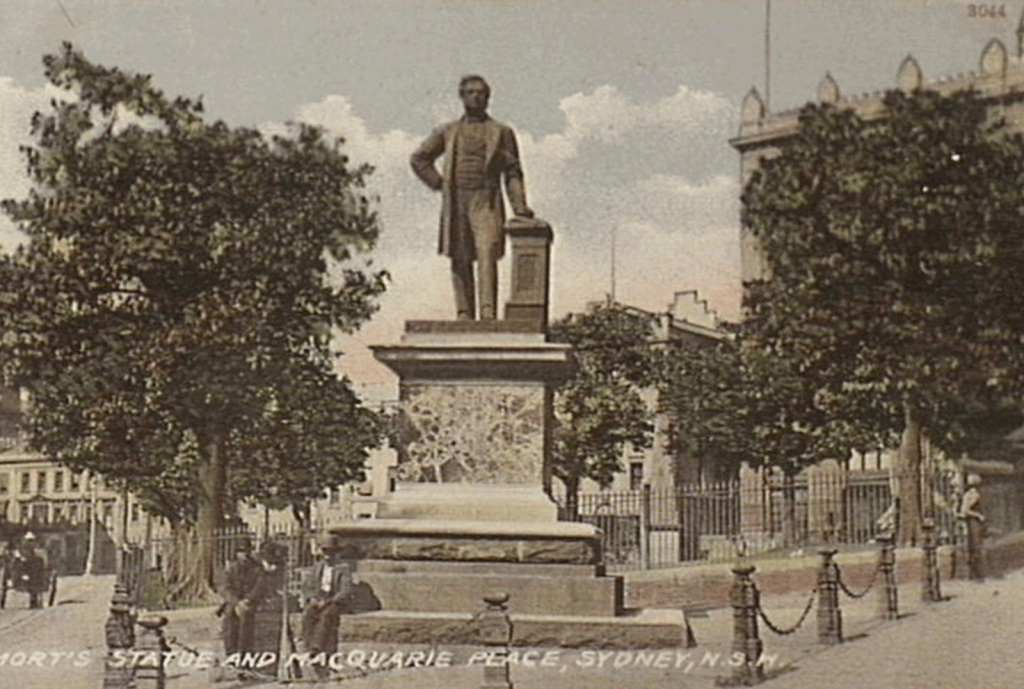
In 1875, Mort’s New South Wales Fresh Food and Ice Company established cold stores in Darling Harbour, and operated abattoirs near Lithgow, held dairying interests in the Southern Highlands, and owned refrigerated railway wagons for meat and milk. (O’Connell 2023) (Barnard 1974) According to Walsh, the Darling Harbour facilities received fresh, refrigerated milk from Berrima and Moss Vale by rail. (Walsh 2016)
From 1878, Camden Park sold milk through Mort’s Fresh Food and Ice Company, in addition to sales of its famous butter and cheese. Camden Park sent milk in cans from Menangle Railway Station to Darling Harbour with extra pick-up from Picton Railway Station when demand required. Camden Park was limited to delivering 100 gallons per day, and in the early 1880s contamination issues arose until it implemented a strict testing regime. From the late 1870s to the mid-1880s, whole milk was the estate’s main source of income. By the late 1880s, butter income was generally on par with whole-milk income. In the early 1890s, the estate sent cream to Sydney for processing into butter. (Walsh 2016: 19)
Camden Refrigerating, Butter Making and Bacon Curing Works
Camden Park Estate announced in June 1895 that it would construct a butter processing works next to Camden Railway Station. The Camden News made the plans and specifications available for public inspection at its offices. (Camden News, 20 June 1895)
The Camden press waxed lyrical about the works just before they opened in April 1896, claiming it was Australia’s most modern-equipped factory. At the same time, Mort’s Fresh Food and Ice Company opened a similar facility at Grafton in early May. The Governor of New South Wales, Lord Hampden, opened the Grafton works, which cost £ 11,000. (Sydney Morning Herald, Friday 1 May 1896, 5) Similar works were to be built in Ulladulla in 1896. (Ulladulla and Milton Times, 2 May 1896, 1)
The Camden processing works aimed to produce four tons of butter daily, with 50 tons storable on site. It was planned to take all the cream from the estate and local farmers, and to store meat. (Ulladulla & Milton Times, 6 April 1895; Evening News, 18 April 1895)
Work proceeded, and an eight-ton boiler arrived from Sydney by horse-drawn wagon in August 1895 (Camden News, 22 August 1895), and in November eight tons of refrigeration equipment was brought in by horse and cart and installed on site. (Camden News, 28 November 1895)
The works opened to the public in April 1896 (Camden News, 16 April 1896). The country and city press covered the works’ opening. (Ulladulla and Milton Times, 2 May 1896, 1; Week (Brisbane) 29 May 1896, 3)
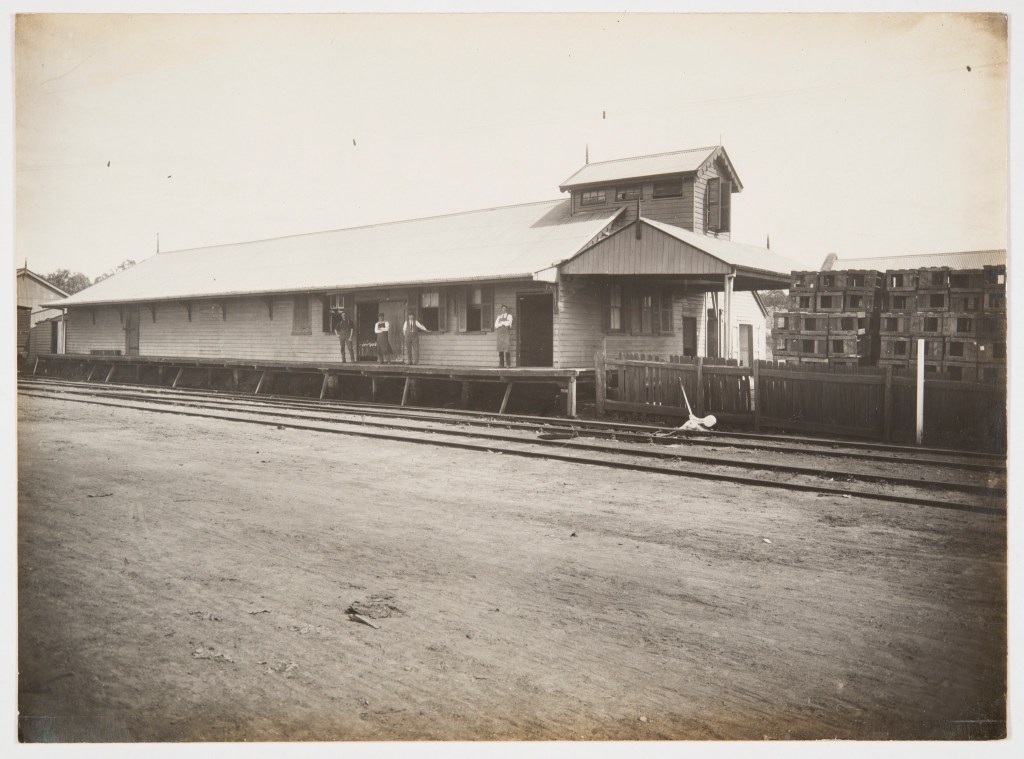
According to CHS Research Office Dianne Matterson, the processing works had frontages at the railway station and at 40-42 Elizabeth Street. (Matterson 2016) Local builder JD Rankin constructed the works, and Sydney consulting engineer WW Crawford designed the plant. (Camden News, 9 April 1896, 1) Cross’s brickyards in Edward Street supplied 50,000 bricks. (Matterson 2026)
According to the Australian Town and Country Journal, the Camden refrigeration works was one of the most modern in Australia. The works included a butter hall, a butter store with a capacity of 50 tons, a pork curing room, a cold store, a bacon drying room, and an overhead railway for handling goods. A brick smokehouse stood some distance from the main complex. (Australian Town and Country Journal, 9 May 1896, p20) In the butter hall, workers churned cream into butter, packed it into 56lb butter boxes, and chilled it before railing it to the Sydney market and for export. (Walsh 2016: 42)
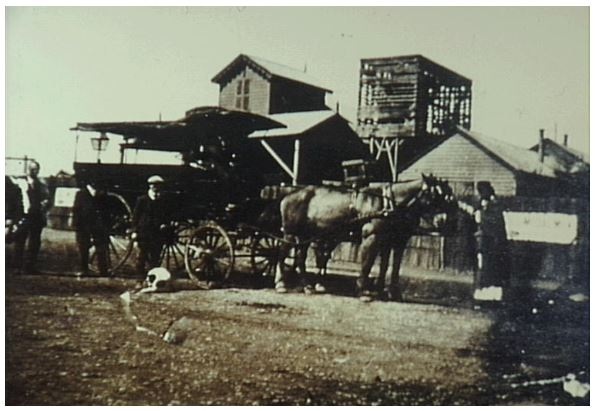
Not everyone supported the construction project, and an unknown ‘vandal’ demolished eight brick piers during construction. (Camden News, 1 August 1895) At Camden Municipal Council, equivocation and dithering by the male aldermen meant the town lost access to electricity from the new butter manufacturing plant. The new butter works generated electricity as part of its operations and could supply the town’s 200 premises, a fact clearly understood by local businessmen and community members. (Camden News, 9 April 1896, 1) In the end, Camden Council wrangling decided the matter. Astley Onslow Thompson, project and estate manager, decided against connecting the town to the plant electricity, despite a deputation of local tradesmen approaching him. (Camden News, 23 January 1896)
The estate had issues drawing water from the Nepean River during operations because low water levels were caused by the ‘Federation Drought’ (1895-1903). (Camden News, 19 September 1895)
The estate principals, including Astley Onslow Thompson, were always at the forefront of innovation and connected the Camden works by telephone to Cawdor and Menangle creameries. Camden township was not connected to the telephone until 1910, unlike Sydney, which had its first telephone exchange at the Sydney GPO in 1881.
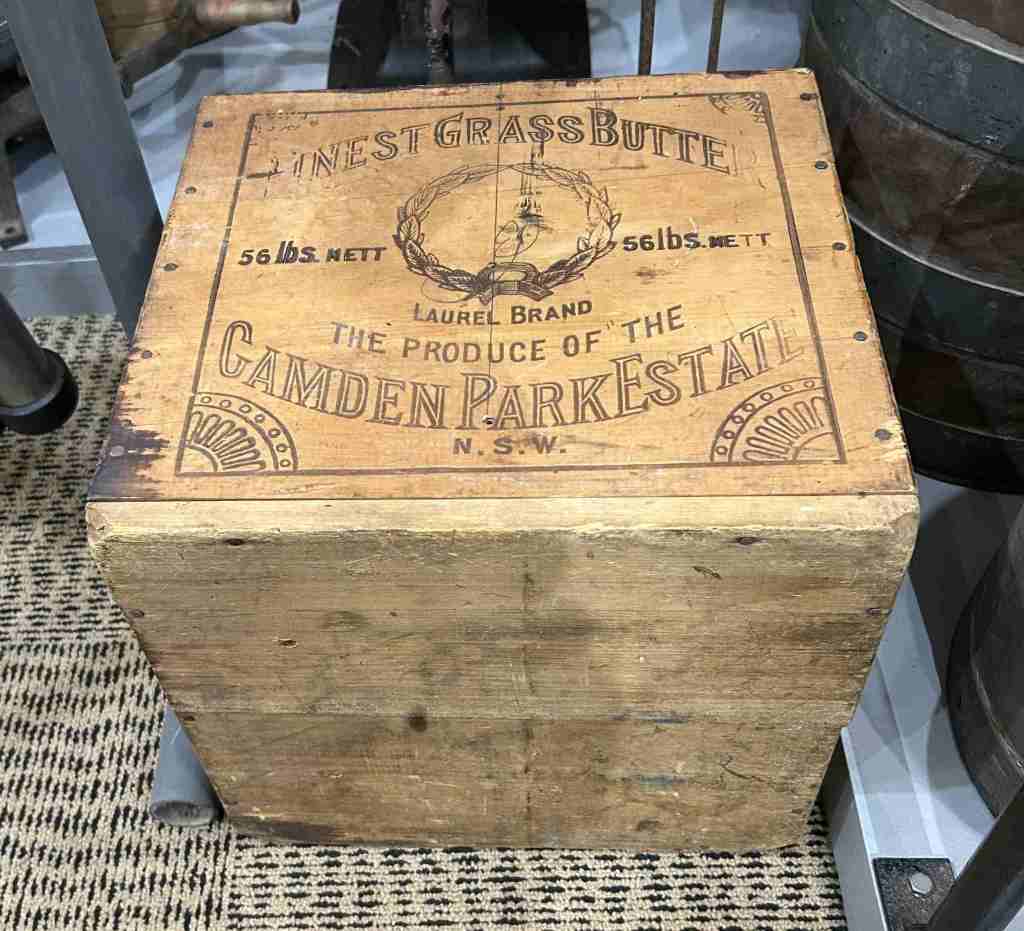
The Camden press reported that the estate’s ‘Laurel’ brand was well renowned in Australia and Great Britain and generated good returns for Camden Park because of its high quality, enabling premium pricing. (Camden News, 9 April 1896) In August, ‘Laurel’ brand butter was exhibited in the Islington Dairy Show in London and was judged to be of ‘superior quality’. (Evening News (Syd), 15 October 1896)
For a short period in late 1896, the works made ice available to townsfolk for 8d. for a 10-pound block to 2s. 4d. for a 50-pound block. It stopped after two months because demand was low. (Camden News, 15 October 1896; 29 October 1896, 3 October 1896)
The Camden works boosted the Camden economy, which was based on dairying. Local farmers could deliver cream and pig carcasses to the local works. (Camden News, 9 April 1896, p1)
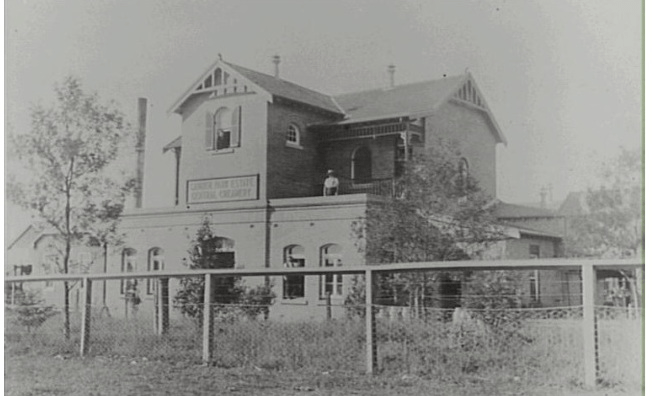
The butter and freezing works came to a sudden halt in February 1898 after two years of operation, due to flooding. The Camden News reported that the works had ‘many feet of water in the building and much damage to the extensive plant is anticipated’. (Camden News, 18 February 1898, 1) The estate transferred all operations to new facilities at Menangle Central Creamery, which opened in September 1898. (Walsh 2016: 42) The new works were on the heavy rail of the Main South Line and overcame the transport issues of the light Camden tramway. (Matterson 2026)
After Camden Park abandoned the Camden site in 1898, the electricity generators apparently remained on the site, and in 1929 Camden Lighting Company signed a contract with Camden to supply the town with electricity from the former freezing works. This continued until 1931, when the council purchased Camden Lighting Company, joined the bulk supply of power from Port Kembla when the Burragorang Valley coalmines connected to the grid, and demolished the former freezing works building. (Matterson 2026)
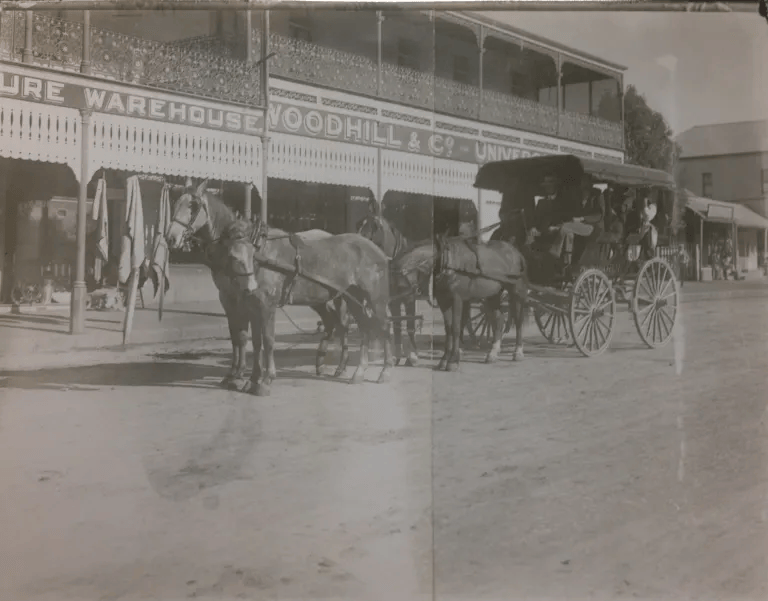
According to Dianne Matterson, once Camden Park left the site, it became mixed-use. In 1904, Woodhill & Co, of 50-100 Argyle Street, operated out of the former freezing works until they rebuilt their store. Woodhill & Co leased the Whiteman’s building from 1903 to 1906.
The Yerranderie Silver Mining Company owned the site around 1911. The former works were renamed the Camden Freezing Works and were operated successfully as a freezing works for rabbits from 1913 to 1921. In 1914, he was supplying around 1500 from Camden, along with his other sites at Orange and Mittagong. Walter Dunk followed in 1923 and operated a blacksmith shop there. (Matterson 2026)
Conclusion
The Camden Refrigerating, Butter-making and Bacon-curing Works exemplified agricultural modernism in the 1890s. The manufacturing facility was a cutting-edge industrial development for a small rural village that was centred on the local dairy industry.
The freezing works illustrated how Camden was part of the British Empire’s global supply chain and how innovations from the other side of the world eventually affected the small community.
The principals at Camden Park Estate innovated in dairying production across the business, and the freezing works marked another step toward the estate’s eventual vertically integrated supply chain in the early 20th century.
Camden townsmen missed an opportunity to electrify the town in the mid-1890s through small-mindedness and short-sightedness. This reflected that not all town residents welcomed the freezing works, and that some resented the Macarthur family’s power and authority over the market town’s daily life.
In the end, the Camden venture of Camden Park Estate was short-lived. The river shaped the future of the works: firstly, water supply from the Nepean River was difficult during the Federation Drought, and then the 1898 flood forced the estate to move its butter manufacturing to Menangle.
References
Barnard, Alan 1974/2006. ‘Mort, Thomas Sutcliffe (1816–1878)’, Australian Dictionary of Biography, National Centre of Biography, Australian National University, https://adb.anu.edu.au/biography/mort-thomas-sutcliffe-4258/text6777, published first in hardcopy 1974/online 2006. Accessed online 12/10/26.
Donnelly, Marea 2017. Thomas Mort’s picnic train to Lithgow was first step in frozen food trade. History Today, The Daily Telegraph, 9 September. Online at https://www.dailytelegraph.com.au/news/today-in-history/thomas-morts-picnic-train-to-lithgow-was-first-step-in-frozen-food-trade/news-story/75ba5dca24646a4faf1db374bfcd5d79 Accessed 12/10/26
Isaacs, Nigel, 2011. Sydney’s first ice. Dictionary of Sydney, 2011, Online at https://dictionaryofsydney.org/entry/sydneys_first_ice Accessed12/10/26
Matterson, Dianne 2026. Timeline: 15-21 Argyle Street, McDonald’s, Camden Machinery & Tractors, D. & R. Stockfeeds. Typescript. Camden Historical Society, Camden.
O’Connell, J. 2023, 1875 New South Wales Fresh Food & Ice Co. formed. Australian Food Timeline, October 9). https://australianfoodtimeline.com.au/fresh-food-ice-co/ Accessed 12/10/26
Walsh, Brian 2016. Milk and the Macarthurs, the dairy history of Camden Park. Belgenny Farm Trust, Camden.
Acknowledgement
I would like to thank the Camden Historical Society Research Officer, Dianne Matters, for assistance with sources for this blog post.
AI Disclaimer
Generative AI was used to construct this post by creating concept summaries and providing supporting evidentiary websites, and auto-correction (Grammarly) was used during proofing.
Discover more from Camden History Notes
Subscribe to get the latest posts sent to your email.

