Sydney’s oldest park
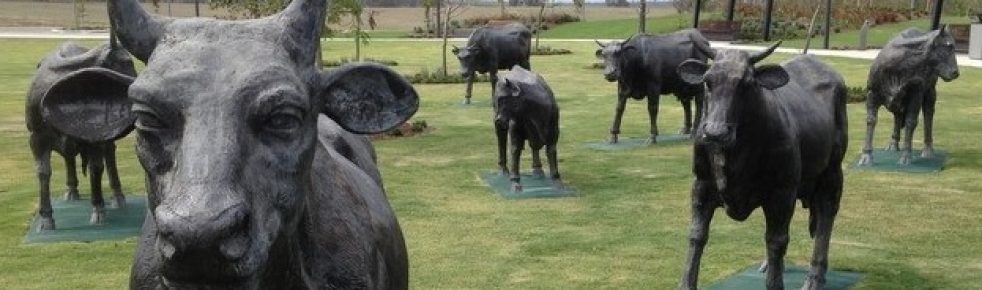
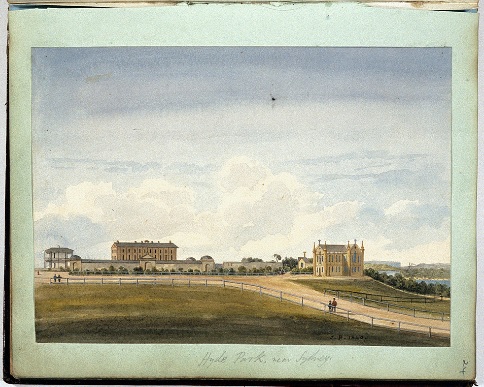
Hyde Park is Sydney’s and Australia’s oldest urban park. The park covers 40 acres (16.2 hectares) and has been known as the Sydney Common, Government Domain, The Common, The Exercising Ground, the Cricket Ground, and the Racecourse. Thousands of people use the park daily for relaxation, recreation, cultural and community events, including protests, and access to public transport. The park is a place for promenading, is one of the green lungs of Sydney, and has several monuments and memorials.
Sydney’s Hyde Park is named after its London namesake. London’s Hyde Park was originally a royal hunting ground and opened to the public as early as the 1600s. The park was named after its London namesake, which was formerly a possession of Westminster Abbey and seized by Henry VIII in 1536 as a hunting reserve. The park’s first coherent landscape design began in 1726, when they formed Lake Serpentine by damming the Westbourne River. The result was an idyllic, domesticated landscape, a piece of the English countryside in London. (The Origin of the Urban Park. The Commodification of Nature, 2020)
Sydney’s Hyde Park, with its beautiful avenue of trees that enchants visitors, is a product of the Interwar period. The City of Sydney engineer Norman Weekes won a design competition for a park upgrade in 1926. According to historian Anne-Maree Whitaker, Weekes was influenced by the City Beautiful movement, although the assessment committee altered his design.
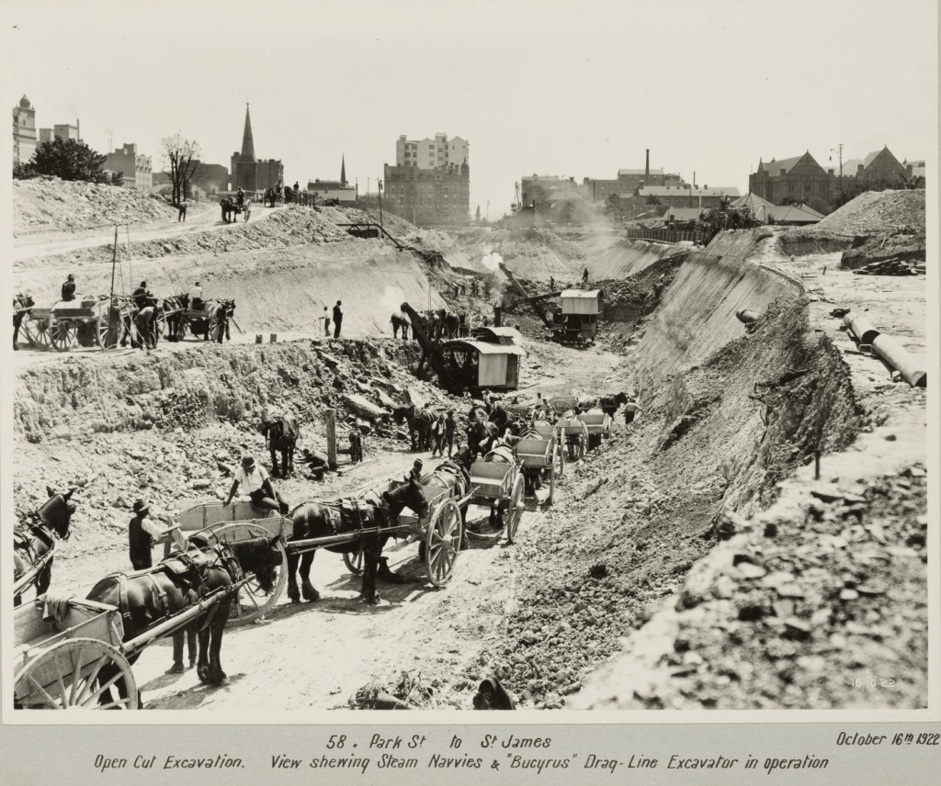
During the Interwar peiod, most of the park had been dug up for the construction of the City Circle Railway Stations of St James and Museum. Clearing started in 1919, with park reconstruction in 1926. The construction used a cut-and-cover method, meaning most of the park’s western side was a long trench running parallel to Elizabeth Street. The project dragged on longer than planned and forced the government to act, leading to the design competition won by Weekes.
The Weekes’ Scheme, according to Ian Innes
followed formal Beaux Arts compositional principles with its central allee, short cross avenues, sunken parkway at Park Street and radiating pathways. At the time, the ‘City Beautiful’ movement was also influencing the design of civic infrastructure, and this is evident in the fine sandstone walls, flights of steps, light fittings and fountains through the park.
The Weekes’ design emphasised expanses of open lawn ‘for health and recreation’ with a preference for large native trees like figs, flame trees, kurrajong, and hoop pines. (Innes 2013)
A rich history
At the time of European settlement in 1788, local Aboriginal people hunted ducks in the swampy marshes that would become Hyde Park. The site was an important ceremonial contest ground for Aboriginal people. The park is the source of Sydney’s Tank Stream.
Governor Phillip first set aside Hyde Park as a reserve in 1792 for the town’s use on an elevated site as a town common. Governor Lachlan Macquarie proclaimed Hyde Park in 1810. In 1810, a public reserve meant something different than it does today.
Initially, Hyde Park served as a racecourse, though Francis Greenway saw it as part of his grand neo-classical town plan. It hosted cricket and children’s games in the 1820s and was therefore the site of some of Australia’s first sporting events. Governor Darling proposed selling the park for housing, but Governor Bourke saved it. College Street divided the eastern side from what became Cook and Phillip Parks. In 1832, Macquarie Street was extended into the park, but it was closed off in 1851 and ‘Lover’s Lane’ was created.
A new water supply in 1837 brought water to Hyde Park. The park’s southern end attracted important buildings, including Sydney College (1832) and the Australian Museum (1849-1851). The Hyde Park Improvement Committee was established in 1854. Cricket was moved to the Domain, and plantings formalised the park. The park reflects the international spread of the English public parks movement, which originated in the mid-19th century, and demonstrates the layout of Victorian parkland.
Civic monuments
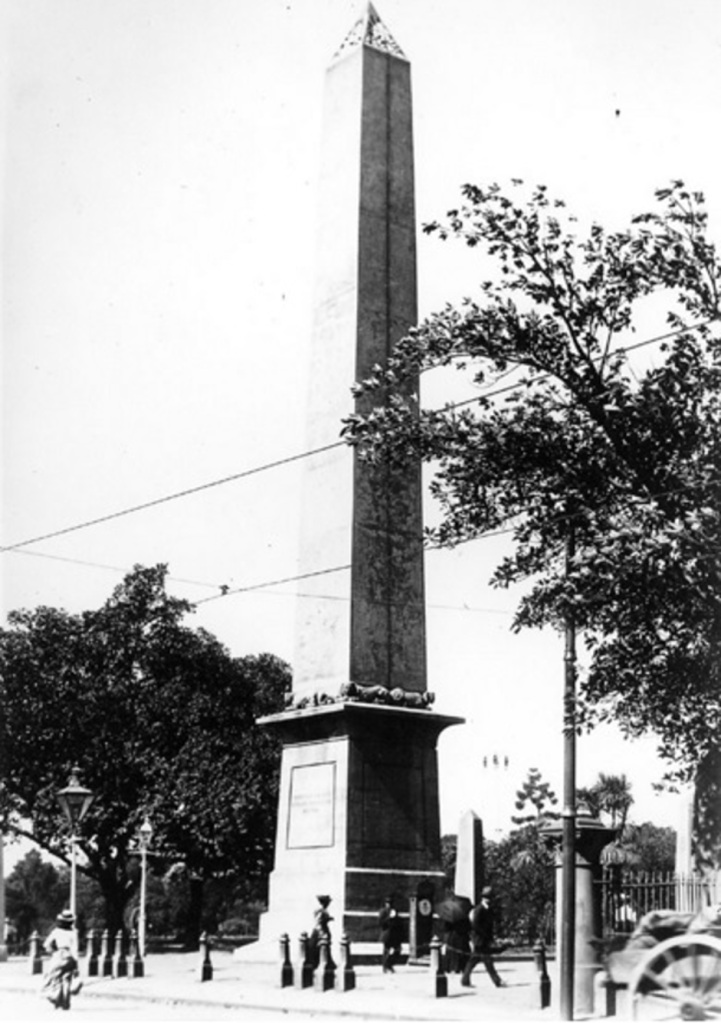
The first of many civic monuments was added in 1857 with the construction of the obelisk facing Bathurst Street, which was a sewer vent. It was modelled on Cleopatra’s Needle in London. A statue of Prince Albert, Queen Victoria’s husband, was erected in 1866, five years after his death. It has since been moved elsewhere.
The central avenue was an effective continuation of Macquarie Street and after the formation of responsible government (1856) was used for political speeches and meetings, and processions.
MLC John Frazer donated the Frazer Fountain, which was placed on the College Street side of the park in 1881, opposite Sydney Grammar School. It has since been moved three times. In 1897, a public subscription funded a bronze statue of populist politician and barrister WB Dalley (1831-1888) at the park’s northern end, near Prince Albert Road.
The city council upgraded the park in 1904 after taking it over. In 1910, the city erected its first women’s lavatory near the corner of Park and Elizabeth Streets, and demolished it in 1955. The Hyde Park Family Centre replaced it, but they removed it in 2000.
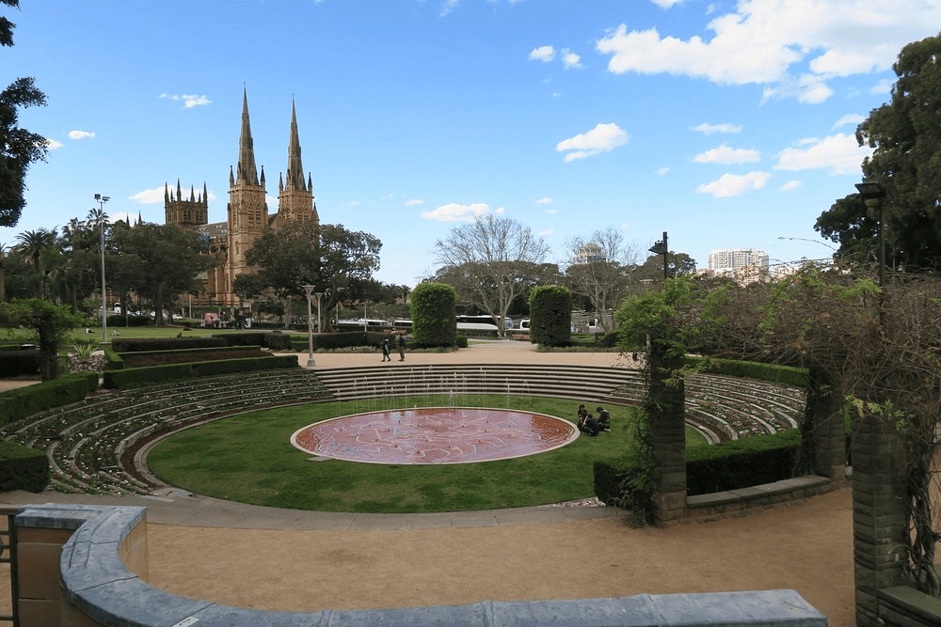
The Sandringham Memorial Garden and Fountain were developed in the northern part of Hyde Park in 1952 to commemorate the intended visit of King George VI and named after Sandringham Castle, the Royal Family’s residence in Norfolk, England. The memorial was designed as a sunken garden with a reflecting pool partly enclosed by a pergola. The King’s sudden death cancelled the tour. The memorial garden was dedicated to King George V and VI in 1953 and opened by Queen Elizabeth on her visit to Australia in 1954. (Williams et al 2026) In earlier years, the Coronation Bandstand stood on the site. They removed it and installed a sunken garden. In September 1951, the council decided to redevelop the site as a memorial garden. (Sandringham Memorial Garden 2026.)
The council added the Walker Fountain on the Elizabeth Street side in 1961 to commemorate Australia’s pioneer farmers. The FJ Walker family donated it, and sculptor Gerard Havekes created it.
Captain Cook statue and colonial legacy
A statue of Captain James Cook appeared in 1879 to celebrate the centenary of his death. The statue stands at the park’s highest point and was created by English sculptor Thomas Woolmer.
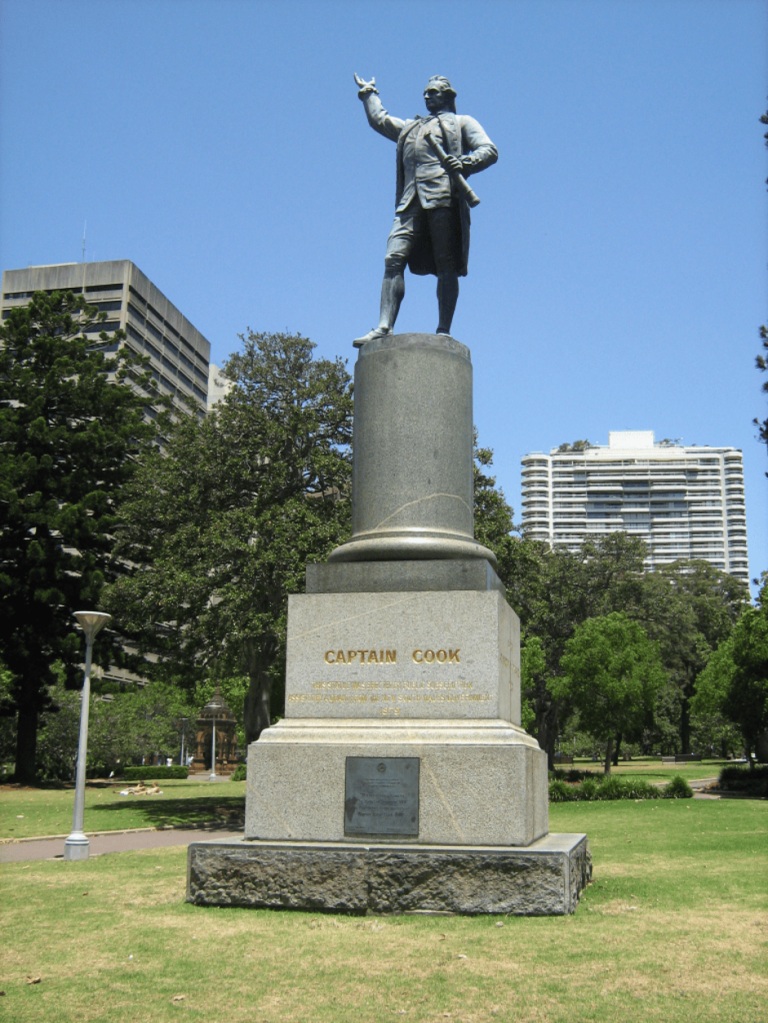
In 2020, the statue was vandalised, and two women were charged with damaging it with spray paint. The police had to form a protective barrier around the statue to keep away ‘Black Lives Matter’ protestors. (Two women charged 2020) In 2024, two protestors took an angle grinder to the statue’s ankle. Both were charged by police with malicious damage. (Bower 2024) These incidents were not the first time the Hyde Park Cook statue had been vandalised. The first reported vandalism occurred in 2017 (The Contested Histories Initiative, 2022). The press reported that the ‘Australian prime minister, Malcolm Turnbull, has likened the vandalism of statues of
Captain Cook and Lachlan Macquarie to Stalinist purges’. (Knaus 2017)
Cultural studies historian Tracey Ireland argues that Cook became a hero of the European Enlightenment shortly after his death in 1779. (Ireland 2018) Reporter Madeleine Bower wrote that statues of Captain James Cook were increasingly being vandalised, with recent attacks in Melbourne, and that calls were growing to remove them. The statues represented, for some parts of Australian society, Cook’s colonial legacy and the violence suffered by Indigenous Australians. (Bower 2024)
War memorials
Hyde Park features war memorials of various types, including four prominent First World War monuments. In 1917, a war trophy, the Emden’s naval gun, was placed near Oxford Street at the southern end. The sinking of the Emden was Australia’s first naval victory.
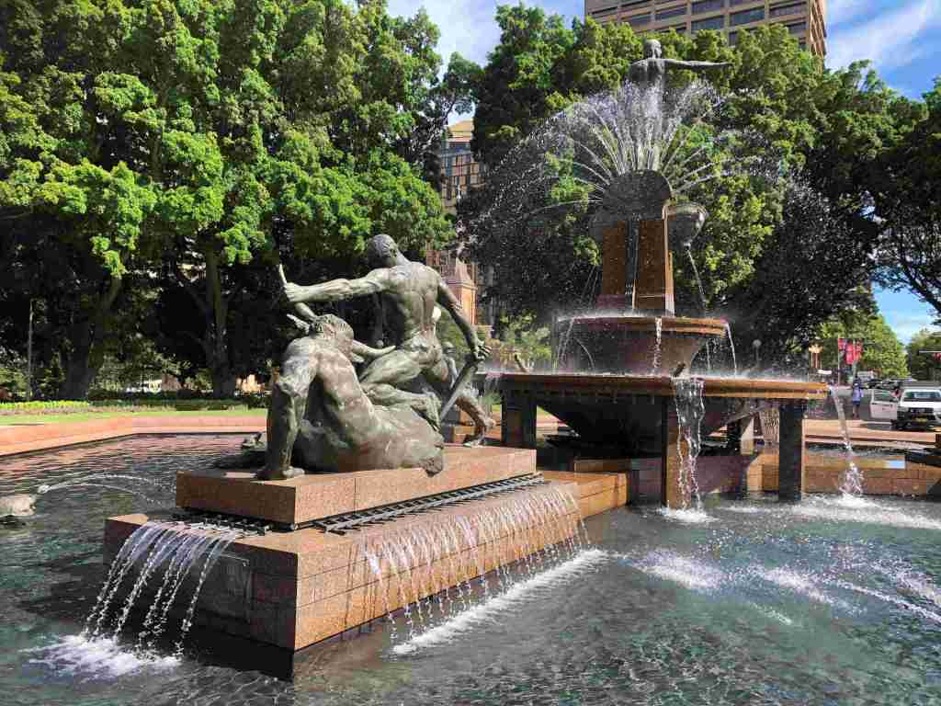
Two important commemorative memorials bookend the park: the Anzac Memorial and the Archibald Fountain. At the park’s northern end is the Archibald Fountain, which commemorates the link between France and Australia. It was a gift from the estate of J. F. Archibald, editor of Bulletin magazine, after his death in 1919. Francois Sicard completed the Archibald Fountain in 1932.
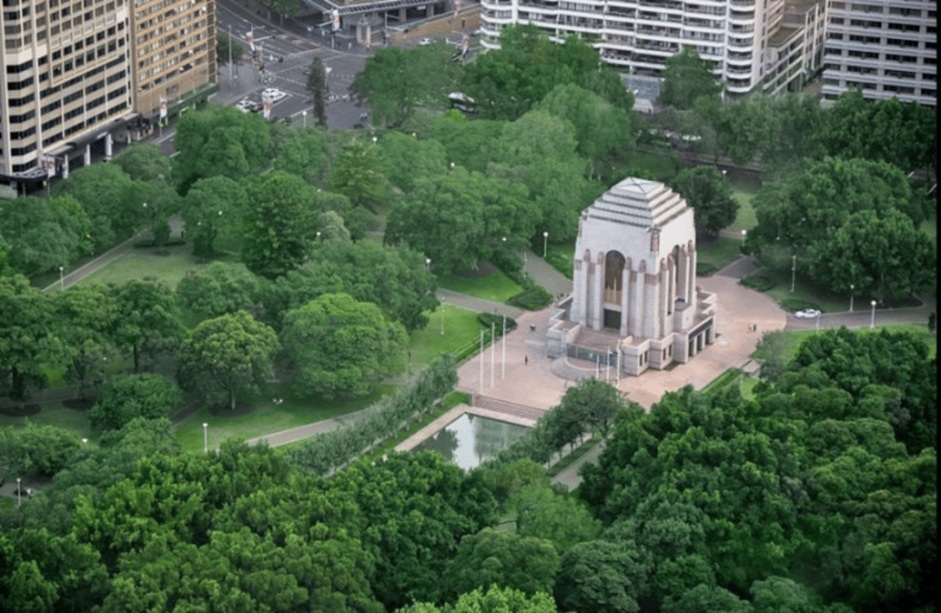
At the southern end of the park is the Anzac Memorial, opened in 1934 and designed by Bruce Dellit in an Art Deco style, with sculptures by Raynor Hoff. In front of the memorial is the Pool of Reflection. Norman Weekes’ winning design for the remodelling of Hyde Park in 1926 included the memorial’s siting.
A third war memorial is located at the corner of Park and Elizabeth Streets. The Grand United Order of Oddfellows donated an elaborate drinking fountain to commemorate their members who died in the First World War.
In Hyde Park South, near the Anzac Memorial, is the Torres Strait and Aboriginal War Memorial commemorating the service of Indigenous Australians. It is titled Yininmadyemi – Thou didst let fall, and was created by Aboriginal artist Tony Albert in 2014. In the same area is the Ataturk Memorial, opened in 2015, recognising Mustafa Kemal Ataturk’s words of comfort to the Anzac mothers who lost their sons in Gallipoli during the Great War in 1915.
Reflection
Hyde Park has been a meeting place for Indigenous Australians and Europeans. The park is an oasis the city’s urban landscape with memorials, historic monuments and dedicated open space with 580 mature trees. The historic landmarks including the Archibald Fountain are used a meeting point for many while the Anzac memorial is a sacred site in the country’s military history.
The park serves as a centre for events, including Anzac Day, Australia Day, and other festivals. Public transport is easily accessible at St James and Museum Railway Station, and the park offers cafes and open areas for picnicking and walking.
References
Bower, Madeleine 2024. Sydney’s Captain Cook statue almost loses its feet to vandals. The Daily Telegraph, 23 June. Reproduced at https://lyndongannon.com/media/f/sydney%E2%80%99s-captain-cook-statue-almost-loses-its-feet-to-vandals Accessed 30/8/26
Innes, Ian 2013. Hyde Park, Grand Old Dame of Sydney’s Park. Public Sydney Exhibition, 30 March-8 September 2013. Museum of Sydney. Online at http://blogs.hht.net.au/publicsydney/category/hydepark/ Accessed 23 March 2026.
Ireland, Tracey 2018. How Captain Cook became a contested national symbol. The Conversation, 11 May. Online at https://theconversation.com/how-captain-cook-became-a-contested-national-symbol-96344 Accessed 30/9/26
Knaus, Christopher 2017. ‘No pride in genocide’: vandals deface Captain Cook statue in Sydney’s Hyde park. The Guardian. 26 August. Online at https://www.theguardian.com/australia-news/2017/aug/26/captain-cook-statue-and-two-others-in-sydneys-hyde-park-attacked-by-vandals? Accessed 26/8/17
Sandringham Memorial Garden, Fountain and Gates, Hyde Park 2026. City of Sydney Archive and History Resources. Online at https://archives.cityofsydney.nsw.gov.au/nodes/view/1981194 Accessed 30/9/26
The origin of the urban park. The commodification of nature. (2020). AGi Architects Blog, December 22. Online at https://www.agi-architects.com/blog/en/origen-parque-urbano/
The Contested Histories Initiative, 2022. ”Captain Cook Statue of Sydney in Australia”, Contested Histories Case Study #7 (May), retrieved from https://contestedhistories.org/wp-content/uploads/Australia-Captain-Cook-Statue-in-Hyde-Park-Sydney.pdf Accessed 30/9/26
Two women charged over alleged defacing of Captain Cook statue in Sydney’s Hyde Park 2020. ABC News. 14 June. Accessed 30/9/26.
Wikipedia contributors (2026). Hyde Park, Sydney. In Wikipedia, The Free Encyclopedia.September 12. Retrieved 01:41, September 30, 2026, from https://en.wikipedia.org/w/index.php?title=Hyde_Park,_Sydney&oldid=1374589306
Whitaker, Anne-Maree, 20087. Hyde Park, Dictionary of Sydney. Online at https://dictionaryofsydney.org/entry/hyde_park, viewed 30 Sep 2026
Williams, Peter, Byers, Russell & John Huth 2026. King George V & King George VI. Monument Australia. Online at https://www.monumentaustralia.org/themes/people/imperial/display/23272-king-george-v-and-king-george-vi Accessed 30/9/26.
AI Disclaimer
AI was used to help auto-correct grammar.
Originally posted on 30 September 2026.
Discover more from Camden History Notes
Subscribe to get the latest posts sent to your email.

