
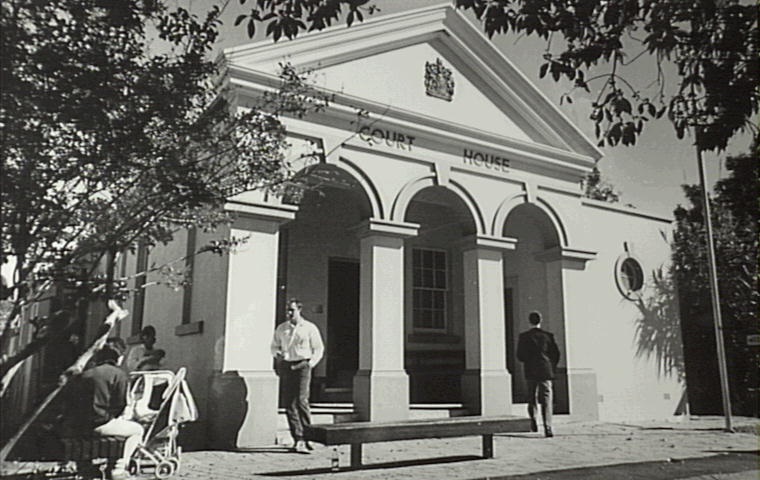
Final closure at Camden
The Camden courthouse building sits lonely and empty in the John Street heritage precinct. Unused, it is a forlorn heritage building of considerable merit. The modest building has a rich history in Camden’s legal landscape, but was eventually deemed unfit for purpose. The court building was deemed unsafe for victims of crime and too small to handle the caseload of a growing urban area. Meanwhile, the local legal profession supported the community’s effort to have the state government construct a purpose-built court building to cope with the Macarthur region’s urban growth.
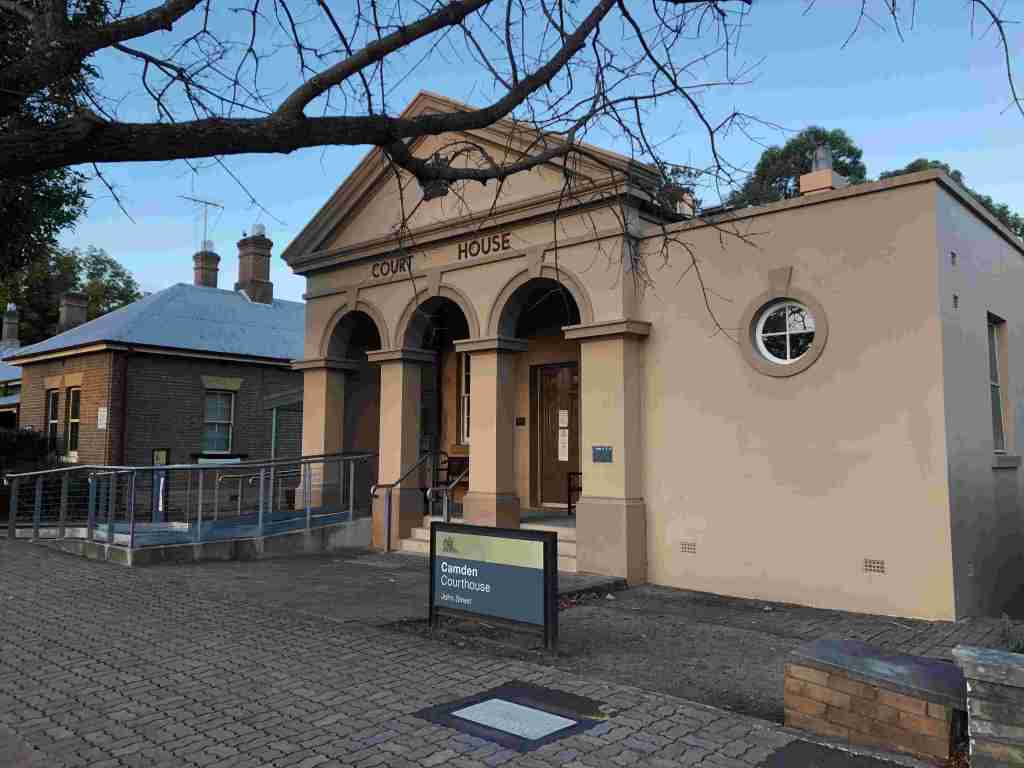
In 2021, the NSW Department of Communities and Justice deemed that the court building was unsafe for victims of crime, especially advocates for domestic violence victims, a decision supported by the Macarthur Women’s Domestic Violence Court advocate Tanya Whitehouse. (Camden Narellan Advertiser, 17 February 2021)
In addition, the mid-19th-century building was too small for a modern court, with very little security, no witness rooms and lacking basic AV equipment, all of which was available at the Campbelltown Local Court. (LSJ, 22 February 2021)
A slow death of cost-cutting and political indecision
The writing was on the wall for the closure of Camden court as early as 2013 when the O’Farrell Coalition Government stated that, as a cost-cutting measure, the courthouse would close ’indefinitely ’ in 2014. The chief magistrate suspended sittings and transferred cases to Picton.
Macarthur Law Society president Laura McGookin argued that Picton court did not have the capacity to deal with the caseload. The response from the Member for Camden, Chris Patterson MLA, said ‘anyone concerned about the closure should take the matter up with the chief magistrate’. (Camden Narellan Advertiser, 3 July 2013)
Later in the year, the Macarthur Women’s Domestic Violence Court Advocacy Service expressed ‘significant concerns’ that the imminent closure of Camden courthouse would place women victims ‘at risk’, with inadequate facilities. (Camden Narellan Advertiser, 21 August 2013)
While the O’Farrell Government was intent on closing the court building, it launched a $200,000 refurbishment, including a new counter in the registry, entry ramps, painting, air-conditioning upgrades, and improved paving at the entrance. Unfortunately, improvements excluded safe rooms for victims of domestic violence. (Camden Narellan Advertiser, 25 September 2013)
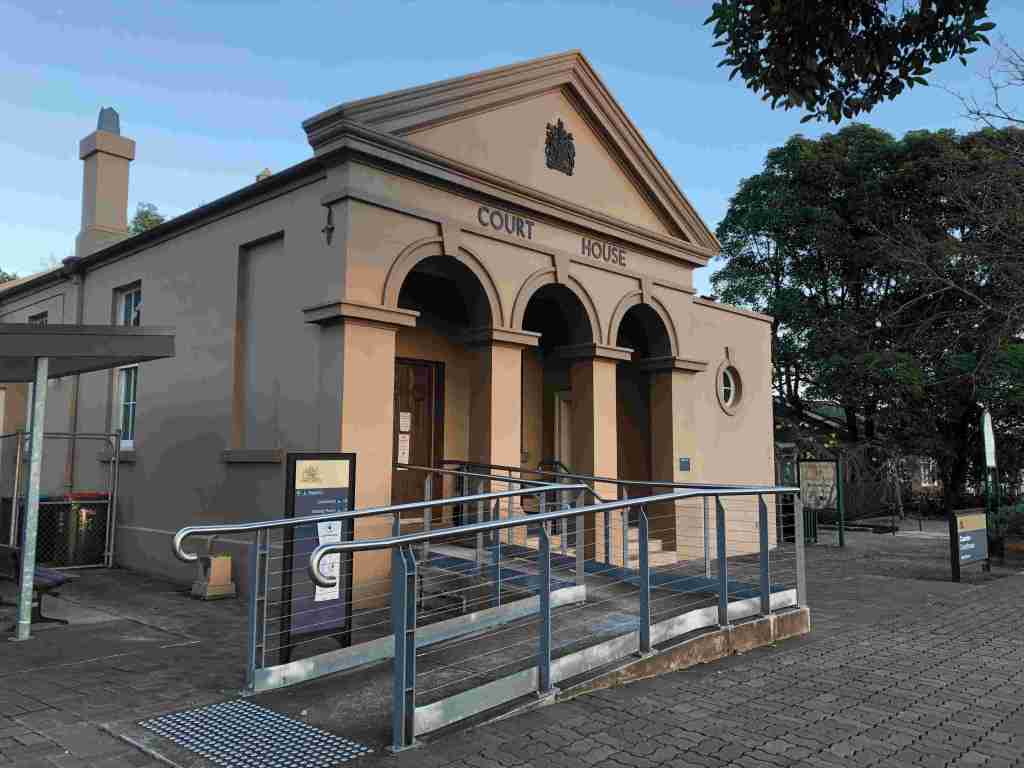
In October 2013, the Member for Camden, Chris Patterson, and the NSW Attorney-General, Greg Smith, were photographed at the front of the court building. Press reports stated that the government was considering whether the closure would go ahead, despite considerable community opposition. (Macarthur Chronicle, 8 October 2013; Camden Narellan Advertiser, 9 October 2013)
Senior associate at Caldwell Martin Cox solicitors Geoff Lloyd said that the suspension of sittings would ‘have a considerable impact on the region’s justice system’. (Macarthur Chronicle, 1 October 2013)
In mid-2014 court sittings at Camden were suspended and transferred to Picton, with only the registry remaining in the building. The shadow attorney-general, Paul Lynch, said that the O’Farrell government was ‘treating Camden residents with contempt’. (Camden Narellan Advertiser, 2 July 2014.
Two years later, flooding at Picton closed the courthouse for twelve months, and the Camden court was re-opened for two sitting days per month, with remaining matters transferred to Moss Vale Local Court. Meanwhile, Liberal Camden MP Chris Patterson had a change of heart and was now campaigning to have the Camden court re-opened full-time. (The District Reporter, 10 October 2016)
Safety concerns and inadequate space eventually led to the demise of the Camden courthouse in 2021, and the NSW Department of Communities and Justice decided to close the Camden court building.
Grandiose palaces of justice
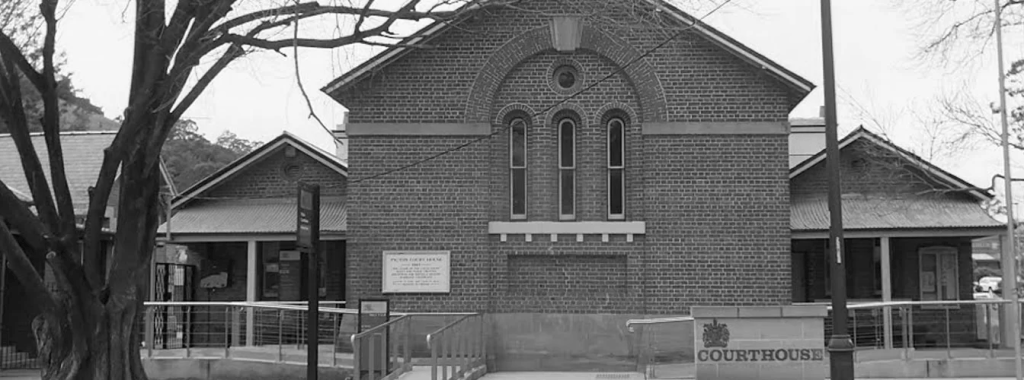
Small village courthouses of the Macarthur region, at Campbelltown (b.1827), Camden (b.1855) and Picton (b.1867), were modest affairs compared with grand legal palaces elsewhere in New South Wales of some major regional centre.
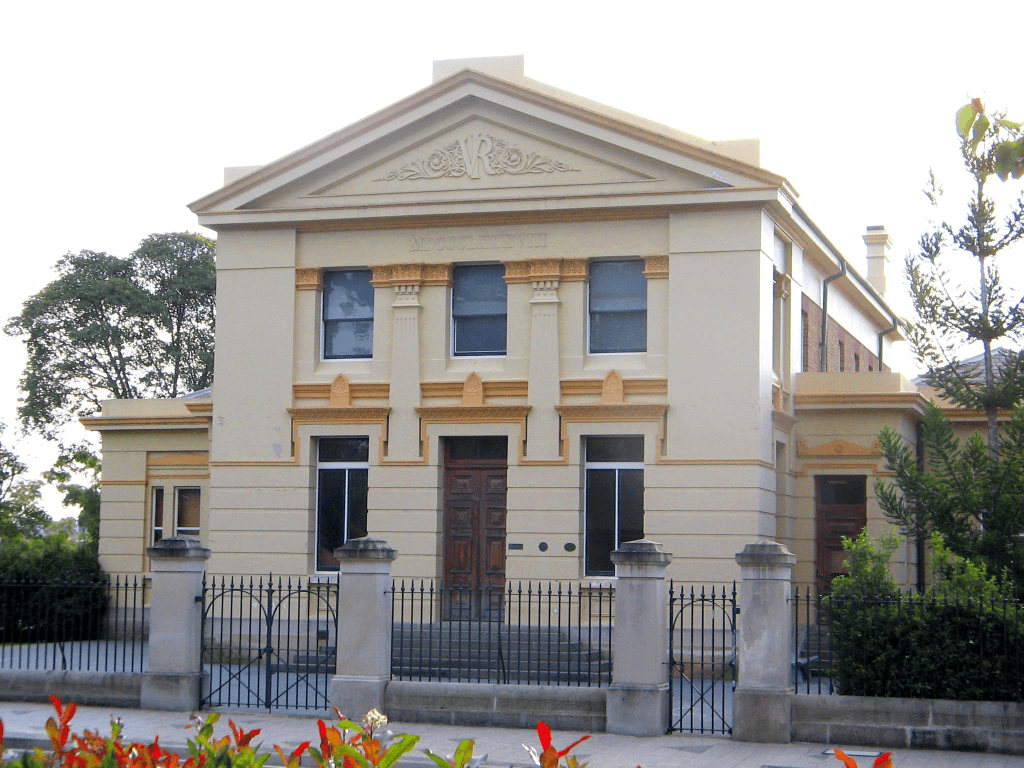
Towns like Goulburn (James Barnett, 1887, 4th building), Bathurst (James Barnett, 1880), Newcastle (Barnett, 1890) and Inverell (James Barnett, 1890), were major regional economic hubs for pastoralism, railways and gold. Designed by James Barnett, the NSW Colonial Architect (1862-1890), the building employed grand Victorian Free Classical, Italianate, and Renaissance styles, costing thousands of pounds, with copper domes, sandstone, and monumental arches to rival buildings in Sydney.
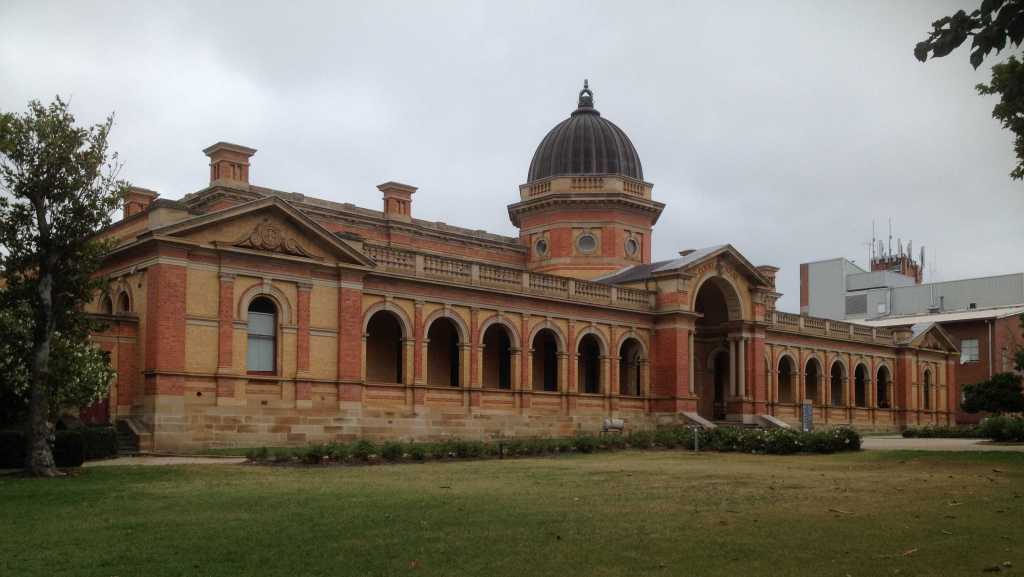
James Barnet served as the New South Wales Colonial Architect from 1862 to 1890, shaping pre-Federation civic identity. He designed over a thousand public works, including the General Post Office, the Lands Department Building, and the Macquarie Lighthouse. His grand Italianate sandstone designs embodied colonial optimism and transformed Sydney’s urban landscape. (Moppett 2025; McDonald 1969)
These grandiose Victorian justice palaces symbolised the immense late-nineteenth-century wealth, regional confidence, and permanence of the British Empire. Reflecting the transition of these centres from small country towns to major regional centres, local leaders lobbied for impressive public works to match their egos and economic importance. Construction of these grandiose structures ended with the 1890s depression.
According to the Rambling Wombat blog, Goulburn courthouse
The building… is one of the most spectacular courthouses in New South Wales and, indeed, in Australia. It features a copper dome, colonnaded facade and an apparently richly decorated interior. It is surrounded by attractive gardens and is enclosed by an iron pike fence and ornate gates – added in the 1900s.(TRW 2020)
The NSW Public Works website describes the Bathurst courthouse this way
Its scale, quality and grandeur reflect Bathurst’s late-nineteenth-century prosperity, founded on gold discoveries as well as pastoral farming and other industries. The building is also an outstanding example of Colonial Architect James Barnet’s work, being the biggest Victorian-era regional courthouse in NSW and its majestic copper dome soaring to a height of over 30 metres. (NSWPW 2022)
A modest utilitarian affair
Camden courthouse was the law and order heart of Camden for over 150 years and was a modest utilitarian affair. The centre of the local legal landscape shifted north when the Camden village was settled in 1840, with the first court sessions held in the town the following year, despite opposition by residents of Campbelltown and Picton.
Camden Court House was built on land set aside for this purpose by James and William Macarthur at the time the town allotment plans were laid down. The brothers also offered £100 towards the cost of the building. (Robinson 2012)
Court sessions were first held in Camden in 1841, after being transferred from the Cowpastures centre of Cawdor, south of the Nepean River. Cawdor’s presiding magistrate was Henry Antill from Picton, and the Clerk of Petty Sessions was James Pearson. (Johnson 2019)
While the Camden courthouse was being built, sessions were held in the Camden Inn, at the corner of Elizabeth and Argyle Streets. Once the Inn was licensed, the court moved to a temporary bark hut on the corner of Argyle and View Streets. (Johnson 2019)
Tenders were called in 1855 for the construction of the Camden courthouse. (NSW Government Gazette, 14 August 1855) The town had a population of 500 when construction began, and the building was completed in 1857, with cells underneath and at the rear. The building was designed during William Weaver’s term as Government Architect. (Robinson 2012)
Englishman William Weaver (1828-1848) was an engineer and foreman of works from 1851 under Colonial Architect Edmund Blacket. He arrived in Australia in 1850 after a failed coal mining venture. He became the NSW Colonial Architect in 1854, though his tenure was short, as he was forced to resign under doubtful circumstances in 1855. In 1856 he became the New South Wales’ Chief Engineer and supervised the construction of the Richmond to Windsor rail line in 1863. While in office, he supervised the construction of several buildings, timber bridges, and other projects. (DoS 2021; ENZ 2026)
The Clerk at Cawdor, James Pearson, died in 1841, and John Downes Wood, a nephew of Charles Cowper, was appointed the first Clerk of Petty Sessions for Camden. Charles Cowper was premier of NSW on five occasions between 1856 and 1870.
Wood resigned in 1843 and was replaced by WH Kingston. The court moved to 37 John Street in 1844, the home of the police Constable Davidson.
Charles Tompson (1807-1883), an interesting character, replaced Kingston in 1847. Sydney-born Tompson was a stringer for the Sydney Morning Herald reporting on Camden matters under the byline ‘From our Correspondent – Camden’. He reported for the Herald from 1847-1852 on police and government matters in an identifiable poetic style. His writing style was described by one 1849 correspondent, TR Johnson, as ‘grandiloquent magniloquence of language’. (Johnson 2019a)
James Benson Martin replaced Tompson in 1852 and held the position for 35 years. Martin wrote his ‘Reminiscences’ of the local area for the Camden Times in 1883. (Johnson 2019) Englishman JB Martin (1818-1908) arrived in Sydney in 1832. He married Honor Orchard in 1856 and lived in Alpha Cottage at the corner of John & Mitchell Streets. (Johnson 2012) Local historian John Wrigley writes that Martin was one of Camden’s ‘oldest and most respected residents’ when he died in 1908. (Wrigley 1990)
The court moved from the John Street address to Mitchell Street, then, in 1856, to its current address next door to the police barracks. (Johnson 2019b)
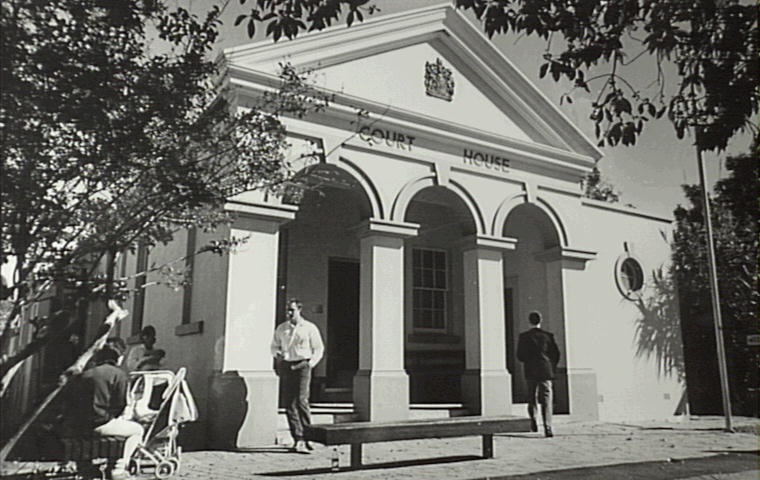
The State Heritage Inventory describes the courthouse as a small Italianate court building with a temple-front loggia with three arches. It is a painted ashlar building with painted chimneys and a gable shingled roof. A circular window is on the front facade, and the side facades have twelve panes and two-pane double-hung windows. The entrance door is a six-panelled timber door. The cells were constructed underneath and at the rear. (SHI 2026)
Reflection-adaptive reuse
The growth of the Camden LGA eventually marked the end of the local legal icon, the Camden courthouse. It was too small and not safe for victims of domestic violence. Colonial-era standards did not suit 21st-century conditions.
Small villages based on mixed farming and dairying had courthouses that were modest affairs compared with major regional centres like Goulburn and Bathurst and their grandiose palaces of justice. The building served the community well for 165 years, and the community was invested in it as part of the John Street heritage precinct.
The Camden courthouse, currently empty, could be put to good community use. Some imagination could see this heritage building revitalised through adaptive reuse as a community centre. An empty heritage building is vandalism by neglect, and should not happen.
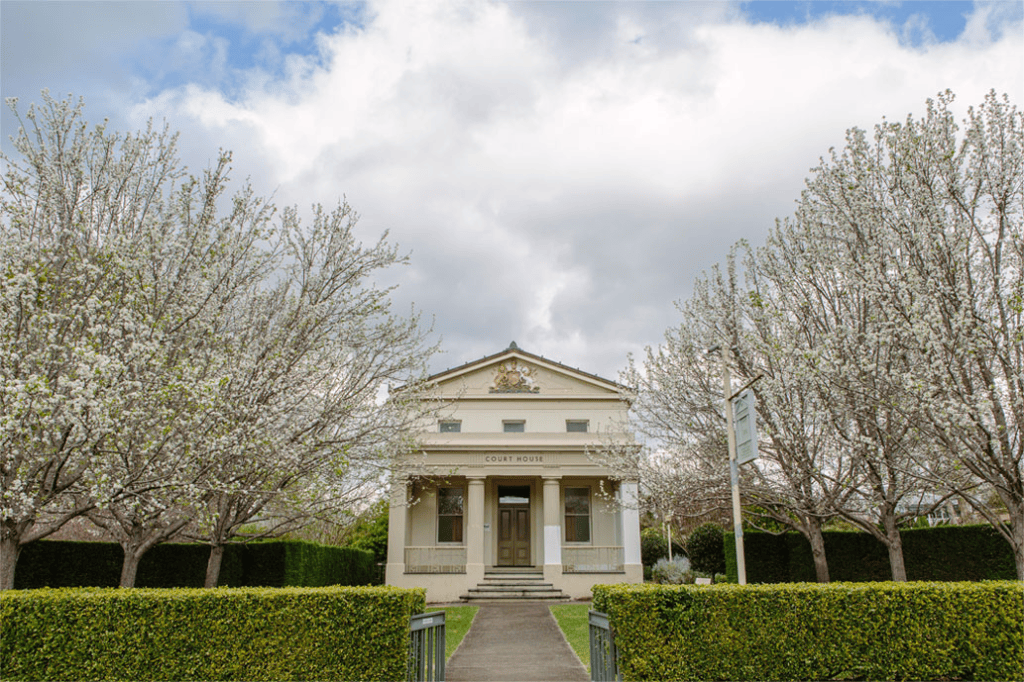
A successful conversion of an empty NSW courthouse to a community centre is the modest Berry courthouse. It was successfully readapted to a community asset in 1999 after being closed by the NSW government in 1988, and is managed by the Berry Courthouse Conservation Committee Inc. (BCC&MC 2026)
Conclusion-a dying need
Continued urban growth across the Camden LGA and other parts of the Macarthur region in Campbelltown and Wollondilly LGAs means the region will eventually require a new purpose-built court facility.
As long ago as 2018, the Law Society of NSW and the Police Association of NSW stated that the then court facilities across the Macarthur region were ‘outdated, overflowing and unsafe’. (Lawyers Weekly, 13 July 2018)
Safety concerns for victims of domestic violence were again expressed in 2023, with no action from the state government.
References
BCC&MC 2026. Berry Courthouse history. Berry Courthouse Conservation and Museum Committee, Berry. Online at https://berrycourthouse.org.au/about-the-courthouse/history-of-the-berry-courthouse/ Accessed 18/8/26
DoS 2021. William Weaver. Dictionary of Sydney, Sydney. Online at https://dictionaryofsydney.org/person/weaver_william#ref-uuid=0fc85db9-5713-3bc4-97e2-87f3f8797c88 Accessed 18/8/26
ENZ 2026. William Weaver (1828-1868). Engineering New Zealand. Online at https://www.engineeringnz.org/programmes/heritage/engineering-hall-fame/william-weaver-18281868/ Accessed 19/8/26
Johnson, Janice 2012. Reminiscences of Early Camden by JB Martin, RH Antill, T Herbert, SH Thompson, O West, R Todd and JJ Moloney. Camden Historical Society, Camden.
Johnson, Janice 2019. Camden Through a Poet’s Eyes, Charles Tompson (Jnr). Camden Historical Society, Camden.
Johnson, Janice 2019. Justice founds its place in new town. Back Then, The District Reporter, 26 January 2019.
McDonald, D. I. 1969. ‘Barnet, James Johnstone (1827–1904)’, Australian Dictionary of Biography, National Centre of Biography, Australian National University, https://adb.anu.edu.au/biography/barnet-james-johnstone-2939/text4257, published first in hardcopy 1969, accessed online 20 August 2026.
Moppett, Patsy 2025. An architect for the colony: James Johnstone Barnet. Heritage, Newsletter of the Blue Mountains Association of Cultural Heritage Organisations Inc. Online at https://bluemountainsheritage.com.au/wp-content/uploads/2026/04/Heritage-Newsletter-Iss.-101-Nov-Dec-2025.pdf Accessed 20/8/26
NSWPW 2022. Bathurst Courthouse conservation works 2020-2022. NSW Public Works, Riverina Western. Online at https://www.publicworks.nsw.gov.au/projects/riverina-western/bathurst-courthouse Accessed 20/8/26
Robinson, Christine 2012. Camden Historic Places, Camden Court House. Camden History, Camden. Online at http://www.camdenhistory.org.au/chhistoricplaces.html Accessed 18/8/26
SHI 2026. Camden Court House. State Heritage Inventory, NSW Government, Sydney. Online at https://www.hms.heritage.nsw.gov.au/App/Item/ViewItem?itemId=1280015 Accessed 18/8/26
TRW 2020. Goulburn Courthouse – “More for ornament than use”. The Rambling Wombat blog, 31 July. Online at https://theramblingwombat.com/2020/07/31/goulburn-courthouse-more-for-ornament-than-use/ Accessed 20/8/26.
Wells, Jamelle 2023. Sydney’s Campbelltown Court in desperate need of NSW government commitment to upgrade. ABC News, 29 January. Online at https://www.abc.net.au/news/2023-01-29/campbelltown-court-upgrade-witnesses-domestic-violence/101898824. Accessed 26/8/26.
Wrigley, John 1990. Camden Characters. Camden Historical Society, Camden.
AI Disclaimer
AI was used to assist in constructing this post by creating concept summaries, searching for evidentiary websites, and auto-correcting grammar (Grammarly).
Discover more from Camden History Notes
Subscribe to get the latest posts sent to your email.

