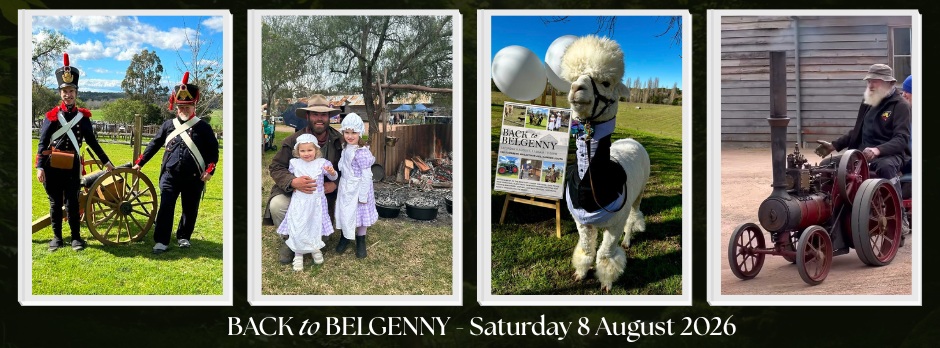
On a glorious winter day full of sunshine with a crisp start, a sold-out crowd rolled into the recent Back to Belgenny Day at Belgenny Farm, part of the original Macarthur family property of Camden Park Estate.
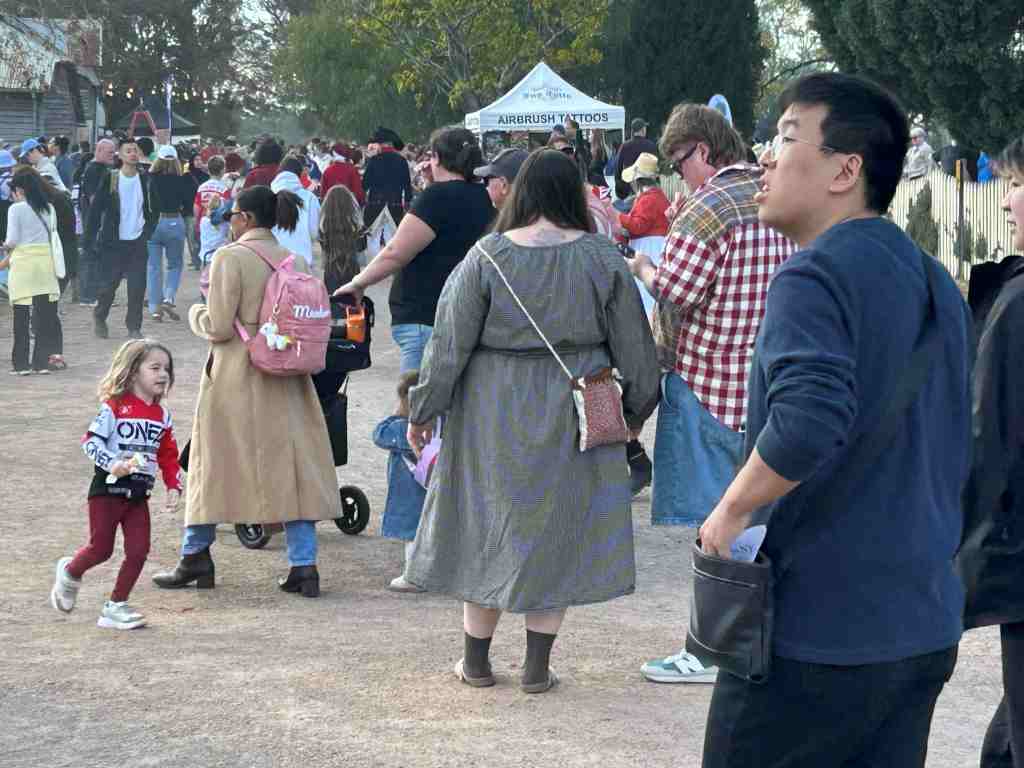
A crowd of over 2800 filed in and created a very buzzy, convivial atmosphere for the large number of families who attended the annual open day.
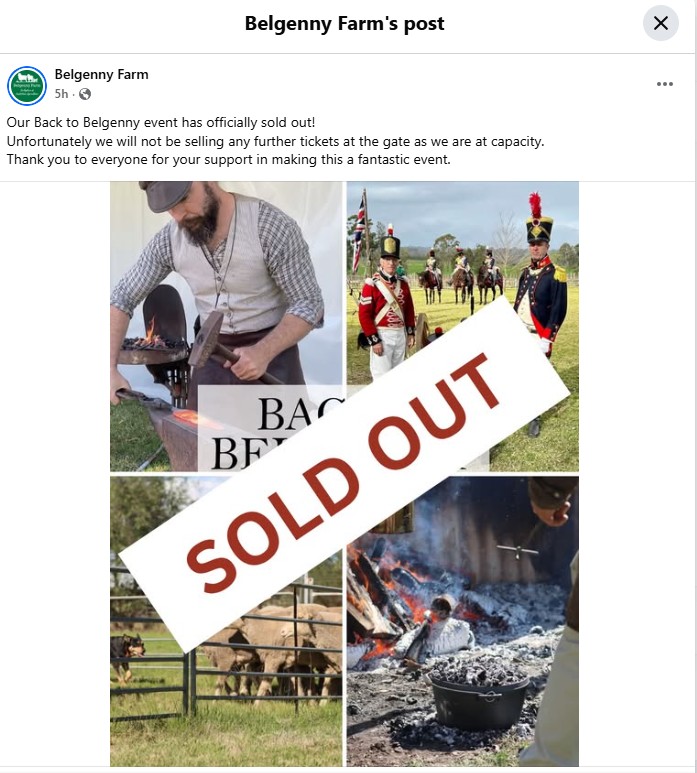
Back to Belgenny 2026 had all online ticket sales sold out before the gate opened on Saturday 8 August 2026. (Belgenny Farm FB)
NSW DPIRD Director of Education, Darren Bayley, said the event offers a rare opportunity to experience living history in one of Australia’s most significant agricultural locations.
Mr Bayley said visitors will be immersed in the stories and skills that shaped Australia’s agricultural foundations, with activities and demonstrations designed to appeal to all ages.
“Each year, Back to Belgenny brings people together to celebrate the site’s history, enjoy its unique setting and learn more about the people and practices that helped shape farming in NSW,” Mr Bayley said. (NSWDPIRD 2026)
Funds raised through this event support the conservation and maintenance of this important heritage site, helping to preserve Belgenny Farm’s stories, buildings and landscapes for future generations to enjoy.
The experience
Many came prepared with picnics, rugs, and trolleys full of goodies, setting up their rugs on the grass and baggsing their spots at one of the tables and chairs scattered around the site.
The large crowd witnessed a variety of living history events through reenactments, period clothing, and hands-on demonstrations to recreate past eras, letting people experience the sights and sounds of the past. History comes alive in front of their eyes on an actual historic site and as they walk around built heritage from the colonial period. This approach builds empathy, makes learning interactive, and reveals things that are not present in textbooks about the past. (I Willis 2026)
Belgenny Farm, formerly called the ‘Home Farm’, provides a living history experience at one of Australia’s most important sites dating back to the early days of New South Wales and the English colonial settler society project of the early 1800s.
The farm site is a living history experience unique in that it is one of the most intact farming complexes in the country as part of the original Camden Park Estate of the early 19th century.
The earliest buildings on the site are the 1815 manager’s cottage, called Belgenny Cottage, and the main stables building, built in the 1820s. The rare example of a smokehouse dates from the 1830s. The site is part of the original 1805 2000-acre grant allocated to John Macarthur.
The site was saved from housing development when the NSW Government purchased the land in 1984 and is now Heritage Listed and managed by the NSW Department of Primary Industries and Regional Development (DPIRD).
The Belgenny Farm website states:
The DPIRD uses the site for agritourism to promote the history of Australian agriculture through the innovations of the Macarthur Family through to modern day farming practices that is still visible through operations at the adjacent land used for the Elizabeth Macarthur Agricultural Institute (EMAI) which was established for biosecurity and agricultural research.
Belgenny Farm is recognised for its strong agricultural and cultural significance. The site reflects generations of farming innovation, rural life and community contribution, preserved through historic buildings, landscapes and ongoing use.Visitors are invited to explore and experience the farm while respecting its heritage and working‑farm operations. (BF 2026)
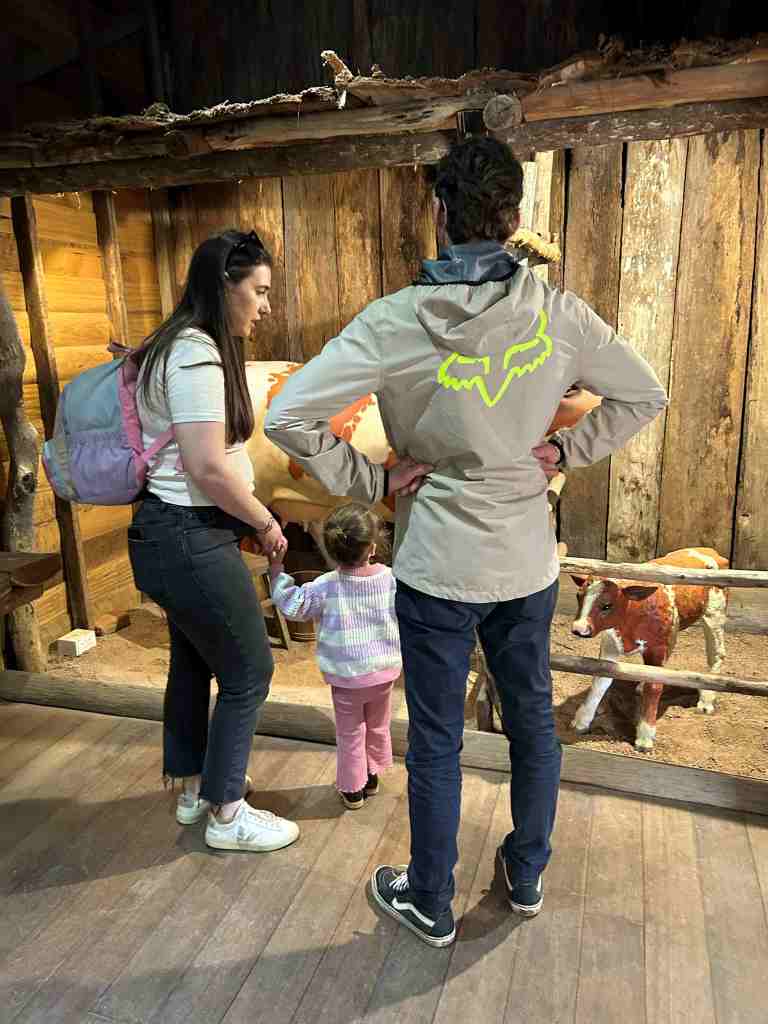
Visitors young and old engaging with the cow and calf as part of the dairy display in the Creamery, itself an item of built heritage constructed in the 1820s as a coach house, with an added upper storey in 1898 when it was converted to a creamery. The Belgeeny Farm site was busy supporting the dairies on Camden Park Estate from the 1890s with four creameries on the property. The story of the Camden Park dairy industry is explained in detail with storyboards, models and static displays. (I Willis 2026)
There was entertainment galore to hold the attention of the young and the young at heart.
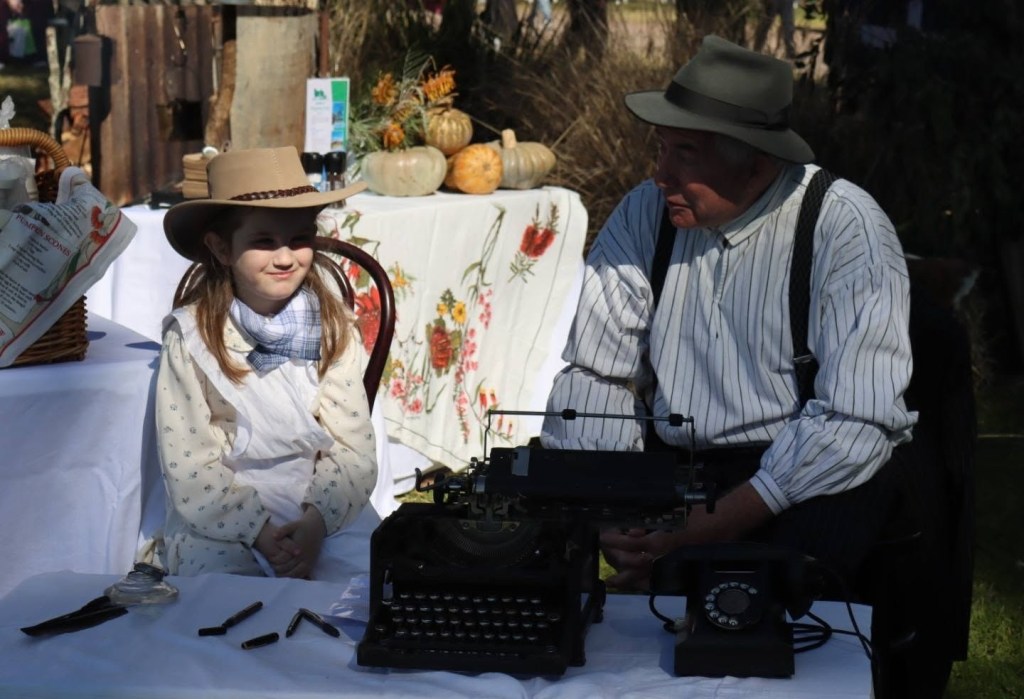
The ‘oldtimer’ was reciting ‘Clancy of the Overflow’ by AB ‘Banjo’ Paterson to his young listener dressed in period costume, first published in The Bulletin on 21 December 1889. Storytelling is for the young and the young at heart, and here a reenactor is telling a story to an attentive listener. This image shows costumed historical reenactors at the Back to Belgenny heritage-themed community event, featuring vintage equipment, a manual typewriter and a rotary-style telephone. (Friends of Belgenny 2026)
Military re-enactment
Colonial re-enactment of horsemanship, marksmanship, drill, live cannon firing, live flint-locked firing and more.
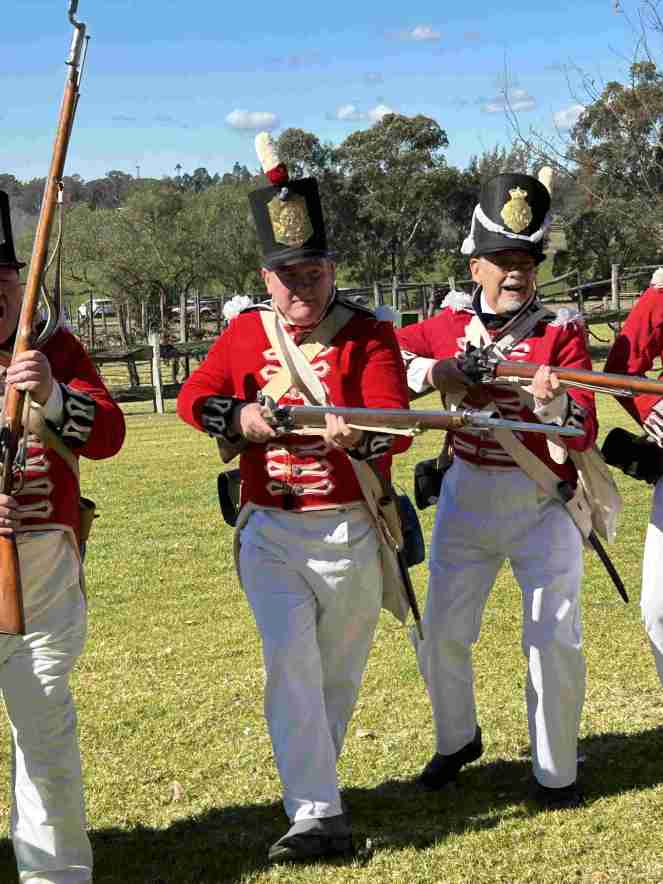
The 73rd Regiment of Foot reenactment unit in action charging the crowd at bayonet point. The Redcoats were an important part of the British colonial forces around the world when the British Empire was at its most powerful. Red dye was cheap, easily available, and ideal for standardising large forces. Originating with the New Model Army in 1645, the bright colour also helped commanders spot their men through thick black powder smoke. Governor Macquarie brought the 1st Battalion of the 73rd (Perthshire) Regiment of Foot, which replaced the New South Wales Corps. The main body of the 73rd departed for Ceylon in 1814. The veterans of the 1st Battalion of the 73rd saw service in the Indian wars, while the 2nd Battalion was raised in 1808 for the Napoleonic Wars and saw action at Waterloo in 1815. (I Willis 2026)
A living history reenactment of a live firing of the cannon by historical re-enactors dressed in 19th-century military uniforms operating a muzzle-loading field cannon, with smoke billowing from a discharge during an outdoor demonstration. The demonstration used black powder to replicate historical firing sequences. The carriage features large wooden spoked wheels designed for mobility across uneven terrain. The reenactors are wearing accurate replica military uniforms modelled after 19th-century Napoleonic-era foot artillery units. The coats are heavy, double-breasted dark blue or black wool frock coats trimmed with red piping and facings on the collars and cuffs. The headgear is tall, cylindrical shako hats made of rigid felt and leather. (I Willis 2026)
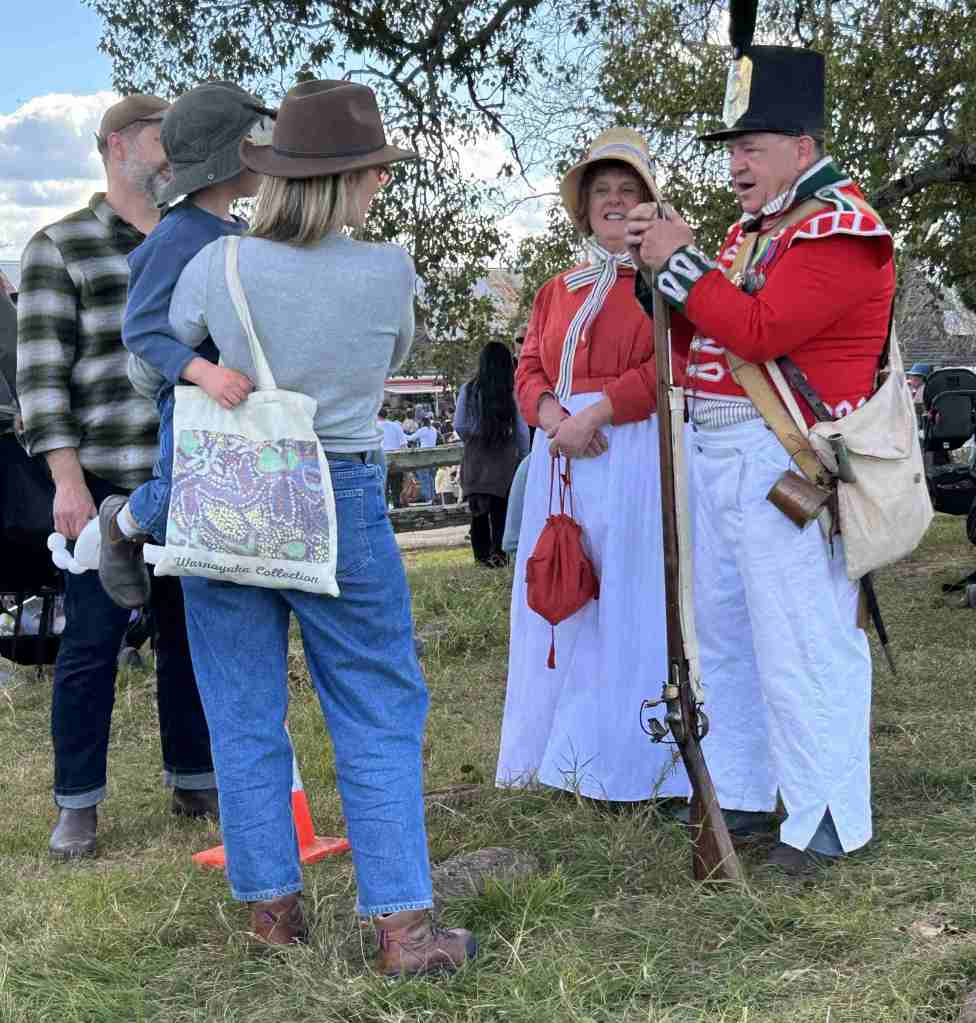
Reenactors engaging with one of the young families that were amongst the thousands of visitors to the Belgenny Farm site. The female reenactor is wearing a traditional Regency-style high-waisted dress, featuring a coral-coloured linen or cotton jacket tied with a striped bow, paired with a long, white gathered petticoat skirt. Her outfit is accessorised with a classic straw bonnet hat and a matching coral drawstring reticule pouch bag. This style of dress mimics the everyday fashion worn by pioneer women and early settlers in Australia during the late 1700s and early 1800s, frequently seen at living history festivals such as those hosted at Belgenny Farm. (I Willis 2026)
Old things
Vintage machinery displays, old cars and steam train rides kept the little kids and the big kids entertained.
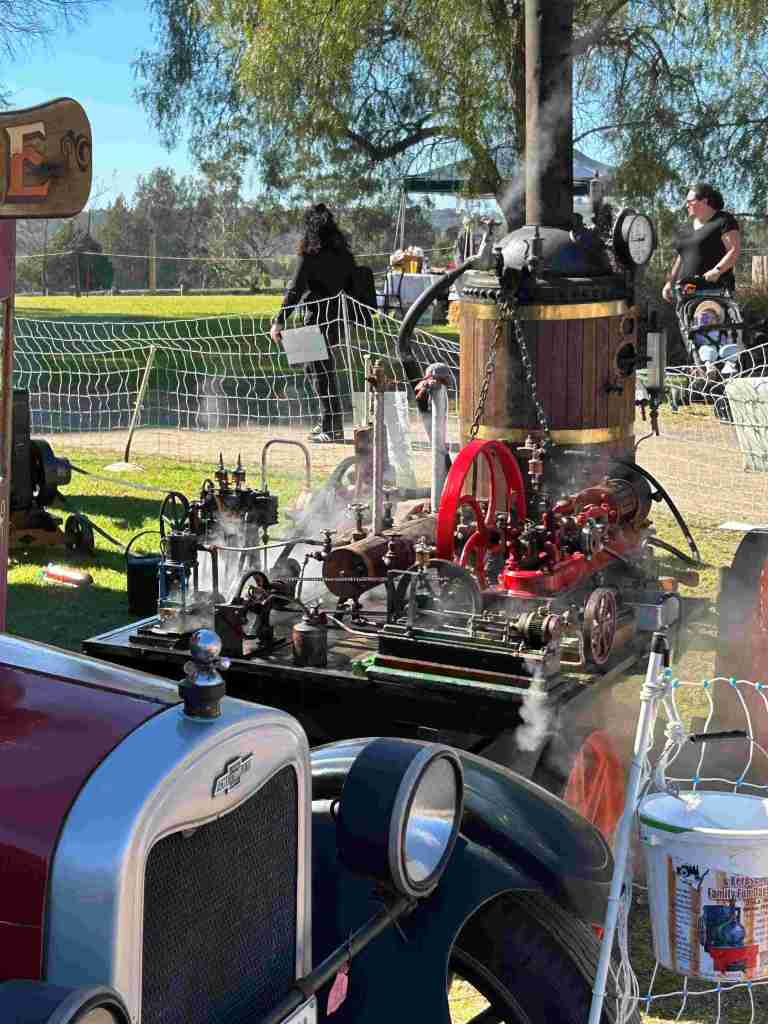
A Chevrolet truck and a stationary engine of the type that might have been used to drive the separators in the creamery on Camden Park Estate in the old days. The stationary engine has a wooden-lagged boiler along with a pressure gauge and a distinct red flywheel. The car has a Chevrolet bowtie badge clearly visible on the centre of the radiator shell grille, along with the characteristic chrome radiator shroud design of late-1920s Chevy models. (I Willis 2026)
This is a Chevrolet truck featuring local area signage. The maroon cab has a bench seat with the clutch and brake pedals. It is a classic 1920s styling, in the Superior or National series. There is a stationary engine in the rear of the image. (I Willis 2026)
Music
Music was supplied by the local groups the Honey Sippers, the Irish band the OJs and a pipe band.
Sheep and dogs
A display of the skills of the kelpies and their handler and their manoeuvres with a small mob of sheep.
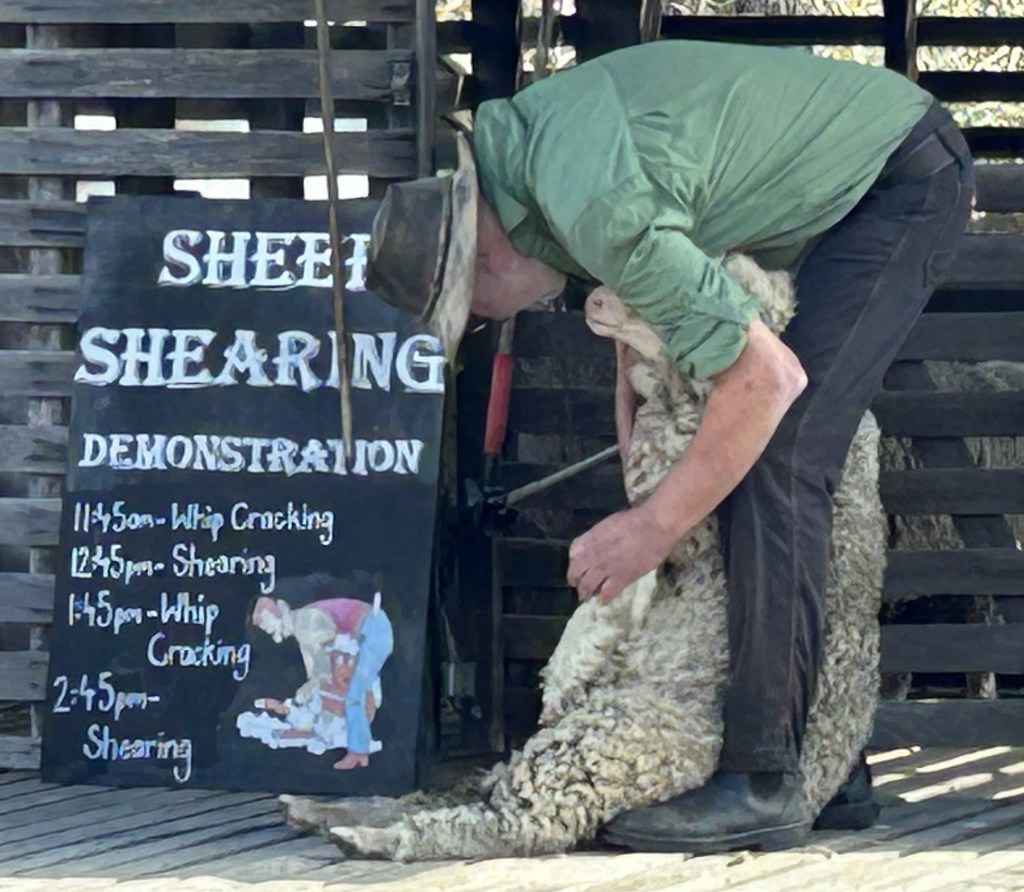
There was a shearing display of live sheep from one of the descendants of the Camden Park merino flock.
Anyone hungry
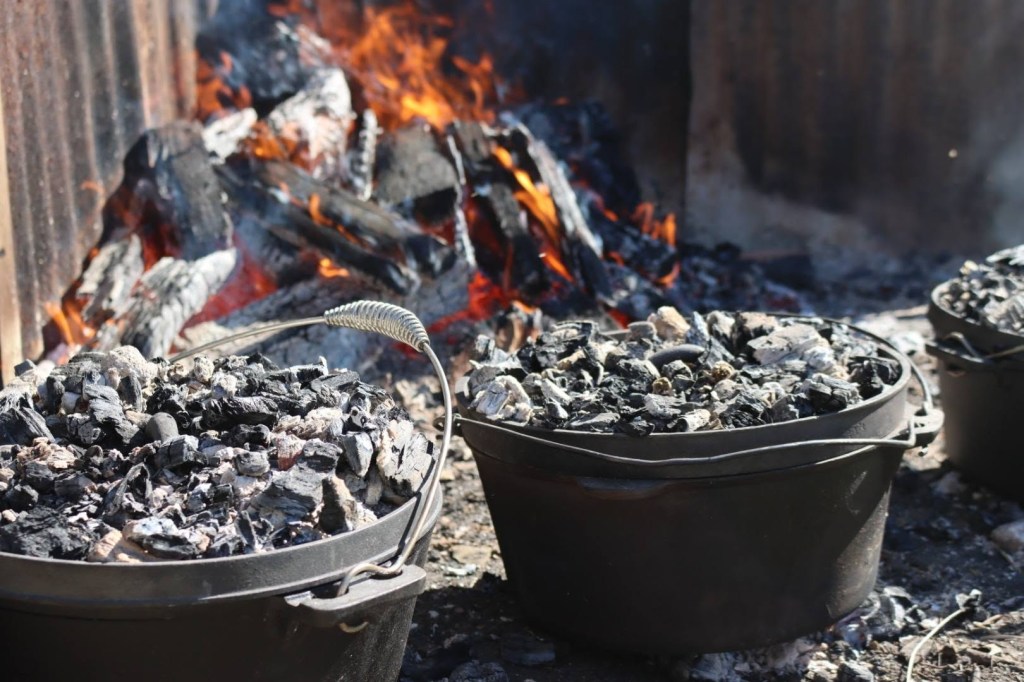
The drover’s camp was a popular spot where visitors could taste a colonial staple, damper and Golden Circle syrup, cooked in a traditional fashion on an open fire using hot coals to provide the cooking heat.
The drover’s camp was a popular spot for damper, cooked in a traditional fashion, and golden syrup, or ‘Cocky’s Joy ‘, is a classic bush tradition. Using ingredients of flour, salt and water, it produces a plain, tasty morsel, adding the sweetness of the syrup. This activity celebrates outback heritage, as celebrated in Henry Lawson’s poem ‘The Ballad of the Drover’ (1889) about the tragic death of drover Harry Dale. (I Willis 2026)
Long queues at the food stalls kept volunteers at the sausage sizzle and damper stall busy all day.
The camp ovens at the drover’s camp were dutifully looked after by Jake and the crew, with John mixing dough ready to put in the ovens, which were then covered in hot coals.
The camp ovens were used to cook the damper with hot coals from the fire on top of the oven. A camp oven is a heavy-duty, thick-walled cooking pot with a tight-fitting lid designed for use over open fires or hot coals. It lets you bake, roast, stew, and fry outdoors by holding and spreading heat evenly from both the bottom and the top lid. The camp oven was an essential cooking vessel before modern gas or electric ovens and was used by drovers, shearers, gold miners, and bush settlers. (Friends of Belgenny 2026)
There was a selection of food trucks across the site, which were a popular attraction at lunchtime.
Traditional Handicraft
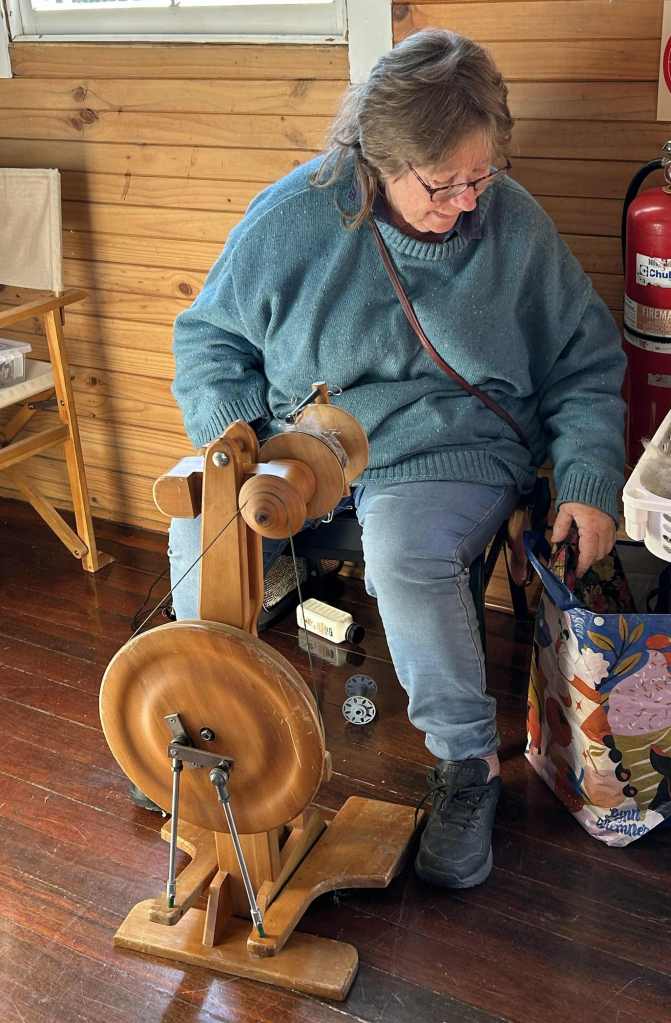
Arts and crafts were demonstrated by a number of women’s groups, including spinning and knitting.
Knitting is a traditional handicraft practised by colonial women in the domestic environment, here demonstrated by a stallholder selling knitted woollen goods. Knitting dates back to the Middle Ages and originates in the Middle East, then was transferred to Spain, Italy, and the rest of Europe. By the 13th and 16th centuries, knitting had become a traditional trade dominated by male guilds. The Industrial Revolution broke the guilds, and today knitting is a craft dominated by women. (I Willis 2026)
Spinning is a traditional craft practised by many Australian colonial women to make woollen clothing for winters in the bush and in town. It is a domestic art form that emerged in the 11th century with the invention of the spinning wheel in Asia, which then moved to Europe and revolutionised textile production until it was replaced by industrial factories in the 18th century. The treadle wheel and foot pedal demonstrated here emerged in the 16th century and freed both of the spinner’s hands to draft the wool fibres evenly, speeding up production. (I Willis 2026)
Traditional Trades
Woodturners created many wonders on the lathes.
A woodturner operates a compact wood lathe mounted on a portable workbench, complete with accumulated wood shavings and gouge chisels. The artisan is turning a wooden bowl or shallow platter. The woodturner has a blank, a wide, circular piece of face-grain timber mounted directly to the headstock chuck. The woodturner uses a bowl gouge, resting firmly on the tool rest, to hollow out and shape the face of the revolving timber blank. (I Willis 2026)
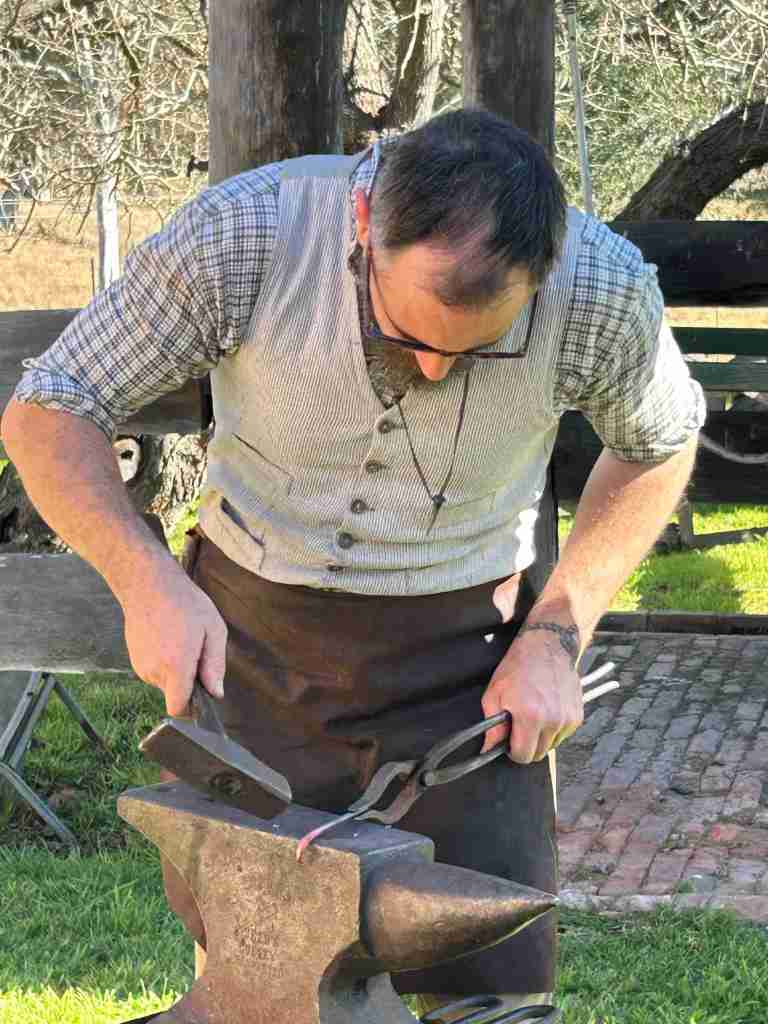
The blacksmith worked hot metal, creating a work of art and craftsmanship.
A blacksmith shapes hot metal on the anvil using a hammer and holding tongs. The blacksmith utilises an anvil and a hand hammer to flatten, taper, or draw out hot steel or iron held securely by specialised forging tongs. The heavy iron anvil features a polished flat face for striking, a tapered horn for bending or shaping curves, and a solid base anchored firmly for safety. He wears period-accurate workwear including a pinstriped vest, a plaid button-down shirt, a protective heavy leather apron, and a specialised pendant around his neck. (I Willis 2026)
Shearing is a traditional trade that dates back to the earliest days of the colonial settler project in Australia. Camden Park, under the direction of John and Elizabeth Macarthur, was an important site in the development of the Australian merino sheep flock in the early 1800s in New South Wales. The earliest shearers used blades to remove the wool, while this demonstration uses electric wide-blade shears. Shearing is a highly skilled rural profession with a long and rich history dating back to colonial times. (I Willis 2026)
Local stories
Local stories are told and retold by the representatives of the local historical and family history societies.
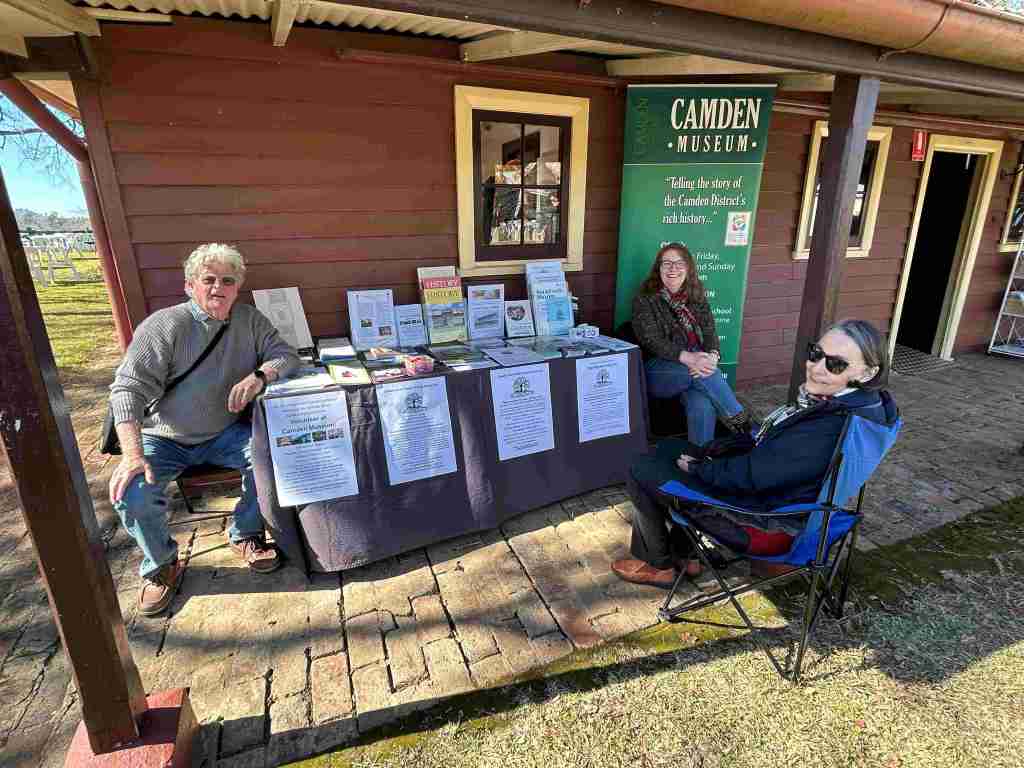
An information stall conducted by the Camden Historical Society and the Camden Area Family History Society at the front of Belgenny Cottage, the former 1820s manager’s cottage. Volunteers IanR, JoOB and DianneM engaged with visitors and handed out information about both societies. The historical society is committed to telling the Camden Story and managing the Camden Museum, while the family history society is engaged in the genealogy of local families. (I Willis 2026)
Private graveyard ghosts.
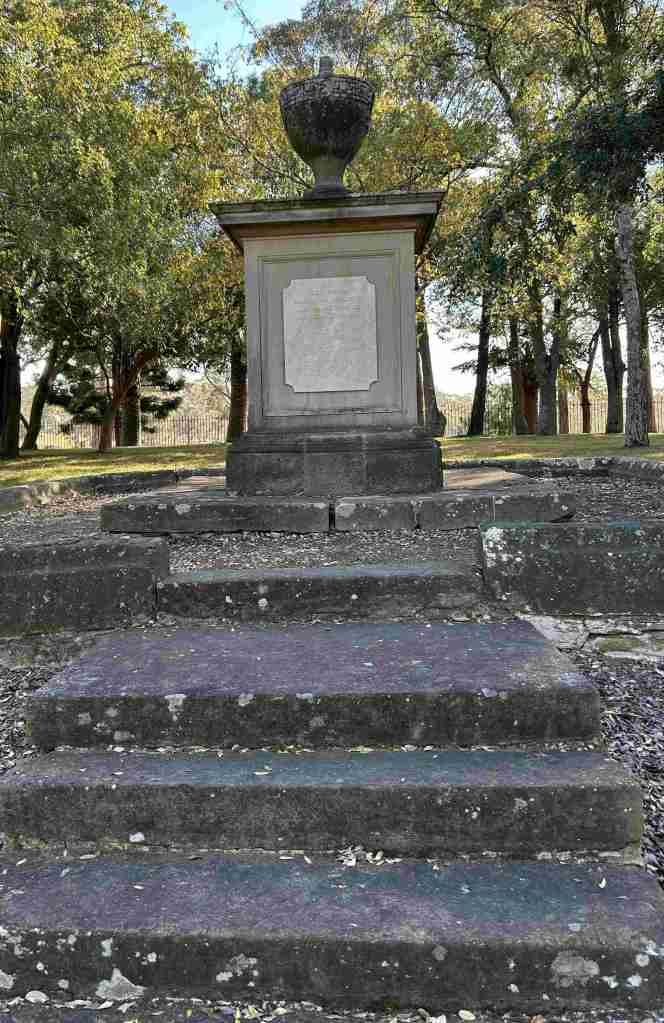
Many members of the Macarthur family of Camden Park Estate are buried in the family’s private cemetery on the original property of Camden Park Estate. The site is now part of the Belgenny Farm precinct and is controlled by the DPIRD.
The Macarthur family vault in the private cemetery on the former Camden Park Estate. The vault below the stairs houses 11 family members, including John and Elizabeth Macarthur and several of their nine children. The Macarthur family tomb has John Macarthur (1767–1834) – Head of family and wool pioneer Elizabeth Macarthur (1766–1850), née Veale Sir William Macarthur (1800–1882) – Fifth son of John and Elizabeth Elizabeth Macarthur (c.1792–1842) – Eldest daughter Mary Bowman (1795–1849), née Macarthur James Bowman (d.1871) – Son of Mary and James Bowman James Macarthur (1798–1876) – Fourth son Emily Macarthur (1806–1880), née Stone Arthur Alexander Walton Onslow RN (1832–1882) Emily Susan Macarthur Onslow (1869–1876) Arthur Alexander Norman Onslow (1881–1883) Closely connected to Camden Park and Belgenny Farm, the cemetery reflects the personal, military and agricultural history of one of Australia’s most influential rural families. (BF 2026b/I Willis 2026)
Reflection
So, to sum up, what is the event’s impact and what does it represent for the community?
The day attracted a sold-out crowd of over 3,000 people who celebrated Australia’s agricultural history. Attendees enjoyed various activities, including historical reenactments, vintage machinery displays, and craft demonstrations. The visitors participated in various types of living history.
Attendance at the event supported conservation efforts at this significant heritage site, preserving its stories and landscapes. Visitors were able to immerse themselves in the stories and skills that shaped Australia’s agricultural foundations, and learn more about the people and practices that helped shape farming in NSW.
Make sure you attend the Back to Belgenny 2027 and enjoy a great day out experience at one of Australia’s most important historic farm complexes. Take in the past, gain an understanding and greater empathy for our ancestors and encounter the sights and sounds of the authentic reenactments and the site’s built heritage.
References
BF 2026a. Belgenny Farm, Back to Belgenny 2026. NSW Dept of Primary Industry and Regional Development, Camden. Online at https://www.belgennyfarm.com.au/ Accessed 9/8/26
BF 2026b. Macarthur Family Cemetery. NSW Dept of Primary Industry and Regional Development, Camden. Online at https://www.belgennyfarm.com.au/ Accessed 9/8/26
Generative AI has been used in the construction of this post by creating concept summaries, providing supporting evidentiary websites and auto-correction (Grammarly) during proofing.
Cows and sheep for the young and young at heart who visited the Back to Belgenny 2026. These soft toys were Belgenny Farm merchandise that can be purchased from the Belgenny Farm office during normal office hours. (I Willis 2026)
Updated 12 August 2026. Originally posted 10 August 2026.
Discover more from Camden History Notes
Subscribe to get the latest posts sent to your email.