
The Camden Realist School Art tells a story
Camden Realism is a style of art that has appeared in the Macarthur region in recent decades and tells the story of the local area. It was recently displayed at the Campbelltown Arts Centre, where the gallery mounted an exhibition of the works of Nola Tegel, Patricia Johnston and others.
Artist Marion Boddy-Evans describes a school of art as
a group of artists who follow the same style, share the same teachers, or have the same aims. They are typically linked to a single location.
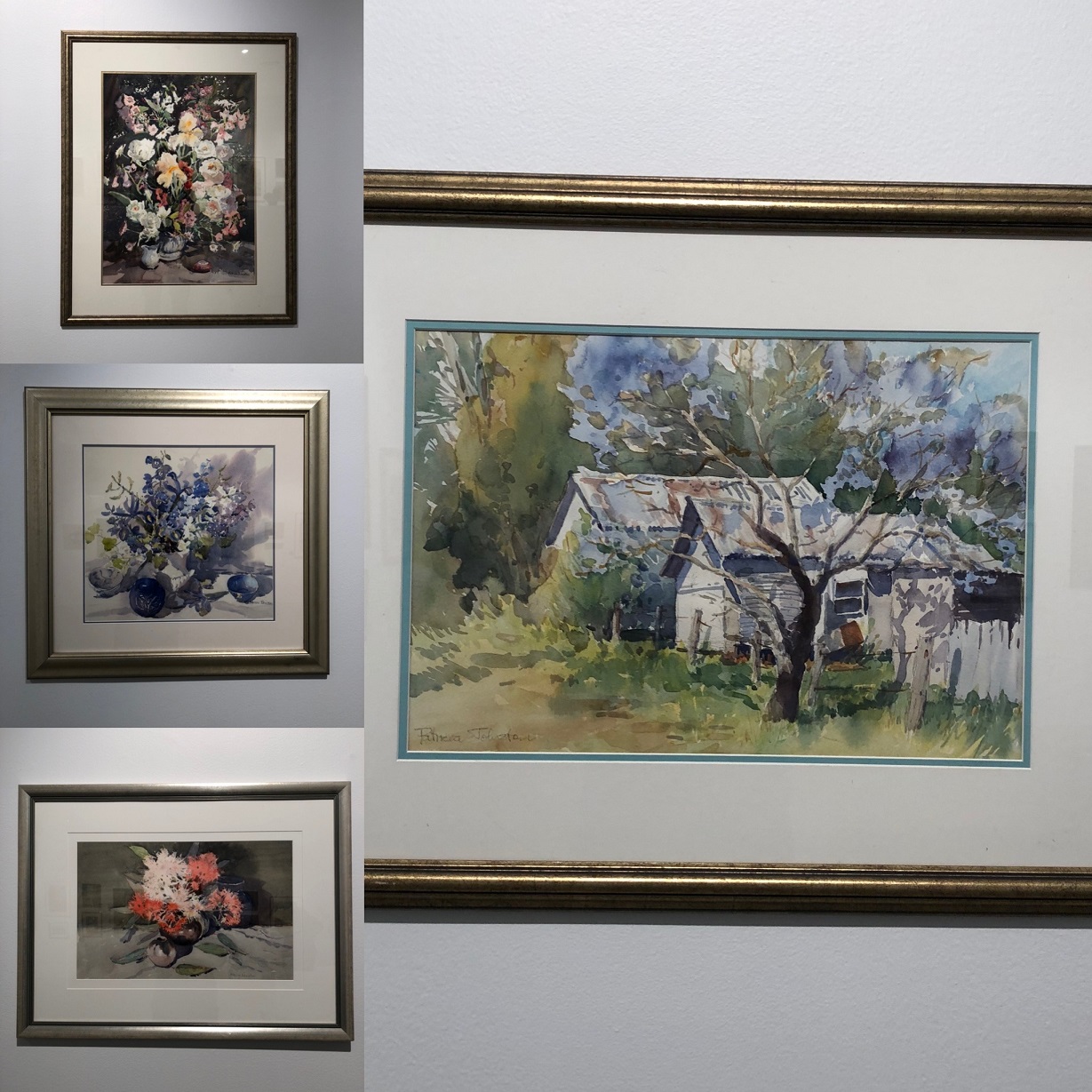
Local artists Nola Tegel and Patricia Johnston follow a representational style of work pioneered in the area by artist Alan Baker in the 1970s. Tegel and Johnston were some of Baker’s students who, together with others, created an impressive and vital body of local artwork.
The followers of Camden realism conduct a form of storytelling through their representational style of artwork, which documents the ever-changing landscape of the Macarthur region and its cultural heritage.
Campbelltown Arts Centre
Camden realism is regularly exhibited at the Campbelltown Arts Centre and the annual Camden Art Prize.
In 2020, Tegel was commissioned by the Campbelltown Arts Centre to
develop a series of paintings that capture glimpses of Campbelltown’s history amongst an ever-changing landscape.
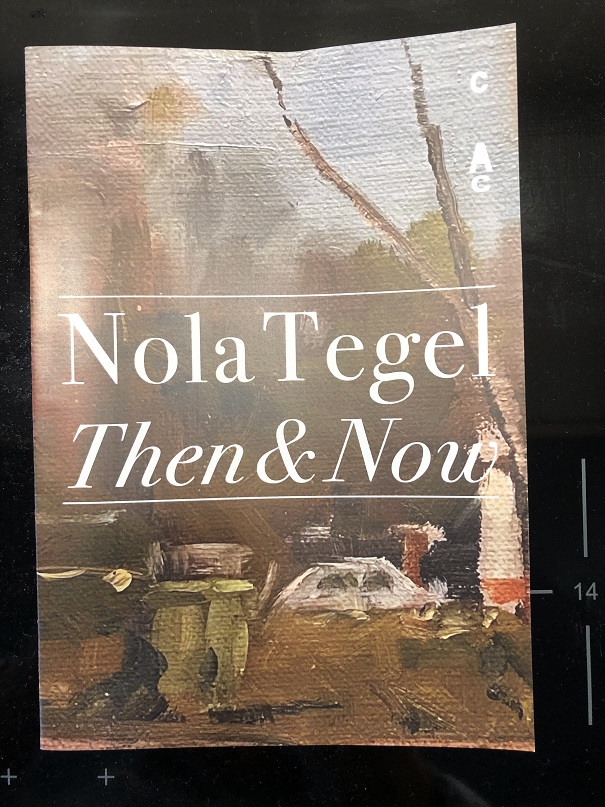
Then & Now Catalogue
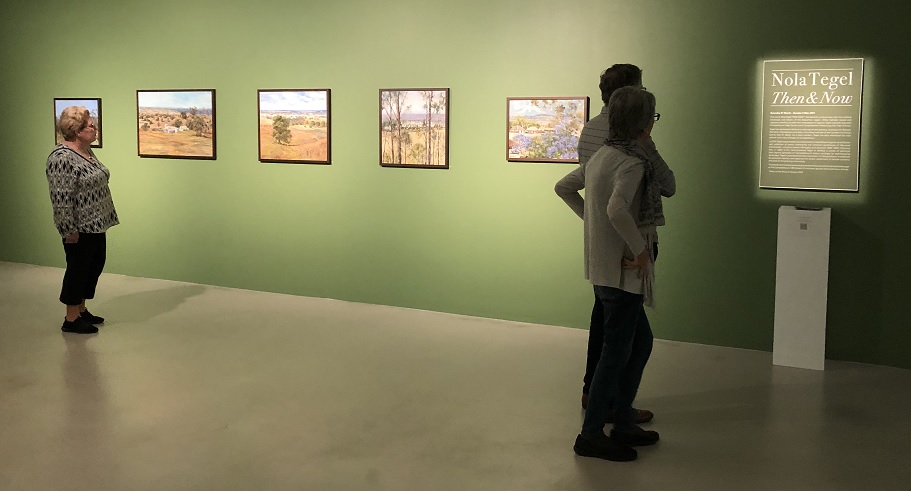
The Campbelltown Arts Centre mounted these works in an exhibition called ‘Then and Now‘ from March to May 2021.
The Campbelltown Arts Centre, established in 2005, boasts that it is a regional creative hub. The gallery encourages local artists to take risks using various techniques, from new to traditional, including Baker’s representational realism.

The Tegel commission
The brief for the Tegel commission stated that she
‘develop a series of paintings that capture glimpses of Campbelltown’s history amongst an ever-changing landscape’.
Storytelling is the essence of Tegel’s artwork, and the exhibition catalogue states her body of artwork has documented
‘the built environment and landscape of the Campbelltown CBD ahead of imminent growth and continuous change’.
Storytelling is an essential element of the creative process, and artist Courtney Jordon argues that:
Storytelling often comes naturally to artists. Sometimes the story starts on a single canvas or sheet of paper and doesn’t end until a gallery full of paintings, a suite of drawings, a set of illustrations, a series of comic strips or an entire graphic novel.
Certain subject matters compel an artist to revisit them again and again, building on a concept or pushing it in different directions. The narrative can be a visible part of the artwork in the form of a written story. But oftentimes, it acts as an invisible framework that guides an artist through the creative process.
Tegel is a storyteller who created a narrative that fulfilled the commission brief with empathy and vision. This was based on her understanding of the area’s sense of place and community identity as a growing community on Sydney’s urban fringe. The exhibition catalogue states that
Tegel’s accomplished documentation of Campbelltown captures the artists’ attachment to familiar outlooks and awe of the growing community.
‘Then and Now’, Exhibition catalogue
The essence of Tegel’s artwork is storytelling. She gives a visual palette to the aspirations and expectations of the local community of locals and new arrivals by capturing the meaning and essence of place on the canvas.
Sydney’s urban fringe is a zone of transition where hope and loss, dreams and memories, are shaped and re-shaped by a shifting sea of urbanisation. Tegel has produced a body of work that tells the story of subtle nuances across the landscape that are only understood by those who have experienced them. She reminds us all that the border between the rural and the urban fringe is a constantly shifting feast.
Campbelltown is a landscape of change, as it has been since the area was proclaimed by Governor Macquarie in 1820. Initially, as a settler society dispossessing the Dharawal of their country, and in the 20th century, urban dwellers dispossessed Europeans of their bucolic countryside.
Tegel has witnessed these challenges through her evocative interpretation of the area’s cultural landscapes and, in the process, captured Campbelltown’s sense of place.
The notes in the exhibition catalogue argue that Tegel has drawn here artistic influences from various sources. Amongst these have been working with artist Barbara Romalis and being a foundational member of artist Alan Baker’s art classes at Camden.
Camden Realism and Alan Baker
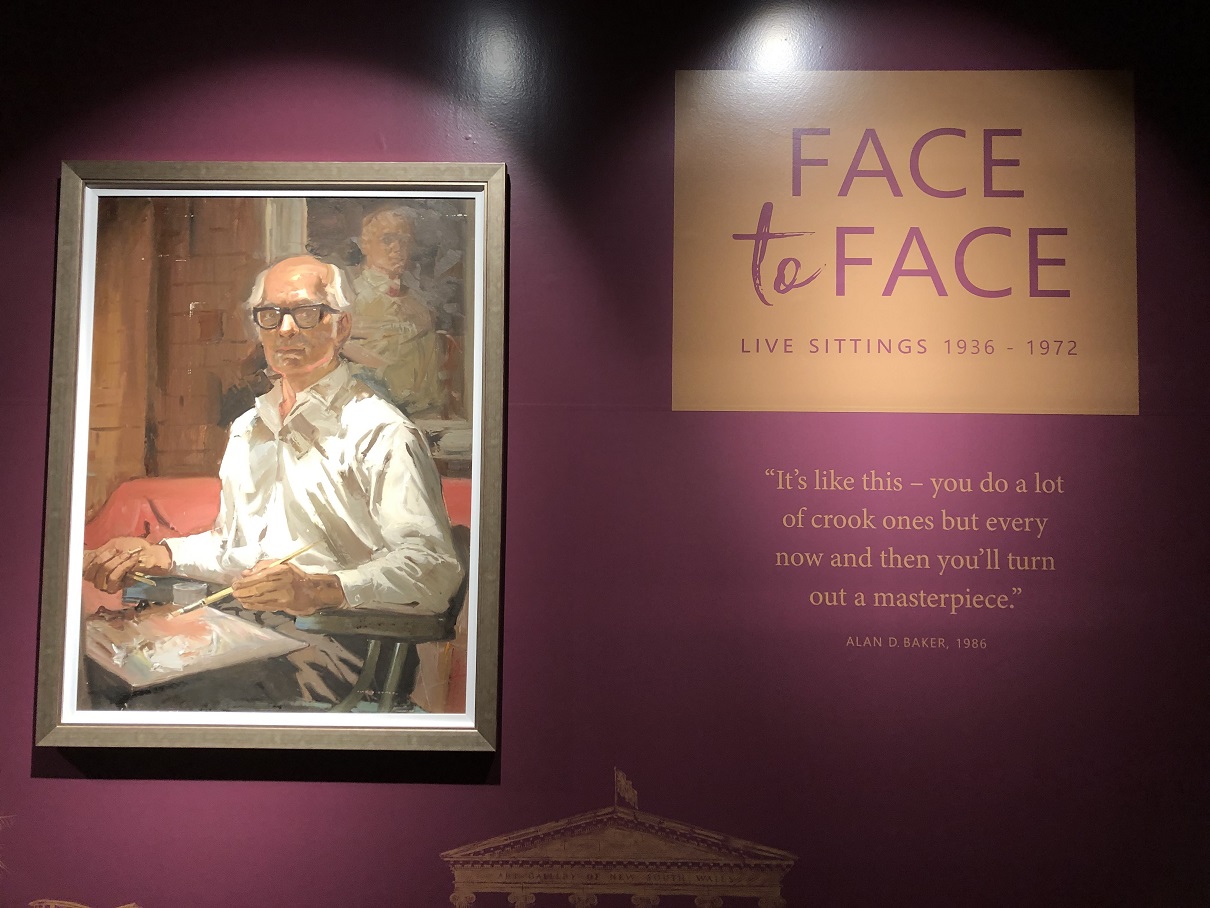
Baker created what might be called the Camden Realist School of Art. He followed the Realist tradition and shunned sentimentalism, modernist abstract and avant-garde styles.
Baker’s influence on Tegel is evident in the ‘Then and Now’ exhibition collection, represented by her ability to capture Campbelltown’s sense of place without sentimentalism or abstraction.
In the 1970s Baker encouraged a realist style amongst students at his Camden Public School art classes, which included Nola Tegel, Patricia Johnston, Olive McAleer, Rizwana Ahmad, and Shirley Rorke.
Baker encouraged a plein-air painting style, a tradition that
goes back to the French Impressionists in the mid-19th century by introducing paints in tubes. Before this, artists made their own paints by grinding and mixing dry pigments powder with linseed oils.
In Australia, the Heidelberg School of Artists regularly painted landscapes en plein air and sought to depict daily life from the 1890s.
Tegel displayed her deft skills as a practitioner of this style in her 2019 Maitland Regional Art Gallery exhibition called ‘In the Light of the Day’. Her artworks were described as coming
from a long standing tradition of painting en plein air, artwork created ‘in the moment’, painted and worked on in situ.
mrag.org.au/whats-on/nola-tegel-in-the-light-of-the-day/(opens in a new tab)
In 2018, Tegel documented the historic colonial Victorian homestead in Maryland at Bringelly, where she was privately commissioned ‘to create 60 paintings.’ These paintings have told the story of one of the Cowpastures most important colonial mansions and farms built between 1820 and 1850. (Then & Now Catalogue)
Patricia Johnston
Another member of the Camden Realist school is Camden-based artist Patricia Johnston.
Johnston is the ‘2021 Focus Artist’ at the Campbelltown Arts Centre for the ‘Friends Annual and Focus Exhibition’.
Another prodigy of Alan Baker and a fan of the plein air tradition, Johnston says that Baker
Revealed the challenge of capturing changing light conditions in open-air painting. The immediacy of this technique and the ability to analyse complex visual scenes established a groundwork that has greatly influenced my painting. The environment became by studio.
Friends Annual & Focus Exhibition Catalogue 2021
Realism on display
Camden Realism’s outstanding body of work is a collection of Alan Baker’s paintings, sketches, and other works at the Alan Baker Art Gallery Macaria in John Street Camden. The gallery presents the Alan Baker Collection, which is
a colourful portrayal of an artist’s life in 21st Century Australia.
Alan Baker Art Gallery Flyer
The Camden Art Prize, established in 1975, encourages Camden realism every year. The acquisitive art prize has various categories attracting a mix of artist styles, including traditional representational works.
Smaller exhibitions of Camden realism add to the body of work. In 2019, local artists Patricia Johnston, Nola Tegel, Bob Gurney, and Roger Percy mounted an exhibition called ‘Living Waters of Macarthur’ at Camden Library. The body of artworks told various stories of the local area in a visual form and captured the essence of place for viewers of local landscapes.
Art as storytelling
The body of work that has grown around Camden realism illustrates the ability of art to tell a story about place. The art style encourages a sense of emotional attachment to a locality by telling stories about the landscapes that surround the community.
Camden realism offers a visual interpretation of the storytelling of Macarthur landscapes and the communities within them. This body of work documents the changes across the local area from pre-European times to the present, illustrating that all these landscapes are transitional.
Perhaps leaving the last word to artist Courtney Jordon, who says:
Even if they are not aware of it, visual artists often develop some sort of narrative in their work..
So what does this mean?
Camden Realism is a School of Art that documents the local area in a different form of storytelling and documents the changing nature of the local landscape.
Local artists provide a different perspective on the Macarthur regional story and its interpretation through a creative process that expresses empathy and understanding about the creation of a sense of place and contributing to community identity.
The history of local artists and their works adds another layer to the complex nature of local stories and their telling to the community.
Art as a storytelling medium has a legitimate place in the telling and making of the history of the Macarthur region and its landscape aesthetic.
Updated 19 October 2024. Originally posted on 1 July 2021 as ‘Camden realism and storytelling’
Discover more from Camden History Notes
Subscribe to get the latest posts sent to your email.


One thought on “Exploring Camden Realism: Art as storytelling”
Comments are closed.