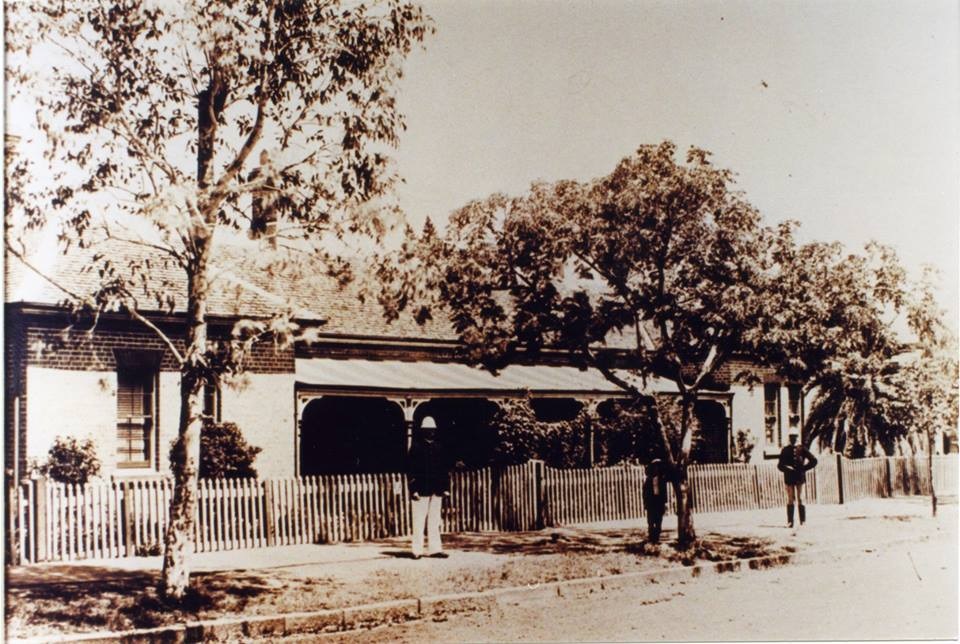
Camden Police Station and Residence
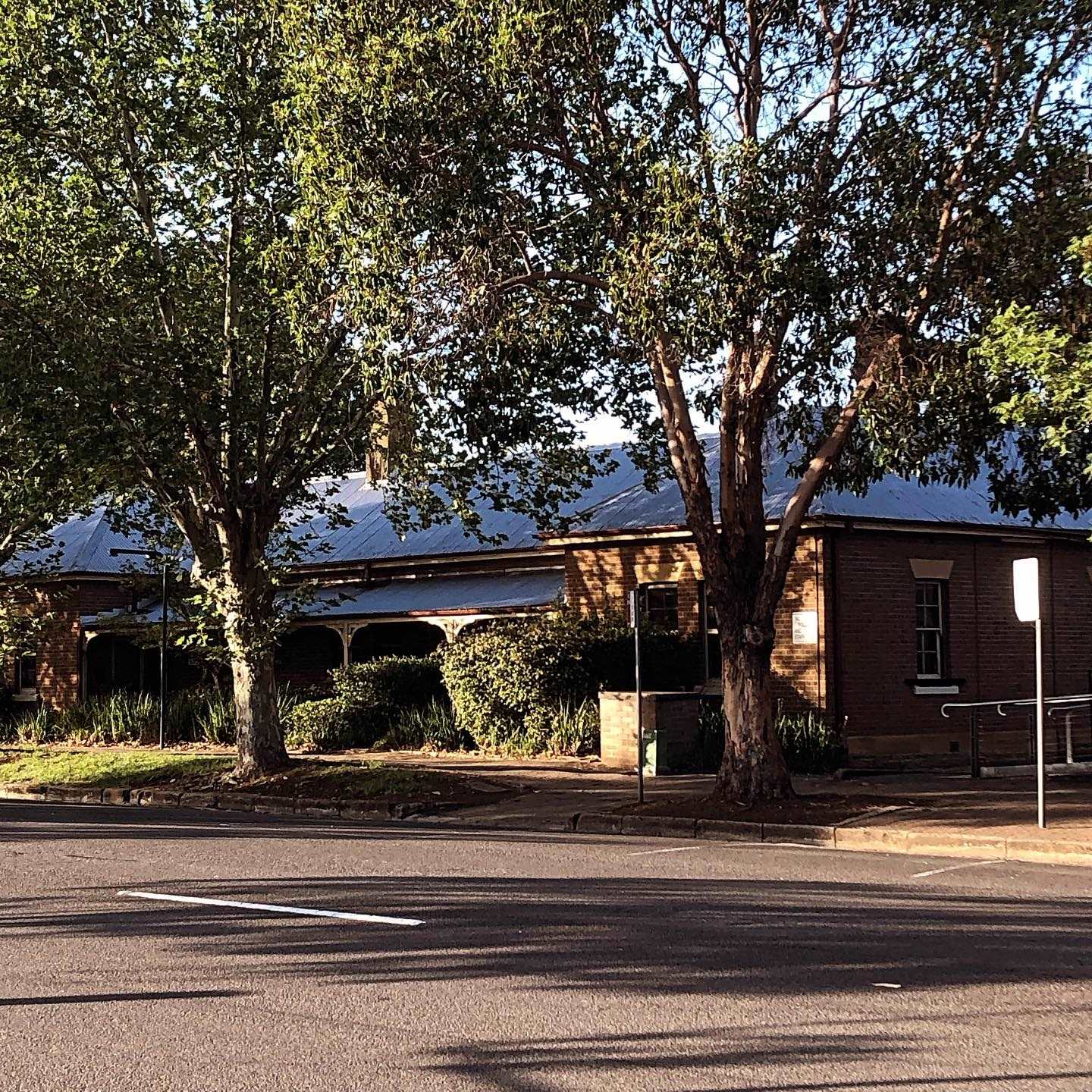
Camden Police Station is a single-storey brick building located at 35 John Street, Camden. It is typical of many official police buildings of the last quarter of the nineteenth century.
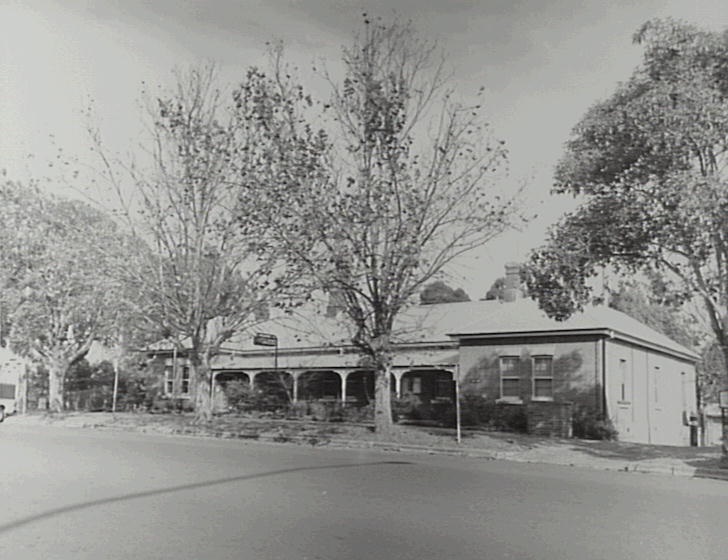
Before the John Street building was constructed, the police used a timber lock-up behind the adjoining residence building (c.1844). (http://www.camdenhistory.org.au/chhistoricplaces.html)
Colonial architect James Barnet designed the police barracks, which were built in 1878. Two adjacent police cottages were originally built in 1879.
Historical sources consider that the Police Sergeant lived on the west end of the building. The constable lived on the east end. The mounted constable boarded elsewhere. The police horse was kept in the non-Presbyterian church area (1925-1950). Wooden posts tethered the horse. (NSW SHI)
Camden Police Station has a corrugated iron-hipped roof and brick chimneys. The building has a paved verandah with carved timber posts and brackets. It has a four-panelled timber entrance door with a highlight window and eight-pane double-hung windows with sandstone sills. The front facade is symmetrically designed with two projecting wings and a central recessed verandah. It is situated next to the courthouse. (NSW SHI)
These police barracks were constructed in face brickwork, and the original picket fence along the footpath has been removed. The building has been restored and modernised to help it continue to be used as a Police Station.
There were alterations and additions in 1972 and 1980. (NSW SHI)
The barracks are a good example of the police buildings for that period. The verandah was once enclosed but has been fully restored in recent times.
The building is no longer used as a Police Station. The new Local Area Command Police Station was opened at Narellan on Friday, 12 August 2011. (http://www.camdenhistory.org.au/chhistoricplaces.html)
The building retains good integrity and intactness (NSW SHI). It is representative of the style of official or important early buildings in the town. The building’s value lies in its relationship to the other important buildings in the John Street Group. (Australian Heritage Database)
The building is listed on the Camden Heritage Inventory, part of the 2010 Local Environment Plan, Item 44.
Early policing
The first policing in the area occurred before the foundation of the Camden village in 1840. The area was known as the Cowpastures district, and there was a government reserve on the left bank of the Nepean River.
A police presence guarded the entry to the Cowpastures reserve at the river crossing. A government hut was constructed to accommodate Constables Warby and Jackson. The hut was east of the present Cowpastures bridge in what is now Elderslie. In 1817, Chief Constable William Charker was appointed with two constables, Joseph Scott and Robert Higgins.
At times, the Cowpastures district was a lawless place with roaming bushrangers. In 1830, soldiers shot bushranger Jack Donahue dead in a shoot-out at Bringelly. Donahue and his ‘Wild Colonial Boys’ had caused havoc between 1825 and 1830, roaming between Bathurst, Yass and the Hunter.
From the 1820s, the Cowpastures district began to be policed from within rather than from Parramatta or Sydney. Gentry property owners lived on their properties rather than making periodic visits. (Atkinson)
A Court of Petty Sessions was held at Cawdor from 1825, ‘with a small body of police’. Local gentry served as magistrates. (Atkinson)
On the right bank of the Nepean River In 1830, smallholder Edward Fletcher became the Chief Constable at Elderslie. The local lock-up was a slab hut on his farm. Two constables were placed at Kirkham.
Macquarie Grove and Kirkham were governed for police purposes from Bringelly. Along with Elderslie in 1832 they came under the control of the Campbelltown Bench. (Atkinson)
The first Cowpastures Bridge opened in 1826 at the Nepean River crossing. This opening increased local traffic along the Great South Road, requiring an increased police presence.
Stone Quarry, later Picton, was the major policing centre on the left bank of the Nepean River under Major Antill.
Anthill and the Macarthur brothers presided over the Magistrate’s Bench at Cawdor. In 1841, the Clerk of Petty Sessions for Picton and Cawdor moved into Camden. A new police district was created centred on the new Camden village.
More reading
Phillip Haylock, The Very Sociable Policeman, Camden History, Volume 3 No 7 March 2014, pp. 256-258,
Charlotte Hemans, ‘Policing Camden in the early years, Camden Police Station, 1805-1878’, Camden History, Vol 2, No 8, September 2009, pp. 305-312
The District Reporter, 6 March 2017
AGY-4737 | Cawdor Bench of Magistrates (): NRS-2901 | Bench books [Cawdor Bench of Magistrates]. Local Court of New South Wales.collection. https://search.records.nsw.gov.au/permalink/f/1ednqkf/ADLIB_RNSW110003144
Alan Atkinson, Camden, Farm and Village Life in Early New South Wales. (OUP, 1988, Sydney)
Discover more from Camden History Notes
Subscribe to get the latest posts sent to your email.

