Tarn House, Elderslie
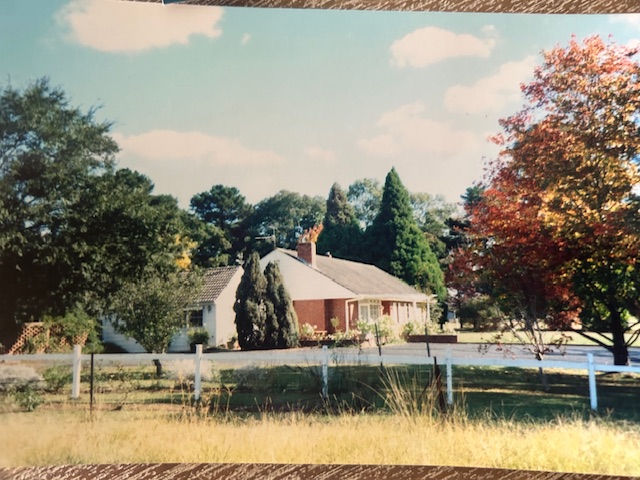
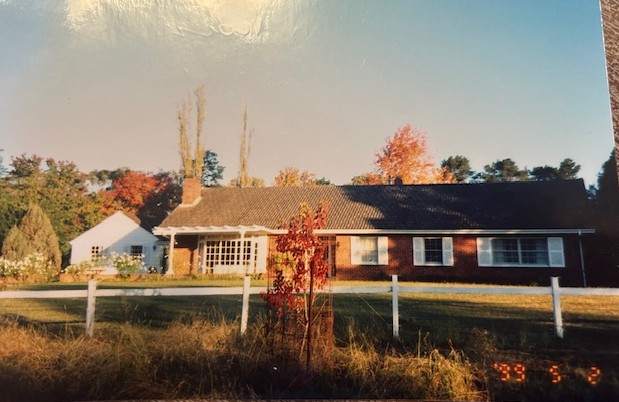
On a ridge to the south of Lodges Road in Elderslie was the site of Tarn House, a ranch-style house owned by surgeon Dr Gordon and June Clowes on Irvine Street, off Lodges Road. The ranch-style house is an example of mid-century modernism, characterised by a strong American architectural influence. Camden resident Bev Amor feels that this style of homes was ‘elegant’. (Amor 2025)
California’s ranch-style housing
Ranch-style housing originated in California and the southwest of the USA, where architects in these regions designed the first suburban ranch-style houses in the 1920s and 1930s. They were simple one-storey houses built by ranchers who lived on the prairies and in the Rocky Mountains.
The American architects liked the simple form that reflected the casual lifestyle of these farming families. After the Second World War, several home builders in California offered a streamlined, slimmed-down version. They were built on a concrete slab without a basement, with pre-cut sections.
The design allowed for multi-function spaces, such as living-dining rooms and eat-in kitchens, which reduced the number of walls inside the house. The design was one of the first to orient the kitchen/family area towards the backyard rather than facing the street.
The design also placed the bedrooms at the front of the house. The marketing of the ranch-style house tapped popular American fascination with the Old West. (Washington Post, 30 December 2006)
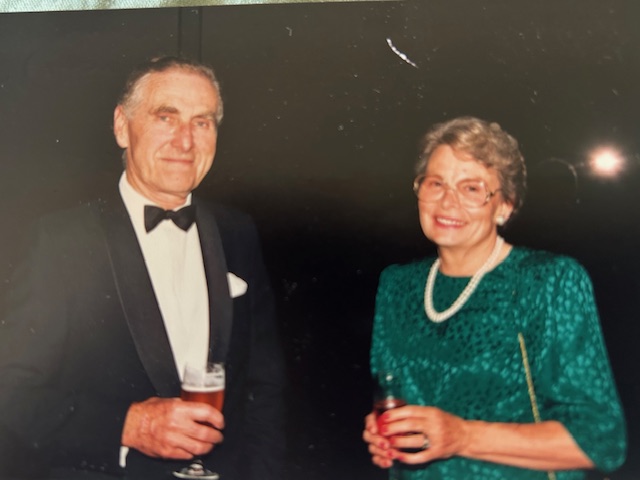
Gordon Clowes
Dr Clowes, who died in 2015, was born in Croydon Park in 1921, grew up in Camden, studied at the University of Sydney, and held junior posts at Sydney Hospital and, as many Australians did, went to London in 1956 and worked at the Postgraduate Medical School, Hammersmith, London under IanAird, and at St Thomas’ Hospital. He returned to Australia in 1957.
Clowes held an honorary position at Prince Henry Hospital and was a visiting surgeon at Camden, Liverpool, Nepean, and Blacktown Hospitals. He was actively involved in the community, serving as an alderman on the Camden Council and holding the position of deputy mayor. He was a long-time member of the Camden Rotary and served as president in 1963. He married June Clinton in 1955 and had four children. (Gillam 2015; Elmerhebe 2015)
June Clowes (nee Clinton)
Melissa Baker (nee Clowes) writes:
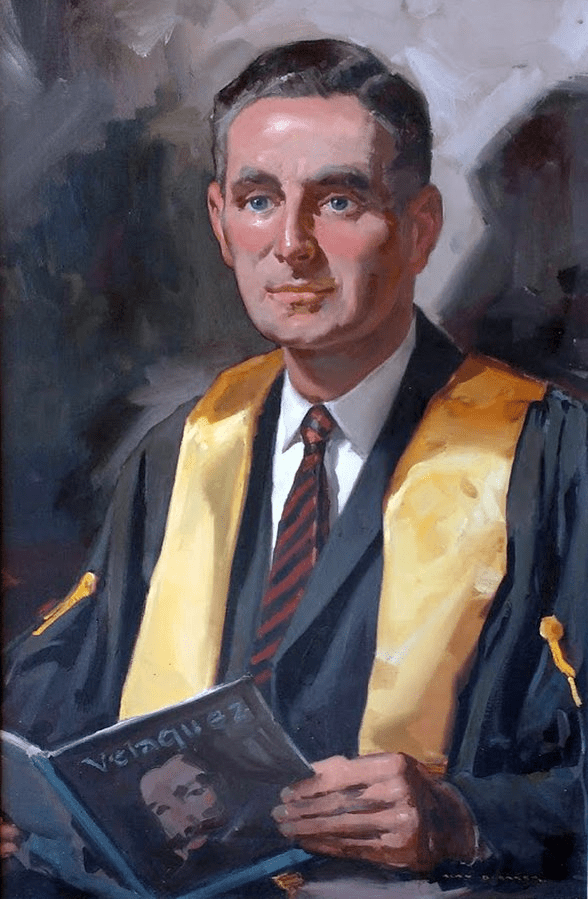
My mother, June ( Clinton) Clowes, was born in Newcastle in 1931. Soon after, she moved with her family to live in Burragorang Valley when her father, Bill, and grandfather, Jack Clinton, secured a mining lease to mine coal from the area along with brothers Ern and Alan and their families. This marked the beginning of coal mining in the Burragorang Valley.
June moved with her family into Camden at 8 years old when the mines were successful, and they bought a house in Elizabeth Street. Later, Bill built a large residence at the top of Somerset Avenue, Narellan, called “ Somerset Park”. June spent her teenage years and beyond in this house until she married Gordon Clowes. (Baker 2025)
June went to the UK for a year during the Queen’s Coronation in 1953 with Enid Clifton and travelled over on the RMS Maloja, arriving in February. (Camden News, 5 February 1953)
The House
Melissa Baker (nee Clowes) writes:
My parents’ home was built in 1963 when I was four years old. I grew up here.
It was built on 60 acres at Elderslie near Camden by Dr Gordon Clowes and his wife, June ( Clinton). They named it Tarn House after a lake ( tarn) in the Lake District of England called “Tarn Howes”.
Our home was at the top of Irvine Street. There were no road numbers. Dad collected mail from his Camden post box.
There were the Moloneys next door, Mrs Webster and then my Nan on acreage in the same street. The Parkers lived in a cottage about halfway along Irvine Street. They were the only houses.
Dad was a farmer at heart and always had Hereford cattle on the property. The vicinity was near Camden, so he could get to the hospital when needed. (Baker 2025)
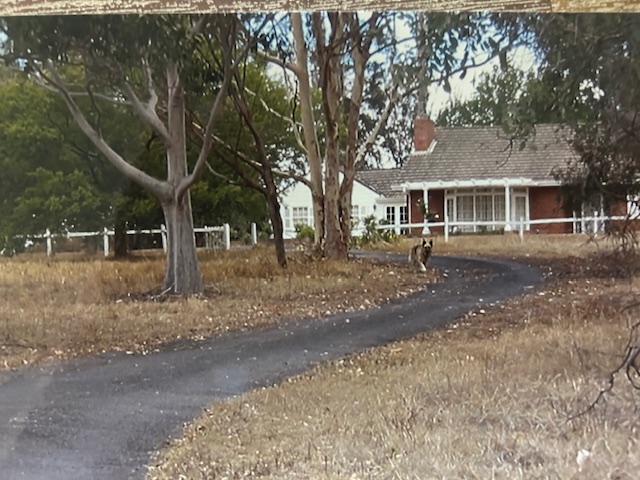
In 1972, the government resumed land at the back of the property to construct the Camden bypass road, leaving them with around 35-40 acres.
In 2002, a developer wanted to develop all the land in the area, including the neighbours, and at first Dad was reluctant, but soon realised it was going ahead and didn’t want to be the last house there surrounded by houses. They sold up and moved to Cobbitty. (Baker 2025)
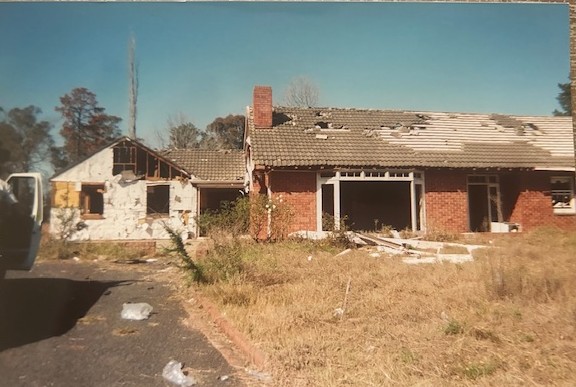
Another mid-century ranch style that was lost in the 2010s was The Hennings House in Elderslie.
Kalinda, Elderslie
Kalinda in Elderslie was another mid-century ranch-style house that is part of the lost Camden story. Located off Lodges Road and owned by Andrew Whiteman, the house was demolished due to the implementation of the New South Wales government’s 2000 Elderslie Urban Release Area plan.
The Whiteman House, Kalinda, was high on the ridge with a pleasant outlook facing west over the Narellan Creek floodplain. Visitors approached the house from Lodges Road by driving up to the ridge’s top along a narrow driveway. The Whiteman family owned a general store in Camden that operated for nearly a century.
Camden resident Megan Murdoch states that her father, Leon Young, ‘built many of the high-end homes of this era in Camden, and he took such pride in his work. ‘ (Murdoch 2025)
Murdoch feels that it is ‘such a shame that many of these [houses] are now gone’, while Elderslie resident Andrew Lundy calls it ‘cultural vandalism’. (Murdoch 2025; Lundy 2025)
Reflection
Ranch-style residential architecture typified the high end of housing in the Camden area in the 1960s.
These houses were typically constructed of timber, although some were later built of brick.
Tarn House and Kalinda were part of Camden’s mid-century modern heritage, which was expressed through ranch-style residential architecture.
Architect Robert Irving has noted the housing style as an Australian domestic architecture. Parramatta City Council has recognised the housing style of heritage significance.
There are a few of these houses remaining in the local area, and they are part of the story of lost Camden.
On a positive note, Melissa Baker (Clowes) writes
It is wonderful to read the history of the homes around Camden built in the 1960’s and of course my own family home. It was a magical upbringing. A trip down memory lane for me and the families I knew in my youth.
Without the telling of these stories, they too will be lost and disappear into the dark reaches of the past.
Nostalgia and memory are powerful historical tools that can help mould community identity and the construction of a sense of place, including the story of Camden’s mid-century modern housing.
Resources
Amor, Bev 2025, Comment on Camden District page, Facebook, 13 November.
Baker, Melissa 2025, Emails to Ian Willis, 13 November, 14 November.
Elmerhebe, Tarik 2015. Valuable doc dies. [online] Macarthur Chronicle. Available at: https://www.dailytelegraph.com.au/newslocal/macarthur/camden-doctor-gordon-clowes-passes-away-aged-93/news-story/f8a0bd095dc50ad40b206d846da5ea1c [Accessed 12 Nov. 2025].
Gillam, S. (2015). E007656 – Clowes, Gordon Joseph (1921 – 2015). [online] Plarr’s Lives of the Fellows. Available at: https://livesonline.rcseng.ac.uk/client/en_GB/default/search/detailnonmodal/ent:$002f$002fSD_ASSET$002f0$002fSD_ASSET:379839/one?qu=Gordon+clowes&h=0[Accessed 12 Nov. 2025].
Lundy, Andrew 2025, Comment on Camden History Notes page, Facebook, 13 November.
Murdoch, Megan 2025, Comment on Camden History Notes page, Facebook, 14 November.
Updated 16 November 2025. Originally posted on 13 November 2025.
Discover more from Camden History Notes
Subscribe to get the latest posts sent to your email.

