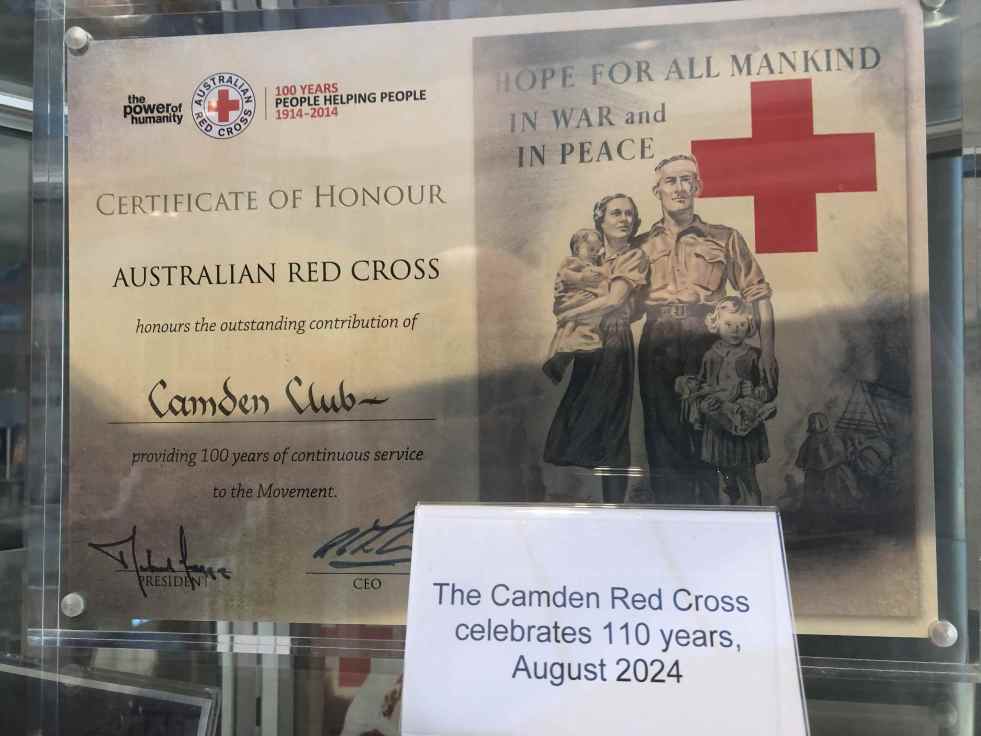
Camden Red Cross 110 Years August 2024
Display of Objects and Ephemera
Camden Library, 40 John Street, Camden, NSW
July-August 2024
Curator Julie Wrigley
Overview
Camden Red Cross
The Camden Red Cross exhibition at Camden Library in August 2024 showcased the historical contributions of local women to the Red Cross during World Wars I and II. Women from the Camden district joined the Red Cross, sewing, knitting, and fundraising for the cause. Led by influential women like Enid Macarthur Onslow and Sibella Macarthur Onslow, they played a pivotal role in supporting soldiers and shaping the narrative of the Australian Red Cross. This exhibition sheds light on the personal and inspiring stories of these women, emphasizing the significance of local studies in understanding extraordinary historical events. The exhibition is part of a larger project funded by the Australian Government and is featured at the Camden Museum until late 2014.
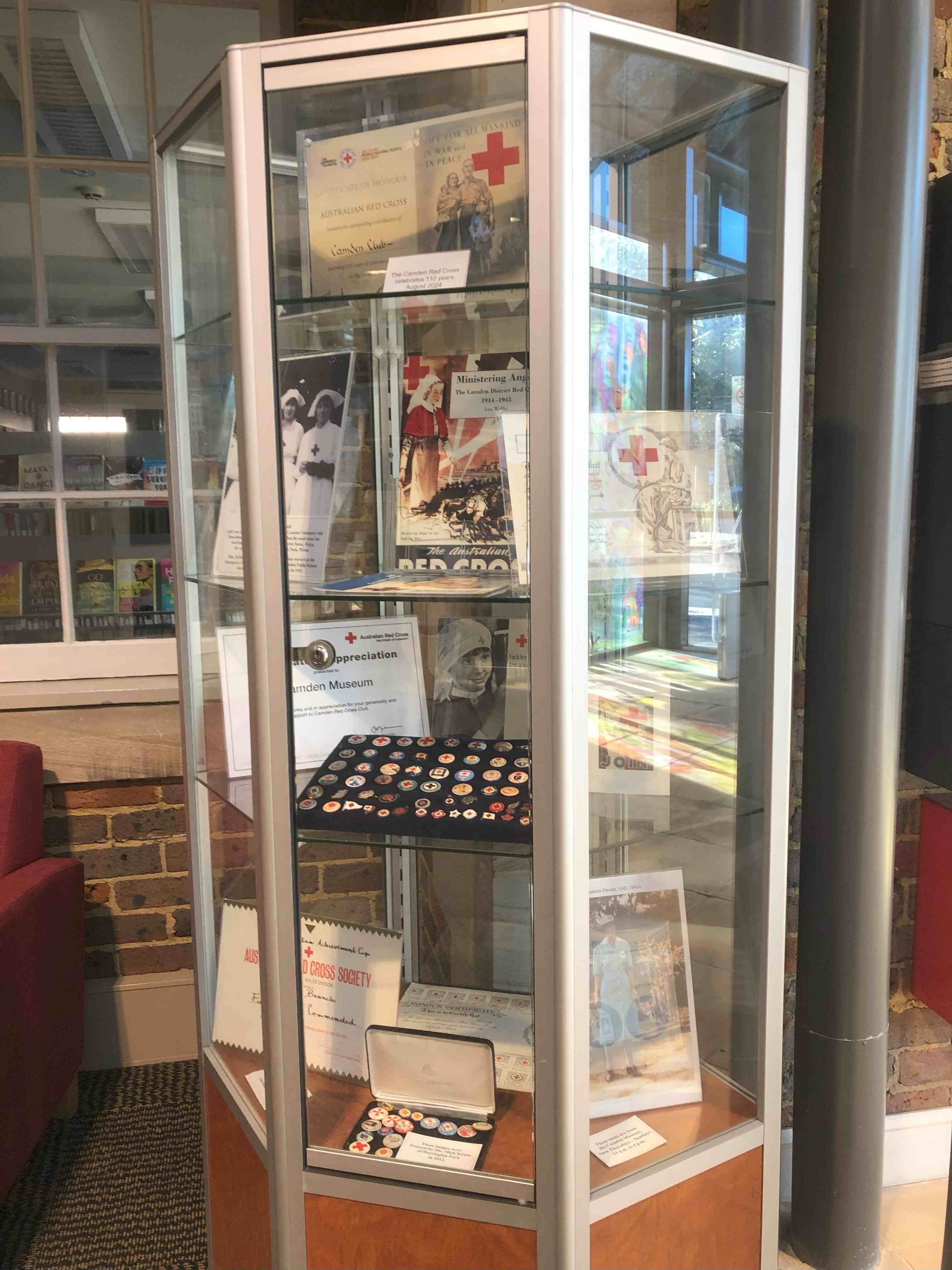
Display objects and ephemera
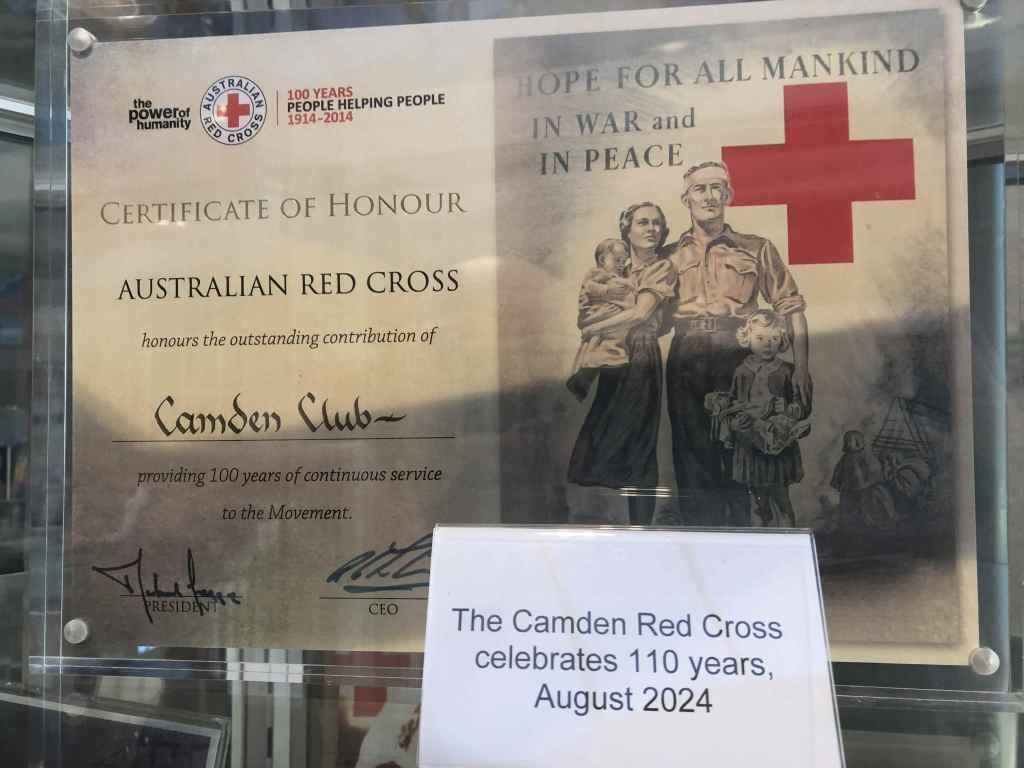
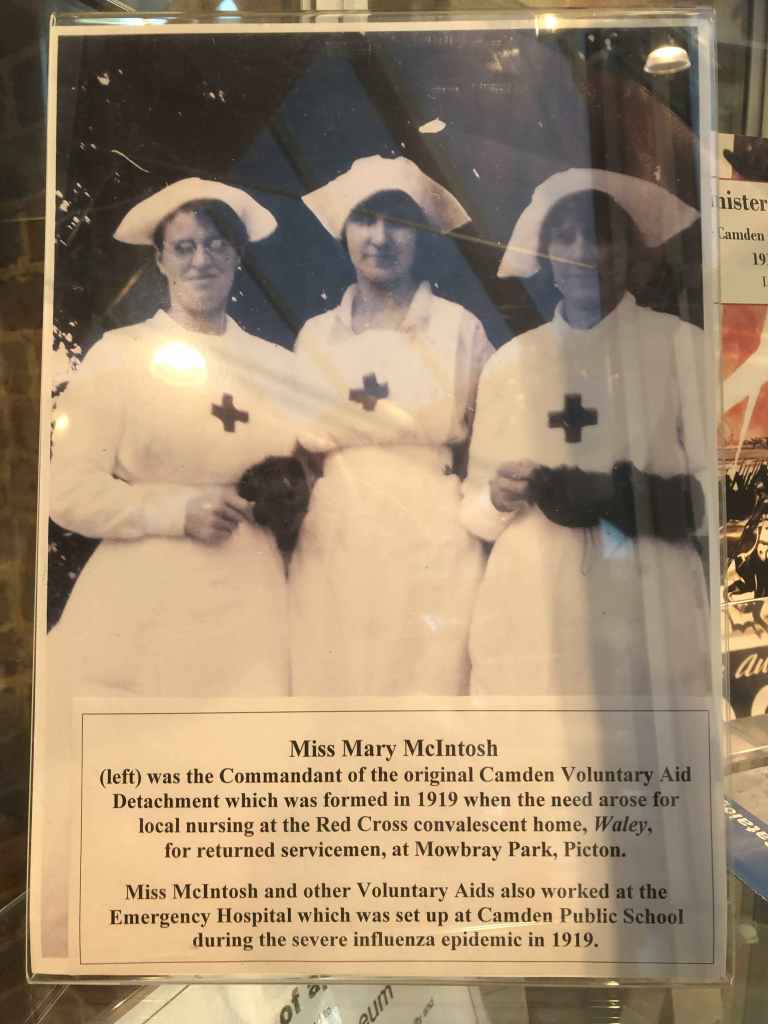
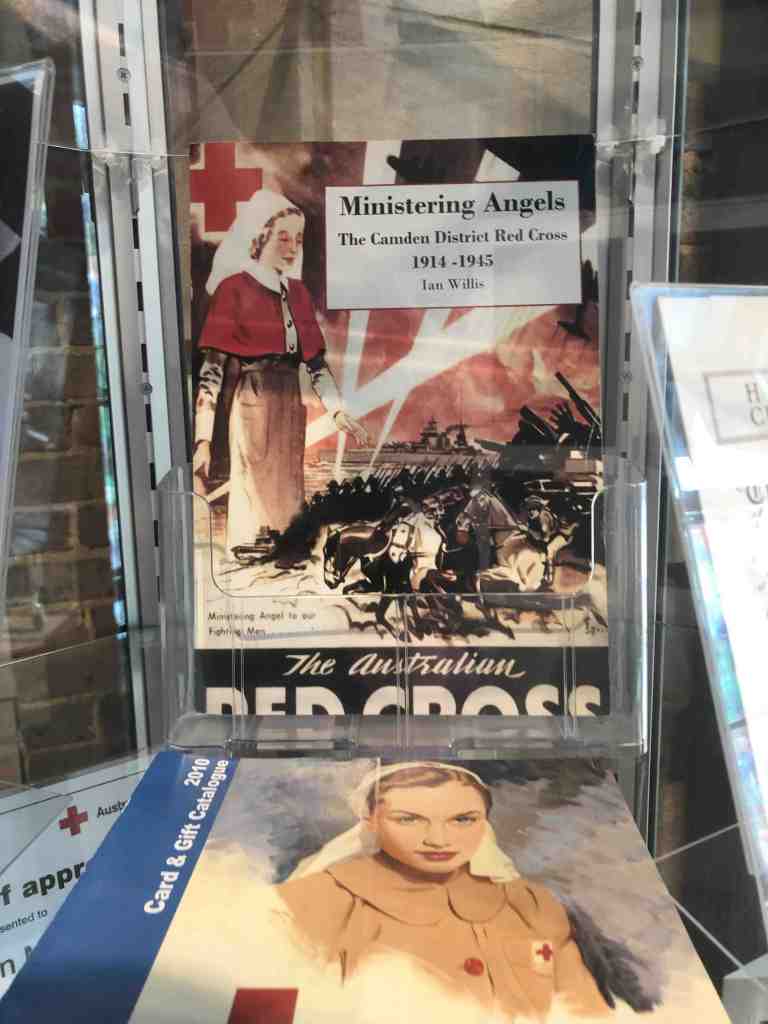
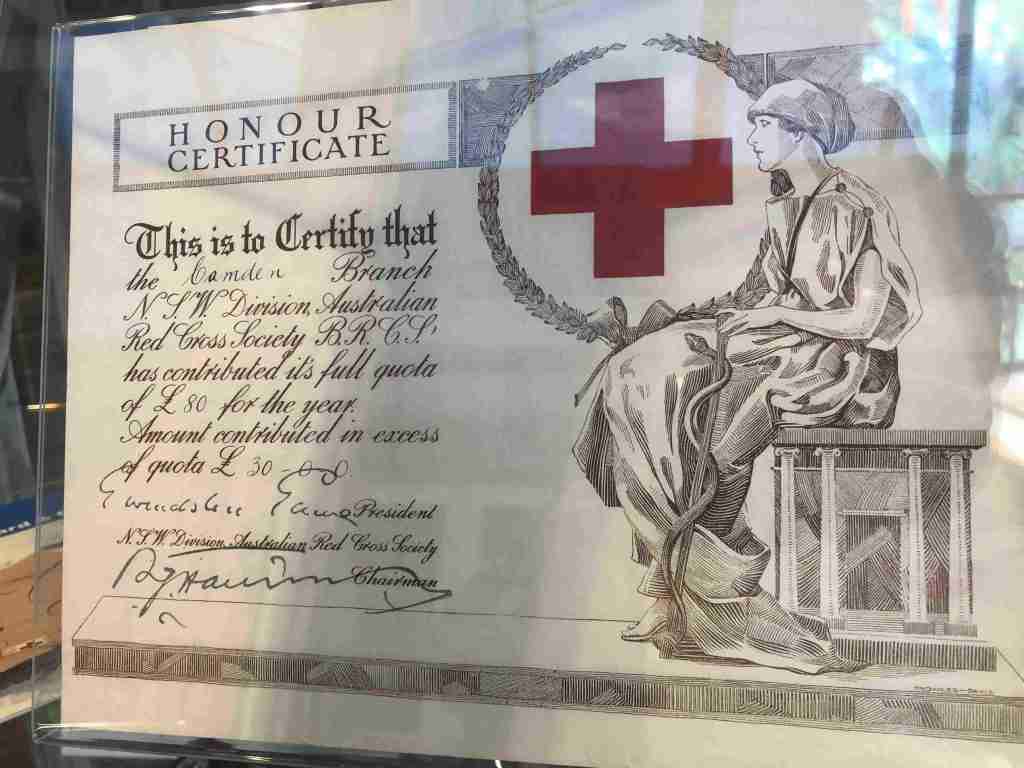
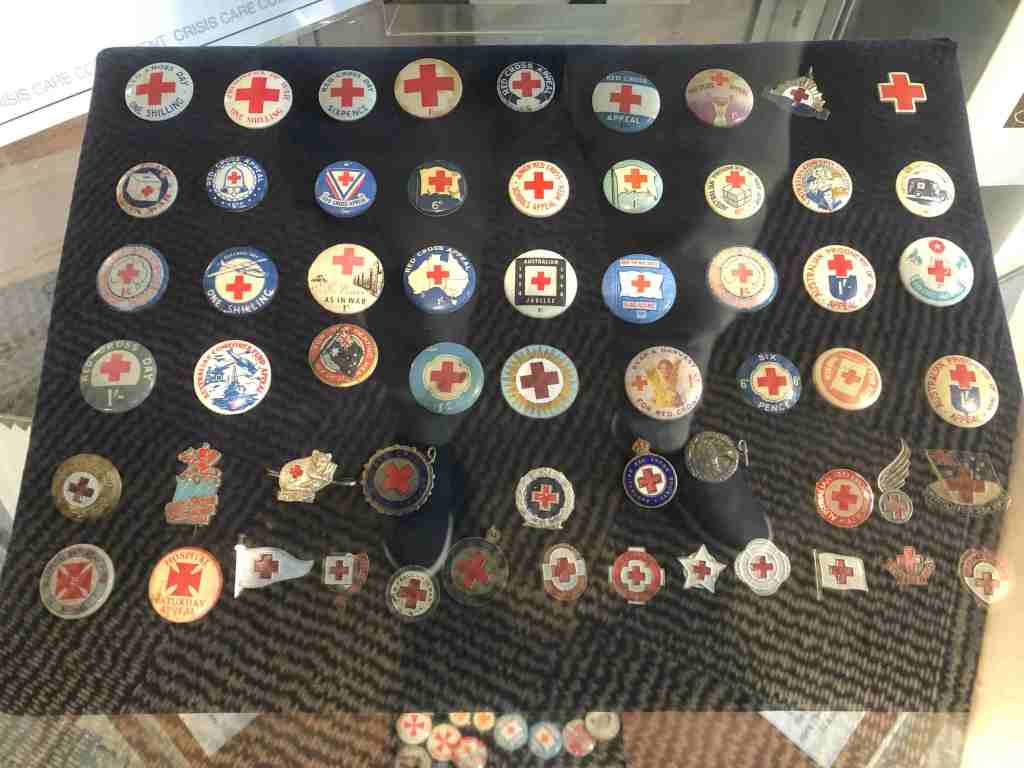
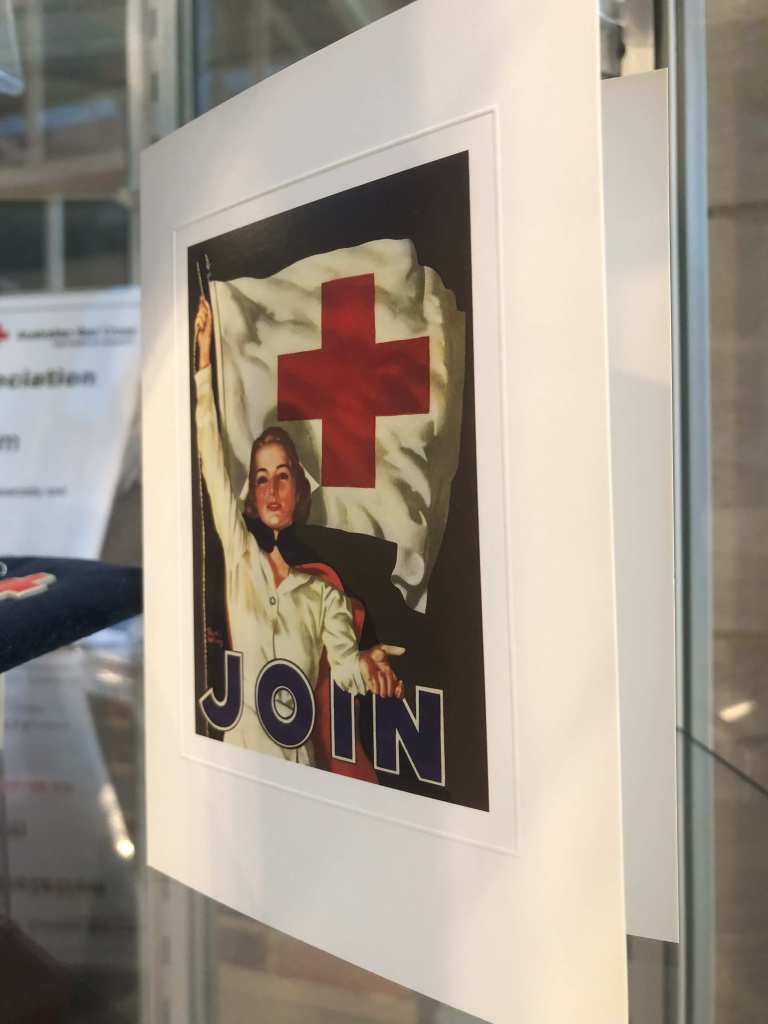
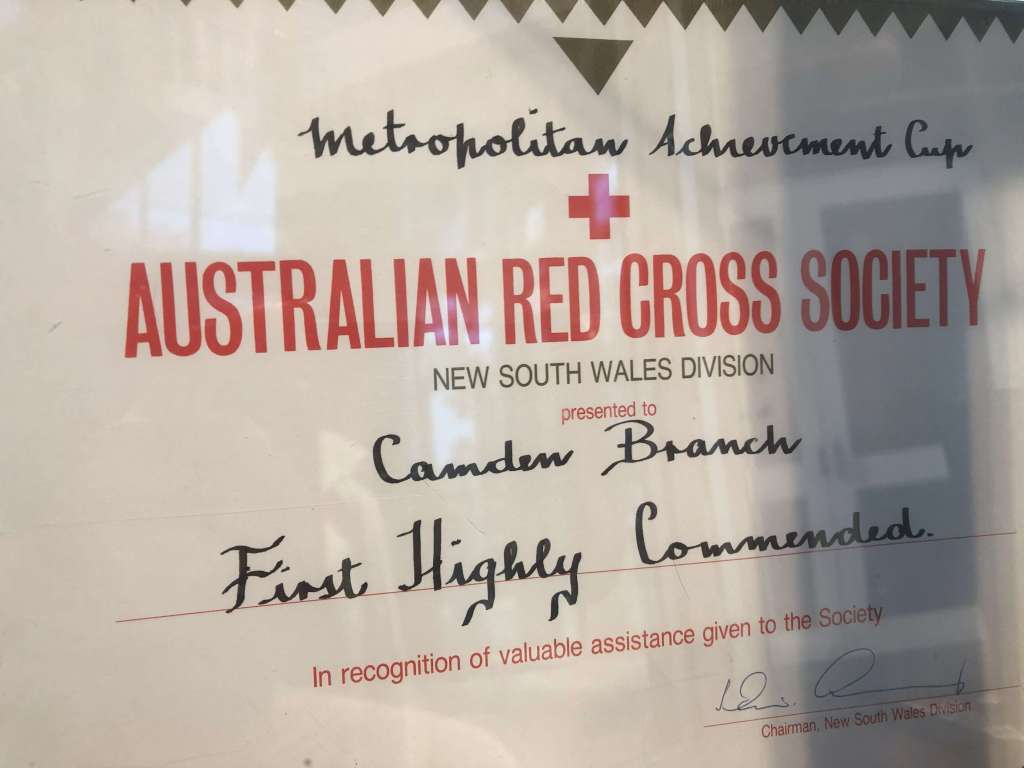
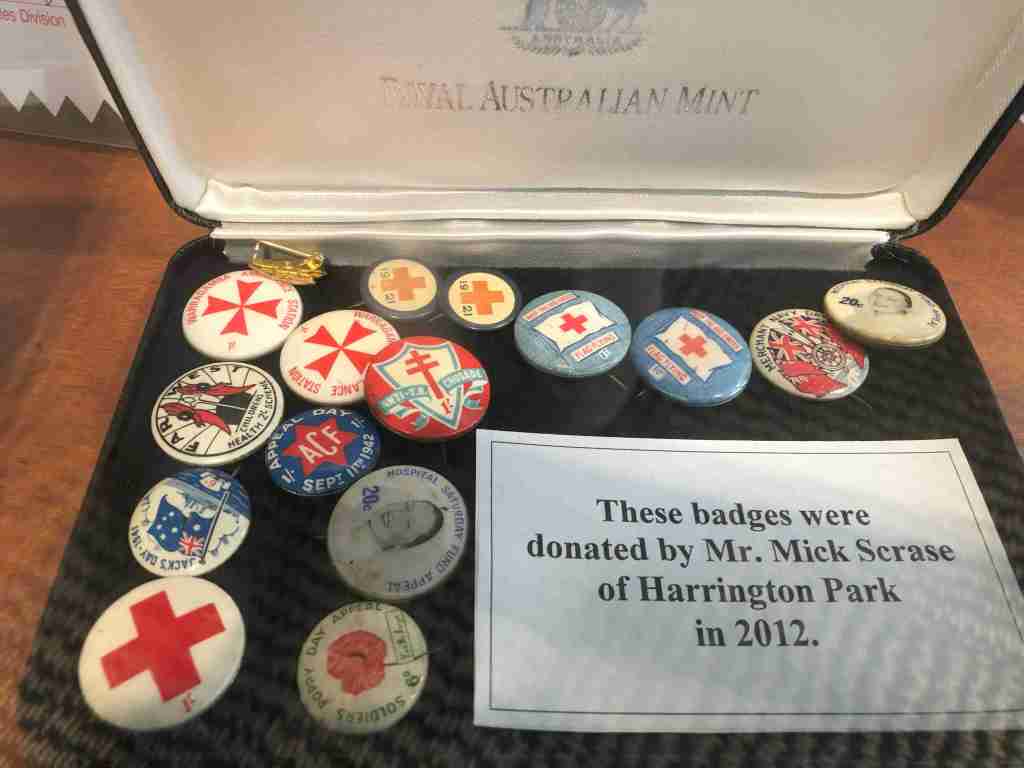
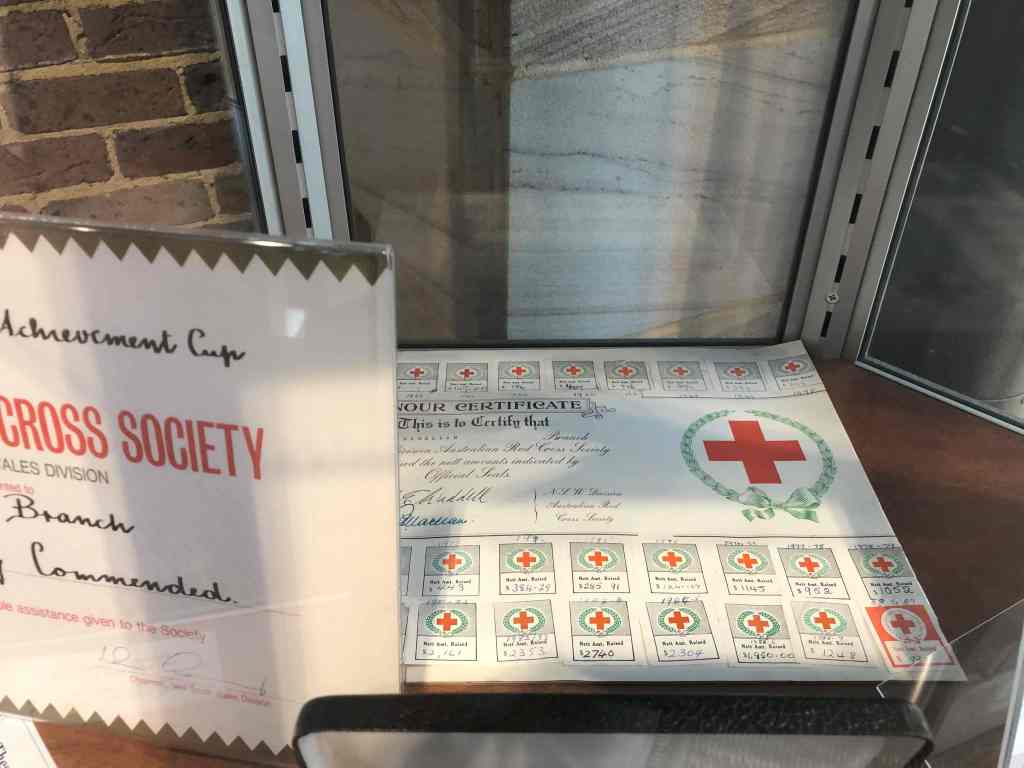
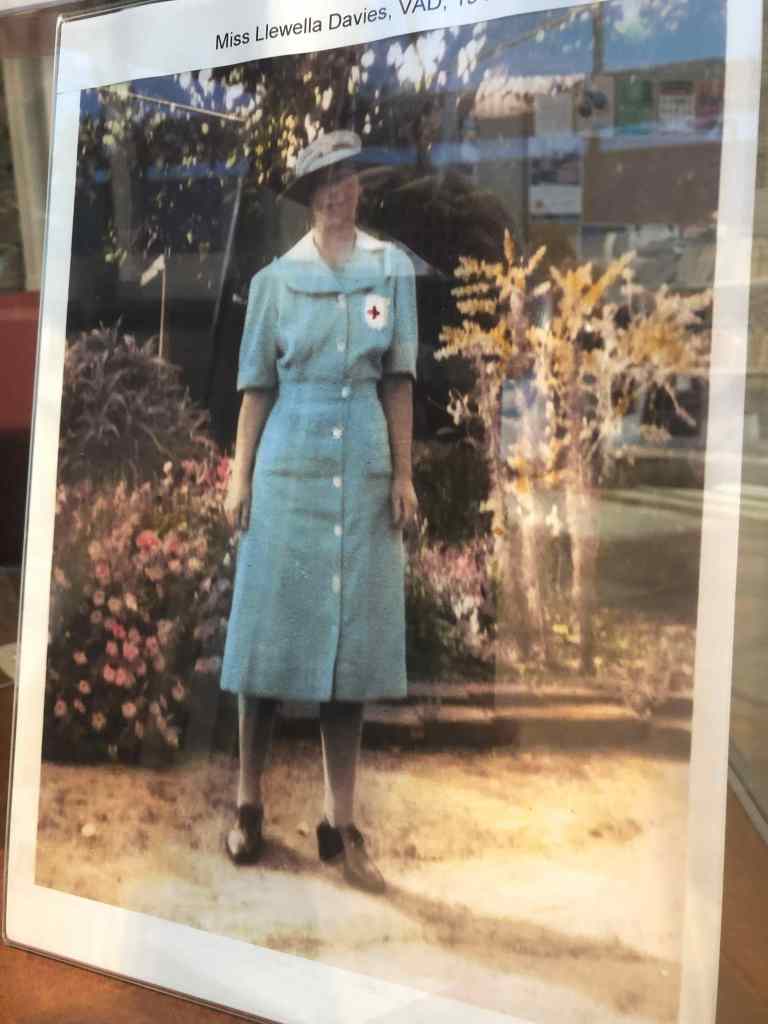
Ministering angels to our warriors of the Empire
A story
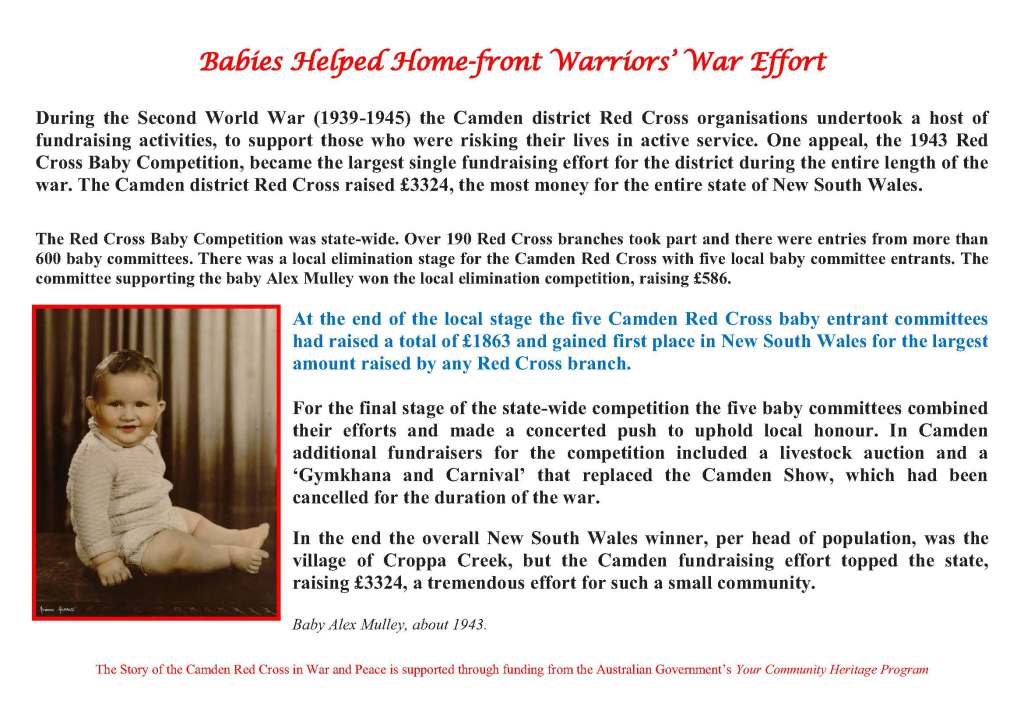
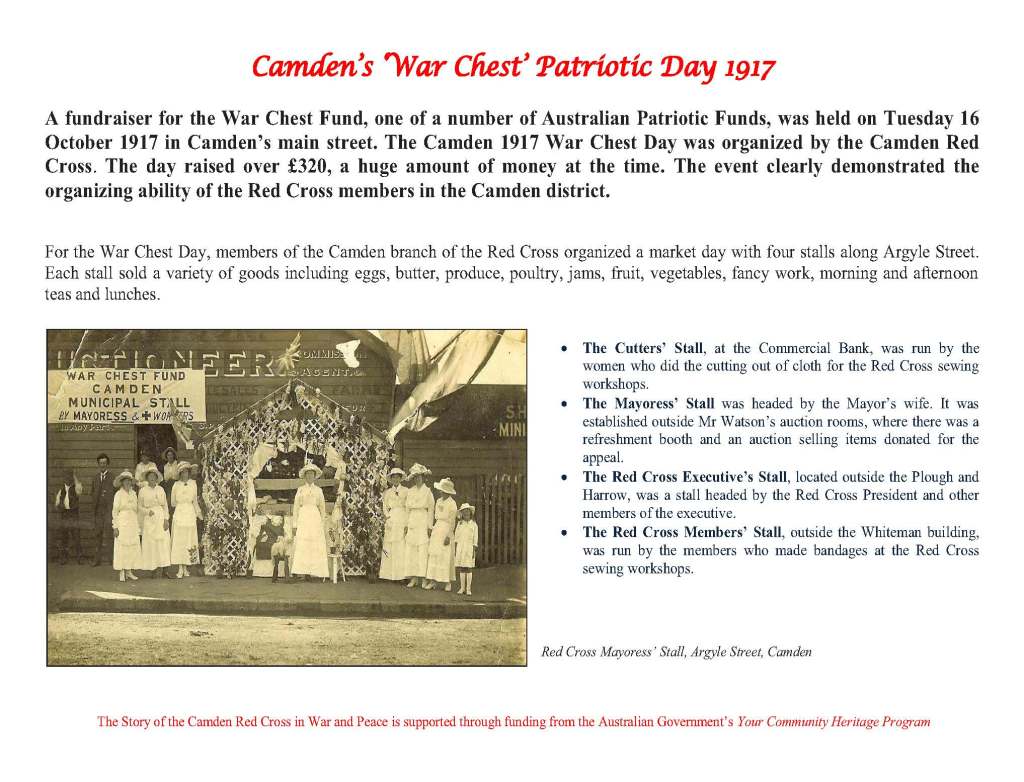
This is a wonderful story of conservative country women doing their patriotic duty in an outpost of the British Empire. From 1914, Camden district women joined local Red Cross branches and their affiliates in the towns and villages around the colonial estate of the Macarthur family at Camden Park. They sewed, knitted and cooked for God, King and Country throughout the First and Second World Wars, as well as during the years in between. They ran stalls and raffles and received considerable community support through cash donations from individuals and community organisations for Red Cross activities.
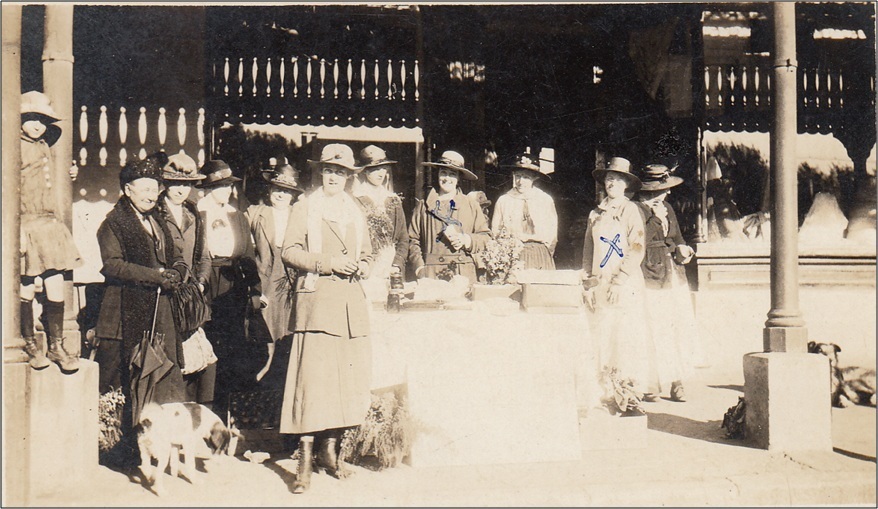
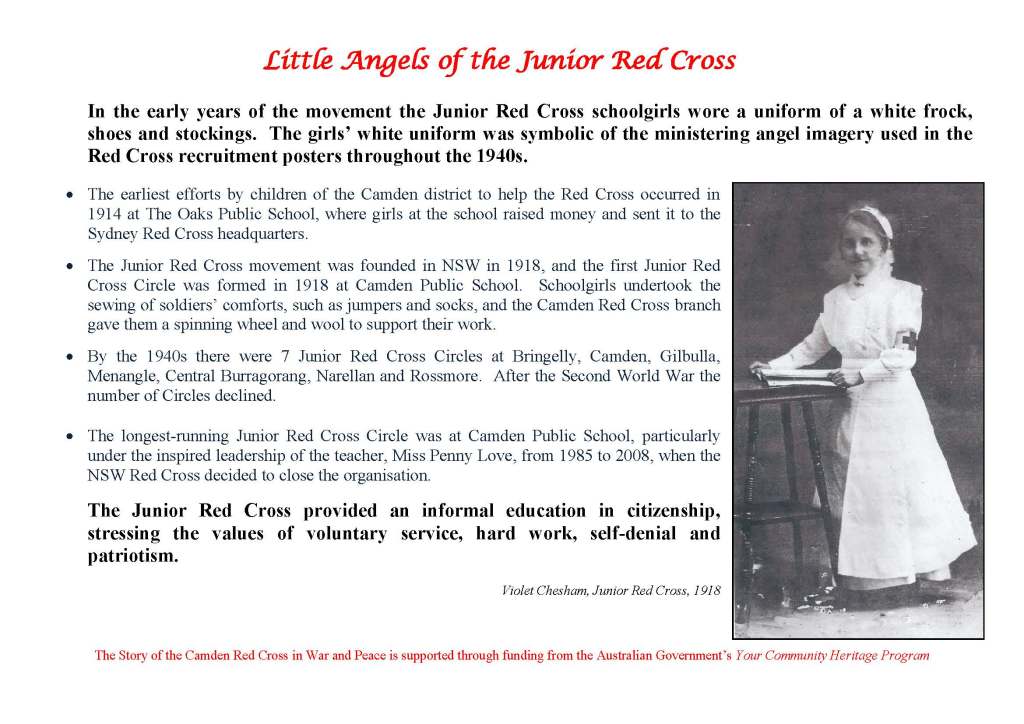
The Red Cross was a national federation of state-based divisions with a place-based branch network that attracted middle-class women as volunteers. Under the enlightened leadership of founder Lady Helen Munro Ferguson, local branches across the country harnessed and thrived using parochialism and localism for national patriotic purposes. The society reinforced this with an iconography that presented the organisation as mothers and guardian angels to wounded soldiers on the battlefield. The Red Cross encouraged women to immerse themselves in the ministering angel mythology and serve ‘their boys’ by volunteering at branch sewing circles and fundraisers, as well as volunteer aids at military, civilian, and Red Cross hospitals.
Camden’s Edwardian women, Enid Macarthur Onslow, Sibella Macarthur Onslow and their ilk, provided leadership at a local, state and national level. These women were intelligent, wealthy, and powerful, and they had extensive transnational networks between Camden, Sydney, Melbourne, and London. Their families, along with others from the district, provided their fathers, sons and brothers as imperial warriors for Australia’s overseas military excursions from the time of the Boer War, and local women worked to support ‘their boys’. The leadership group created ground-breaking opportunities that empowered country women and allowed them to exercise their agency by undertaking patriotic activities for the first time within the strict confines of rural life.
The experience of these women was highly personal, sometimes tragic, and always inspiring as they devoted their lives with missionary zeal for the Red Cross cause. In their wake, the women created the most important voluntary organisation in district history, a small part of the narrative of the Australian Red Cross, arguably the country’s most important not-for-profit organisation. Their stories were the essence of place, and the success of the district branches meant that, over time, homefront volunteering became synonymous with the Red Cross. Local Red Cross volunteering in war and peace provides a small window into the national and transnational perspectives of one of the world’s most important welfare organisations. [Ed.note: Vol 10, No 2 (2013) of History Australia contains several articles on the International and Australian Red Cross societies.]
This work, and other local studies like it, are few and far between. Those that do exist tell the story of ordinary people in extraordinary times. Local studies are part of the appeal of Australian history and have an enduring popularity. Unfortunately, many dismiss them as unimportant, thereby devaluing their potential to provide a useful model for historical research. This lecture is part of a larger project funded under the Australian Government ‘Your Community Heritage program’ and is supported by an exhibition currently showing at the Camden Museum (see http://www.camdenhistory.org.au) until late 2014
Ian Willis reports on a public lecture he presented on 9 October 2013 at the Camden Historical Society called ‘The story of the Camden district Red Cross in war and peace, 1914-1945’.
Republished from PHA (NSW) Blog online at https://www.phansw.org.au/ministering-angels-to-our-warriors-of-empire/
Information boards compiled by Julie Wrigley for the CHS Red Cross exhibition on 13 August 2013
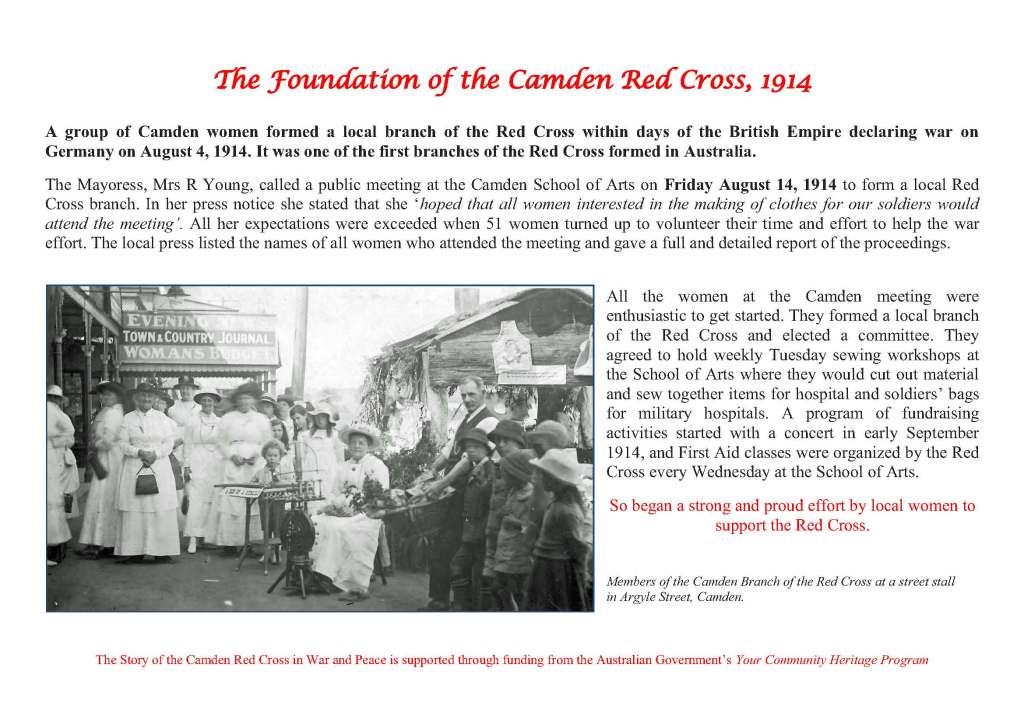
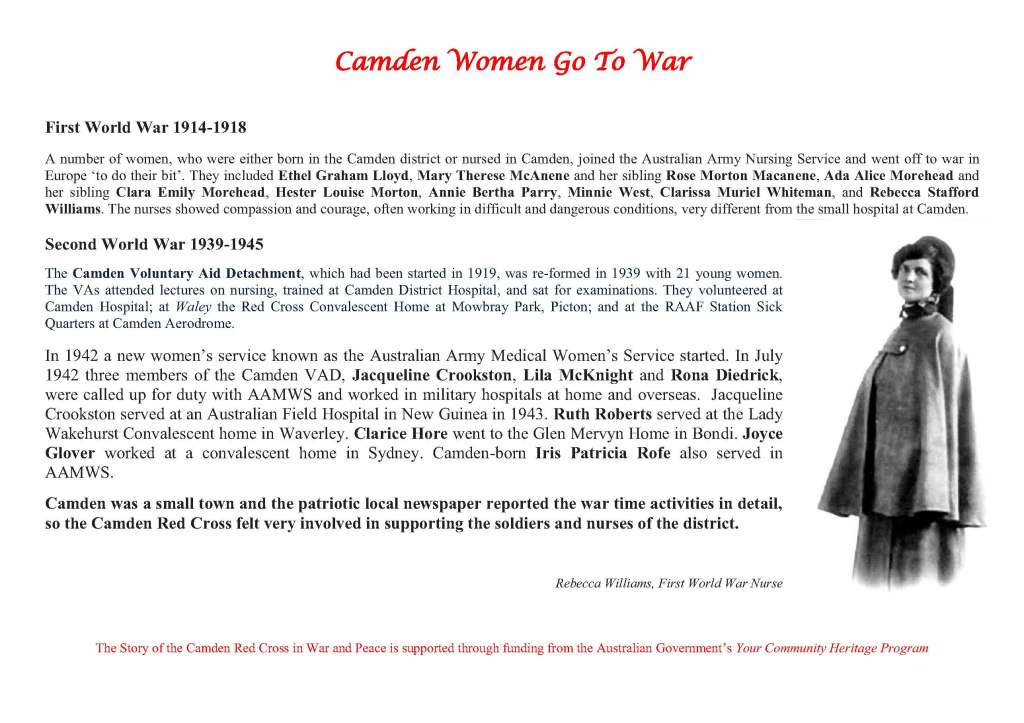
Camden Red Cross Sewing Circles in wartime
The genesis of the Red Cross sewing circle in Camden
Local women founded a Red Cross branch in Camden soon after war broke out in Europe in August 1914. A sewing circle began shortly afterwards, at which between 80 and 100 women would gather every Tuesday.
Volunteer members worked together to produce articles for injured troops, raise funds and solicit community donations towards the sewing efforts. This helped the branch meet the cost of purchasing materials and equipment.
The Camden Sewing Circle’s output during the First World War was remarkable. At every meeting, sewing machines whirred constantly, and some women stitched while others cut fabric.
Prolific output
By the end of the first week in September 1914, the women had produced 90 pairs of pyjamas, 53 flannel shirts, 55 kit bags and 75 handkerchiefs.
The sewing circle also acted as a collection centre for woollen socks knitted by district women. They worked hard to keep up with the constant demand. In the wet and muddy trenches on the Western Front, socks soon rotted through. Unless replaced regularly, this led to the dreaded problem of ‘trench foot’.
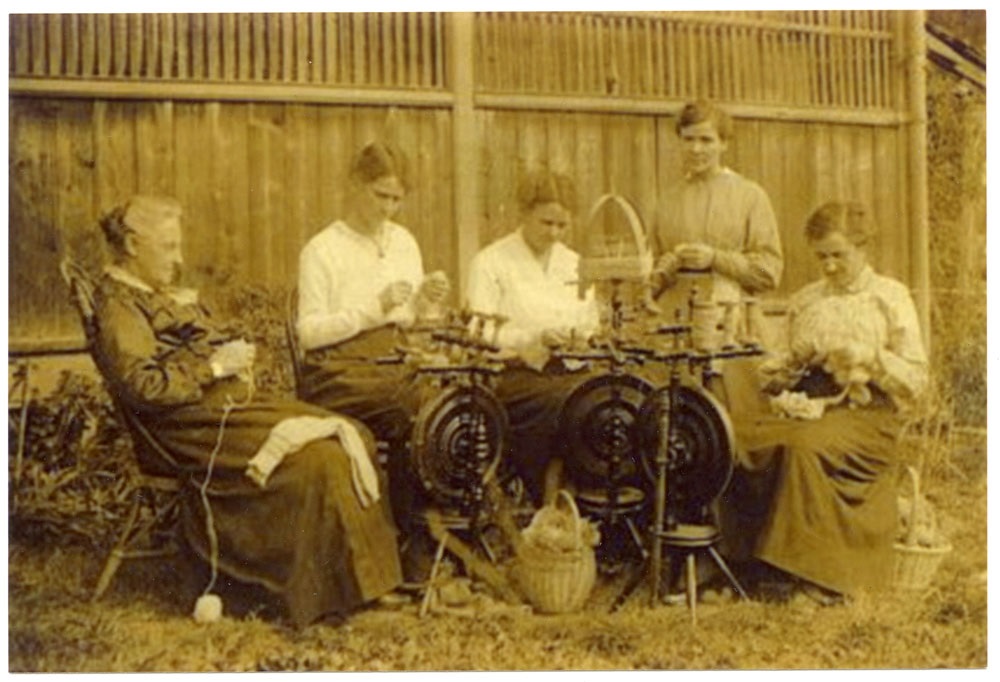
Spinning wheels were used towards the end of the war, as the cost of wool soared, forcing the women to spin their own yarn.
Altogether, Camden’s sewing circle produced more than 20,300 articles in 40,000 volunteer hours during the war.
Branch members also organised concerts, bazaars, garden parties, and other community events to raise funds for Red Cross causes.
A rise (and fall) in numbers
By 1918, the sewing circle had grown too big for the space. Foresters’ Hall in nearby Argyle Street provided more generous quarters, but branch membership numbers fell when the war ended.
The Camden sewing circle closed in September 1919, although its members continued to fundraise, take part in community events and support the agenda of the national Red Cross.
Picking the needles up again
When the Second World War was declared on 1 September 1939, branch members quickly reconvened to restart their knitting and sewing efforts. Once again, Camden sewing circle meetings were held regularly right up until August 1946, when the circle disbanded.
Between 1940 and 1946, in addition to their fundraising efforts, the women of the Camden Red Cross made more than 25,000 articles of clothing in 45,000 hours of volunteering (that’s the equivalent of 1,875 days or just over 5 years) – a selfless contribution during some of the darkest times in Australia’s history.
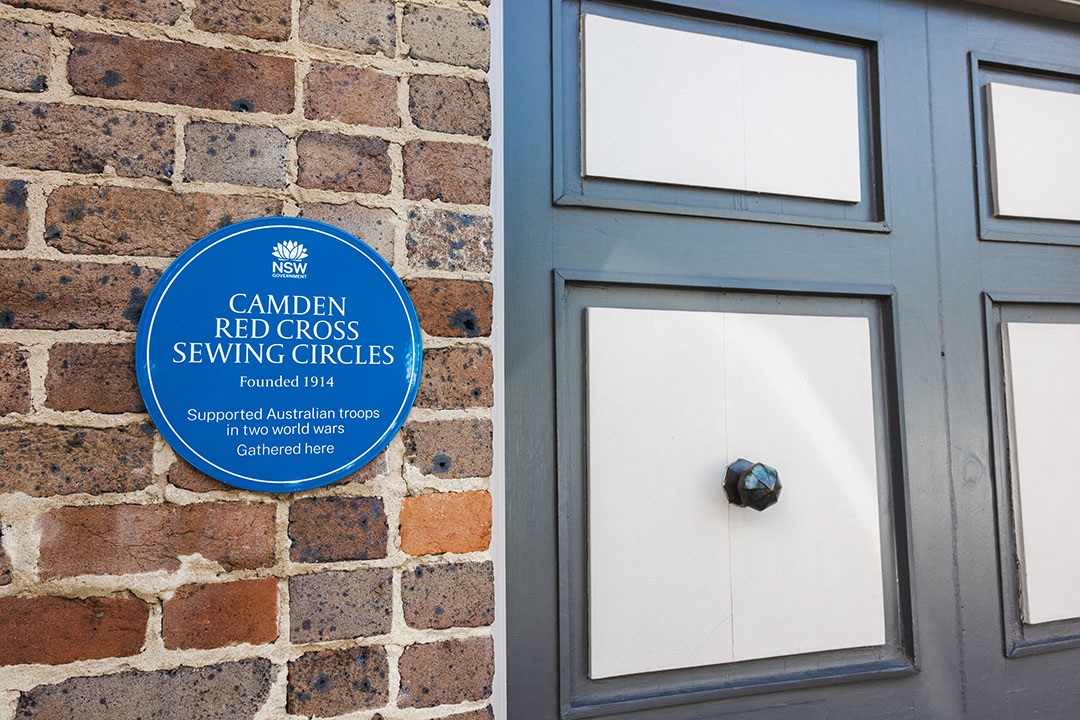
Blue Plaque honours the sewing effort of the Camden Red Cross
Discover more from Camden History Notes
Subscribe to get the latest posts sent to your email.

