Private wedding
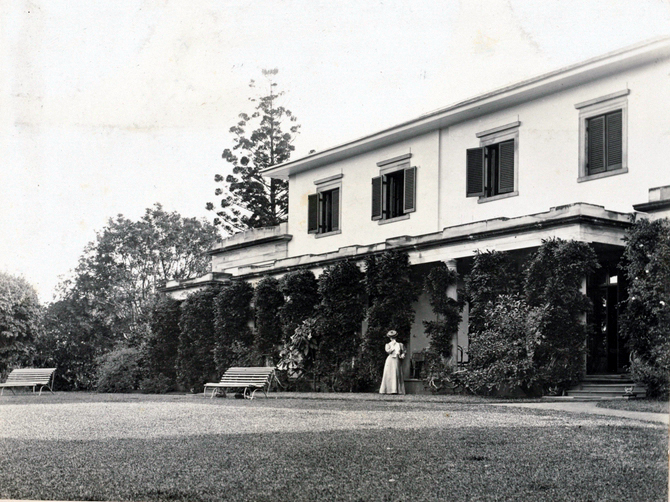
In mid-1905, a private marriage was held in the library at Camden Park house. The ceremony was performed by Rev CJ King of St John’s Camden and Rev WG Taylor of the Central Methodist Mission, Sydney. (Evening News, 6 May 1905)
The private wedding was between Ebenezer Vickery MLC, of Edina, Waverley, aged 82, and Deborah Louise Ellis MA, a teacher from Darlinghurst, aged 52, and was conducted with Church of England rites. (Walsh 1976) Ellis was of Irish ancestry, practised as an Anglican, and was described as a charity worker. (Vickery DL, Obituaries)

Bulletin scuttlebutt
Early in 1905, the upcoming marriage made the gossip column of The Bulletin magazine, which reported that
A startling marriage is that of Mr Ebenezer Vickery, a very rich Sydney citizen, who owns, amongst other properties, Vickery’s chambers in Pitt Street. His private house in out Waverly way. Mr Vickery’s wife died a year ago or so ago. I don’t know how old he is; but this week at a Sydney Methodist meeting, which he “chaired,” he owned up to having taken an interest in missions for 70 years. His eldest son is past 50; and he has a son-in-law who is one of the greybeards of the Methodist conference. The new wife, who was his typewriter, is in the neighborhood of 21. (The Bulletin, 2 March 1905, p14)
The Bulletin’s scuttlebutt typified its reporting, including its inaccuracies, such as Louise’s age, which was actually 52 years old.
The Mudgee Guardian reported that Vickery took offence to his fiancée being called his ‘typewriter’ by The Bulletin. He threatened the magazine with a libel suit, and The Bulletin settled out of court for £200. The Guardian referred to Vickery’s fiancée as a ‘fair young girl not long out of her teens’. According to the Guardian, Miss Ellis should ‘flatter herself that she is allied to a gentleman, who although a bit old in the years, has a big pile of sovereigns and a well-deserved reputation for piety’. (Mudgee Guardian and North-Western Representative, Monday 8 May 1905) Even the country press was not shy about publishing gossip from the Bulletin.
The wedding
The bride, Louise Ellis, was given away by Mrs [Elizabeth] Macarthur Onslow, and Miss [Sibella] Macarthur Onslow and Miss Ellis, who also acted as bridesmaids. (Manning River Times, 10 May 1905)
There was a list of notables at the private wedding and included Mrs E [Enid] Macarthur Onlsow, Colonel J Macarthur Onslow, Mr GM Macarthur Onslow, Sir Arthur Renwick [physician, philanthropist and politician], Mr Joseph Vickery, and Mr George B Vickery. (Evening News, 6 May 1905)
The marriage received coverage in the Sydney and country presses. (Leader (Orange), 8 May 1905; Mudgee Guardian and North-Western Representative, Monday 8 May 1905)
At a local level, the private wedding was reported in the personal column of the Campbelltown Herald, while The Camden News remained silent on the matter. (Campbelltown Herald, 10 May 1905)
The Sydney newspaper Watchman commented that
If marriages are not always made in heaven, they are sometimes made very close to that invisible line at which earth ends and heaven is expected to begin. (Watchman, 13 May 1905)
As events unfolded, Ebenezer Vickery died the following year in England while the couple were touring the USA and England to study the latest ‘evangelistic methods’. (Walsh 1976)
Ebenezer Vickery
The Sydney press reported that Vickery was independently wealthy and undertook many philanthropic interests linked to the Methodist Church.
Robert Carr says of Vickery that he was ‘one of Sydney’s wealthiest aristocrats but also regarded as a generous philanthropist’.
According to Carr
Vickery M.L.C.’s personal empire was extraordinary with wealth derived from a diverse range of investments and speculations that included gold, copper and coal mines. (Carr 2016)
Carr writes that Vickery was a ‘perplexing, contradictory and stoic character of whom little else is known, apart from his charitable contributions and business ventures’.(Carr 2016)
Vickery was part-owner of the Mount Kembla mine when it exploded in 1902, killing 96 men and boys, and remains Australia’s largest mining accident. He, personally or through the mining company, offered no assistance to those killed or their families. (Carr 2016)
Carr concludes that Vickery had ‘a glossy self-image of success, power and virtue’. (Carr 2016)
Sydney’s Sunday Times claimed on his death, Vickery was worth over £500,000. He was a director of many companies, including coal, steamship, fire and marine insurance, finance and other public corporations’. ‘He owned Coal Cliff and Mount Kiera Collieries and Vickery’s Chambers in Pitt Street’. He was a member of the NSW Legislative Council from 1887 to his death in 1906. (Sunday Times, 26 August 1906,)
Louise Ellis
Louise Ellis was a teacher.
According to the Sydney Mail, Ellis was ‘well known in Sydney philanthropic circles’ and took a particular interest in ‘factory girls’. The Mail claimed that Ellis was brought to ‘prominence’ by the Methodist Church by giving a series of ‘clever lectures’. (Sydney Mail and New South Wales Advertiser, 10 May 1905)
According to the Brisbane press, these lectures, sponsored by the Methodist Church, were called ‘Socialism in relation to the Family’. (Saturday Observer, 6 May 1905) This was likely in response to two pamphlets published by HG Wells, which discussed the contemporary attitude of ‘Modern Socialism to the Family’. (Wells 1906)
The Singleton Argus reported that Ellis may have ‘had something to do with Mr Vickery’s recent purchase of the Lyceum Theatre’ in Sydney. Apparently, a portion of the building is to be devoted to Ellis’s work with factory girls. (Singleton Argus, 13 May 1905)
Louise Vickery was an enthusiastic worker for the Church of England and took a keen, practical interest in the boys’ and girls’ homes of the Church at Carlingford and Glebe Point. (Vickery DL, Obituaries)
Ebenezer Vickery donated the Lyceum Theatre to the Methodist Church in 1908. (Walsh 1976)
Conclusion
This case study demonstrates that significant insights can be gained from the personal columns of country and metropolitan newspapers on the NLA Trove digitised newspaper database.
The Sydney and country press reported the Vickery-Ellis, but only in snippets. Sometimes it is what these newspapers do not tell you that is important.
The silence of the Camden press on this Vickery-Ellis marriage speaks volumes about the power and influence of the Macarthur family, the Camden area, and the anonymity they sought for the Vickery-Ellis private wedding.
The Campbelltown press was not so reticent and published the details. Some parts of the wider press presented snippets of information that showed that not everyone liked or agreed with Ebenezer Vickery and his business decisions.
There was considerable dislike of the Vickerys on the South Coast. Their mines remain profitable, and Mount Kembla was operating profitably seven weeks after the 1902 mining accident. (Carr 2016)
The Vickery-Ellis wedding was a demonstration, if any were needed, of the complex interplay between privacy, piety, and power that existed among the people at the wedding and within Camden Park itself before the First World War.
References
Walsh, G.P. (1976). Vickery, Ebenezer (1827–1906). [online] Anu.edu.au. Available at: https://adb.anu.edu.au/biography/vickery-ebenezer-4779 [Accessed 26 Jun. 2025].
‘Vickery, Deborah Louise (1853–1924)’, Obituaries Australia, National Centre of Biography, Australian National University, https://oa.anu.edu.au/obituary/vickery-deborah-louise-28874/text36241 , accessed 29 June 2025.
HG Wells 1906, ‘Socialism and the Family’, London, AC Fifield. EBook, Project Gutenberg Australia 2013 https://gutenberg.net.au/ebooks13/1303581h.html (Accessed 29 June 2025)
Carr, R. (2016). Revisiting the Vickery legacy: E. F. Vickery and his dream of a new world on the South Coast of New South Wales. Journal of the Royal Australian Historical Society, 102(1), [88]-110. https://search.informit.org/doi/10.3316/ielapa.094076316108249
Discover more from Camden History Notes
Subscribe to get the latest posts sent to your email.

