
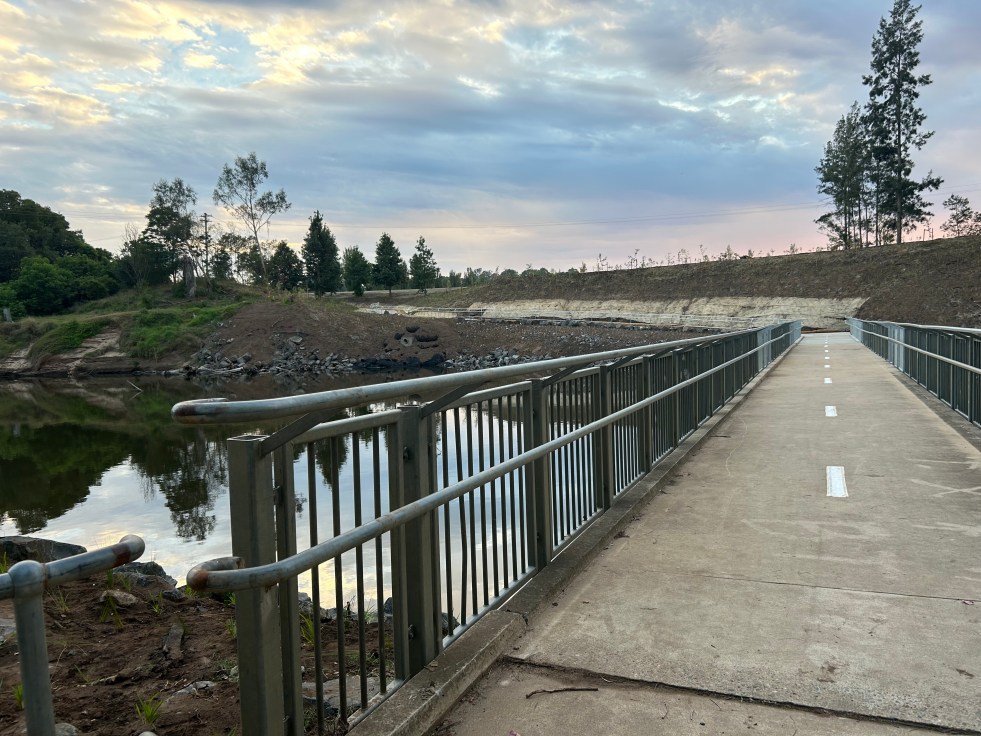
Iconic river footbridge reopens
One of Camden’s most iconic and popular walking trails has had its missing link reopened, the footbridge at Little Sandy.
Walkers and runners, adults and children, have all been keen to try out the newly refurbished footbridge to see what it is like.

The Little Sandy footbridge is an essential link in the Nepean River Trail, one of Camden’s ever-popular walking trails.
The footbridge is located at Little Sandy, a site on the Nepean River at the bottom of Chellaston Street, and was built during WW2 by the military. Little Sandy has been popular for swimming, picnicking and other activities with locals for over a century.
Recent flood damage
The footbridge was closed in 2020 after flood damage. (CC 2025)
There was significant scouring of the abutment, as well as damage to the pathway approaching the bridge. (South West Voice 23 April 2025)
The footbridge has been closed again for maintenance and reconstruction following the 2022 Nepean River floods, and then again in March and September 2024. (CC 2025)
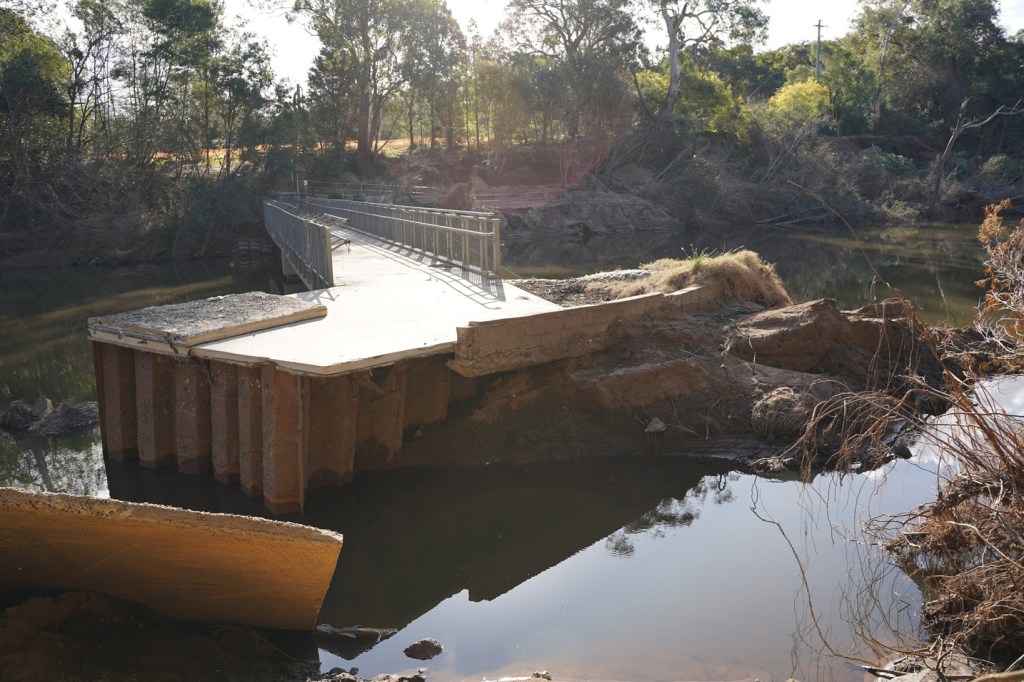
The raging floodwater caused further damage to the eastern (Elderslie) side of the bridge, washing away the bridge approach, pathway, and large sections of the riverbank and vegetation. (South West Voice 23 April 2025)
In April 2025, Mayor Ashleigh Cagney said, “This is a complex project – there is now a 24-metre gap between the end of the bridge and where the riverbank exists today.’
The Australian Government and the Department of Regional NSW partially fund the $3.7 million project rectification works. (South West Voice 23 April 2025)
Flood damage prompted a new footbridge
Damage to the footbridge is not new.
In 2012, the flood damaged the wooden footbridge and led to its closure, and residents immediately began campaigning for a replacement.
There was a community meeting in the mayor’s office in August 2013 when 19 residents attended an information session with the mayor, the Member for Camden, the council’s general manager and engineering staff.
These meetings resulted in the council and the state government jointly funding a new concrete footbridge, and the council let contracts in September 2013.
The new precast concrete 43-metre footbridge was completed in April 2014.
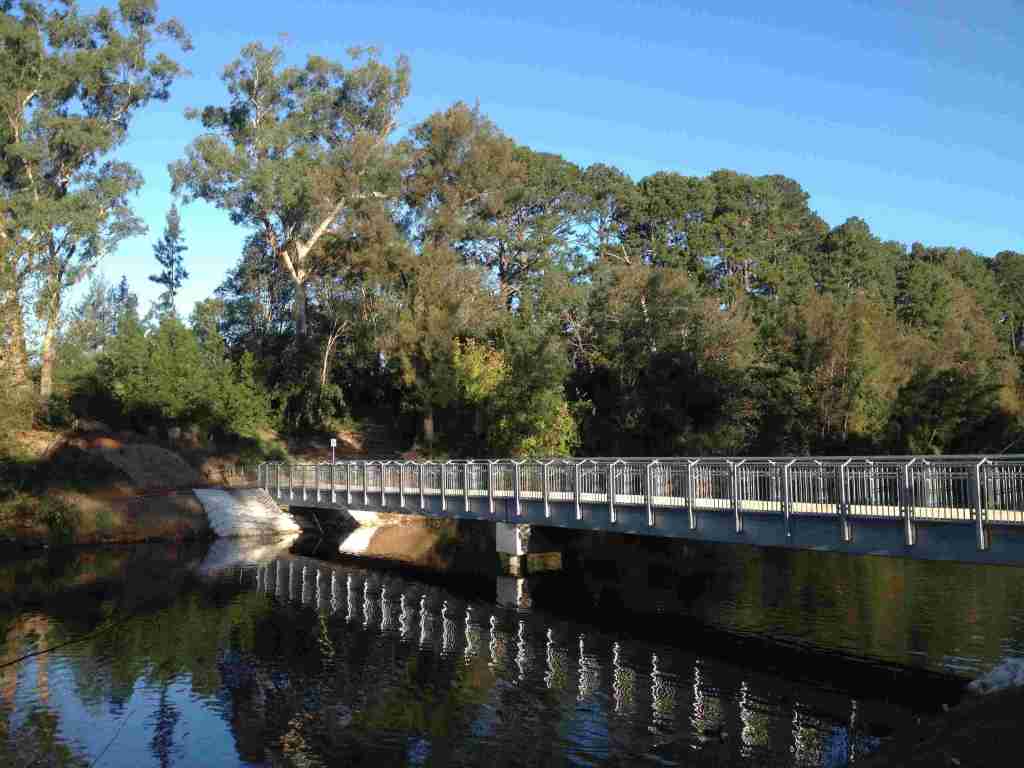
The finished footbridge is part of the Nepean River cycleway, which joins Camden with Elderslie, South Camden, and Narellan.
In 2012, resident Kevin Browne said, ‘the bridge was part of the unique attraction of living in a rural area [and] the availability of serene, natural beauty’.(Camden Narellan Advertiser 31 July)
The original footbridge
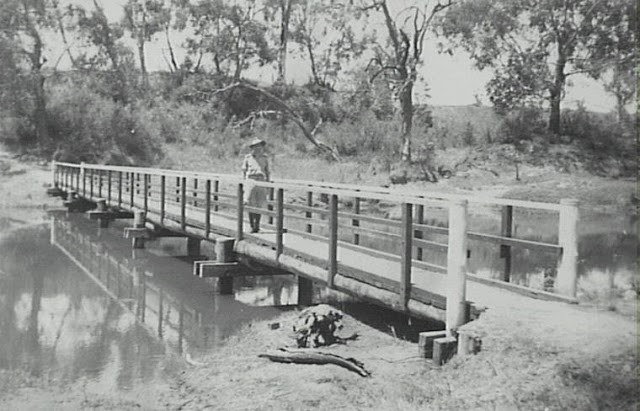
The original timber footbridge was constructed in 1943 as a military training exercise by the AMF Engineering Corps stationed at the Narellan Military Camp.
Military authorities at the camp were eager to conduct a practical training exercise for engineers and increase goodwill with the community. In September, they sought the Camden Municipal Council’s view on erecting a footbridge, and the council immediately agreed to the proposal.
The site chosen was at the bottom of Chellaston Street, where the bridge would connect two reserves on either side of the Nepean River. One on the Chellaston Street side and the other at River Road, Elderslie.
Camden Council funded the cost of the materials so that the bridge remained the Council’s property.
The AMF engineers provided the labour of 40 men, supervision, transport vehicles and operators for the transport of stores and construction material.
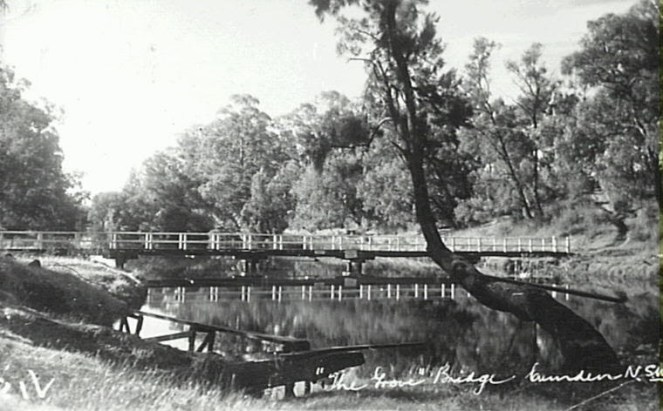
The AMF began work in late September 1943 and built a wooden footbridge, 120 feet long and 4 feet wide. Construction took around four weeks and was finished by 28 October.
Observers commented that the local community would ‘fine piece of workmanship…that would be much appreciated’. (Camden News, 16 September 1943, 23 September 1943, 28 October 1943).
Little Sandy has always been a popular spot on the river
Before 1908, there was no Little Sandy.
Little Sandy was created on the riverbank when the Camden Compensation Weir was constructed on the Nepean River downstream of the church, making a four-kilometre pondage behind the weir.
The area of Little Sandy was a part of St John’s Church Glebe, and later known as Kings Bush Reserve. The reserve was named in 1970 after the rector of St John’s church, Reverend Cecil John King, from 1892 to 1927.
The Camden Weir was constructed by the New South Wales Public Works Department after the completion of the Cataract Dam in 1907. The compensation weir was one of a number built along the Nepean River to safeguard the ‘riparian rights’ of landowners affected by the interruption of flow to the river, according to John Wrigley. (Wrigley 2001)
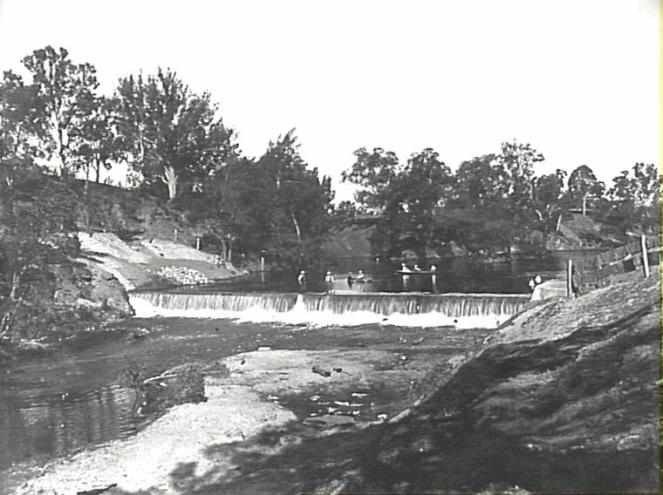
A riparian right is the ability to take water from the river. The water supply dams of the Upper Nepean Scheme reduced the flow of the tributaries of the Nepean River, and the weirs were to ‘compensate’ for the loss of water flow. (Wrigley 2001)
The deep water created by the weir pondage at Little Sandy became a favourite swimming spot.

In 1909, the community organised the Camden Aquatic Sports carnival in an area now known as Kings Bush Reserve (Little Sandy) and attracted over 1000 spectators. The Camden Swimming Club was subsequently established in the 1920s, and the club built galvanised-iron dressing sheds painted green.
Olive McAleer said, ‘Little Sandy was a popular spot for family picnics between the 1920s and 1940s’.
‘The area was divided into Big Sandy, which was a deep hole, near Kings Bush Reserve. About 100 metres upstream was Little Sandy, where the water was shallower. Learn-to-swim classes were held for a short time, and the Boy Scouts would go swimming there,’ said Milton Ray.
‘In the 1950s, the area was used for swimming by pupils from Camden Public School’, said Len English. ‘The girls went with the female teachers to Little Sandy, while the male teachers and boys went downstream to Camden Weir.’
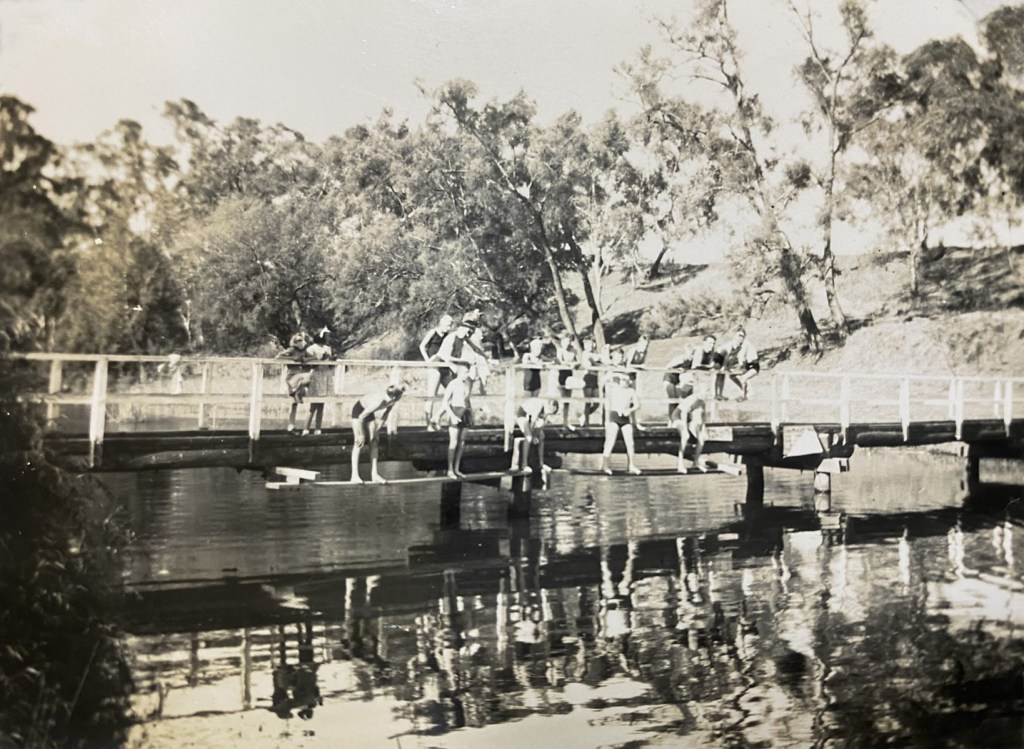
The river ceased to be a swimming spot when medical authorities condemned it for pollution in the early 1960s. It was replaced by the Camden Memorial Swimming Pool in 1964. (Mylrea, 2006)
Reflection
Before 1908, there was no Little Sandy and no footbridge.
The construction of the compensation weir and the pondage created Little Sandy, a popular swimming and recreation spot on the river.
The footbridge was constructed during World War Two by the military from the Narellan Military Camp. The bridge was a training exercise and earned the army the community’s goodwill.
The footbridge has become an essential part of the Nepean River landscape, which is one of the defining features of Camden’s community identity and sense of place.
The outcry from residents on the closure of the footbridge after flooding has been an indicator of its importance to the community.
References
‘Five years later, Camden bridge is about to be repaired’. South West Voice 23 April 2025
CC 2025, Little Sandy Bridge, Major Projects, Camden Council. https://www.camden.nsw.gov.au/major-projects/little-sandy-bridge (16 /12/25)
Mylrea, P. 2006. ‘Swimming in the Nepean River at Camden’, Camden History, March, vol 2, no 1. pp. 3-19
Wrigley, J, 2001. ’ Nepean River Weirs’, The District Reporter 3 August
Discover more from Camden History Notes
Subscribe to get the latest posts sent to your email.

