

Fussing over socks
During the First World War, there was a considerable fuss over socks. Not just any ordinary socks but hand-knitted socks. Camden women hand-knitted hundreds of pairs of socks. So what was going on?
As it turns out, there was a good reason for all the fuss.
Soldiers on the Western Front suffered terrible conditions in the trenches. They were constantly wet and cold, and in winter, temperatures were freezing.
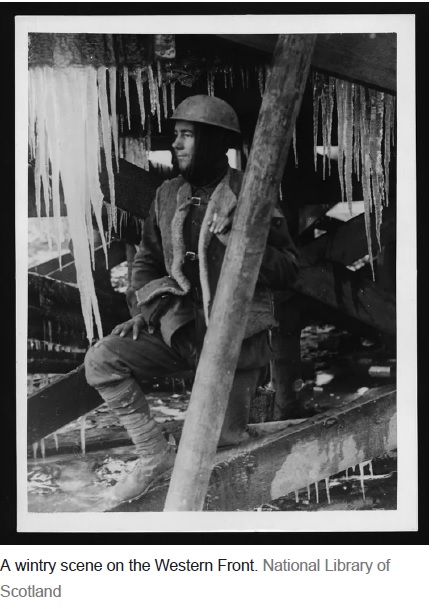
Fungal feet
Under these conditions, there was a constant danger of the soldiers getting trench foot. Jenny Raynor at Sydney Living Museum writes that this was
a potentially debilitating fungal infection that thrived in the wet, cold and squalid conditions, and could lead to gangrene and amputation if left untreated. (Raynor 2022)
Soldiers wore stiff leather boots poorly insulated with two pairs of socks in freezing winter conditions to keep out the cold and wet.
Authorities recommended that troops change their socks twice daily to avoid trench feet. Reports from New Zealand maintained in 1915 that
a pair of socks lasted no more than two weeks when on active service. (Lady Liverpool Great War Story)
So, it was unsurprising that there was a constant shortage of socks.
Shortages from the start
Sock shortages commenced from the outbreak of war and illustrated how the war’s progress completely overwhelmed military authorities with unrealistic expectations.
At the Liverpool Infantry Camp in November 1914, military authorities advised that three pairs of woollen socks would be adequate for the campaign. New recruits were advised to bring ‘strong boots’ and ‘knitted socks’ because the army could not supply them. (Sydney Morning Herald, 5 November 1914, p.8)
Military supply authorities never really got to grips with the problem of shortages throughout the war. Even the vast US military machine could not supply sufficient numbers of socks to their troops when the US government entered the war in 1917. The U.S. government Committee on Public Information sponsored the ‘‘Knit Your Bit’’ campaign conducted by the American Red Cross. (Orwig 2017)
Keep knitting
Knitting for the troops was not restricted to the American Red Cross.
Knitting was part of the homefront response to the outbreak of war across all British Empire countries, including Australia, New Zealand, Canada, and the United Kingdom.
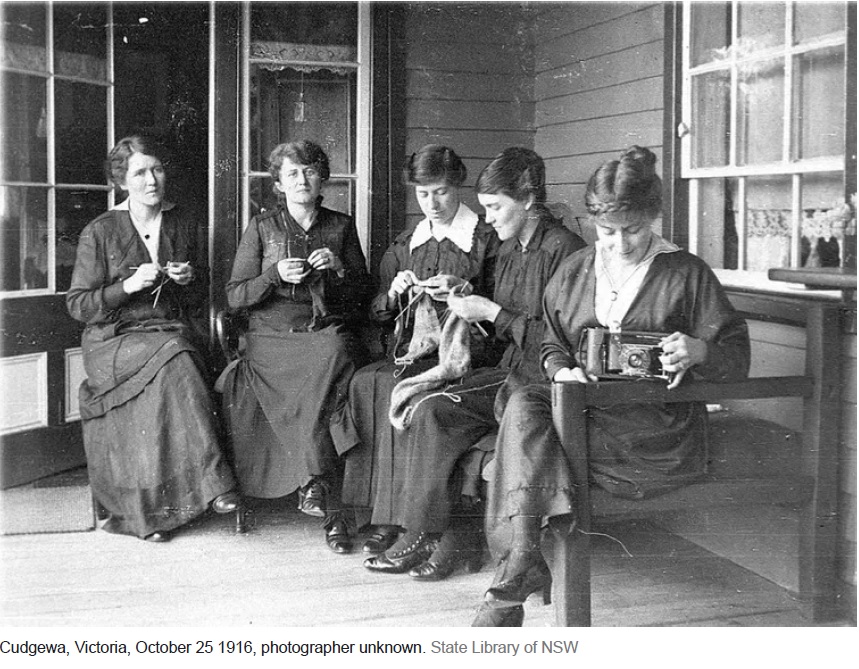
Across the globe, millions of knitted items found their way to the trenches on the Western Front.
Socks were only one of an extensive list of items that women made for the war effort. Other knitted items included cholera belts, scarves, gloves and balaclavas, supplemented by a considerable effort in sewing hospital supplies.
Women volunteer to supply socks
Australian women volunteered to supply knitted items from the start of the war. Unlike women in the United Kingdom, Australian women did not replace men in their civilian roles during the war.
In Australia, the Red Cross, the Australian Comforts Fund, and other groups, including the Soldiers’ Sock Fund, coordinated the push for knitted socks and other items.
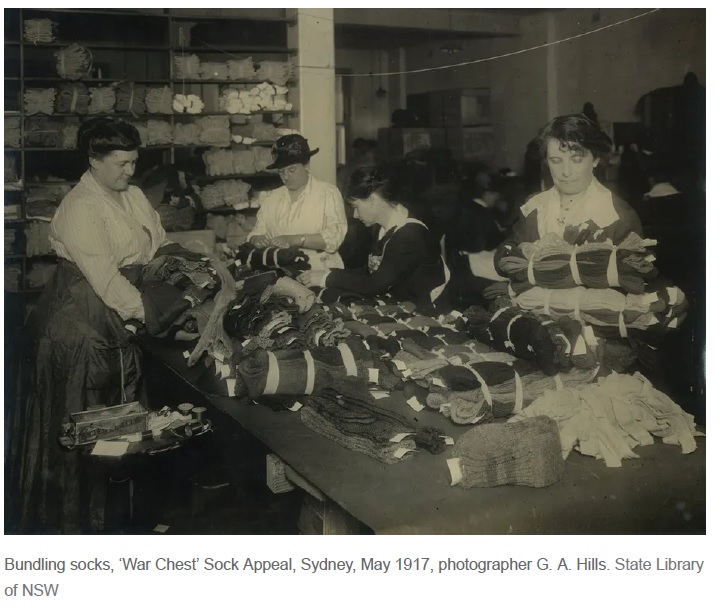
In Queensland, the Governor’s wife, Lady Goold-Adams, established the Queensland Soldiers’ Sock Fund.
Knitted socks were part of the soldier’s bag that Red Cross volunteers signed up to supply on the foundation of branches throughout New South Wales in August 1914. Red Cross knitters in Camden and across Australia supplied soldiers with thousands of knitted socks. (Willis 2014)
In Camden, the new Red Cross branch supplied ‘a large number of socks’ in the first weeks of the war, including supplies for the Australian Light Horse regiment and the 4th Battalion of Infantry. By September 1915, Camden Red Cross workers had supplied 456 pairs of knitted socks to Red Cross headquarters in Sydney, amongst other hand-made items. (Willis 2014)
Annette, Lady Liverpool, the wife of New Zealand Governor Lord Liverpool,
Lady Liverpool instigated ‘Sock Day’, when the women of New Zealand were encouraged to knit enough socks to provide every soldier with two new pairs (around 30,000 pairs in total). (Lady Liverpool Great War Story)
The First World War was not the first time women volunteers had supplied knitted socks to Australian troops in wartime. In 1900, Camden women supplied 120 pairs of knitted socks to Camden troops in South Africa in the New South Wales Mounted Rifles. These were similar to the activities of British women. (Willis, 2014)
Millions of socks
It has been estimated that Australian women knitted over 1.3 million pairs of socks for the Red Cross and the Australian Comforts Fund for the war effort. (Black 2014)
Often with a small personal note inside the sock informing the digger who had knitted the garment along with a brief message. (The Conversation 11 August 2014)
Knitting patterns were distributed, and cheap wool was made available to knitters.
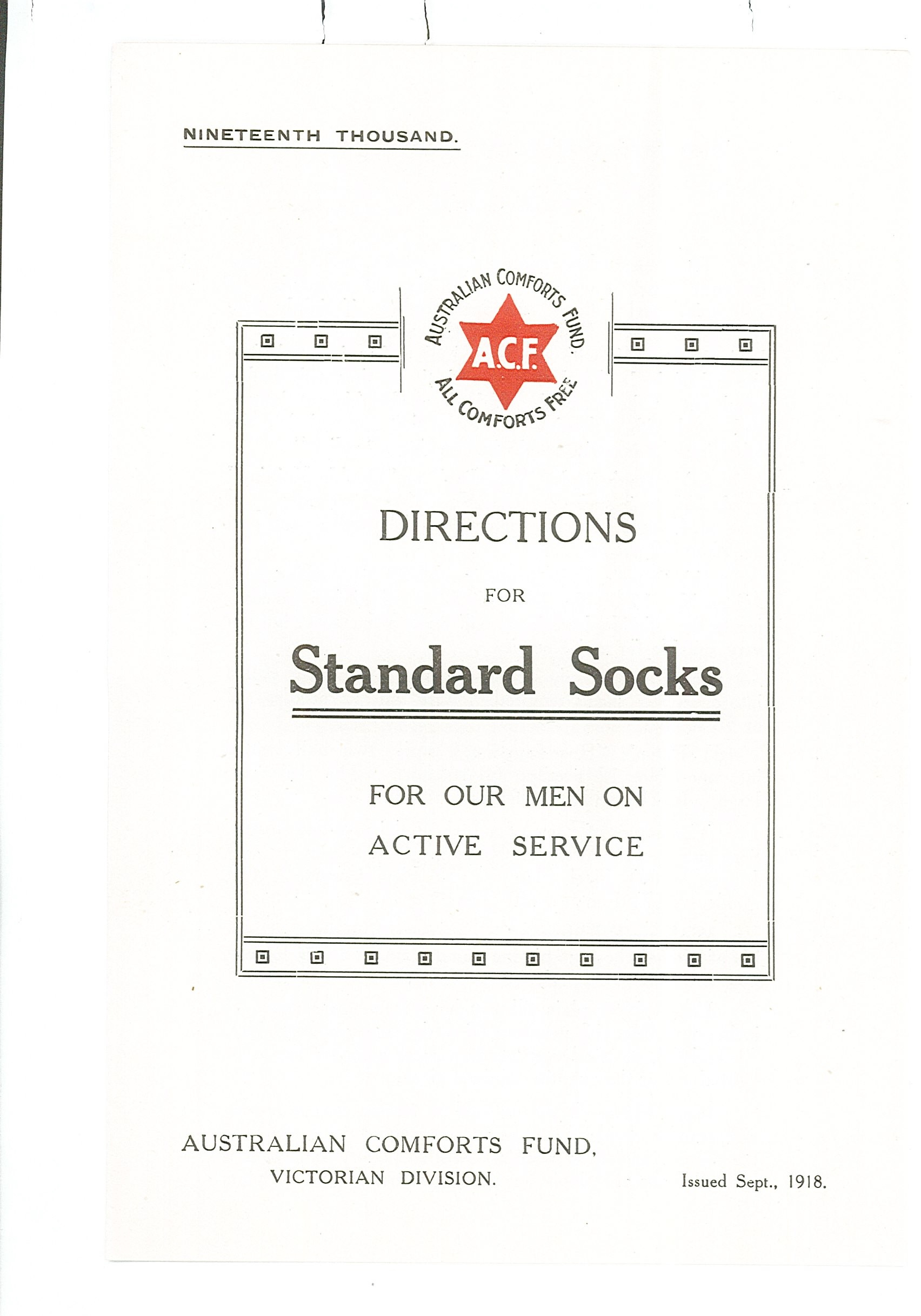
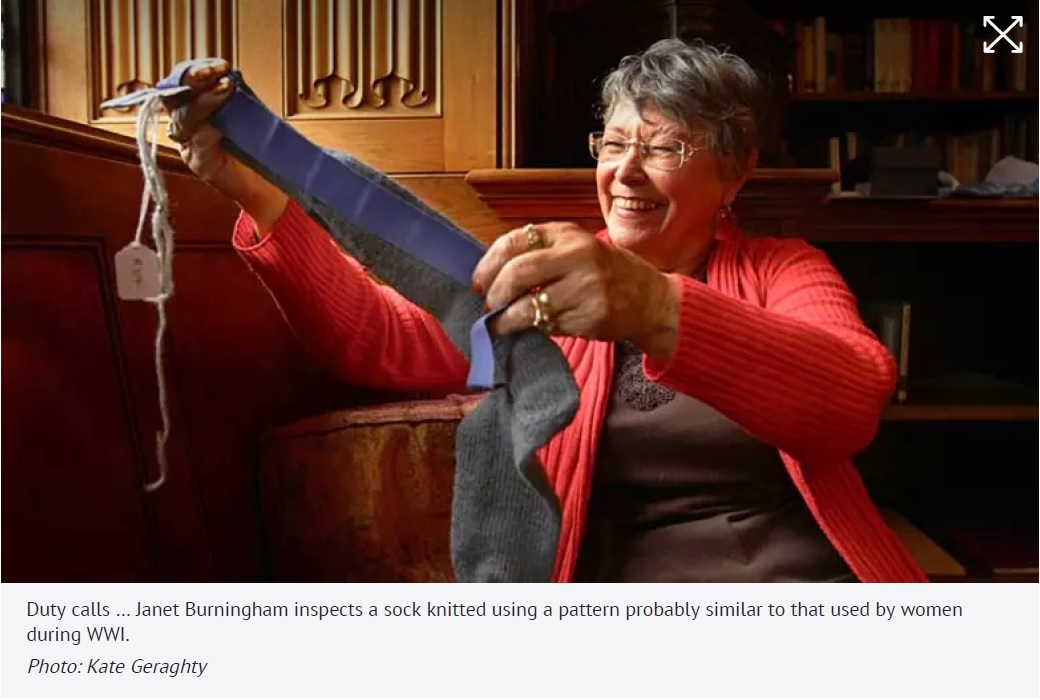
In 2012, volunteer knitter Janet Burningham from Wrap with Love found that it took about a day to knit each sock. She used a rare grey sock pattern, Paton’s 8-ply grey wool, and needles. Socks were knitted in the round on double-pointed needles, leaving no seams.
The iconic sock knitter
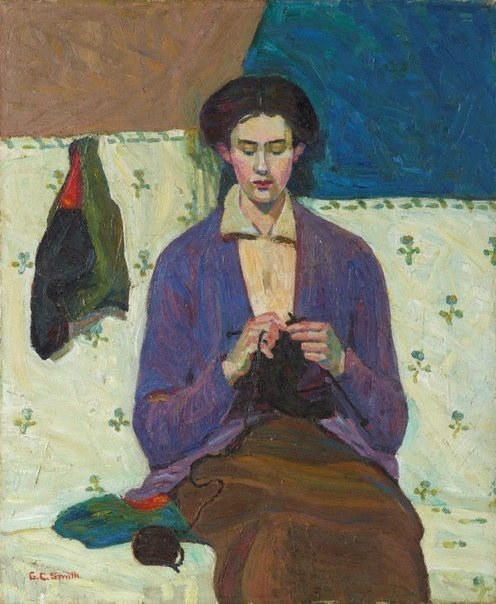
The solo woman sock knitter was one of the everlasting iconic images of the war at home in Australia.
The iconic image of The Sock Knitter is a 1915 painting by Grace Cossington Smith found at the Art Gallery of NSW. The gallery states
The subject of the painting is Madge, the artist’s sister, knitting socks for soldiers serving on the frontline in World War I. Distinctly modern in its outlook, ‘The sock knitter’ counterpoints the usual narratives of masculine heroism in wartime by focusing instead on the quiet steady efforts of the woman at home. (Smith 1915/1984)
Knitting mediating grief
Camden women and others who became wartime sock knitters acted out of patriotism. They supported their boys using one of their traditional domestic arts.
Knitting, sewing, and other domestic arts were unpaid war work and a form of patriotism when women in Australia, unlike the United Kingdom, did not replace men at home in the First World War. Historian Bruce Scates has written that women invested a large amount of ‘emotional energy’ in their knitting and sewing. (Scates, 2001)
Women were the mediators of wartime grief and bereavement, and knitting and sewing groups were women-only spaces where they could comfort each other and ease the loneliness. (Willis 2020)
Sock solution
Suzanne Fischer writes that the sock problem and trench foot still existed in the Second World War for American troops stationed in Alaska. She states:
Characteristically, Americans finally reduced their trench foot casualties by throwing more technology at the problem. The Shoepac system, introduced in 1944, combined a rubber foot and an impermeable outer leather layer with a felt liner to keep feet dry. These boots were also stylish, which increased their use. (Fischer 2011)
References
Black, Prudence 2014. One million pairs of socks: knitting for victory in the first world war. The Conversation, 11 August. Online at https://theconversation.com/one-million-pairs-of-socks-knitting-for-victory-in-the-first-world-war-30149
Fischer, Suzanne 2011. The Technology of Socks in a Time of War, A historian traces the history of humble footwear in the trenches. The Atlantic, 7 November. Online at https://www.theatlantic.com/technology/archive/2011/11/the-technology-of-socks-in-a-time-of-war/248006/
Lady Liverpool Great War Story, URL: https://nzhistory.govt.nz/media/video/lady-liverpool-great-war-story, (Manatū Taonga — Ministry for Culture and Heritage), updated 4-Oct-2021
Orwig, M. L. (2017). Persuading the Home Front: The Communication Surrounding the World War I Campaign to “Knit” Patriotism. Journal of Communication Inquiry, 41(1), 60-82. https://doi.org/10.1177/0196859916670149
Power, Julie 2012. Purler of a yarn on how women kept troops in comfortable socks. Sydney Morning Herald, 1 November. Online at https://www.smh.com.au/national/purler-of-a-yarn-on-how-women-kept-troops-in-comfortable-socks-20121031-28ke5.html
Raynor, Jennie 2022, The Sock Knitter, Belle Thorburn. World War One, Museums of History NSW. Online at https://mhnsw.au/stories/ww1/sock-knitter-belle-thorburn/
Scates, Bruce (2001-11). The unknown sock knitter: voluntary work, emotional labour, bereavement and the Great War. In Labour History. (81), 29-49.
Smith, Grace Cossington 1915/1984, The Sock Knitter. Art Gallery of NSW. Online at https://www.artgallery.nsw.gov.au/collection/works/OA18.1960/#bibliography
Willis, Ian 2014. Ministering Angels, The Camden District Red Cross 1914-1945. Camden Historical Society, Camden. Online at https://www.academia.edu/41478013/Ministering_Angels_The_Camden_District_Red_Cross_1914-1945
Willis, Ian 2020, Red Cross humanitarianism and female volunteers in Australia. Hektoen International, A Journal of Medical Humanities. Winter. Online at https://hekint.org/2020/02/04/red-cross-humanitarianism-and-female-volunteers-in-australia/
Updated 29 October 2024. Originally posted 10 March 2020.
Discover more from Camden History Notes
Subscribe to get the latest posts sent to your email.


One thought on “The patriotism of the wartime sock knitter”
Comments are closed.