
Patients and their treatment
There are no surviving patient records from the early days of the Camden Cottage Hospital on Mitchell Street. For the forensic researcher, the local press can be a gold mine of information about the goings on at the hospital. It is possible to paint a picture of patients’ ailments and treatment at the hospital.
In the first few months of operations at Mitchell Street, various patients presented themselves at the hospital, reflecting the trials and tribulations of rural life at the end of the 19th century.
The first patient admitted to the hospital arrived three weeks after the hospital opened at the beginning of April. A horse had kicked the patient. (CN 6 April 1899) (CN 27 April 1899)
Accidents were common, and the local press sometimes gave detailed accounts, for example, of an accident outside the Camden News printery in Argyle Street.
Local woman thrown from sulky
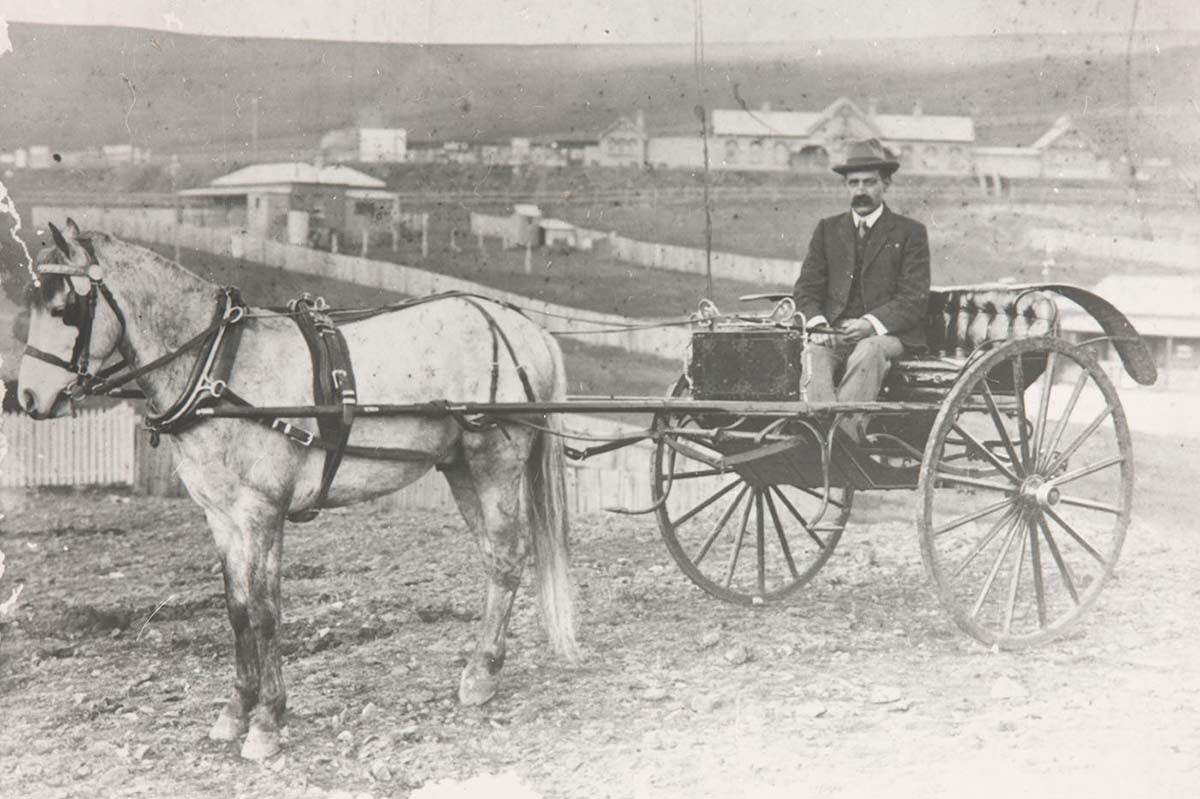
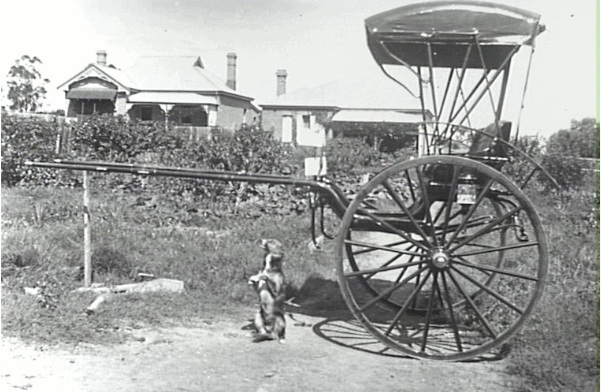
On leaving the Camden News printery office on Thursday, 21 December 1899, Miss Sidman was thrown on the roadway from her sulky outside the printery office in Argyle Street, Camden, next door to the Camden Post Office. Miss Sidman was the social editor of the Camden News, the newspaper’s book-keeper and the daughter of the owner-editor William Sidman. (CN 28 December 1899) Miss Sidman was someone of note in Camden, being in paid employment of the local newspaper, and of independent means with her own transport.
Miss Sidman had reins in hand, and with her foot on the sulky step, the horse became restless and, about 10 yards from the Camden News office, she was thrown to the roadway. She was taken to a bedroom, and surgical assistance was rendered. No better the following morning, she was taken to Camden Cottage Hospital. (CN 28 December 1899)
Miss Sidman suffered a severe injury to her temple, and she remained partially conscious and only answered ‘yes’ to questions from her mother. Dr Bell and Dr Morton said the high summer temperature has not helped her. (CN 28 December 1899)
The Camden News continued to report on her progress. A week after the accident, Sidman was able to recognise her mother and knew she was not at home.(CN 28 December 1899)
By the beginning of January, it was reported Miss Sidman was improving, and the doctors thought that her eye may have needed surgery. (CN 4 January 1900)
After three weeks at Camden Cottage Hospital, Dr Bell said Miss Sidman was still not well enough to go home. (CN 11 January 1900)
After four weeks, Sidman was allowed to undertake ‘outdoor exercise’ although Dr Bell did not let her go home. (CN 18 January 1900)
At the end of January, the Camden News reported that Miss Sidman was allowed to go home. She had made ‘satisfactory’ progress while under the doctors’ care and Matron Hetherington’s care.
The hospital received a glowing endorsement from Miss Sidman. She
‘speaks in the very highest terms of praise of the greatest courtesy and attention shown her by the matron and nurses of the hospital and for the excellence of the internal arrangements of the institution’. (CN 25 January 1900)
Amputations at the cottage hospital
The local doctors were expected to perform surgical procedures as part of their treatments, some of which took place at the hospital.
In late 1899, two accidents resulted in amputations at the Camden Cottage Hospital. In early October, a man, Bert Lewis, was hunting hares with relatives at Glenmore and climbed under a fence; the gun discharged and shattered his left arm. He was taken to the hospital, and his arm was amputated close to his shoulder. The following day, it was reported he was doing favourably. (CN 12 October 1899)
A second amputation occurred at the hospital in December on a road worker, Alexander Morgan. He was putting a shot for blasting the rock on Peaks Road at Burragorang, west of Camden. The shot exploded, shattering Morgan’s arm and causing other serious injuries. He was brought to Camden on the Pippen coach, and his arm was amputated. (CN 7 December 1899)
The Camden doctors presumably would have used chloroform to perform these amputations at the hospital. Chloroform was first used in Scotland in the early 1840s. (History.com Editors, 2023)
Death from typhoid
The Camden News reported the deaths of patients who were admitted to the hospital in Mitchell Street.
In April 1900, a 12-year-old girl, Margaret Lavercombee of Camden, died from typhoid. She had been suffering from typhoid for several weeks and, for ‘security’ reasons and ‘direct medical attention’, was taken to the isolation ward of Camden Cottage Hospital. (CN 26 April 1900)
The first death of a patient at the hospital occurred in June 1899, three months after the hospital opened. A 21-year-old man, T Brown of Camden, died from an ongoing chest complaint. (CN1 June 1899)
Doctors provide honorary service at the cottage hospital
In 1899 and 1900, the two doctors in Camden, Dr Bell and Dr Morton, both gave their services on an honorary basis to the Camden Cottage Hospital.
One letter writer to the Camden News ‘A Bushman’ praised the work of the doctors and their skill and drew the observation that
‘The Camden Cottage Hospital would be nil and void without the active, in touch, and personal supervision of these generous hearted skilful men, whose services have so far been gratuitously given. (CN 1 February 1900)
Patients slow to embrace the cottage hospital
The community was slow to embrace the Mitchell Street cottage hospital in the early months of its operation.
In the opening months, patient numbers averaged around 1 to 2 a week; on some occasions, there were no patients.
Accident victims reluctant to use the hospital
In the first year of the cottage hospital’s operation, some in the local community appeared reluctant to use its facilities despite suffering serious accidents.
In the first week of January 1900, the Camden News reported three accidents in which patients were not admitted to the hospital.
In one accident, a man, A McLeod, was caught in a chain while separating two bullocks and was dragged for ‘a considerable distance’ suffering bruises.
In a second accident, a buggy containing three local women capsized on the Brownlow Hill Road after their horse shied at a white object. One of the women, G Wallace of Theresa Park, had her dress caught on the buggy and was dragged ‘some distance’. She was taken home, suffering from severe head injuries.
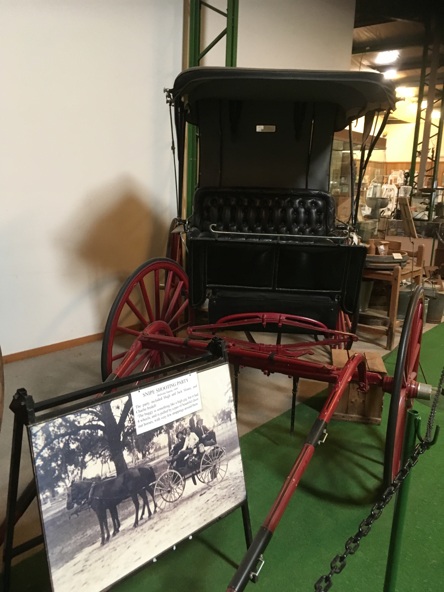
A young man, Sam Arnold of Razorback, had three fingers shattered when a gun exploded when he was shooting at a hare. The gun barrel separated from the stock. Arnold came to Camden to the local doctor’s rooms for surgical treatment and was doing well.
None of these patients used the cottage hospital. (CN 4 January 1900)
Patients embrace cottage hospital
In the weeks before the opening of the new permanent building at Windmill Hill in April 1902, patient numbers at Mitchell Street increased to around 6 to 8 per week.
The Mitchell Street hospital reached capacity by August 1901 when it was reported that it had been full for several weeks. When two patients arrived from Yerranderie with fractures, one had to be accommodated in a local home. (CN 8 August 1901)
The drawing area of the Mitchell Street facility was well beyond what was considered the Camden district (Willis 2015). Patients came from a wide area, including Campbelltown, Picton, Burragorang Valley, Bringelly, and Menangle.
When the new permanent building on Windmill Hill opened in April, the local community’s reluctance to use the cottage hospital had disappeared.
New permanent building on Windmill Hill
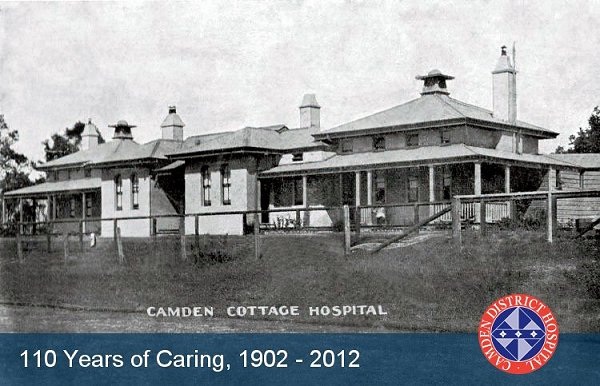
The new permanent cottage hospital building on Windmill Hill was opened in late May 1902 by NSW Premier Sir John See (CN 29 May 1902) and admitted patients shortly after.
References
History.com Editors, 2023, Ether and Chloroform, History. Online https://www.history.com/topics/inventions/ether-and-chloroform
Willis, Ian 2015. Pictorial History of Camden and District. Kingsclear Books, Sydney.
Discover more from Camden History Notes
Subscribe to get the latest posts sent to your email.

