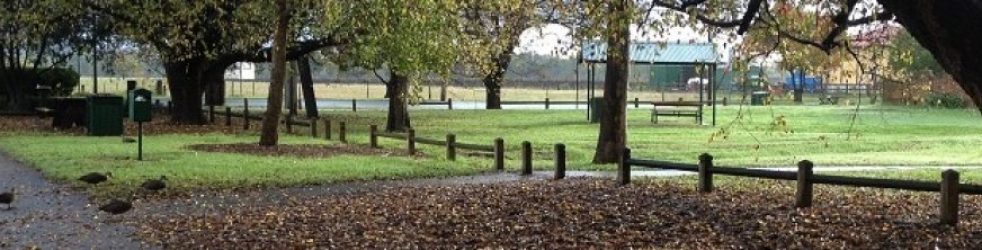
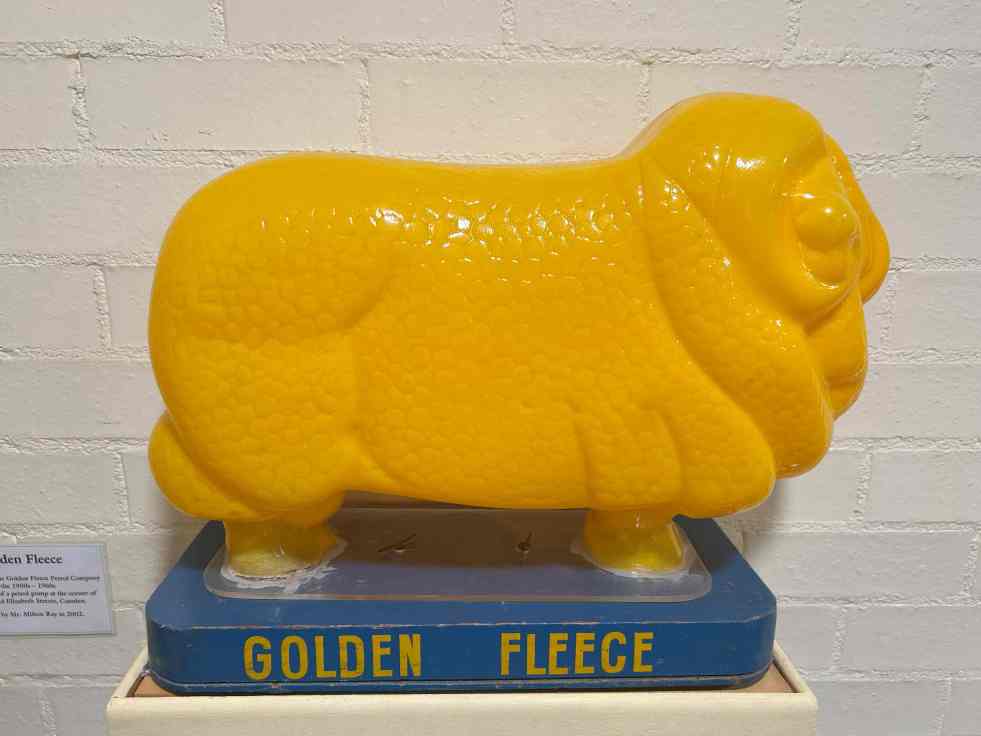
Golden Fleece Globe Light
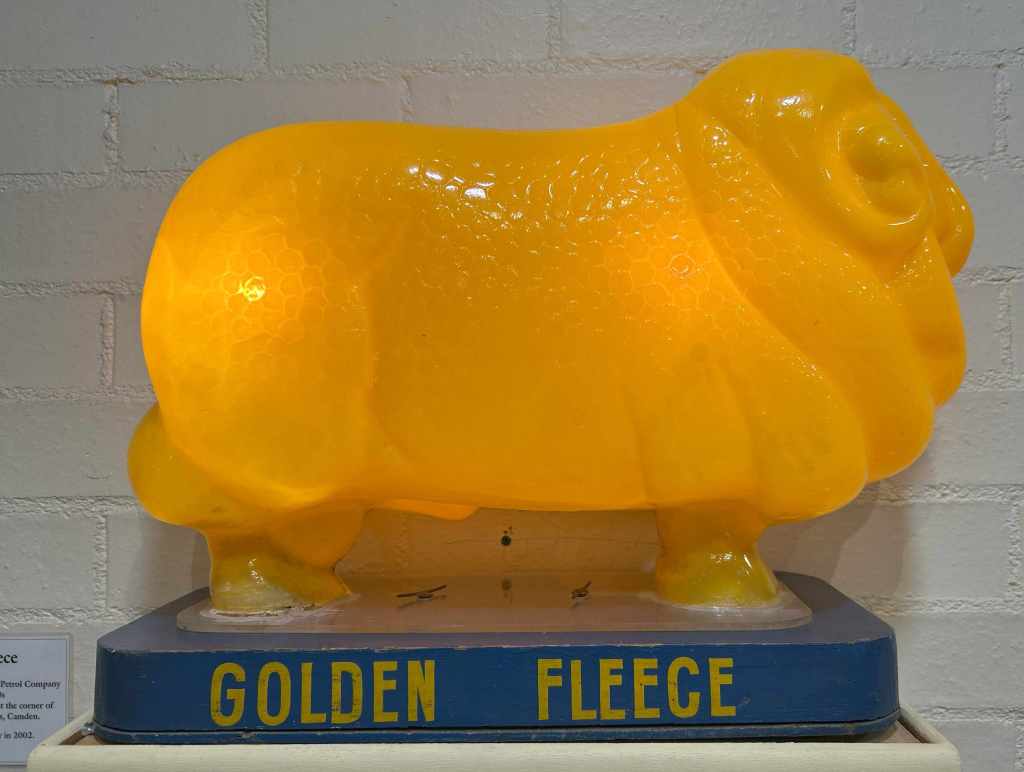
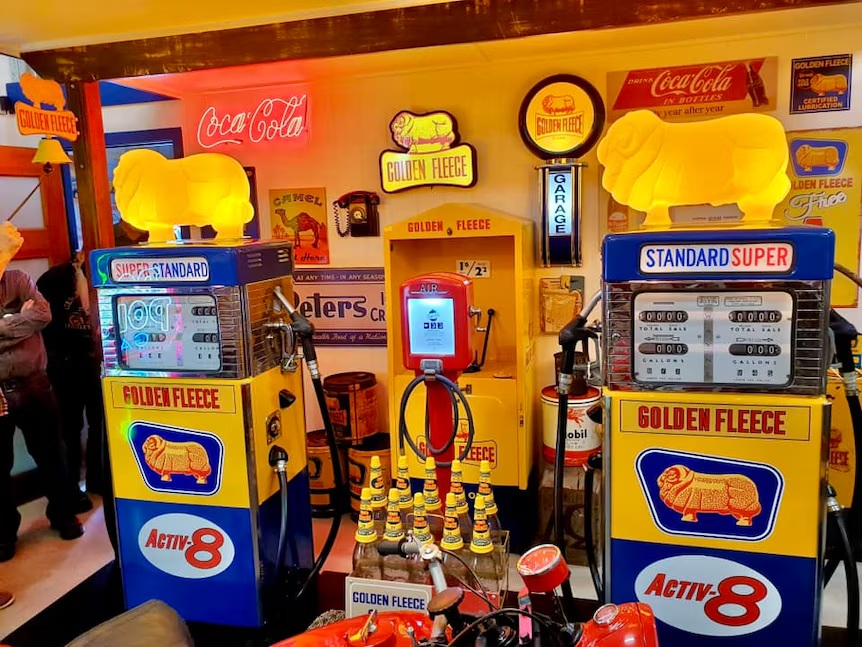
The Camden Museum features a plastic golden sheep on the back wall of the ground floor, illuminated by a lights. Many older Australians would recall the golden plastic model of a sheep sitting atop petrol bowsers at Golden Fleece service stations. The Camden Museum sheep is more correctly a ram from the Riverina called David.
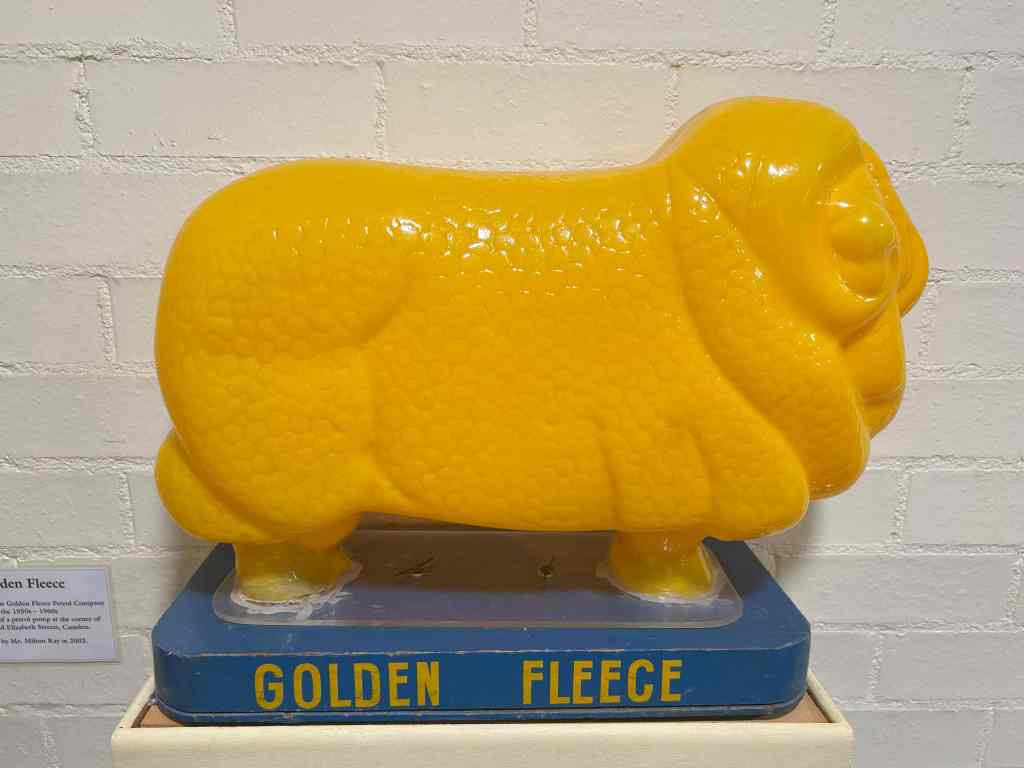
The Camden Museum Golden Fleece globe light, as referred to by the Powerhouse Museum, is an example of a stylised figure or brand mark used in marketing a brand.
Milton Ray
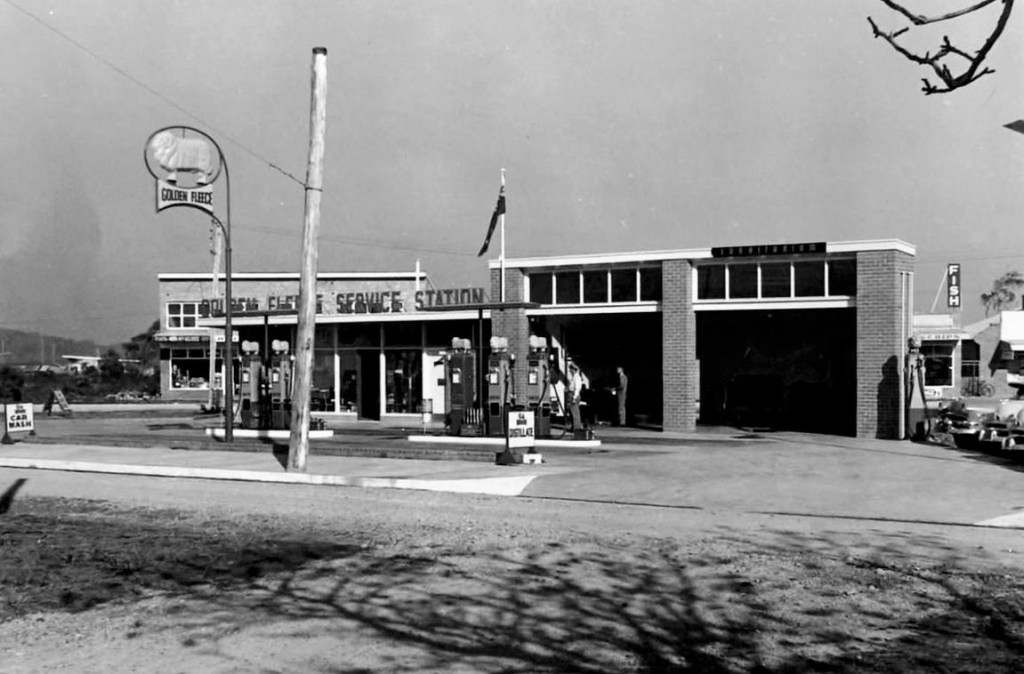
The Golden Fleece Globe Light sat on top of a petrol pump at the Golden Fleece fuel depot, located at the corner of Mitchell and Elizabeth Streets, Camden, which was run by former historical society member Milton Ray. Ray donated the golden ram to the museum in 2002.
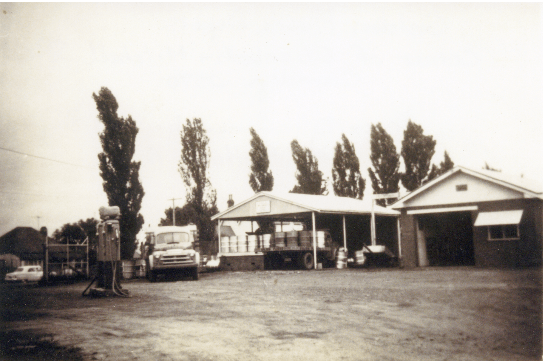
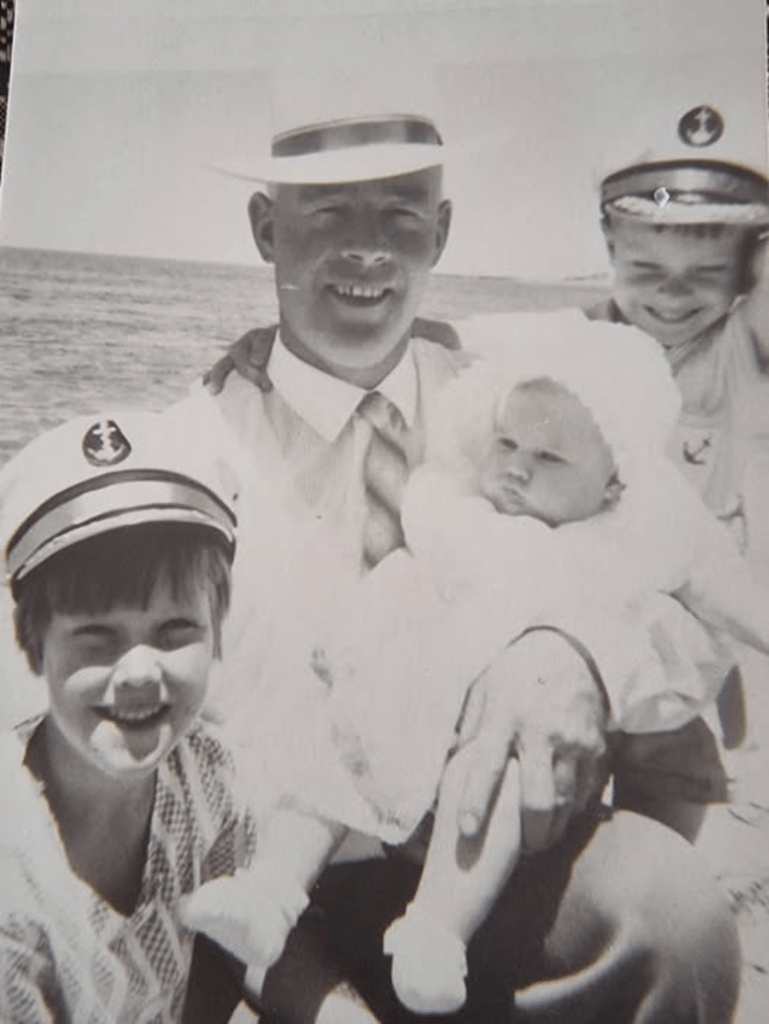
Milton Ray was a local businessman and a founding member of the Camden Historical Society. Milton’s daughter, Gail Carroll (nee Ray), says that volunteering was central to Milton’s life at the Camden Museum and as a fireman. (Carroll 2018) Milton was a founding member of the Menangle Steamers, with his Fordson tractor, and was involved in the Camden Show Society.
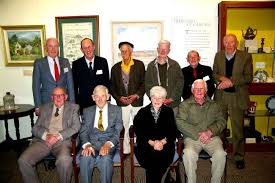
Milton also served as a warden at St John’s Church and was a member of the Camden Public School P&C Society, as well as the high school P&C, alongside his wife, Elaine. He was a keen photographer, and his home movies are archived at the Camden Museum. Milton raced go-karts at the Harrington Street Go-Kart Track in Elderslie. He ran the Golden Fleece fuel depot for many years. (Carroll 2018)
HC Sleigh
The name Golden Fleece, according to Thomas Melluish, was registered as a trade name in 1917. (Melluish 2025) In 1913, HC Sleigh began importing fuel supplies from California, selling under the Golden Fleece brand. (Victorian Collections 2025) The company chose the name from popular Australian culture, referencing the saying “Australia rode on the sheep’s back” and the pivotal role the sheep and wool industry played in the nation’s early economic development and prosperity. (Rudder 2017)
David the ram of Deniliquin
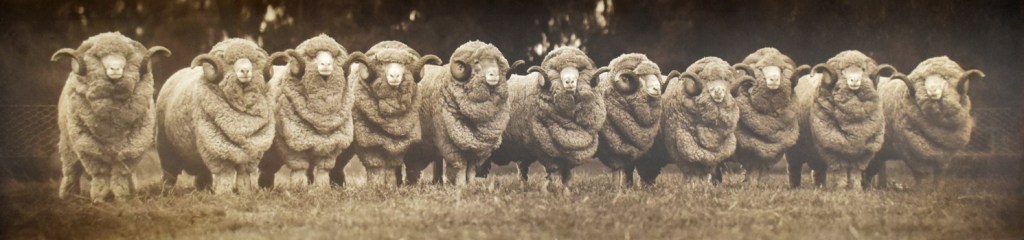
According to the Geelong National Wool Museum, the stylised sheep was based on a prize-winning merino ram called ‘David of Dalkeith’, from Boonoke Stud. The stud was run by the Faulkner family, near Deniliquin in the southern Riverina, established by FS Falkiner in 1878. According to the Powerhouse Museum, the Faulkners paid a record price for the ram in 1927, and Otway Faulkner named the ram after his champion racehorse. (Victorian Collections 2025) (Rudder 2017)
David the ram was part of the Peppin Merino lineage developed by the Peppin brothers, George and Frederick, on the property Wanganella Station, near Wanganella, in the southern Riverina. The brothers purchased the property in 1858, part of which was later sold as Boonoke to a partnership, including FS Falkiner, in 1878. (Rudder 2017)
David the ram design team
According to William Robertson, the son of Arthur Robertson, HC Sleigh had a photograph of David the ram, and at a meeting in 1947 with SA’s enameller AM Simpson and sign-writer Arthur Robertson, wanted to design a ‘Golden Fleece’ symbol that was ‘bold, strong and colourful’.
Robertson produced a sketch of the ram, and there was a discussion between Simpson and Robertson about the size of the testicles – they were not big enough. They were made larger in the sketch. (Rudder 2017)
End of wartime petrol rationing
When wartime petrol rationing ended in February 1950, an advertisement in the Adelaide Mail showed a Golden Fleece bowser with David the ram on top. The promotion promised there would be a fast-pumping electric bowser in Adelaide within six months. (The Mail, 22 April 1950)
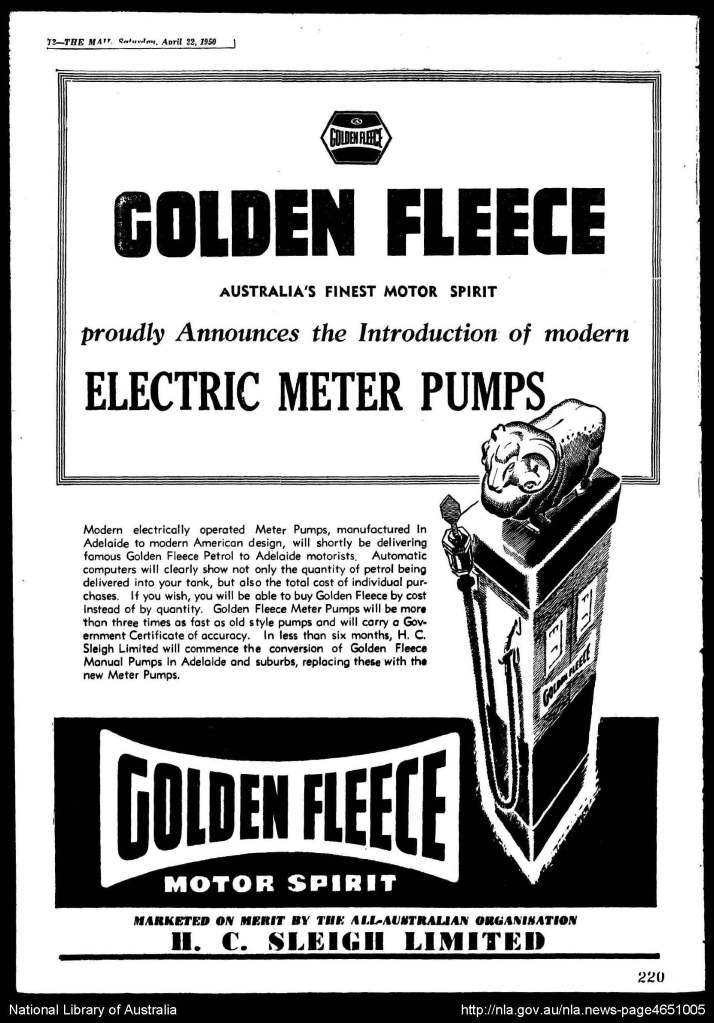
In 1951, HC Sleigh followed Shell’s example by establishing single-brand service stations, using the symbol of David the Ram as their logo. The Golden Fleece was featured at the top of their bowsers from 1950 to 1980. Up to this point, HC Sleigh had been marketing Golden Fleece using
a gold sheep hanging from a cord around its ribs, a symbol used to represent wealth from wool since 1430, when the Duke of Burgundy created the chivalric Order of the Golden Fleece. (Rudder 2017)
In 1940, the HC Sleigh had used two globe-shaped discs on top of the bowser, but no sheep.
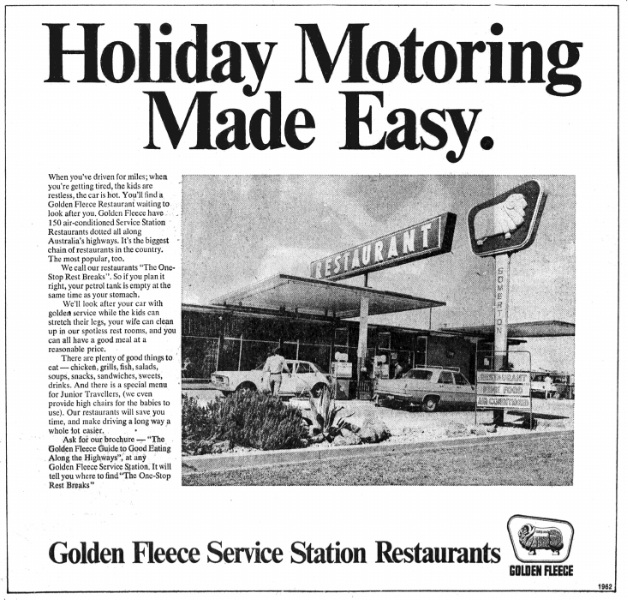
An interesting historical note is that by 1975, HC Sleigh had the largest fast-food chain in Australia, with its Golden Fleece restaurants, which were established in 1957. (Rudder 2017)
Goulburn’s Rambo the ram
HC Sleigh is not the only one to use a ram as a marketing logo. At Goulburn, Rambo the ram modelled Goulburn’s Big Merino, built in 1985. Rambo was a prize-winning ram raised on Bullamallita, a Goulburn merino stud, celebrating the area’s superfine wool history. (Customer Service 2023) Rambo’s balls were used in a promotion for men’s health in 2014. (Pearce 2014).
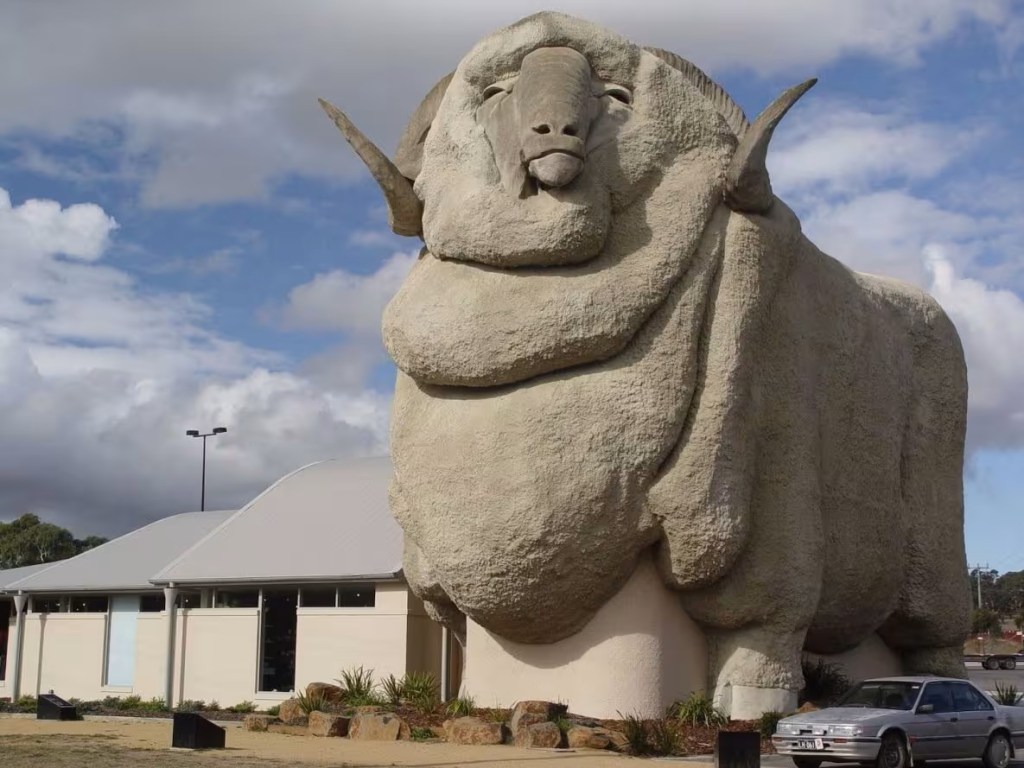
1 Sowerby Street, Goulburn NSW 2580 The world’s biggest merino is a three-storey structure of concrete and steel measuring 15.2 metres high and 18 metres long. (NSW Dept Customer Service 2025)
Reflection
The symbol of the ram, created by HC Sleigh and its design team, has been a metaphor for the growth and development of the wool industry in Australia, as well as for the oil company HC Sleigh and its Golden Fleece brand. The company lost its way in the 1980s, as did the wool industry.
The Camden Museum’s David the ram is representative of the special place of John Macarthur’s Spanish merinos of Elizabeth Farm and Camden Park in the Camden story, along with the Rileys of Raby and their use of Saxon merinos in the 19th century.
The golden fleece is celebrated in Greek mythology, and Camden utilised it in its celebration of the 150th anniversary of the Australian wool industry in 1960.
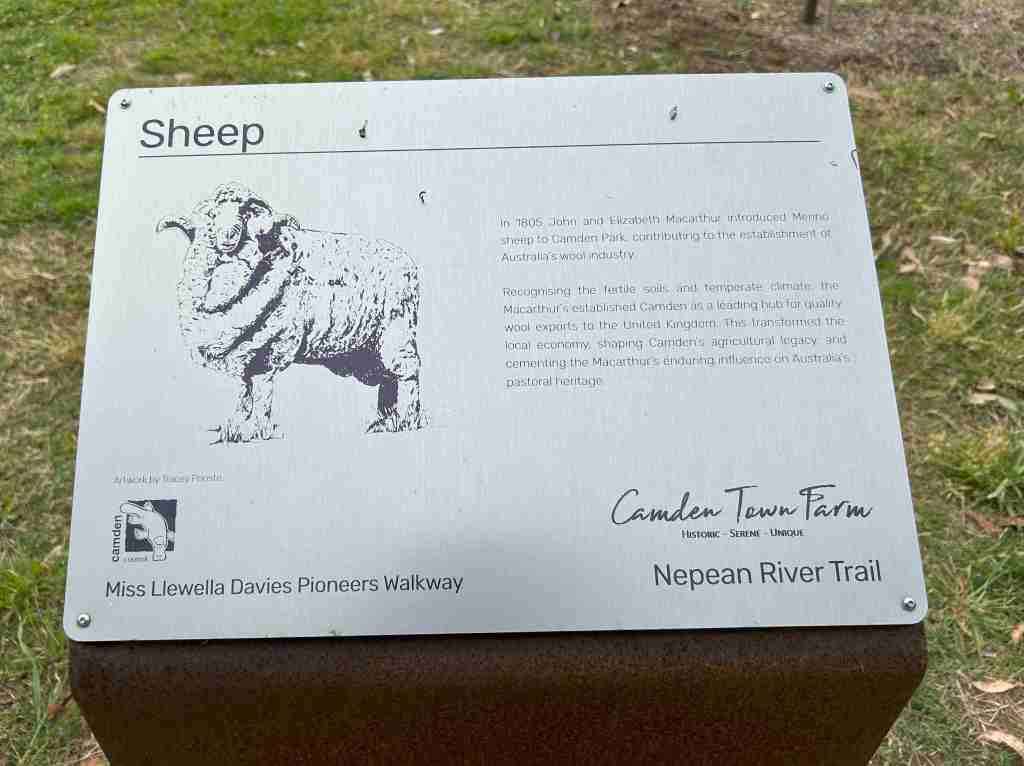
The symbol of the ram is used in the logos of several Camden organisations, including the Camden Rams RLFC and the former Camden Council coat of arms, which was updated in 2005.
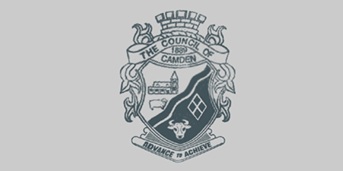
The ram is an enduring symbol of the Macarthur region and its early influence on the growth and development of the Australian wool industry, as well as its promotion of men’s health in Goulburn.
Resources
Brandel, P. (2024). How Golden Fleece, Australia’s first oil company and biggest restaurant chain, vanished overnight – ABC News. ABC News. [online] 15 Jun. Available at: https://www.abc.net.au/news/2024-06-16/golden-fleece-oil-company-service-station-roadhouse-history/103964006 [Accessed 6 Oct. 2025].
Carroll, Gail (nee Ray) 2028, Memories of Milton and Elaine Ray. Camden History Journal of the Camden Historical Society, September, v4, n6, pp.274-275.
Customer Service (2023). Big Merino. [online] NSW Government. Available at: https://www.nsw.gov.au/visiting-and-exploring-nsw/locations-and-attractions/big-merino [Accessed 5 Oct. 2025].
Melluish, Thomas 2025, ‘The Land of the Golden Fleece’. Camden History, Journal of the Camden Historical Society, March, v5, n9. Pp458-464
Pearce, M. (2014). Goulburn’s Big Merino in ‘blue balls’ campaign, raising awareness about testicular and prostate cancer. [online] Abc.net.au. Available at: https://www.abc.net.au/news/2014-09-10/goulburn-big-merino-in-blue-balls-campaign-for-mens-health/5733222 [Accessed 5 Oct. 2025].
Rudder, Debbie (2017). Powerhouse Collection – ‘Golden Fleece’ globe light by H Sleigh Ltd. Powerhouse Museum [online] Available at: https://collection.powerhouse.com.au/object/158247 [Accessed 5 Oct. 2025].
The Fitzwilliam Museum 2021, The Myth of the Golden Fleece, The University Cambridge, Cambridge. Online at https://golden-fleece.fitzmuseum.cam.ac.uk/myth/ Accessed 5 October 2025.
Victorian Collections. (2025). Petrol Bowser, Golden Fleece petrol bowser with ram and hose. National Wool Museum Geelong. [online] Available at: https://victoriancollections.net.au/items/54065db49821f50e3cc9d482 [Accessed 5 Oct. 2025].
Discover more from Camden History Notes
Subscribe to get the latest posts sent to your email.

