
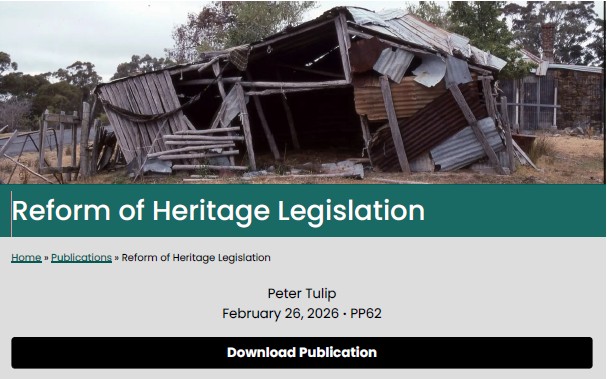
Centre for Independent Studies | Reform of Heritage Legislation | Policy Paper 62 | 2026
Neo-liberalism’s assault on NSW heritage laws
The forces of neo-liberalism at the Centre for Independent Studies have mounted a frontal assault on the NSW heritage laws, saying they add to the current housing crisis.
Bloomberg Australian Briefing reported it this way
Australia’s heritage laws are exacerbating the country’s housing affordability crisis by protecting hundreds of thousands of low-value buildings without weighing the economic costs, according to a report by the Centre for Independent Studies [CIS]. (Australia’s Heritage Laws 2026)
The CIS, a conservative think tank, published a report called “Reform of Heritage Legislation” in February and drew heavily on submissions made to the review of New South Wales 2025 Draft Heritage Strategy. ((Tulip 2026; DCCEEW 2025)

Australia’s architecture is ‘unremarkable’
The CIS report states that there are
too many unremarkable buildings are preserved, restricting housing density and exacerbating the housing crisis. (Tulip 2026:1)
The CIS report predictably takes a narrow cost-benefit approach to heritage regulations. This ignores aesthetics, placemaking, community identity, and other broader elements of heritage, which have their own economic costs and are, according to the report, only the concern of heritage ‘insiders’. (Tulip 2026:5)
While the heritage protection regime is far from perfect and has its weaknesses, it is better than what existed 60 years ago and should not be dismantled. If these attitudes had prevailed in the 1970s under the administration of the 1970 Sydney Cove Redevelopment Authority, The Rocks area of Sydney would have seen large-scale demolition and been replaced with a landscape of mundane skyscrapers. The Rocks and similar areas are worth millions of dollars to Australian tourism.

Similarly, in the 1920s, early Australian colonial and Victorian architecture was viewed with disdain. Following the First World War, the ornateness of Victorian architecture was considered outdated and costly to maintain. (Rae, 2020). It was only because of the work of renowned Australian architect William Hardy Wilson and others that public attitudes changed. No one disputes the worthiness of Australian colonial architecture today. (Willis 2024)
‘Unwieldy’ heritage restrictions
The report argues that heritage regulations stifle development in inner-city suburbs that are full of Californian bungalows. (Tulip 2026:3) Owners of early 20th-century bungalows, like those in Mosman, are not restricted in what they can do with their properties. The Mosman Collective reports that there have been six ‘mega-lot’ proposals in the first six months of 2025 alone. (Mosman Collective, 6 May 2025)
These comments by the CIS illustrate a lack of understanding of the issues.
Often, land developer design guidelines in new housing developments are more onerous than any heritage restrictions, eg, in Sydney’s Macarthur region. New arrivals who buy into these new land releases do not complain and willingly comply with the developer’s restrictive design guidelines.

According to the CIS report
There is disproportionate emphasis placed on protecting historical architecture compared to the rest of our history. (Tulip 2026: 4).
If anything, there is insufficient emphasis placed on Australia’s built heritage.
The report argues
The heritage industry seems oblivious to many items of real historical significance (Tulip 2026:4)
Which part of our history is the CIS report referring to? Is the report referring to the ‘new’ history of Australia as written by a former prime minister? (Abbott 2025)
The CIS states that ‘real historical significance’ is the ‘Honeysuckle Tracking Station’. While a worthwhile nomination, it ignores Australia’s broader cultural history, including women’s history, environmental history, immigrant history, labour history, and more.

Government Area. The guide covers a range of housing styles in the Camden LGA, along with material and paint tips, a material guide, a colour matrix, and case studies. This type of professional assistance adds economic value to Camden’s built heritage and assists the growth of local tourism (Camden Council 2023)
Heritage and marketing
The report’s author argues that “context is not a criterion” for heritage listing and ‘criteria for listing do not reflect community values’ (Tulip 2026, 6, 4).
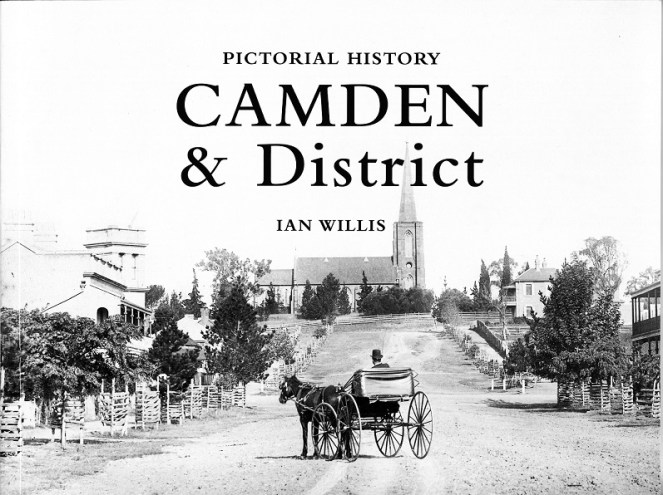
It is often the streetscape that is the important feature of a heritage overlay, as is the case for the Camden Heritage Conservation Area, which incorporates the former country town centre. The CHCA has created a marketing opportunity for local businesses.
History and marketing combined in 2026 in the Camden Village promotions by harnessing nostalgia as a marketing tool. (Willis 2026)
The Camden Village marketing campaign required local heritage assets to remain intact and in good order to support its marketing strategy.

Placemaking was the foundation of the marketing strategy, where the original country town centre is front and centre. (Willis 2012)
Journalist Ben Lutkevich says nostalgia marketing is an effective tool because it links a product to past memories, establishing an emotional bond. The marketer will use symbols from the past, including images, icons, and other representations, to link the product to customers’ memories and shared experiences. Nostalgia marketing promises to transport customers back to a happy time and its fond memories. (Lutkevich 2023).

The Camden Village marketing campaign harnessed the history and heritage of the Camden town centre as a potent sales tool.
Reflection
So, the question is: Is the CIS criticism of heritage regulations and legislation fair and equitable?
A narrow economic interpretation of heritage, framed through cost-benefit analysis, misses the human dimension of the story. Heritage is related to history, placemaking, sense of place, community identity, community well-being, mental health and community resilience. There is a real economic cost to all of this.
A broader view of heritage regulation would take account of social costs. Even big business supports social responsibility through the triple bottom line. Heritage and marketing can be successfully combined in a sales strategy, bringing strong economic benefits to a community.
Conclusion
The Centre for Independent Studies argues that NSW heritage laws exacerbate the housing affordability crisis by preserving unremarkable buildings, thus restricting development. It critiques a narrow economic view of heritage that neglects community values, highlighting that a broader understanding of heritage’s social and economic benefits is essential for sustainable urban planning.
.
References
‘Australia’s Heritage Laws’ 2026. Bloomberg Australian Briefing, Email, 26 February.
Abbott, Tony 2025, Australia, A History. HarperCollins, Sydney.
DCCEEW 2025. NSW Heritage Strategy – Sustaining the past for the future – Draft for public exhibition. Department of Climate Change, Energy, the Environment and Water, NSW Government. Online at https://hdp-au-prod-app-nsw-haveyoursay-files.s3.ap-southeast-2.amazonaws.com/5217/6601/4675/NSW_Heritage_Strategy_Sustaining_the_past_for_the_future_-_Draft_for_public_exhibition.pdf (Accessed 9/3/26)
Lutkevich, B. (2023). Nostalgia marketing explained: Everything you already know. [online] techtarget.com. Available at: https://www.techtarget.com/whatis/feature/Nostalgia-marketing-explained-Everything-you-already-know [Accessed 31 Jul. 2025].
Rae, Christina. (2020). 1920s houses Australia: a guide to architecture styles in 1920s. [online] Australian House and Garden. Available at: https://www.homestolove.com.au/the-block/1920s-houses-australia-21696/ [Accessed 1 Mar. 2026].
Tulip, Peter. (2026). Reform of Heritage Legislation. [online] The Centre for Independent Studies. Available at: https://www.cis.org.au/publication/reform-of-heritage-legislation/ [Accessed 26 Feb. 2026].
Willis, Ian. 2012. Townies, ex-urbanites and aesthetics: Issues of identity on Sydney’s rural-urban fringe. AQ – Australian Quarterly, 83(2), 20–25. https://search.informit.org/doi/10.3316/informit.697645319083276 (Accessed 2/3/26)
Willis, Ian 2024, Unveiling Hardy Wilson’s architectural legacy and his influence on Camden’s aesthetics Camden History Notes blog. Online at https://camdenhistorynotes.com/2024/10/04/unveiling-hardy-wilsons-architectural-legacy-and-his-influence-on-camdens-aesthetics/ (Viewed 26 February 2026)
Willis, Ian 2026. Is Camden a Village? Unpacking History and MarketingCamden History Notes, 18 February. Online at https://camdenhistorynotes.com/2026/02/18/is-camden-a-village-unpacking-history-and-marketing/ (accessed 26/2/26)

Discover more from Camden History Notes
Subscribe to get the latest posts sent to your email.

