
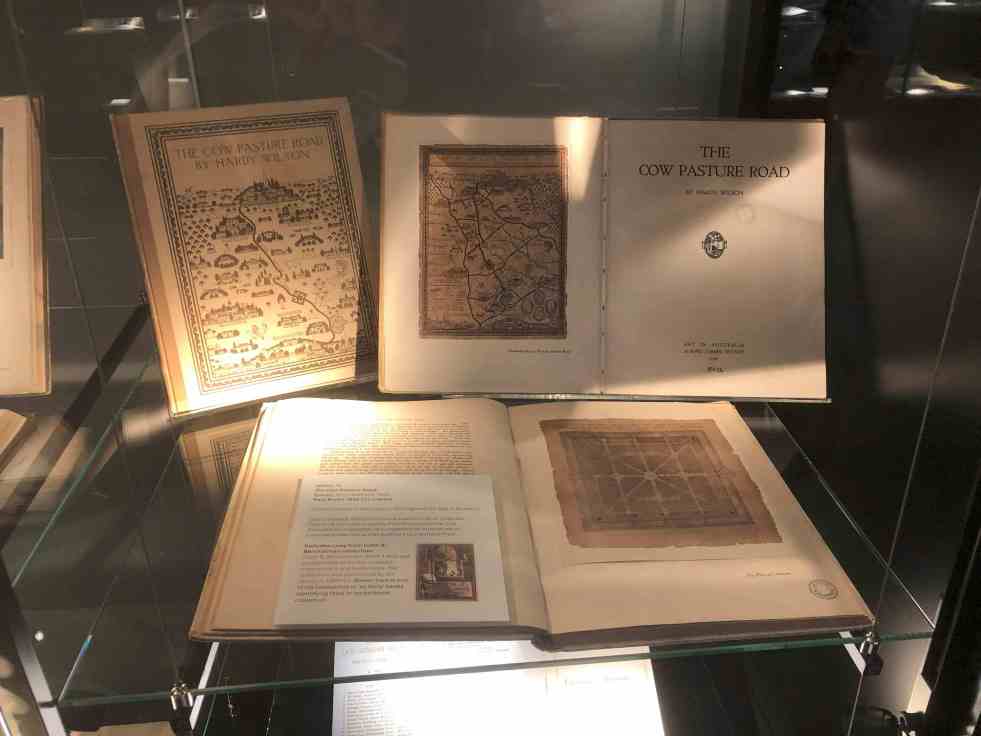
A map at the library
A framed copy of Hardy Wilson’s parchment map, The Cow Pasture Road, hangs on the wall at the Camden Library. Most people would not understand its significance.
Campbelltown-born architect, artist, and writer William Hardy Wilson is largely unknown in the local area and has no recognised place in the Camden story. Yet he deserves to be better known.
Wilson wrote and illustrated The Cow Pasture Road in 1920, a seminal work in the history of the Camden district.
For decades, Wilson’s romantic observation in the book influenced the imagery and aesthetics of writers, artists, poets, and others’ interpretations of the Camden story and the Cowpastures in magazines and newspapers. (Willis 2012)
Wilson was the earliest professionally trained architect to recognise the importance of the colonial architecture of the local area.
Who was William Hardy Wilson?
Wilson was a complex character. An outstanding architect with an artistic eye, an anti-modernist, and a colonial. He embraced interwar fascism and the ‘vitalist’ tradition, which was influenced by the ideas of thinkers like Hegel, Bergson, and Nietzche. (Keri)
Biographer Zeny Edwards has called Wilson a visionary, an aesthete, a critic and a racist. (Edwards)
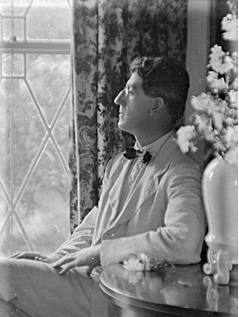
In the early 1900s, Wilson trained as an architect at Sydney Technical College, took instruction from artist Sydney Long and made friends with George Lambert and Arthur Streeton. (Apperly)
Wilson travelled to Europe and the USA and became interested in the colonial revival style architecture of the eastern States. From this experience, he became an enthusiastic advocate of Australian Georgian colonial architecture and is credited with popularizing the ‘Colonial Revival Style’.
Exhibition at the University of Sydney Library
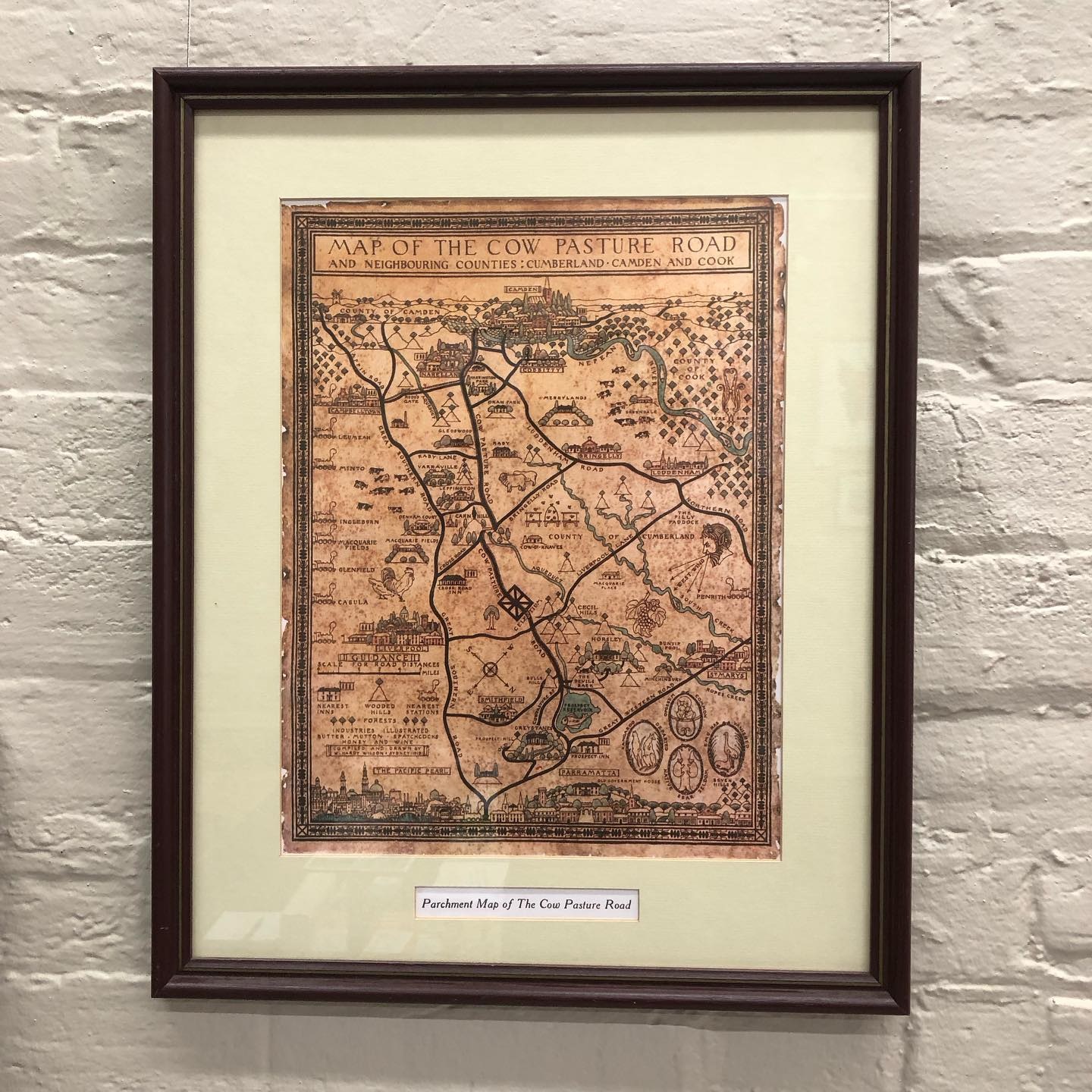
Honouring this legacy, the University of Sydney Library has mounted an exhibition marking the 100th anniversary of Wilson’s seminal work Old Colonial Architecture in New South Wales and Tasmania (1924).
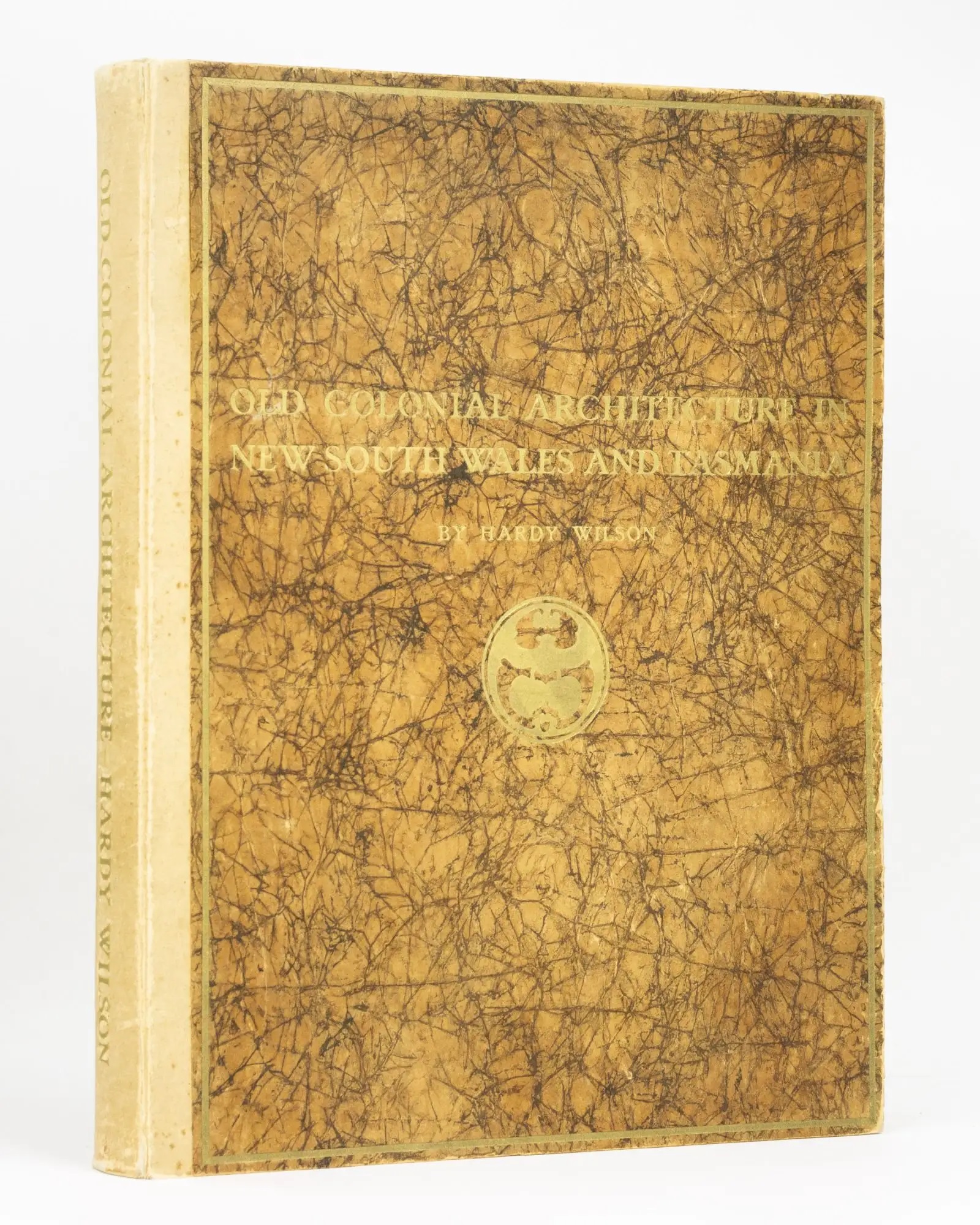
The ‘Hardy Wilson’s Old Colonial Architecture 1924-2024’ exhibition aims to draw attention to the book’s creation, examine its ‘enduring presence and influence in Australian architecture’ and contextualise it ‘in Wilson’s biography and wider body of published work’. (Exhibition Notes)
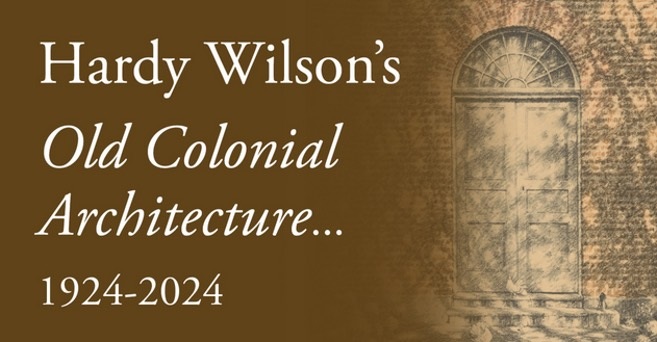
Old Colonial Architecture was a groundbreaking work in Australian architectural history and displayed Wilson’s considerable artistic talent. (Exhibition Notes)
The exhibition raises questions ‘about how we evaluate his work considering his outmoded and odious social views, which became apparent in his later writing’ from the perspective of the 21st century. (Exhibition Notes)
The main question asked by the exhibition is, ‘Why is Hardy Wilson’s ‘vision of architecture of the early colonies proven so durable and natural to his readers and admirers?’ (Exhibition Notes)
The displays include 50 plates from Old Colonial Architecture; Wilson’s other publications, biographies and works influenced by Wilson.
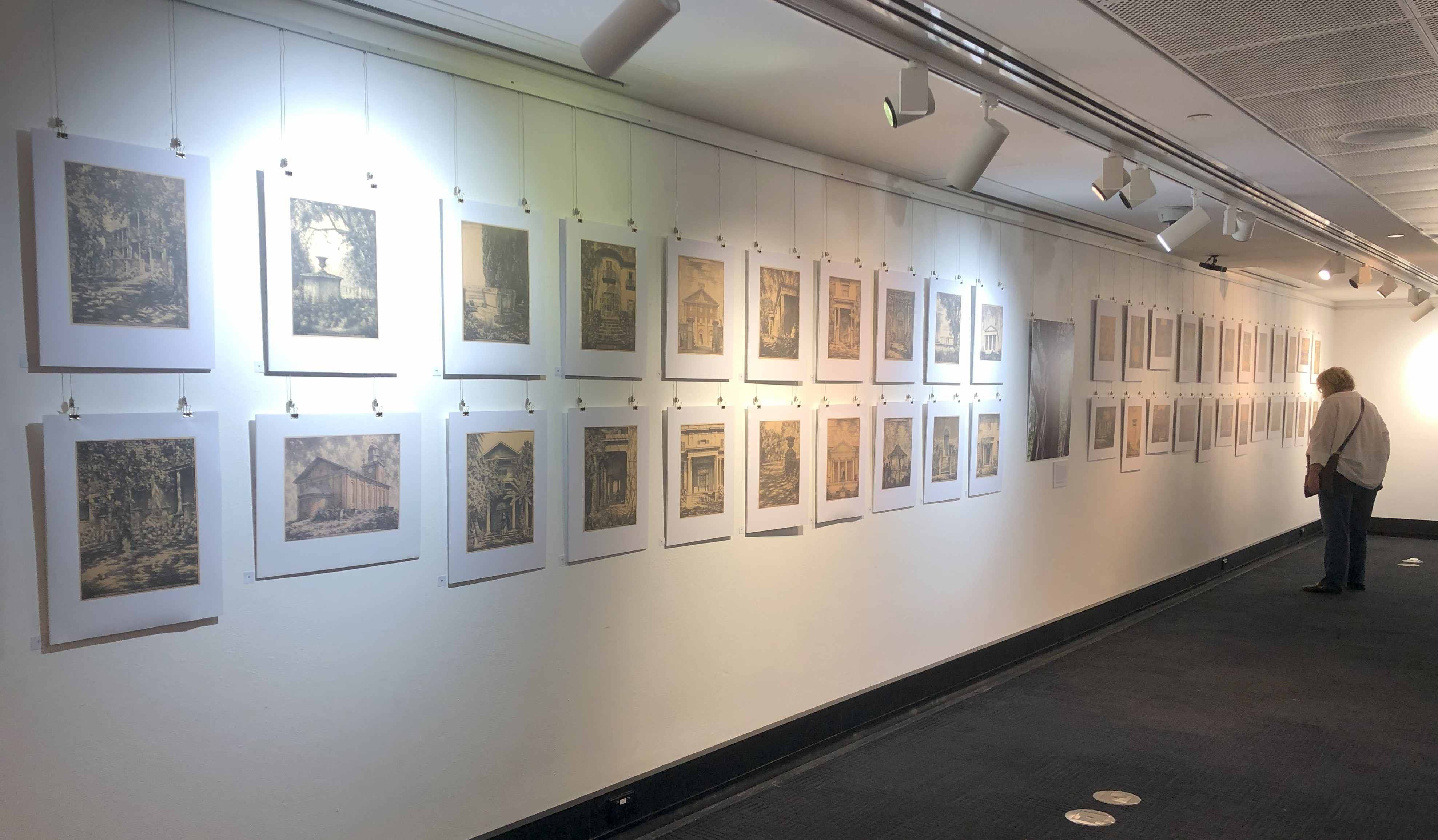
The exhibition has been curated by Associated Professor Cameron Logan (Sydney School of Architecture, Design and Planning), Sydney conservation architect Hector Abrahams and architecture graduate Olivia Salkeld (Hector Abrahams Architects) with the University of Sydney Rare Books and Special Collections.
Symposium
Part of the exhibition was a symposium organised by the University of Sydney School of Architecture, Design and Planning, called ‘Hardy Wilson and the Colonial Imagination’.
The symposium considered how Hardy Wilson’s Old Colonial Architecture has become ‘one of only a handful of books that are absolutely essential to understanding the field of architectural history’. (Symposium Notes)
According to symposium organisers, Cameron Lodge and Hector Abrahams, Old Colonial Architecture is an essential marker in Australian architecture history and publishing.
An exciting part of the symposium was a walk around the exhibition led by Abrahams. Works were brought out of the display cabinets and he paid particular attention to the 50 drawings from Old Colonial Architecture. These created what Abrahams called ‘a landscape across the wall’.
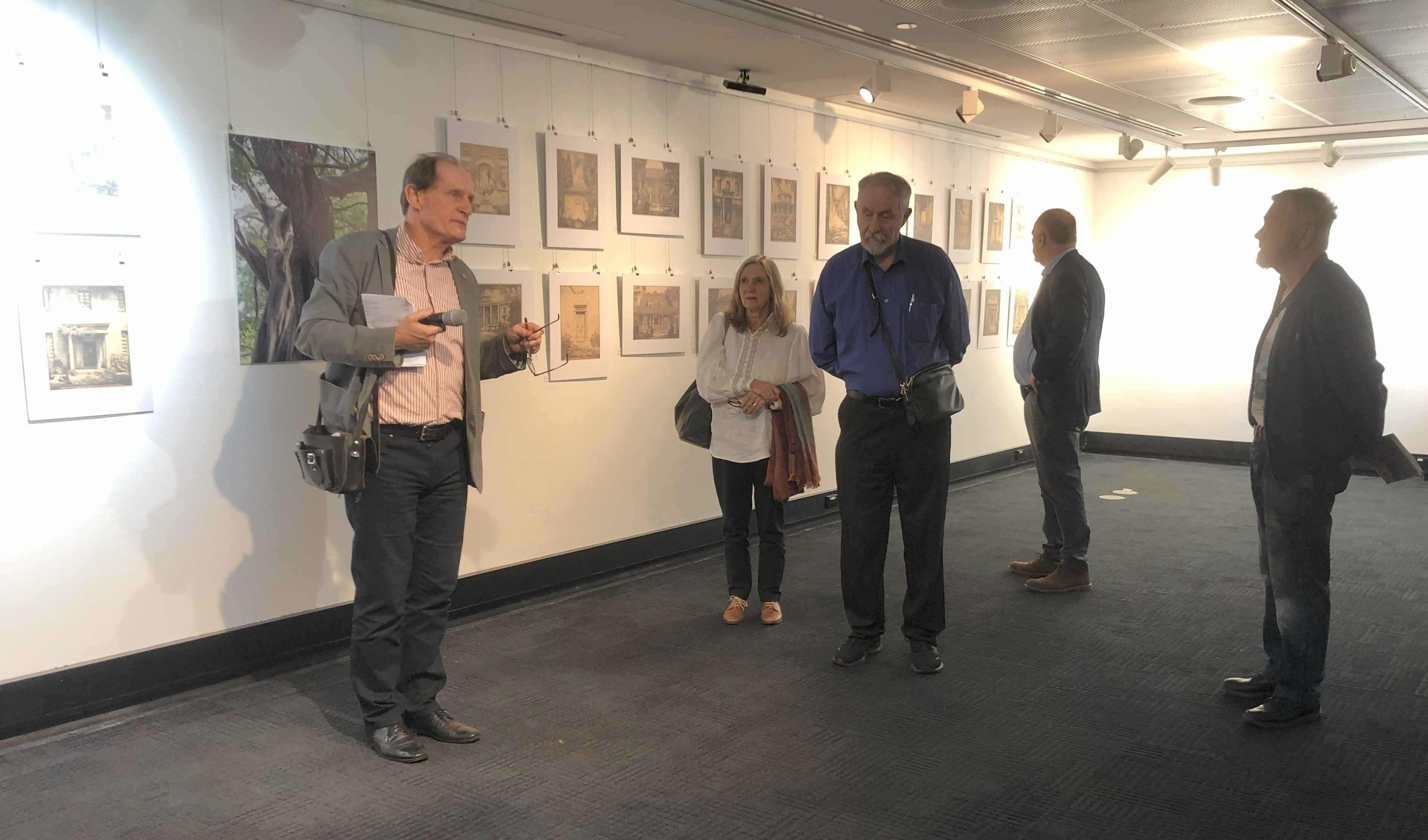
Hardy Wilson’s drawings, according to Abrahams, were done in a ‘romantic’ style, slightly ‘out of focus’. The subject matter is interesting – a cemetery monument here, a front door there. Abrahams asked, ‘Was there any order to the presentation of the drawings in the book?’ Answering his question, he says, ‘There is no honest answer’.
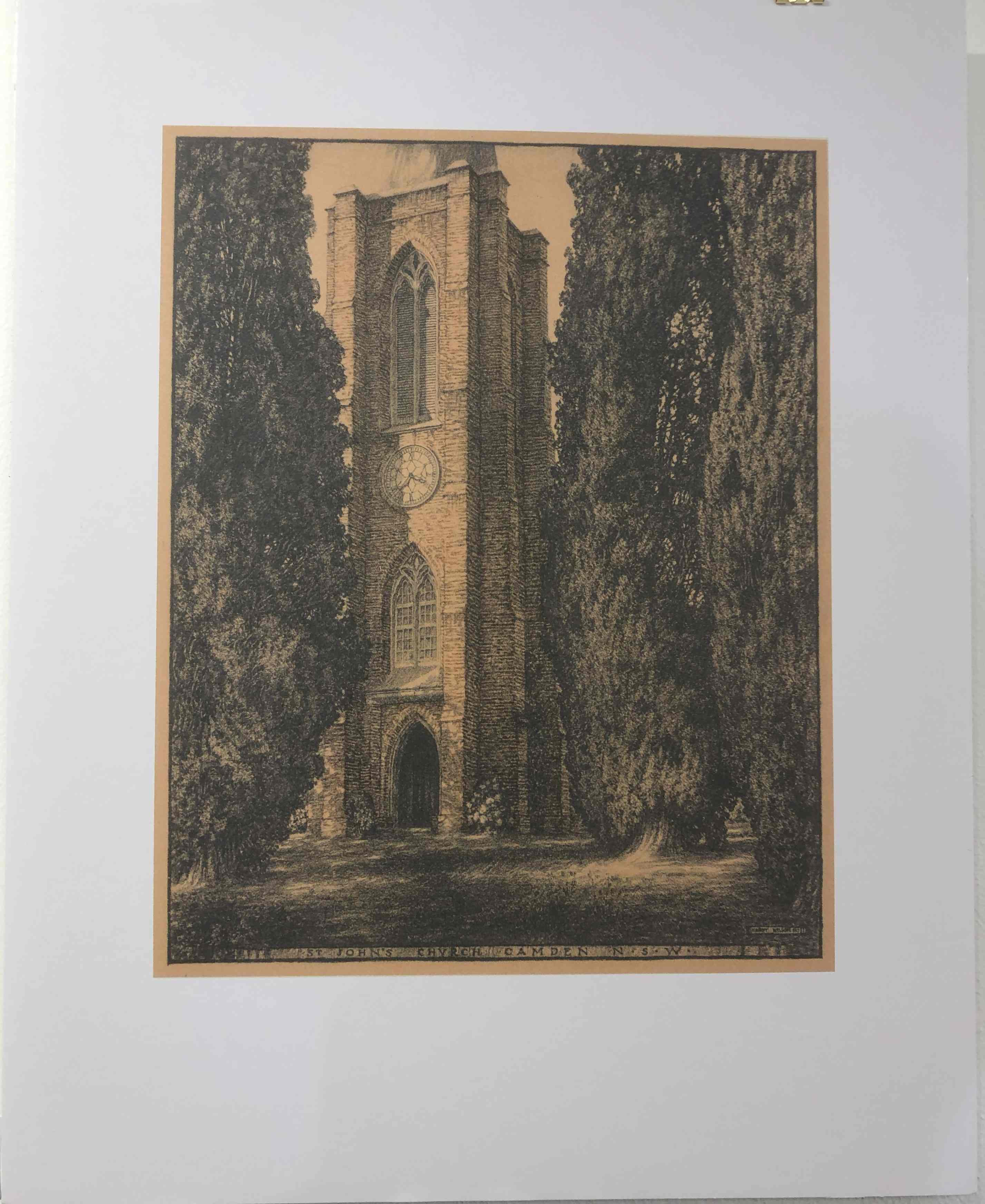
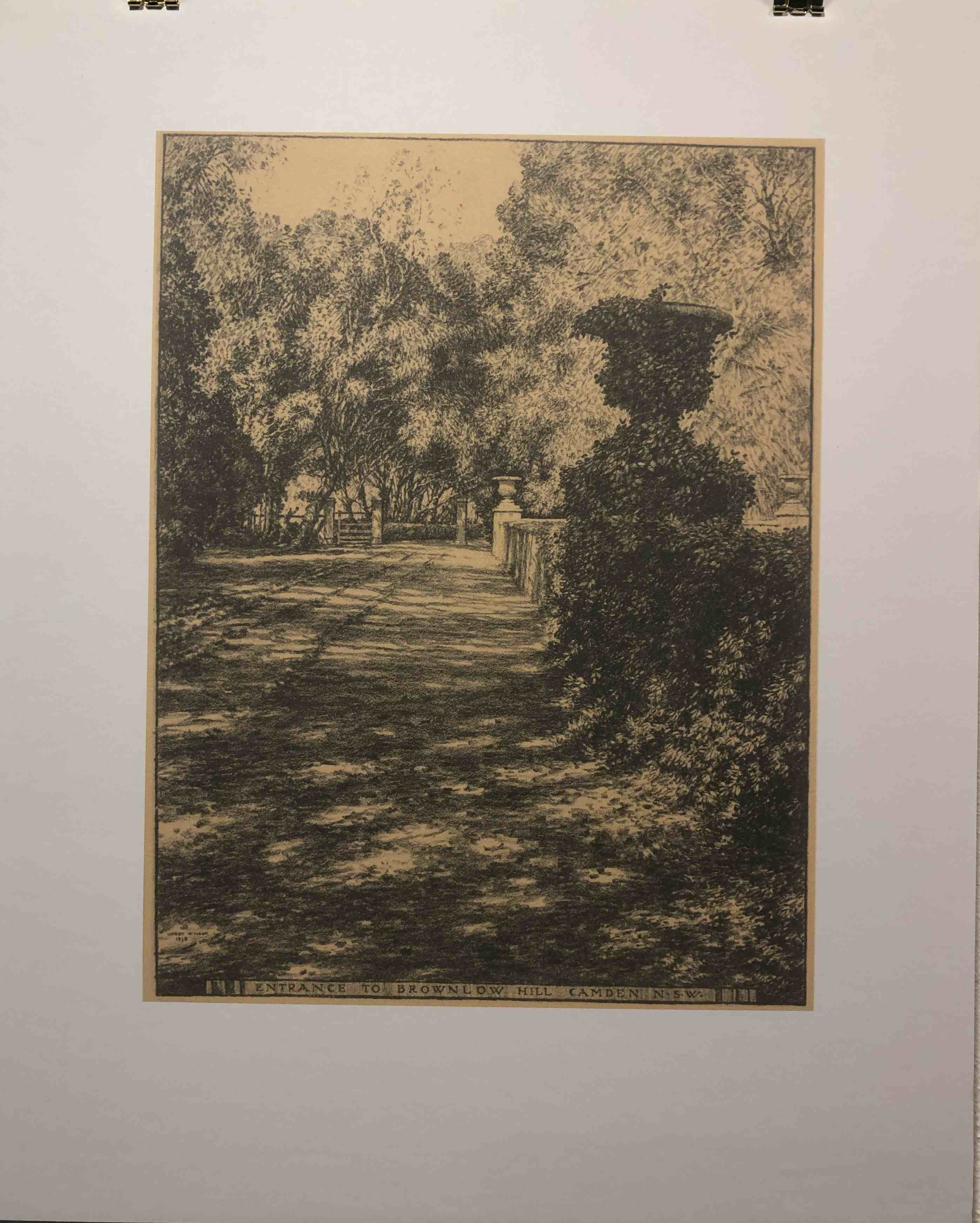
Amongst the drawings hung from Old Colonial Architecture are three images from the Macarthur region: St Paul’s Church Tomb in the Churchyard (plate n8, 1840s, drawn 1914); Brownlow Hill garden wall and vases (plate n17, 1837, drawn 1919) and St Johns Church Camden (plate n50, 1840s, drawn 1917). (Exhibition Notes)
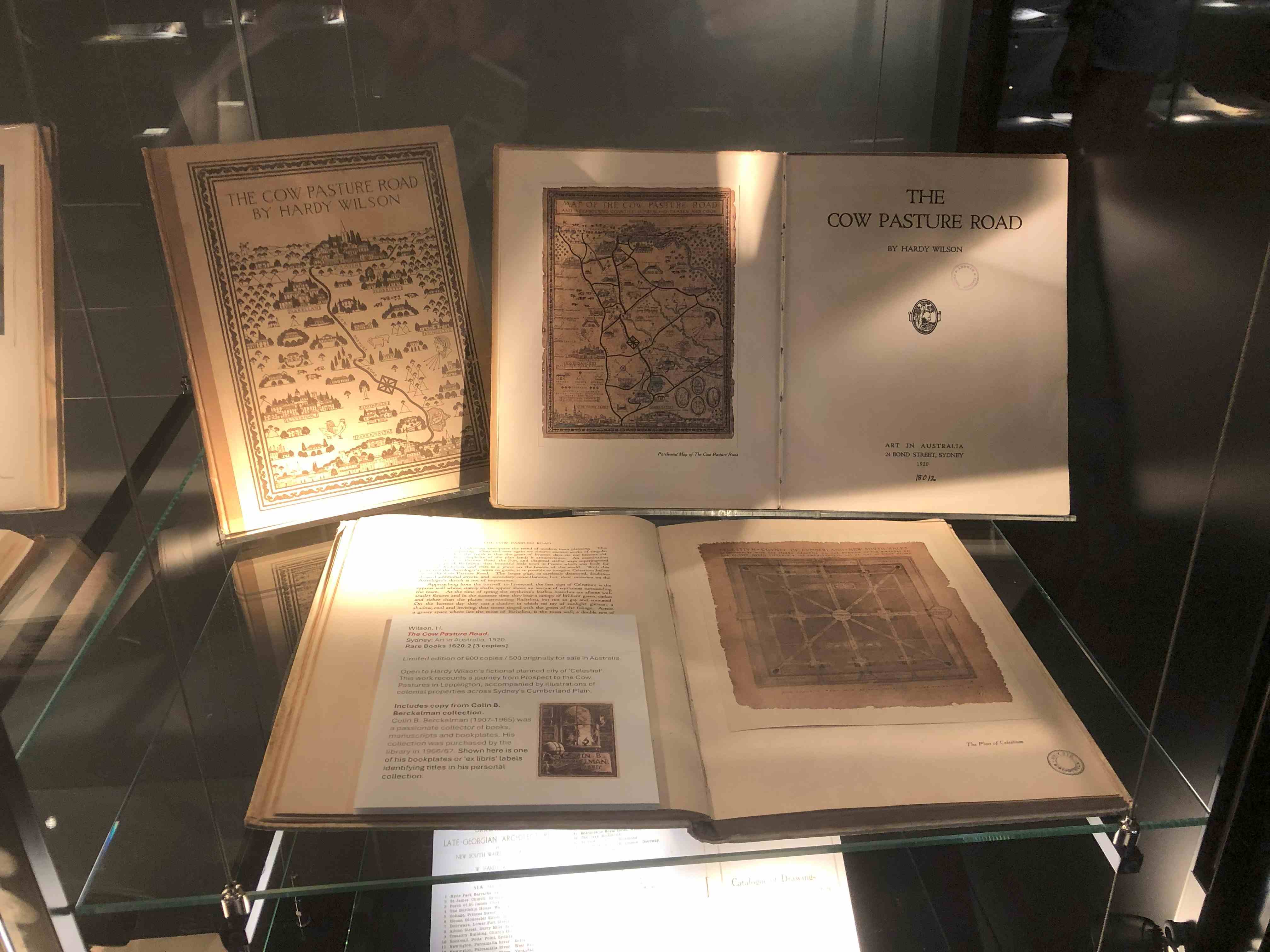
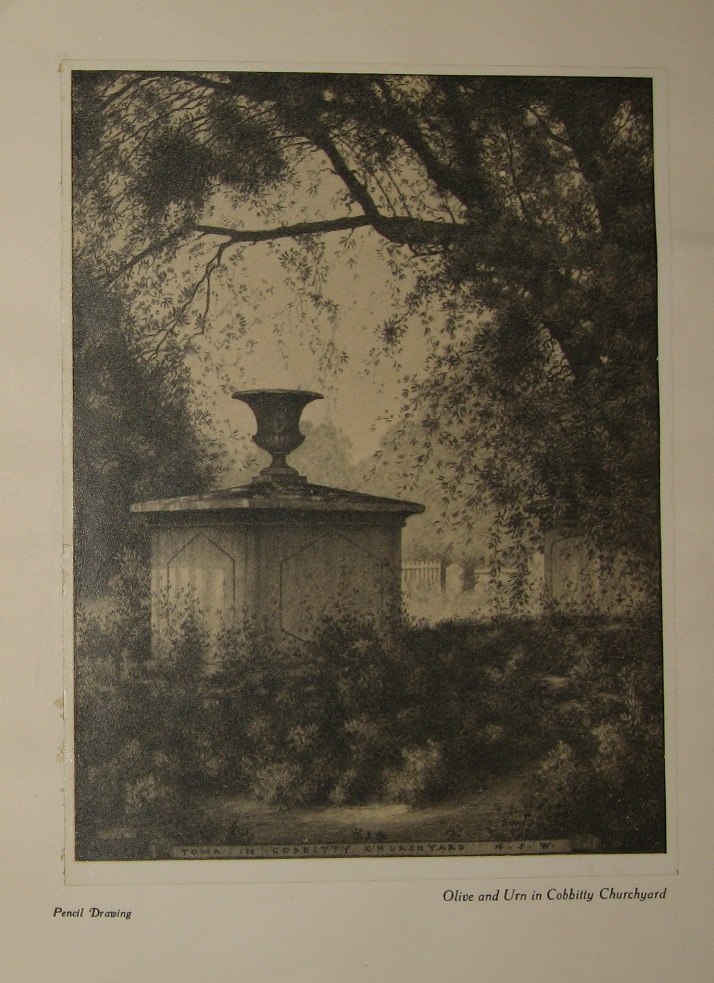
Two of these drawings were published in Wilson’s The Cow Pasture Road (1920): Olive and Urn in Cobbitty Churchyard (p51); and St John’s Church (p59).
The Cow Pasture Road (1920)
The Cow Pasture Road is a whimsical fictional tale about a walk down the Cowpasture Road from Prospect to Camden. Wilson never learnt to drive, instead catching the train and walking. (Edwards, 220) Wilson takes a semi-autobiographical role and sees himself as ‘Promise Brown, a builder living in Narellan. Brown searched the Narellan School of Arts for inspiration for house designs’. (Johnson, 220)
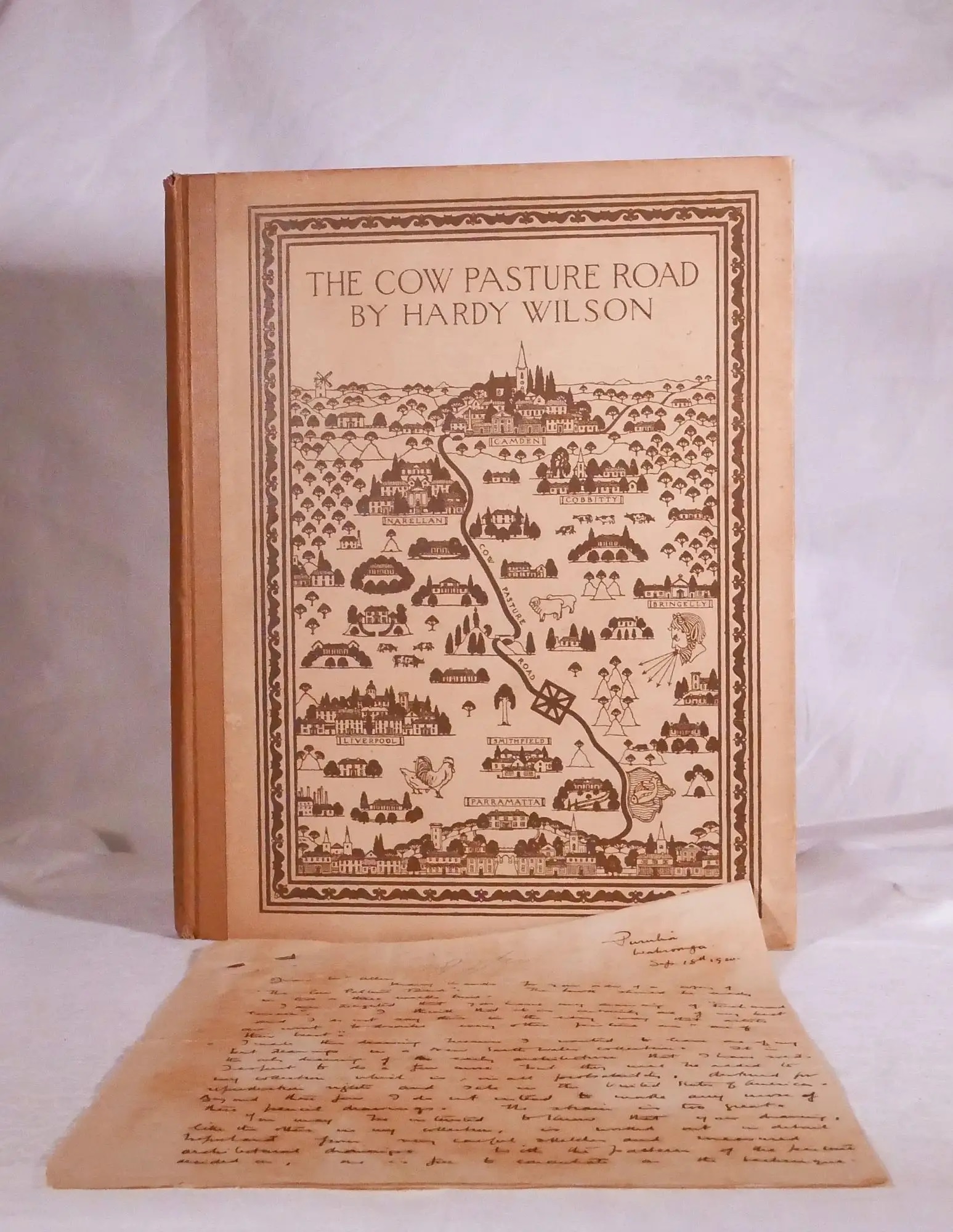
The story is complemented by 12 pencil and watercolour images of colonial properties along the Cowpasture Road. Only 600 of The Cow Pasture Road were published, with 500 sold in Australia.
In The Cow Pasture Road, Wilson details the Reptonian influences on the hilltop location of the Cowpastures gentry homestead sites that were built after the warfare of the colonial frontier had been subdued. He wrote:
Pioneer squires chose serene summits on which to place their homesteads. They had no climatic rigours to contend with and feared no hostile invasions. Selecting the tallest hill upon estates presented by the Crown, they built with taste and imagination, settling their white-walled houses like snowflakes fallen on cushions of verdure. Tranquillity surrounded them. Thus situated, like little monarchs on their own hill-tops, at the head of assigned garrisons, they saw the world at the feet without thought of conquest. Their ramparts were fences to keep off trespassing cattle. Napoleon besieging Europe did not rouse the click of a trigger on Cow Pasture muskets.(Hardy Wilson, The Cow Pasture Road, p9)
Wilson detailed how the Cowpastures gentry re-created the English-style estate villages around colonial homesteads:
In pioneering days these homesteads resembled small villages. Each provided its own necessary commodities. The grape furnished wine and the wheat bread; on the pasturages grazed sheep and cattle, and grey olive trees gave a fruit which has become distasteful now that salad is taken without oil. In the kitchen gardens flourished artichokes and luscious melons and bountiful crops of commoner nourishment. Blacksmiths, carpenters, shepherds and vigerons, congregated in out-buildings, were employed welding iron and turning wood, tending flocks and vineyards; in short, performing all those tasks necessary to sustain a village in the wilderness. (Hardy Wilson, The Cow Pasture Road, p9)
Casting an artistic eye across the colonial gardens of the gentry homesteads, according to James Broadbent, Wilson saw these gardens in ‘the clear singing brightness of light and pure colour’. He looked at these gardens with ‘the fresh eye of a Northener’. (Broadbent, 65)
Wilson wrote:
They raised prolific oranges and olives and luxuriant oleanders; laurels side by side with pomegranates flourished…the fragrant Francisea (Brunfelsia latifolia) whose flowers opening like the violet dawn imbibe blue from the mid-day sky and then, nearly at the end of their life spent perfuming their neighbourhood, turn pale as moonlit stars, and like stars from the firmament, fall to the ground fragrant to the last. (Hardy Wilson, The Cow Pasture Road, p8)
At Gledswood Wilson admired the ‘enchanting garden’ of ‘verbona, roses, larkspur, hollyhocks, flourish amongst flowers as rare as they are beautiful’. (Hardy Wilson, The Cow Pasture Road, p40)
Throughout The Cow Pasture Road, Wilson admired the architectural grandeur of the trees around the homesteads, from olives to cypresses, araucarias and apple-oaks (angophora), making particular note of what Broadbent calls ‘signature plants’ strategically placed around the homesteads or in the gardens. (Broadbent, 67)
Legacy
Wilson was a complex character who had several roles throughout his life. He was an outstanding architect and artist whose legacy had an identifiable influence on the imagery and aesthetics that developed around the history of the gentry estates of the Cowpastures during the interwar period. (Willis 2012)
Artists, writers and others embraced a romantic notion of the colonial period and its architecture built by the Cowpastures gentry with their hilltop homesteads and English-style gardens. (Willis 2012)
In the post-war years, the work of Hardy Wilson influenced people like Dr Ivor G Thomas, the founder of the Campbelltown and Airds Historical Society, who campaigned for the recognition and protection of Campbelltown’s Georgian heritage. (Willis 2009)
Wilson’s influence endures. Between 2006 and 2008, the Historic Houses Trust of NSW conducted four popular tours of homesteads on the Cow Pasture Road based on Hardy Wilson’s work. (Knight)
Most recently, the Alan Baker Art Gallery in Camden has offered architectural drawing classes, a legacy of Wilson and his vision of the Cowpastures.
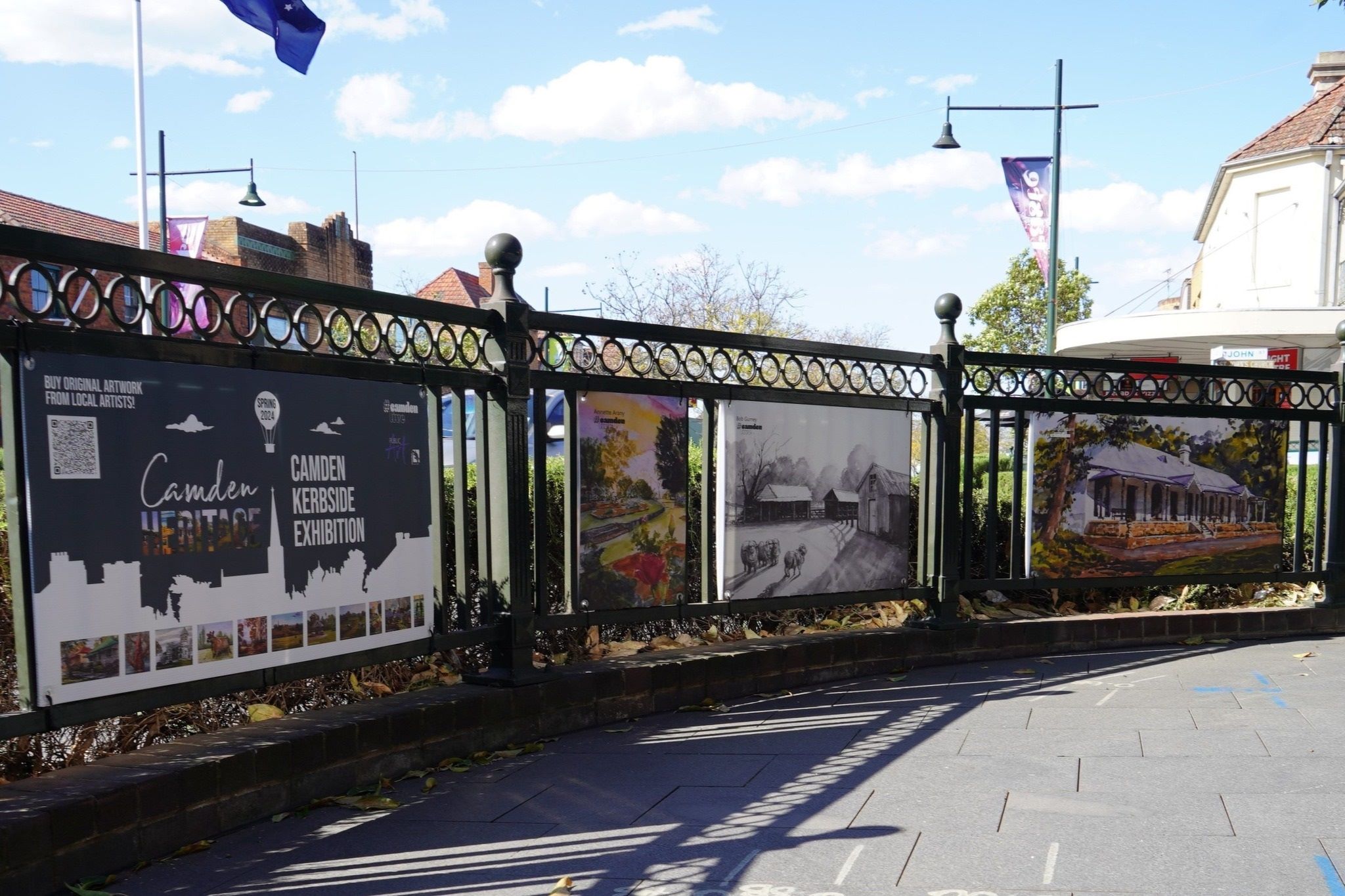
In 2024, the Camden Kerbside Exhibition program took up the theme of Camden Heritage, with a strong theme based on the built heritage, with posters displayed in local bus shelters.
Conclusion
The exhibition and symposium illustrate William Hardy Wilson’s groundbreaking work and its impact and relevance 100 years after the publication of Old Colonial Architecture.
Wilson’s The Cow Pasture Road (1920) has influenced the aesthetic interpretation of the Cowpastures and the colonial gentry homesteads, particularly by writers, artists and poets during the Interwar period in newspapers and magazines.
Wilson’s work still has supporters and devotees and has a profound impact on historical architecture despite his support of fascism and racist views.
Wilson was a complex character, and his work deserves to be better understood within the context of its creation. However, his social views are unacceptable in today’s world.
William Hardy Wilson has influenced how the Camden story is told, the making of local history and the understanding of Camden aesthetics.
Exhibition details
The University of Sydney Library exhibition was launched on Thursday, 22 August, and will be displayed on level 2 of Fisher Library until the end of semester 1, 2025.
If you have the time, the exhibition is well worth a visit.
References
Apperly, Richard E 1990. ‘Wilson, William Hardy (1881–1955)’, Australian Dictionary of Biography, National Centre of Biography, Australian National University, https://adb.anu.edu.au/biography/wilson-william-hardy-9147/text16141, published first in hardcopy, accessed online 29 September 2024.
Broadbent, James 1980. ‘Gardens’, in William Hardy Wilson, a 20th century colonial, 1881-1955. Caroline Simpson (ed), National Trust of Australia (New South Wales) Sydney.
Edwards, Zeny 2001. William Hardy Wilson : artist, architect, orientalist, visionary. Watermark, Surry Hills, N.S.W. Garsington.
Exhibition Notes 2024, ‘Hardy Wilson’s Old Colonial Architecture 1924-2024 exhibition’. Typescript, University of Sydney Library, Sydney. Online at https://www.library.sydney.edu.au/about/news/hardy-wilson-exhibition
Johnson, John 2001. ‘The Road to Kurrajong’, in William Hardy Wilson : artist, architect, orientalist, visionary. Edwards, Zeny (ed), Watermark, Surry Hills, N.S.W. Garsington.
Keri, Adrian 2021. Australian Literary Fascists, 1905-1945: A Comparative Case Study into the Development of Fascist Ideology in Australia, MA Thesis, University of Notre Dame Australia, pp. 63-140
Knight, Katherine 2008. ‘Colonial Homes and Gardens of The Cow Pasture Road’. Phanfare, No 230 – May-June, pp14-20. Online at https://www.phansw.org.au/wp-content/uploads/2012/04/PhanfareMayJune2008.pdf
Symposium Notes 2024., ‘Hardy Wilson and the Colonial Imagination’. Typescript, University of Sydney Library, 20 September.
Willis, I. C. 2012, ‘Townies, ex-urbanites and aesthetics; Issues of identity on Sydney’s rural-urban fringe’, AQ-Australian Quarterly, vol. 83, no. 2, pp. 20-25.
Willis, Ian, 2015, Pictorial History Camden and District. Kingsclear Books, Sydney.
Willis, Ian 2009. “Stories and Things: The Role of the Local Historical Society, Campbelltown, Camden and The Oaks.” Journal of the Royal Australian Historical Society 95, no. 1: 18–37. https://search.informit.org/doi/10.3316/ielapa.200906492.
Wilson, Hardy 1920. The Cow Pasture Road Art in Australia Sydney 1920
Discover more from Camden History Notes
Subscribe to get the latest posts sent to your email.

