The emotional heart of the town
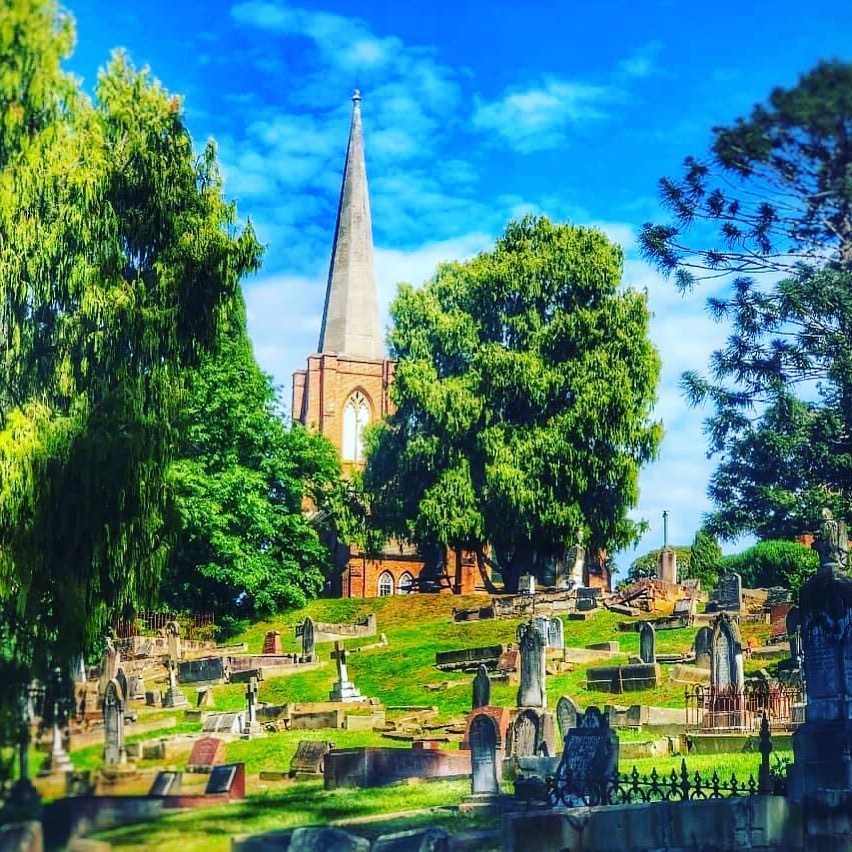
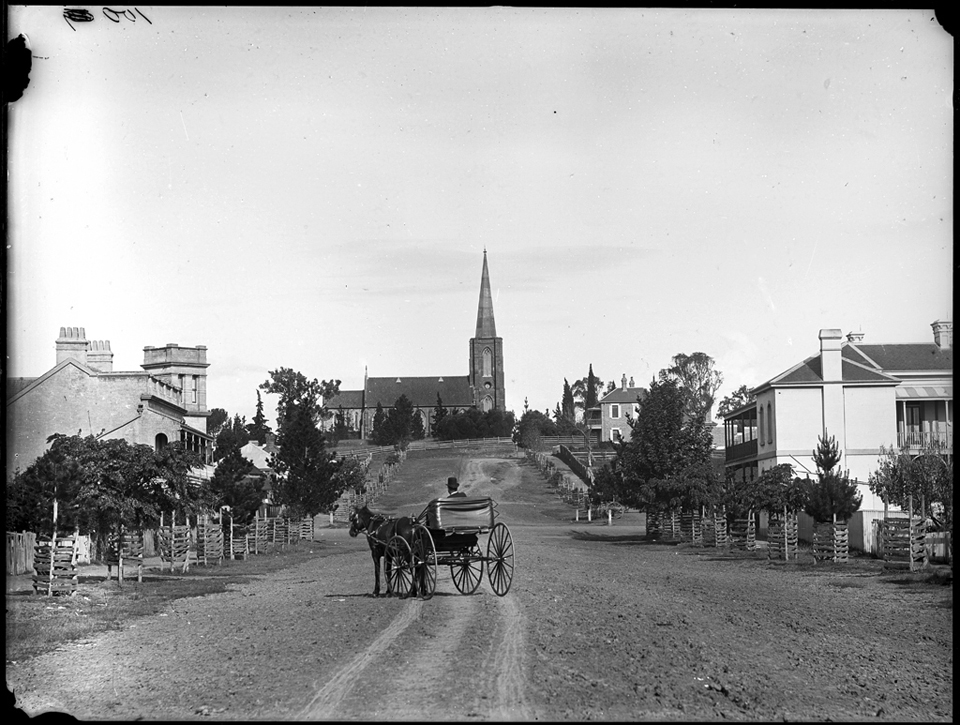
On the hill overlooking the Camden town centre is a church building representing the community’s historic, moral and emotional heart, its sense of place. It would not be an exaggeration to say that the church represents the town’s soul, built below it on the Nepean River floodplain in the mid-19th century.
A metaphor for the order and stability
The church is a metaphor for the order and stability it represented in the wilds of the colonial frontier. It was at the centre of the original proposal for the English-style village of Camden in the 1830s, along with a courthouse and a gaol.
For the Macarthurs of Camden Park estate, the church was the centre of their moral and spiritual conservatism. As part of similar early 19th English estate villages, the church represented the stability and order Macarthur required of the new community on their estate. More than this, the church was a central part of the landscape vistas of the village from Camden Park House.

James Macarthur’s view of the world
According to Alan Atkinson, the church represented James Macarthur’s religious view of the world where faith emanated from the ‘joint initiative of all classes’. Macarthur maintained that ‘collective and mutual dependence’ was an essential part of the ‘Christian spirit’ that would be a ‘symbol of for their reliance on each other’. [i]
The church cause was promoted by James and William Macarthur, and they appealed to neighbours and employees for a fund to construct the church. By 1835 the Macarthurs subscribed £500 of a total of £644 from estate workers and neighbours.
The church’s building coincided with Governor Bourke’s Church Act of 1836 which offered a subsidy for building churches in the New South Wales colony. Macarthur applied for a subsidy of £1000 of the total cost of £2500.[ii]
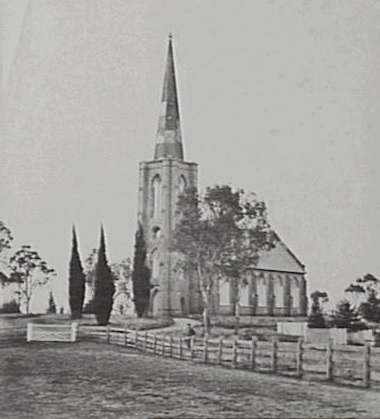
The church was constructed with local bricks and timbers and was consecrated in 1849. Hector Abrahams states that St John’s church:
In its architectural innovation and picturesque placement in a controlled landscape, it is among the most important parish churches in Australia.[iii]
Camden religious precinct
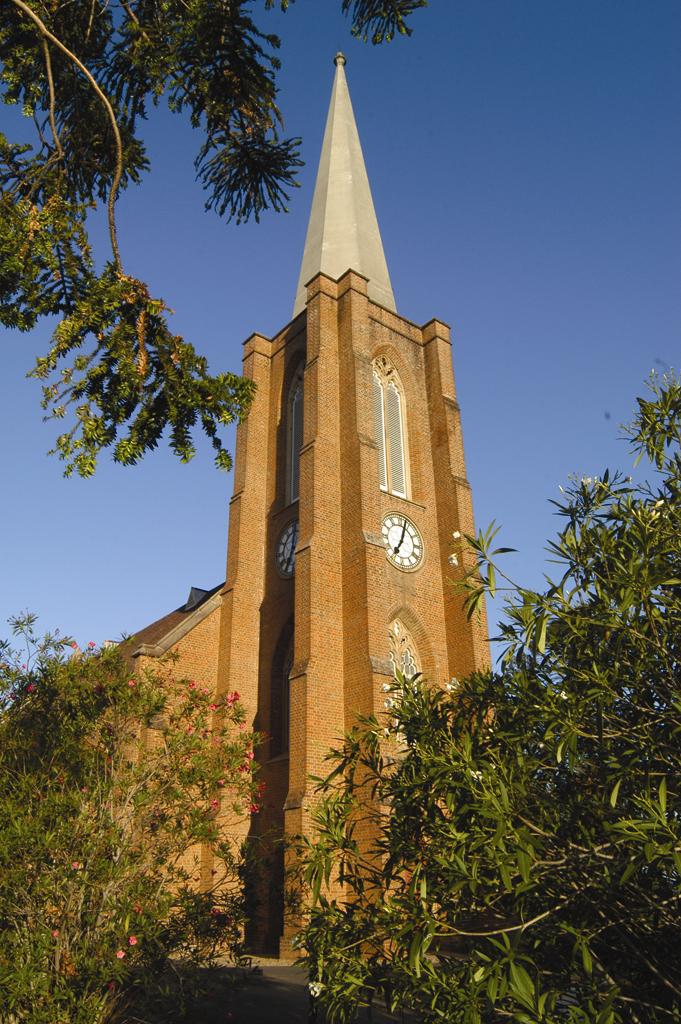
The church and its grounds are in a religious precinct that includes the rectory and stables (1859), church hall (1906), and a cemetery. While the church was initially proposed in a ‘classical’ style, it was eventually constructed in the Gothic Revival style, which became popular in Sydney then. Sydney architect Hector Abrahams maintains that St Johns was the first Gothic Revival church in the colony of New South Wales when it finished in 1844.
Gothic revival
Gothic revival looked back to the glory of the medieval period, in contrast to neo-classical styles, which were popular at the time. To its supporters, Gothic architecture was representative of Christian values that were being destroyed by the Industrial Revolution. Gothic architecture was aligned with the conservatism of the Macarthurs rather than the republicanism of the French and American revolutionary wars and neoclassicism. Its popularity was partly driven in the colony of New South Wales by the rebuilding of the British Houses of Parliament in 1834, which evoked a romantic age.
Camden’s Englishness
Over the subsequent decades, St John’s church has represented Camden’s Englishness. Probably the first reference to St John’s church and its Englishness was in the Anglican newspaper, the Sydney Guardian when it stated
it’s graceful and really well proportioned spire presents a cheering object to the up country traveller, as it breaks the dull outline of bush hill carrying the mind back to scenes well remembered and deeply loved by all English hearted folk (Sydney Guardian quoted in Clive Lucas Stapleton & Partners, St. John’s Anglican Church Precinct Menangle Road, Camden Conservation Management Plan, 2004, Sydney, p.44)
In 1926 the church was at the forefront of the mind of Eldred Dyer, who wrote in the Sydney Morning Herald that Camden was reminiscent of English parish church towns. He wrote that as he stepped out and walked around the town centre, he lifted his:
eyes to the old church as it stands in beauty on its hill, and In a flash you are transported to some old English church town. In a moment, if you have understanding, you and in a flash you are transported to some old English church town.[iv]
To a travel writer for the Sydney Mail in 1926, the church was the dominant English-style landscape feature on a road trip through the area:.
the shapely and lofty steeple of its church raising itself above the copse of frees on the hilltop and giving the little township a quaintly European aspect.[v]
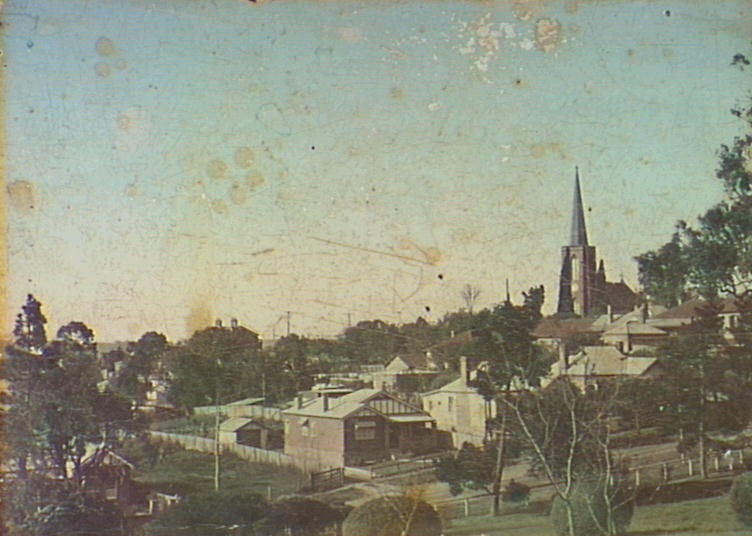
From its inception, the church has become central to all representations of the Camden township and what it means to be born and bred in the district. The church is the fundamental icon is the community’s sense of place and identity.
Church symbolism
The church symbolism is central in tourism literature, business promotions, stories of the town, its history, and other representations of the district.
The church continues to dominate the town centre skyline and the minds and hearts of all Camden folk. Here hoping that this continues for another century.
Notes
[i] Atkinson, Alan. Camden / Alan Atkinson Australian Scholarly Publishing North Melbourne, Vic 2008 http://www.loc.gov/catdir/toc/fy0904/2008431682.html pp.30-32
[ii] Atkinson, Alan. Camden / Alan Atkinson Australian Scholarly Publishing North Melbourne, Vic 2008 http://www.loc.gov/catdir/toc/fy0904/2008431682.html pp.30-32
[iii] Hector Abrahams, Christian church architecture, Dictionary of Sydney, 2010, http://dictionaryofsydney.org/entry/christian_church_architecture, viewed 16 March 2017
[iv] Sydney Morning Herald (NSW: 1842 – 1954), Saturday 28 August 1926, page 9
[v] Sydney Mail (NSW: 1912 – 1938), Wednesday 11 August 1926, page 46

Updated on 13 May 2023. Originally posted on 16 March 2017.
Discover more from Camden History Notes
Subscribe to get the latest posts sent to your email.


4 thoughts on “St John’s Church Camden, the soul of a country town”
Comments are closed.