A statement of industrial modernism
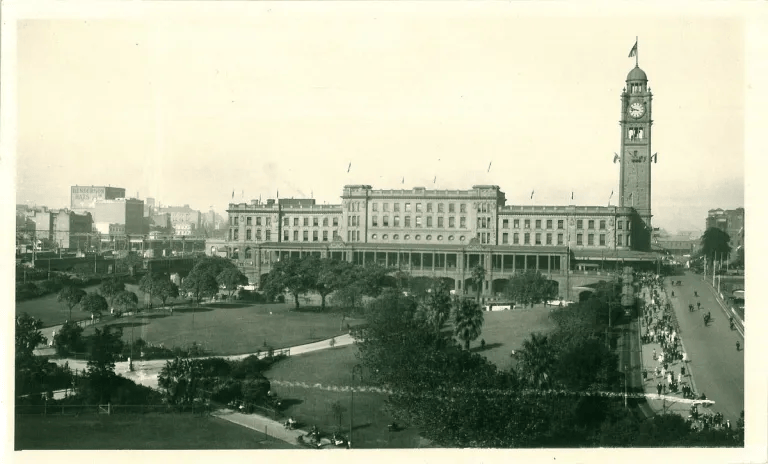
Sydney Central Station reflects a high point of industrial modernism in Sydney, showcasing design, technology, and engineering when it opened in 1906. Built to impress, the Sydney Terminus reflected the optimism of the Australian Federation era and the country’s future, rivalling railway stations in Europe and North America.
The current station symbolised the status and importance of railways in New South Wales. It was the largest and most elaborate station built in the state, designed to be seen and complement the cityscape. The elaborate station design and use of space enhanced passenger flow, with cab porticos that reinforced a sense of place.
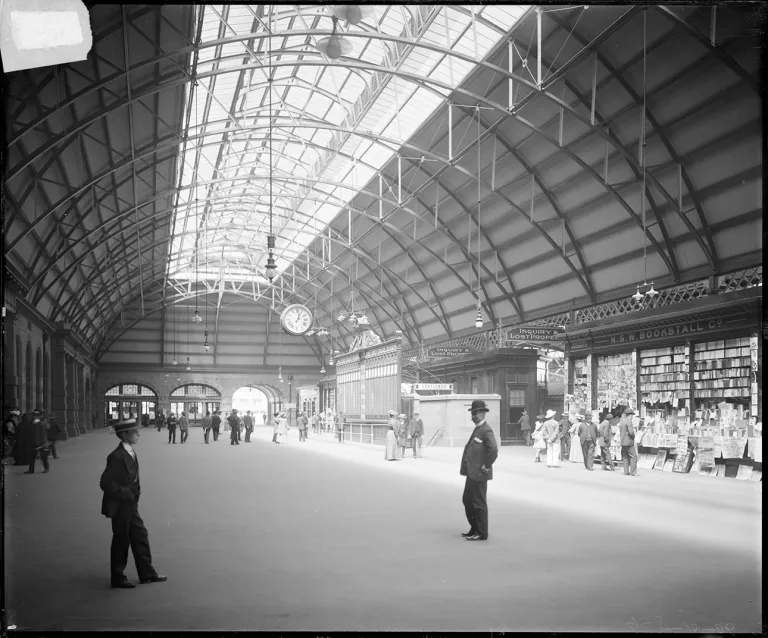
From the outset, the innovative design included multi-level access for passengers, trams, trains, and cabs; innovations in baggage handling and passenger subways; and up-to-date use of telegraph and telephone technology. Construction innovations included one of the earliest uses of concrete floor slabs in New South Wales and crescent roof trusses over the concourse area. (Heritage NSW 2026)
Three historic stages
The current Central Railway Station is the third station on that site and is a grand Victorian edifice in the tradition of British railway stations, demonstrating to the world the importance of rail travel in New South Wales at the beginning of the 20th century.
The NSW State Archives and Records has neatly summarised the three historic stages in Central Station’s history. They are:
- The first ‘Sydney’ station, 1855-1874
- The second ‘Sydney’ station, 1874-1906
- The third ‘Sydney’ station, 1906-present – Central Railway Station
In 1855, the station was known as Redfern Railway Station, but it was not at Redfern. The present Redfern station was called Eveleigh. After 1874, the second station was still called Redfern. The current Redfern Station was named Redfern at the grand official opening of the current Central Station in 1906, and the 1874 Redfern terminus was demolished.
The New South Wales Lyne Government gave the go-ahead for a new Sydney terminus station on the northern side of Devonshire Street in 1895.
Dangerous congestion at Redfern station (Sydney terminus) continued into the late 1890s, and the city railway needed an extension. Several solutions were proposed, including a terminus at the intersection of St James Road and Elizabeth Street and the resumption of Hyde Park, which met opposition.
Cost considerations meant that eventually it was decided to resume the Devonshire Street Cemetery and a number of other buildings and institutions. These included Benevolent Asylum, Devonshire Street Cemetery, Christ Church Parsonage, Police Barracks, Sydney Female Refuge, Convent of the Good Samaritan and the South Sydney Morgue. (Eveleigh Stories 2022)
Railway engineers largely determined the station’s layout, with the architectural design overlaid on those plans. The government architect, Walter Liberty Vernon, designed a building that reflected the railways’ importance and status in NSW in 1901. (Upton 2018)
Sydney Trains’ Self-guided tour of Central Station states:
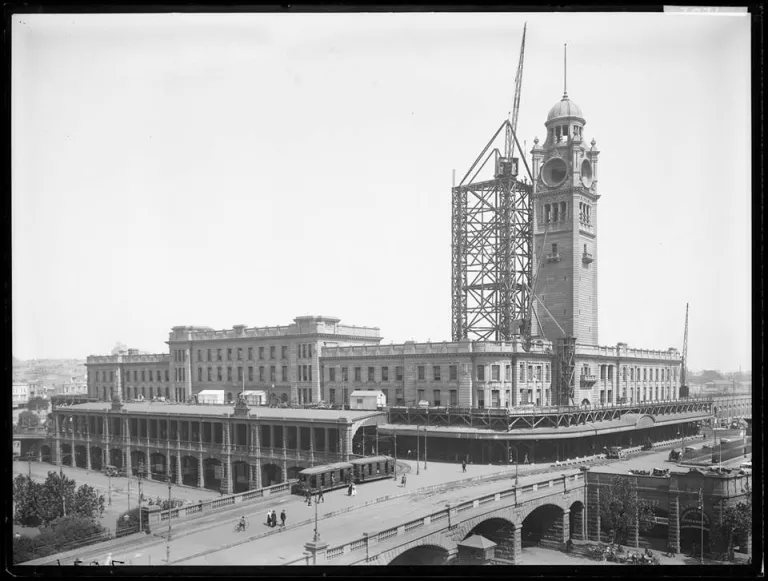
The foundation stone was laid on 30 April 1902 with a promise the station would be one of the world’s most handsome and reminds us of the grandeur and romance of rail travel in days gone by. (TST 2026)
A second level was added to the original design in 1902, and a clock tower was added in 1921. The station concourse design with its truss roof was influenced by Union Station in St Louis and rivalled those of the USA and Europe to accommodate increased passenger traffic. Several ancillary functions are located off the concourse area, including refreshment rooms, waiting rooms, and a booking hall. Platforms 1-15 run perpendicular to the main concourse and accommodate interstate, country and interurban services.
Impressive terminus
Heritage NSW describes the main Sydney Terminus building this way:
The Central Terminus sandstone building was designed in the Beaux Arts style by the Government Architect, Walter Liberty Vernon. Its dominant location and elevated siting permits the use of the topography to gain road access to several levels, enabling the development of an extensive subterranean luggage network, the separation of modes of transport, and commercial space. It is a classically inspired Beaux Arts building consisting of a sandstone and brick structure organised in a “U” form that encloses a steel-framed Main Hall and platforms. The interior of the Hall features a skylight barrel vaulted steel truss roof, clad with corrugated iron. The internal brick walls are banded and the asymmetric arrangement of archways and ticket office entries have sandstone entablatures, pilasters and Gibbs surrounds. Access to the Hall is from the east and west through barrel vaulted entries with coffered ceilings and horizontal banding similar to that of the Main Hall. (Heritage NSW 2026)
Other buildings in Central Station historic precinct
Other buildings in the Central Station historic precinct include:
- Railway Institute– b.1891 in a Queen Anne Revival style and used for training and social activities.
- Mortuary Station -b. 1869, designed by colonial architect James Barnett in Gothic Revival style, originally built for funeral parties to accompany the coffin to the necropolis at Rookwood Cemetery.
- Suburban Electric Platforms – b. 1926, platforms 16-23, and two additional underground stations were started in 1948 and completed in 1979.
- Devonshire Tunnel – b. 1906 as an underpass; now the Devonshire Street Tunnel, connecting with the Goods Line in Ultimo.
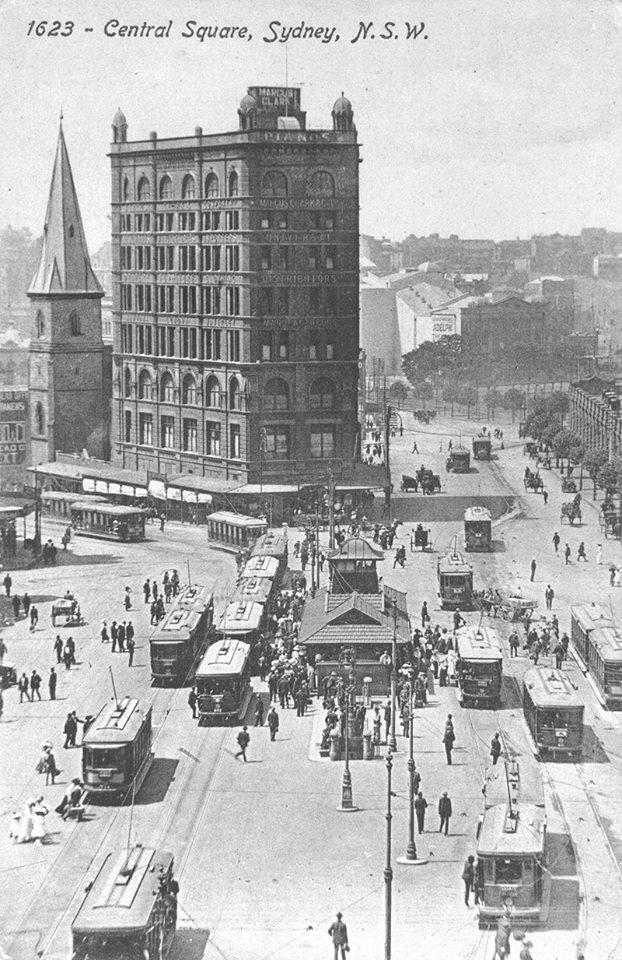
- Railway Square – originally Central Square at the junction of Pitt & George Sts,
- Parcel Office Building -b. 1906, on the western side of the station, a loading dock for parcels and mail, was passed to the terminus by an underground tunnel, now apartments.
- Yards – b. 1855, on the northern side of the station precinct, provides wide vistas of the cityscape on arrival at the Central Station precinct.
- The Goods Line – b.1855 to connect the station to Darling Harbour, first cuttings and George Street overpass on NSW rail network, converted to pedestrian traffic 2012-2015 at the end of the Devonshire Street Tunnel. Lillyfield-Dulwich Hill, 5.6 km, was used as an extension of the light rail in 2009.
- Light Rail – ramp b.1906 for trams, now light rail, with access to Grand Concourse.
- Metro platforms – beneath platforms 13-14, construction started in 2018, and M1 NW Metro was completed in 2024.
Television series
Sydney’s Central Railway Station still impresses and was the subject of a 2021 SBS television series called Inside Central Station: Australia’s Busiest Railway. The series publicity stated:
Narrated by Shane Jacobson, this immersive observational series provides Australians with unique access to Central Station and tracks the daily challenges of Sydney Trains, one of the world’s biggest and busiest rail networks.
The 10-episode television series promised to blend ‘unscripted high-stakes drama with extraordinary engineering marvels’ by introducing viewers ‘to memorable diverse characters who are passionate about their jobs, share quirky moments and bring a strong sense of Australian history’. The series publicity claimed the television documentary showed how station staff dealt with daily events such as ‘crime, extreme weather, accidents, breakdowns, delays and rail upgrades and maintenance under time pressures’.
The SBS television series copied many of the features of the British television series Inside Central Station, which looks at Central Station in Glasgow, which has been ’the heart’ of the city for over 140 years. The television series trailer promoted Sydney Central Railway Station this way:
Inside Central Station is a rich mix of unscripted high-stakes drama, extraordinary engineering marvels, memorable, diverse characters who are passionate about their jobs, quirky moments, and a strong sense of Australian history.
To view the Central Station series trailer on YouTube click here.
References
Eveleigh Stories 2022. Terminus. Eveleigh Stories. Online at https://eveleighstories.com.au/stories/paddocks/terminus Accessed 28/8/22
Heritage NSW 2026. Sydney Terminal and Central Railway Stations Group. State Heritage Inventory, NSW Government, Sydney. Online at https://www.hms.heritage.nsw.gov.au/App/Item/ViewItem?itemId=5012230 Accessed 23/11/26
SBS Guide 2023. Journey ‘Inside Central Station: Australia’s Busiest Railway’. SBS On Demand. Online at https://www.sbs.com.au/whats-on/article/journey-inside-central-station-australias-busiest-railway/nz815spz4 Accessed 23/11/26
TST 2026. Self-guided tour of Central Station. Transport Sydney Trains, Sydney. Online at https://www.transport.nsw.gov.au/sydneytrains/culture-and-heritage/self-guided-tour-of-central-station Accessed 23/11/26
Upton, Suzanne 2018. Central Railway Station: Through The Lens. MHNSW, Sydney. Online at https://mhnsw.au/stories/general/central-railway-station/ Accessed 23/11/26
AI Disclaimer
WordPress auto-corrected this post during proofing.
Updated on 23 November 2026. Originally posted on HistoryNotes.com on 28 April 2022 as ‘Sydney’s Central Railway Station’.
Discover more from Camden History Notes
Subscribe to get the latest posts sent to your email.

