An unacknowledged modernist icon
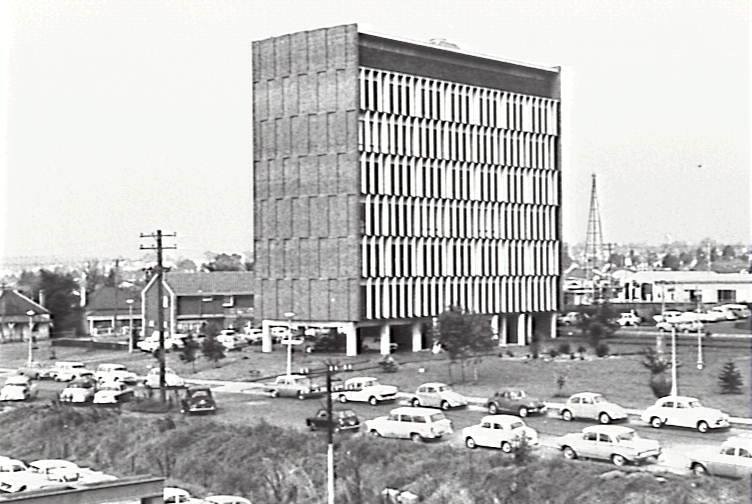
In the centre of Campbelltown’s central business district is an iconic building hidden in plain sight. It is the 1964 mid-century modernist office tower of Campbelltown City Council.
The office building is an unacknowledged statement of mid-century modernism in Campbelltown.
The Campbelltown Council office building is an outstanding example of a mid-century modernist high-rise office tower in the Macarthur region. Unfortunately, the hopes and dreams of local decision-makers who approved its construction were dashed in later decades.
A new administration building and a symbol of mid-century modernism
In 1964, the Campbelltown-Ingleburn News ran a banner headline on its front page: SYMBOL OF PROGRESS. The newspaper announced the opening of a new council administration building as part of a proposed civic centre precinct in the town centre.
The newspaper headline was a statement of faith in the confidence of Campbelltown and its planned declaration as a satellite city by the state government.
The eight-storey office building was the tallest structure in the town centre and was visible from all parts of the area. The top floors provided a ‘bird’s eye’ view over central Campbelltown and completely dominated its surroundings.
A metaphor for a community on the move
The new administration building was a metaphor for Campbelltown’s growing confidence in the 1960s and the town’s future.
The building symbolised the hopes and dreams of planners and administrators and the immense changes that engulfed Campbelltown over the following decades.
At the official opening on 28 November 1964, Campbelltown Mayor TK Fraser felt the town was on the verge of something special. He said,
At the threshold of the most dynamic period in the history of its area, Campbelltown Municipal Council, imbued with a strong sense of purpose and complete confidence in the future, has provided this imposing Administrative Building’.
The building, the first stage of a Civic Centre which will cater for the needs of a rapidly expanding community, stands as a practical demonstration of the confidence with which Council faces the future convinced that this area, steeped in history, at present of unsurpassed rural charm, will develop, in the near future, into a thriving Satellite City. (Official programme)
The administration building was developed under the guidelines of the County of Cumberland Scheme. It was part of an existing Campbelltown civic precinct that included the ambulance station and courthouse and was adjacent to the police station and railway station.
Alderman Percival, the vice-chair of the council Civic Centre committee, maintained that the building’s design catered to the anticipated administration of the council as a satellite city. The status of a satellite city was part of the proposed decentralisation by the County of Cumberland, with Campbelltown’s projected population growing to 200,000. (Construction, 11 September 1963)
Planning for the new office building began in 1961 when the school of arts building was inadequate in accommodating council staff. Initially housed in the old town hall, council staff had moved out into the school of arts after the 1948 amalgamation with Ingleburn Municipal Council.
‘The move into the new 1964 building was not without criticism’, said Alderman Percival. He argued that the council’s progression with the project was a ‘considerable moment’ for the municipality.
He said, ‘It was a necessary demonstration of confidence in the municipality by Council’. (Campbelltown Ingleburn News, 1 December 1964)
The architects agreed and said that the building’s size, height and position emphasised ‘the importance and dignity of Local Government function in the affairs of the city’. The two-storey atrium in the vestibule added greater emphasis to the building’s importance because of its aesthetic features, including ‘sculptured central column, cascades and pool’. (Construction, 11 September 1963)
‘Campbelltown’s future assured’, says Deputy Premier at the official opening
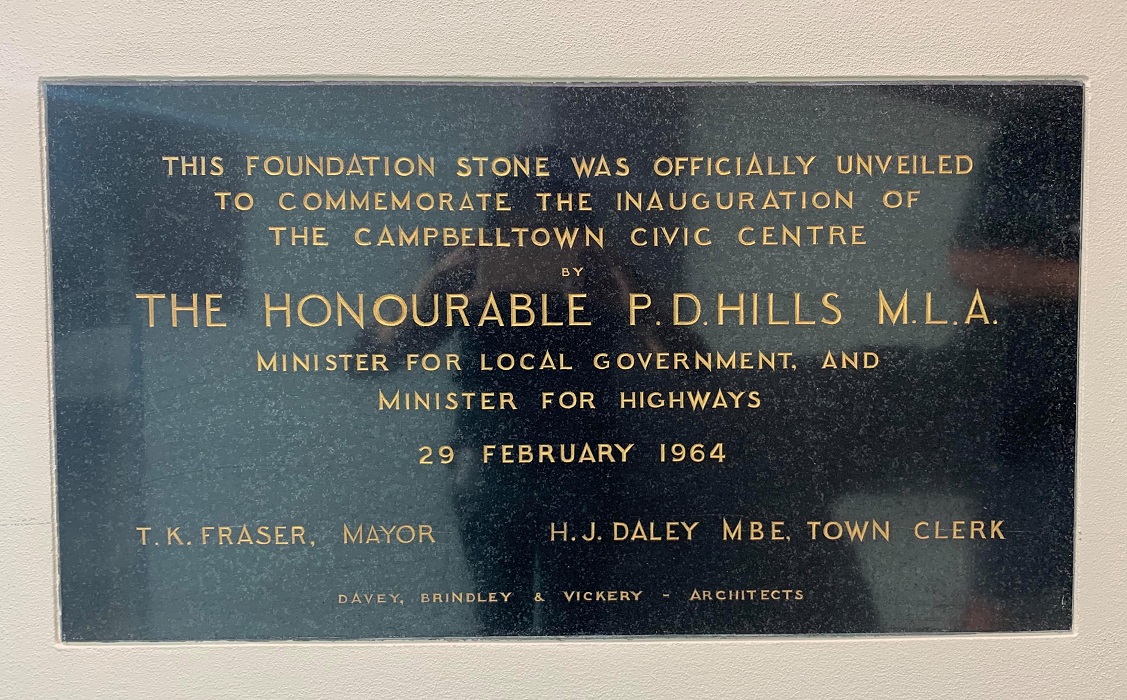
The New South Wales Minister for Local Government and Deputy Premier PD Hills officially opened the building on 28 November 1964.
Minister Hills reassured the council that the state government was about to make Campbelltown a self-contained satellite city beyond the Green Belt of the Cumberland Plan.
Mr Hills said, ‘Campbelltown is a thriving urban centre set in rural surroundings, but so close to Sydney metropolis that it largely acts as a dormitory-area for a workforce which finds its employment in the metropolitan area’.
‘It will be necessary to create accommodation within or close to the County of Cumberland, but outside the Green Belt, for an additional 300,000 people every eight years’, he said.
‘This means that we must have beyond the Green Belt but within 30 to 50 of Sydney a series of satellites which will be self-contained in the local sense but yet regionally associated with the metropolis’.
The minister said, ‘In the selection of sites for such development, the Campbelltown area is an obvious choice’. (Campbelltown-Ingleburn News, 1 December 1964)
Storm clouds gather on the planning horizon
Campbelltown Municipal Council decided to build the new office accommodation based on the direction and security provided by the state government’s County of Cumberland plan.
Unfortunately for the council, the New South Wales had abolished the County of Cumberland in December 1963 twelve months before the opening of the new building.
The state government had removed the security of the existing planning framework on which the council had initially based its decision to proceed with the new building.
Yet the minister continued to reassure Campbelltown Council of its position at the opening of the administration building in November 1964. (Campbelltown-Ingleburn New, 1 December 1964)
The New South Wales state government’s State Planning Authority Act 1963. replaced the County of Cumberland with The State Planning Authority (SPA) in December 1963. The SPA explicitly abandoned the Cumberland scheme’s green belt and satellite cities and devised a Sydney Region Outline Plan 1970–2000 A.D.
The state government proceeded with developing the 1968 Sydney Region Outline Plan and followed up with the 1973 New Cities Structure Plan Campbelltown, Camden and Appin.
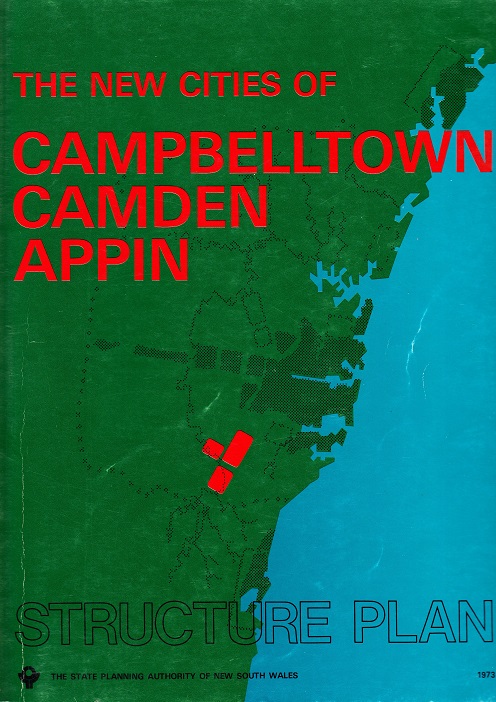
The rosy future of Campbelltown, spoken about by the minister and the mayor, was not entirely as secure as they might have presented it to the community.
Upbeat statements by the mayor and minister encapsulated the elements that eventually foreshadowed dark clouds gathering on the Campbelltown planning horizon.
In the end, the storm clouds that gathered around the planning processes rained down on the Campbelltown area in the late 1970s and early 1980s, creating much angst for many in the community.
An important mid-century modernism icon
While the contested nature of the planning regime gave many in Campbelltown severe heartburn in the late 1970s and early 1980s, the city was left with an iconic mid-century modern marvel.
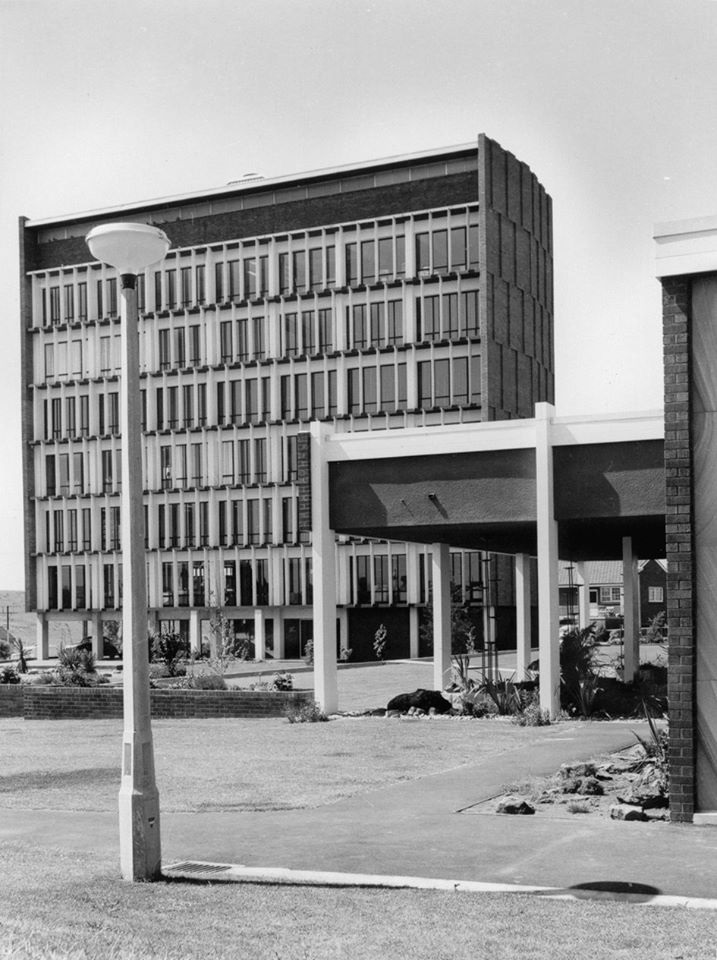
Designed by Sydney architects Davey, Brindley, and Vickery in an Internationalist style, the office building is a rare, intact example of this type of architecture in the local area.
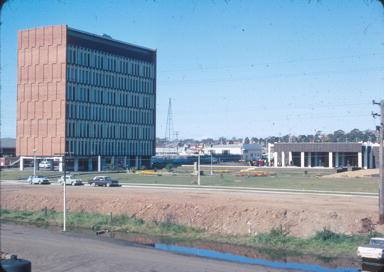
The building retains much of its 1964 integrity with its clean lines, minimalist, non-maintenance finish, and functional design using concrete, brick, glass, and aluminium materials.
The office building is an essential marker of mid-20th century Campbelltown and a statement of intent by a council that felt that the town had a secure future as a Sydney satellite city.
A modernist architectural gem
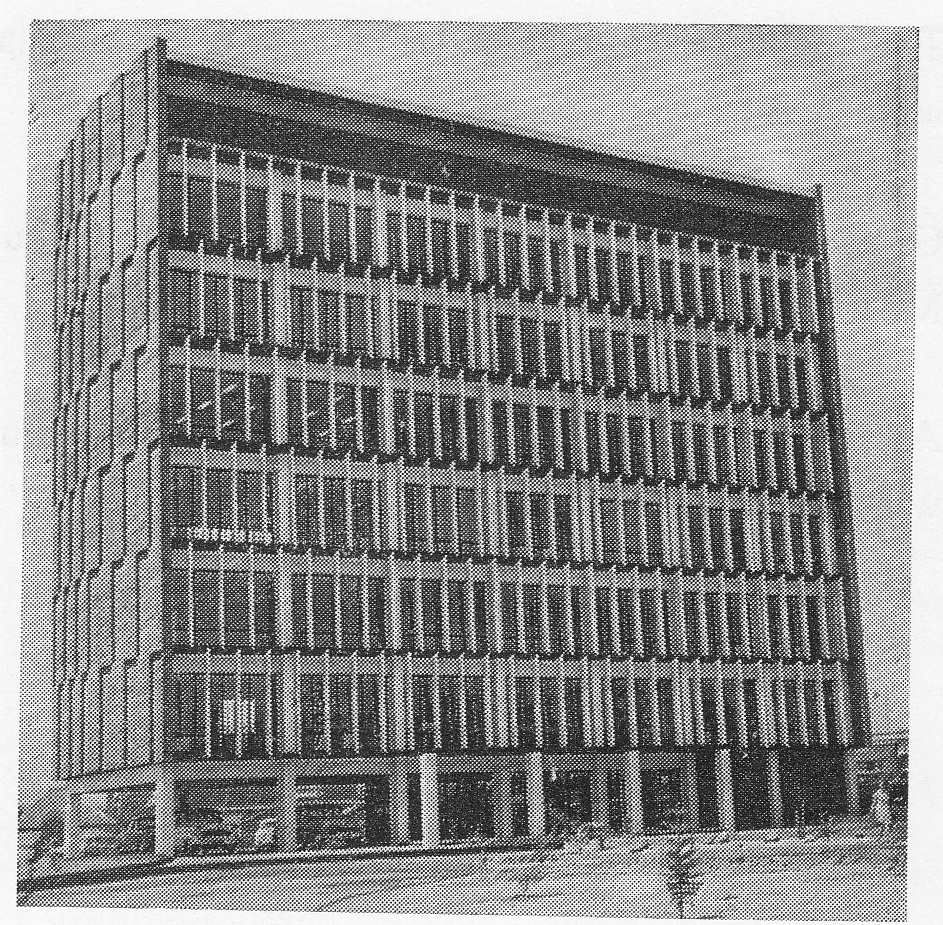
Sydney architects Davey, Brindley and Vickery stated that the eight-storey building’s ‘sharp vertical lines’ had a steel-encased frame and was built on piles with reinforced concrete floors connected by two high-speed lifts.
The International modernist design style had steel, glass, and mass-produced materials as its main characteristics. The rooms had the full expanse of the width of the building, with clean lines supported by dull and shiny surfaces. (Campbelltown Ingleburn News, 1 December 1964)
A feature of the building was the entrance vestibule with a two-storey open atrium, which contained a floating stairway over an indoor garden. On the east side of the vestibule was a cast bronze multiplane historical mural by Bim Hilder mounted on a highly exposed aggregate wall. (Campbelltown Ingleburn News, 1 December 1964)
The north wall of the foyer was faced with black marble with contrasting white marble door jamb and scag-terrazzo floor. The architects noted that the primary colours were black and white, compared with the red cedar-lined ceiling under the mezzanine level. (Campbelltown Ingleburn News, 1 December 1964)
The stairs to the first level were black scag-terrazzo with a black anodised aluminium balustrade with clear glass panels. On the first floor, the panelled cedar walls contrasted with contrasting black and white colouring. (Campbelltown Ingleburn News, 1 December 1964)
The architects stated that the building was finished with non-maintenance materials. The exterior charcoal colouring contrasts with a black anodised aluminium building. The sun blades were heavy baked enamel with infill walls of dark brick. (Campbelltown Ingleburn News, 1 December 1964)
Conclusion
The 1964 international modernist building created quite a precedent in the small country town of Campbelltown, where the local community leaders confidently predicted a bright future.
Unfortunately, much of that hope was undone in later decades due to poor planning and unrealised expectations by a host of actors, from the state government to the local council and residents.
The 1964 council administration building does not receive the acknowledgement it deserves at a level or in the broader context of the Sydney region.
The mid-century modernist tower is an iconic statement of the optimism of the Campbelltown community in the 1960s about the town’s potential for the future.
The Campbelltown Council office building, completed in 1964, is an unrecognized icon of mid-century modernism, symbolizing the town’s optimistic vision as a satellite city.
Despite its structural significance and initial hopes for community development, later planning challenges undermined this vision, leaving the building’s legacy complex and often overlooked.
Acknowledgements
I would like to thank the Local Studies Librarians at Campbelltown City Council Library for their assistance in the completion of this post.
Updated on 14 February 2025. Originally posted on 28 May 2020 as ‘A symbol of progress – mid-century modernism and a new administration building’.
Discover more from Camden History Notes
Subscribe to get the latest posts sent to your email.


One thought on “Exploring Campbelltown’s Mid-Century Modern Administration Building”
Comments are closed.