A Camden interwar banking chamber
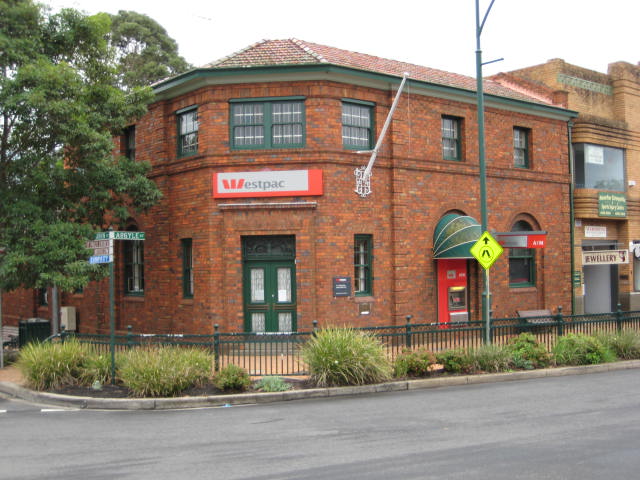
In central Camden is an empty bank building of understated significance at the intersection of John and Argyle Streets. This building was the premises of Westpac, formerly the Bank of New South Wales, and was the second banking chamber on that site. Constructed in the 1930s by a prominent firm of local builders and designed by one of Sydney’s top award-winning architects. It is a building of much architectural merit, and few know its history.
First bank in Camden
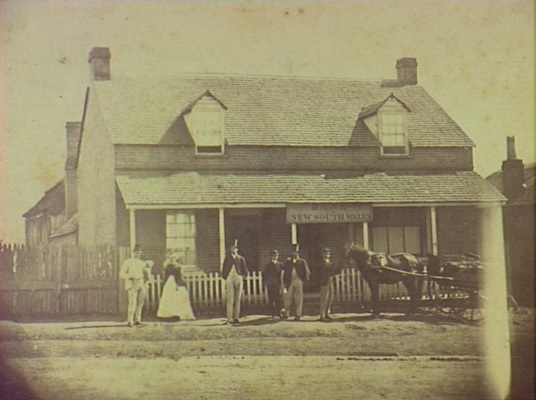
The Bank of New South Wales was the first bank in Camden. The bank initially occupied 23 Argyle Street, a colonial-style brick building with corrugated iron gable and brick chimneys. This banking chamber opened in 1865. These premises were used by Wilkinson & Sons as a plumbing and tin smithing business. A funeral parlour currently occupies it. (Willis, 2015)
The oldest bank in Australia
The Bank of New South Wales is the oldest bank in Australia and was established in 1817 when Governor Macquarie signed its charter of incorporation. It was set up to provide financial stability in Sydney’s military garrison but quickly became a South Pacific trading hub. The new bank financed local economic activity and financed overseas trade. The bank eventually merged with the Commercial Bank of Australia in 1982 and became the Westpac Banking Corporation. It is still one of the largest banks in Australia. (DoS)
When the Bank of New Wales moved into Camden, it provided the newly emerging market town with financial stability. It financed the emerging trading activity for the town’s small business sector. In 1873 the original building had outlived its usefulness, and the bank moved west along Argyle Street to its current location at the corner of John and Argyle Streets.
Woolpack Inn (later Crofts Inn)
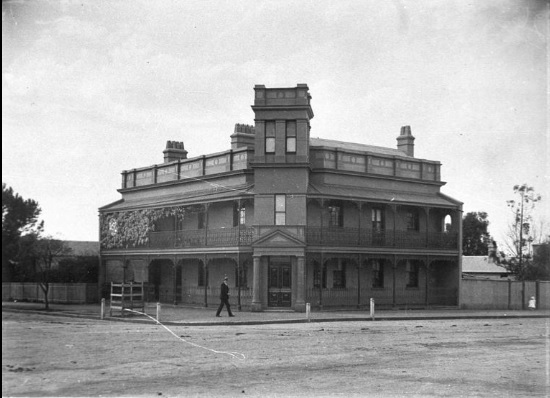
In 1873 the Bank of New South Wales purchased the former Woolpack Inn (later Crofts Inn) at 121 Argyle Street with its picturesque Victorian verandahs. Licensee Thomas Brennan had purchased the Woolpack site in 1852 and constructed the Victorian-style two-storey building with iron-lace work and outbuildings. Brennan sold the inn to Henry Denton, who sold it to innkeeper Samuel Croft by 1863. (Willis, 2015)
The former hotel served the Bank of New South Wales well until the 1930s during the Interwar period when the economic prosperity of the district from the Burragorang coalfields encouraged the bank to build new premises to reflect its status in the town better. (Willis, 2015)
In 1936 Camden Municipal Council ordered the bank to remove the verandah posts on the Argyle Street frontage as part of the modernisation of the town centre. The council orders may have prompted the bank to consider updating its banking chamber on Argyle Street and demolishing the Victorian premises (Camden News, 15 October 1936).
121 Argyle Street
Architect-designed and locally built
The contract for the two-story banking chamber was awarded to Camden builder Harry Willis & Sons and designed by Sydney architects Peddle, Thorp & Walker. These architects were established in Sydney in 1889 and designed Science House, corner Gloucester and Essex Sts, Sydney, which won the inaugural Sir John Sulman Medal in 1932. (PTW; SMH, 14 July 1936))
On the awarding of tenders, the old bank building was demolished. Temporary premises for the bank staff were found in one of WC Furner’s shops opposite the Empire Theatre. Here Mr J Stibbard, the bank manager, assured customers that they would find banking convenient during the building work. (Camden News, 11 June 1936)
Hand-made nails and a cellar
During dismantling, the Sydney Morning Herald reported that hand-made nails had been extensively used in the construction of the former hotel, made by ‘nail-smiths’ (SMH, 14 July 1936). The nail-smith in the 19th century was probably the local blacksmith, one of the most important trades in the area.
Local timbers had been used extensively throughout the former hotel building and were reported to be in ‘an excellent state of preservation. A long-forgotten cellar was discovered under the bank floor and ‘recalled the existence of an inn on [the] site during the coaching days’. (SMH, 14 July 1936)
Commodious banking chamber
In 1936 the Sydney Morning Herald stated the new building had a ‘commodious banking chamber and offices for the staff’. ‘Textured brick’ was used for ‘facing’ throughout the building ‘relieved by lighter-coloured treatment of the external woodwork. The bank entrance at the splayed angle at the intersection of the two streets will be treated with especially brick architraves and pediment surmounted by a synthetic sandstone ornamental shield. The interior was treated with polished maple woodwork throughout. The Georgian character design will be a colourful and artistic addition to this historic town’s architecture. (SMH, 14 July 1936)
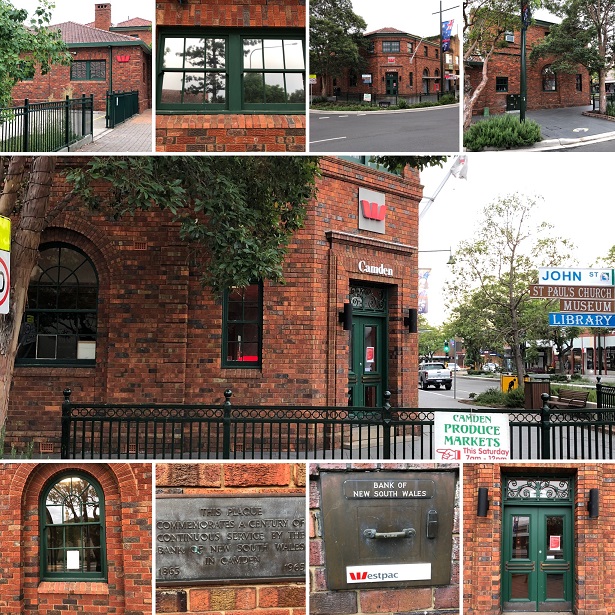
Georgian Revival
The NSW Heritage Inventory states: ‘The 1936 two-storey glazed and rough brick building with double hung windows and tiled roof. Its detailing includes quoining and multipaned windows, typical characteristics of the Georgian Revival style.’ (HNSW)
Georgian Revival is an architectural style nostalgic for the colonial period in the USA and the early 19th century in the United Kingdom, sometimes called Neo-Georgian. The style has a proportionate symmetry and austere elegance, characterised by proportion and balance. Commonly there is brick construction with a gable or hip roof line and equal placement of windows, generally two storeys and rectangular.
The former Bank of New South Wales building is a high-quality contributor to Camden township’s substantial eclectic fabric and the overall cultural significance of the Camden Town Conservation Area. The building retains its historic integrity and is intact. (HNSW)
Vacant
Westpac closed the Camden branch in 2020, and the building has remained vacant.

References
Ian Willis, 2015, Pictorial History Camden & District. Kingsclear Books, Sydney.
Dictionary of Sydney staff writer, Bank of New South Wales, Dictionary of Sydney, 2008, http://dictionaryofsydney.org/entry/bank_of_new_south_wales, viewed 06 Feb 2023
Updated 11 July 2023. Originally posted 6 February 2023 as ‘Interwar Modernism and a Camden banking chamber’.
Discover more from Camden History Notes
Subscribe to get the latest posts sent to your email.


One thought on “ The former Bank of New South Wales building in the country town of Camden”
Comments are closed.