Pip: Welcome to a deep dive into Camden, where even a glass of milk turns out to have a backstory involving Tudor architecture, wartime charity, and a rotolactor. Camden History Notes has been busy.
Mara: This episode covers two interlocking stories: the design and opening of a genuinely unusual interwar building on the Hume Highway, and the broader dairy industry legacy that building was built to promote.
Pip: Let’s start with the building itself — a milk bar dressed as an English country inn.
A Milk Bar Built to Look Like Old England
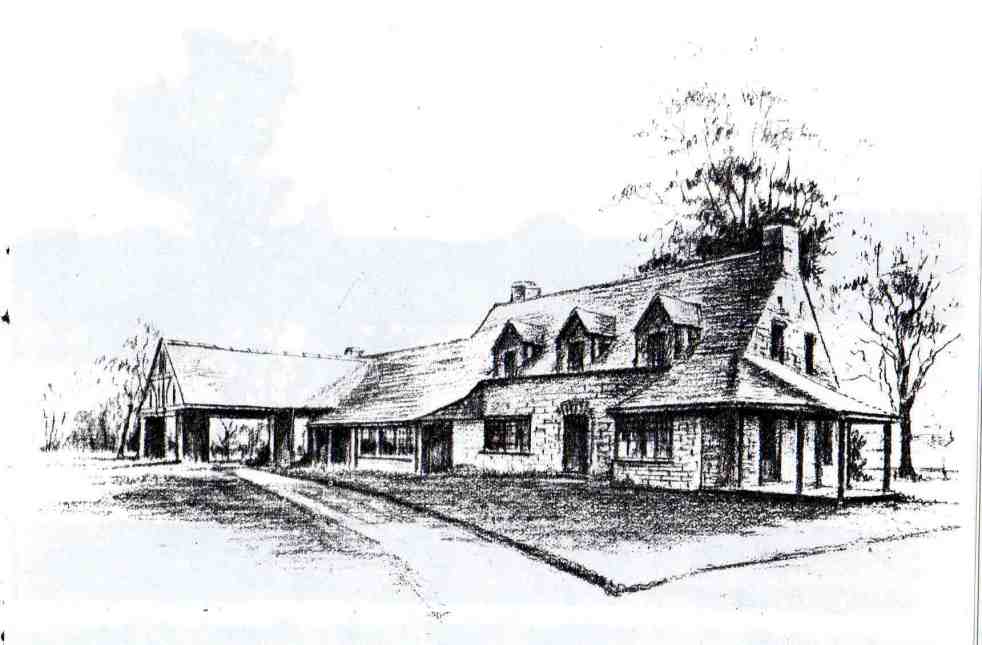
Mara: The question this post opens with is a good one: what is that old English pub on the southern outskirts of Camden? The answer is that it was never a pub at all — it was a milk bar, built in 1939 to promote Camden Vale special milk at a time when milk was a genuine public health concern.
Pip: Sydney architect Cyril Ruwald designed it in Interwar Tudor Revival style — half-timbering, wrought iron, leadlight windows. He’d spent time in Europe and came back adapting modernist hotel aesthetics. For a milk bar, that’s a significant architectural brief.
Mara: The promotional brochure described walls in “attractively coloured brickwork suggesting a touch of modernity,” with a lounge fitted with open grates “where log fires will add necessary warmth and comfort during cold days and evenings.” It was also Camden’s first drive-through, via a porte-cochère at the entrance.
Pip: It opened nine weeks after war was declared, with a promise that six months of profits would go to the Red Cross. The Red Cross ended up with £50 — because the milk bar ran at a loss.
Mara: The building still stands as the Camden Valley Inn, heritage-listed, described today as “an idyllic boutique destination hotel and event venue” retaining “its quaint charm and country friendliness in an atmosphere reminiscent of old England.”
Pip: From disease-free milk to boutique hotel. The Englishness, at least, was always the point.
Mara: That Englishness connects directly to the dairy brand behind the building — and that story starts much earlier.
Camden Vale Milk and the Making of a Brand
Mara: The History of Camden Vale Milk post opens with a museum poster — a 1938 promotional piece hanging in the dairy display at the Camden Museum — and uses it to unpack a century of dairy history, public health, and agricultural modernism.
Pip: A poster as a primary source. That’s doing a lot of work for something nondescript on a wall.
Mara: The poster traces the herd’s lineage directly. It reads: “So the modest forerunners of Camden Vale Special Milk herds had established a vast superiority over their contemporaries a century ago, and the process of research and improvement by selection has gone on ever since.”
Pip: That’s the brand’s whole argument in one sentence — continuity, science, and quiet superiority. The herd started with John Macarthur’s 700 English-breed cattle in 1821, and by 1938 that lineage was being sold as a quality guarantee.
Mara: The post explains why that guarantee mattered. Milk-borne illnesses included diphtheria, scarlet fever, polio, and tuberculosis. The Powerhouse Museum is quoted noting that more than a quarter of children under four admitted to a Melbourne hospital with tuberculosis in 1923 had the bovine type.
Pip: So the premium branding was also a public health claim. Camden Vale special pasteurised milk sat at the top of four regulated price grades introduced by the NSW Milk Board in 1930 — the most expensive, and the most tested.
Mara: The post traces the full distribution chain: milk processed at Menangle, sent by rail to Darling Harbour, trucked to a Redfern depot. Camden Vale was also first to deliver in bottles and introduced the aluminium cap — the gold-coloured top became the brand’s signature.
Pip: And the building that kicked off this episode was one more piece of that promotional apparatus — a Tudor Revival roadside stop designed to make people feel good about buying the most expensive milk on the market.
Mara: The post also points to the former Camden Vale milk depot at the northern entry to Camden township as a surviving piece of that legacy — a building most people pass without knowing what it represents.
Pip: A roadside milk bar as architectural statement, a museum poster as economic history. Camden’s dairy past keeps turning up in unexpected places.
Mara: The built heritage, the objects, the brand names — they’re still there if you know what you’re looking at.
Disclaimer
This podcast was created by WordPress and Generative AI in June 2026.
Discover more from Camden History Notes
Subscribe to get the latest posts sent to your email.

