Museum poster
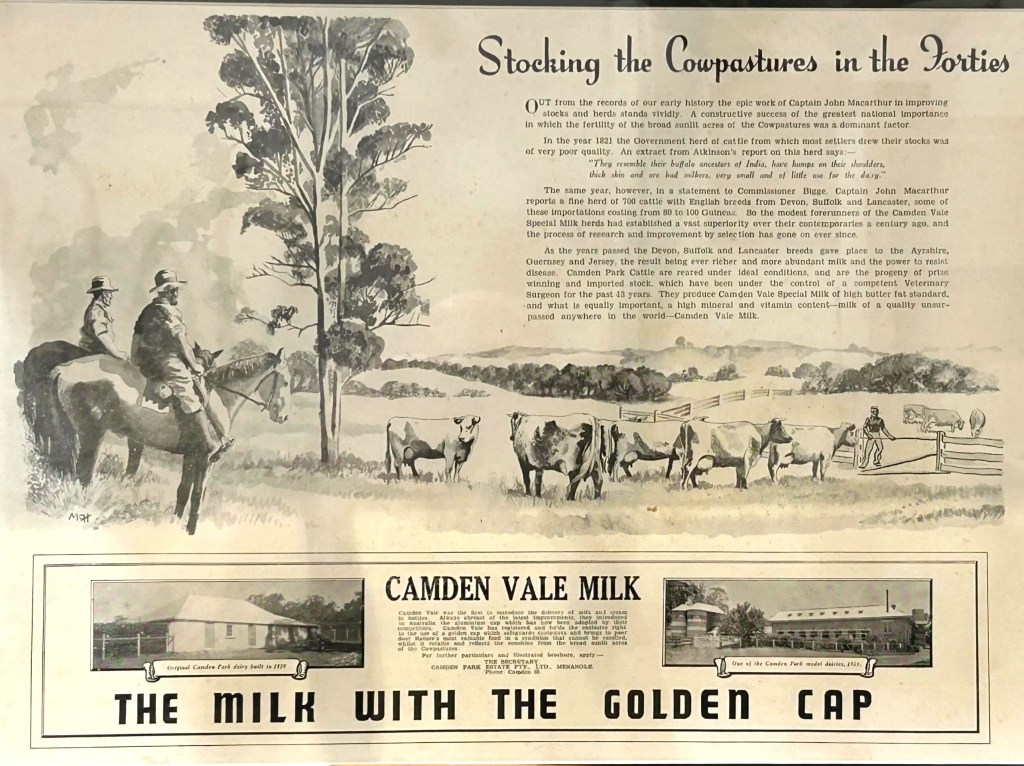
Hanging on the wall in the dairy display at the Camden Museum is a nondescript poster. A closer look reveals an interesting story about one of the most important industries in the local area and one business that was part of it.
The poster tells part of the story of agricultural modernism and how a local farming industry incorporated the latest scientific innovations and industrial design, while also illustrating developments in public policy, health, business and economic history, and a host of other areas.
Advertising poster
A 1938 Camden Vale special silk promotional poster advertising the brand, produced by Dairy Farmers Cooperative, hangs in the dairy display at the Camden Museum. The poster promotes the special qualities of the dairy herd located on the Camden Park Estate at Menangle.
Transcript of poster
Stocking the Cowpastures in the Forties.
Out of the records of our early history the epic work of John Macarthur in improving stocks and herds stands vividly. A constructive success of the greatest national importance in which the fertility of the broad sunlit acres of the Cowpastures was a dominant factor.
In the year 1821 the Government herd of cattle from which most of the settlers drew their stock was of very poor quality. An extract from Atkinson’s report on this says:
They resemble their buffalo ancestors of India, have humps on their shoulders, thick skin and are bad milkers, very small and of little use for the dairy.
The same year, however, in a statement to Commissioner Bigge, Captain John Macarthur reports a fine herd of 700 cattle with English breeds from Devon, Suffolk and Lancaster, some of these importations costing from 80 to 100 Guineas.
So the modest forerunners of Camden Vale Special Milk herds had established a vast superiority over their contemporaries a century ago, and the process of research and improvement by selection has gone on ever since.
As the years passed the Devon, Suffolk and Lancaster breeds gave place to the Ayrshire, Guernsey and Jersey, the result being richer amd abundant milk and the power to resist disease. Camden Park Cattle are reared under ideal conditions, and are the progeny of prize winning and imported stock, which have been under the control of a competent Veterinary Surgeon for the past 48 years. They produce Camden Vale Special Milk of high butter fat standard, and what is equally important, a high mineral and vitamin content – milk of a quality unsurpassed anywhere in the world – Camden Vale Milk.
Camden Vale Milk
Camden Vale was the first to introduce the delivery of milk and cream in bottles. Always abreast of the latest improvements, they introduced to Australia the aluminium cap which has now adopted by the competitors. Camden Vale registered and holds the exclusive right to the use of the golden cap which safeguards customers and brings to your door Nature’s most valuable food in a condition that cannot be excelled whilst it retains and reflects the sunshine from the broad sunlight acres of the Cowpastures.
For further particulars and illustrated brochure apply – The Secretary, Camden Park Estate Pty Ltd, Menangle. Phone Camden 68.
Milk With the Golden Cap
(Dairy Farmers Co-operative Milk Co. Ltd. 1938)
The poster’s links to other objects and cultural artefacts
The story of the poster has several connections to other objects and cultural artefacts that warrant exploration to fully understand its significance. These include (1) an illustrated brochure on Camden Vale, (2) the back story of the poster (3) the story of Camden Vale brand and special milk (4) milk contamination and Camden Vale (5) Camden Vale milk as a health drink (6) Camden Vale bottled milk, (7) Camden Vale special milk delivery, and (8) Camden Vale Inn Milk Bar.
Each of these issues is examined briefly below, though there is much more to discuss another time. This is just a start.
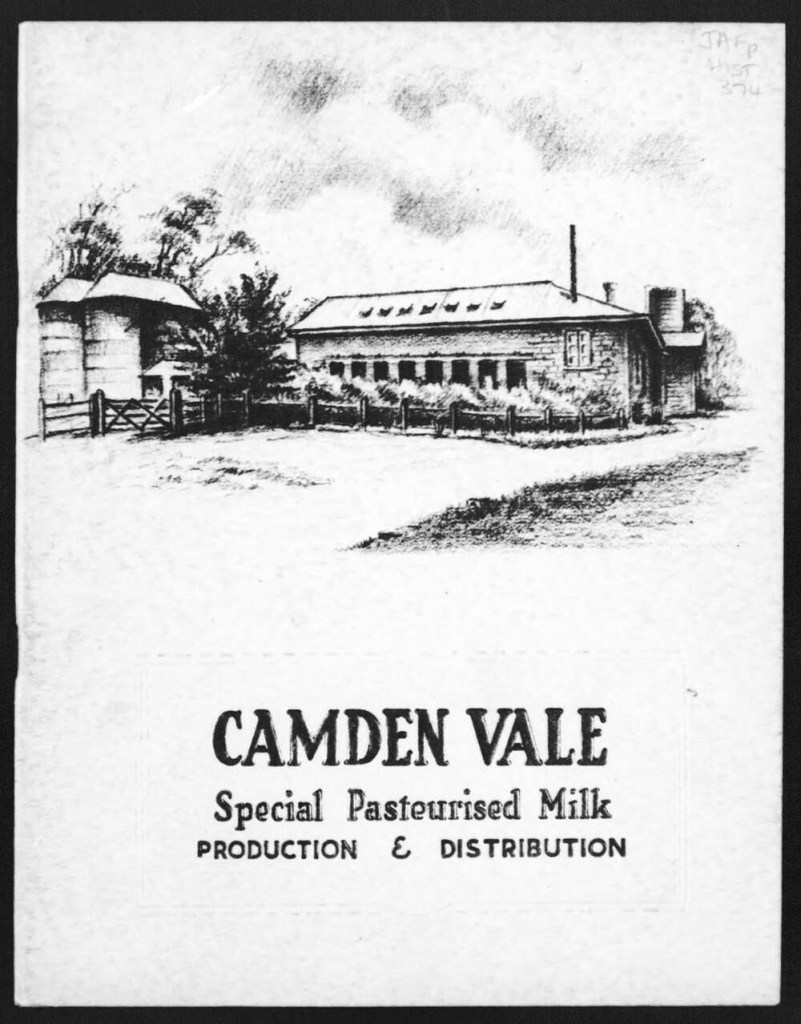
Illustrated brochure for Camden Vale special milk
The Camden Vale special milk poster advertised that an illustrated brochure was available on application from The Secretary, Camden Park Estate Pty Ltd. The brochure’s publication date places the poster in 1938.
Poster back story
According to the Camden Museum archives, the poster was found upstairs at the Camden Valley Inn by Sandra and Ray Brown, who owned the inn and were building the motel. The donors found this poster stored upstairs in the Camden Valley Inn building. They had it framed and presented it to the Camden Historical Society. (Camden Museum Mosaic Archive Record 2000.30)
Camden Vale brand and special milk
At the northern entry to the Camden township, you pass one of Camden’s iconic buildings, the former Camden Vale milk depot. Camden Vale is a brand name that is displayed on the building, yet few know its history.
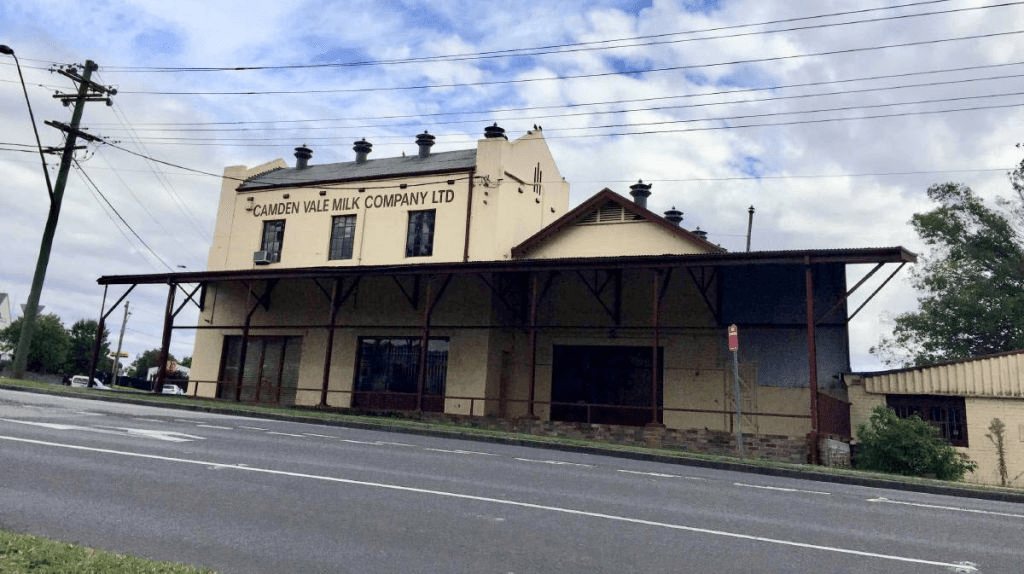
The brand was used by Camden Park Estate Pty Ltd for its whole milk when it sold it in the Sydney market. The brand appeared when Camden Park Estate Pty Ltd established the Camden Vale Milk Company in March 1920. The business took advantage of economies of scale and operated as a vertically integrated organisation. (Walsh 2016)
According to Brian Walsh, the brand was used as a vehicle for distributing whole milk to the Sydney market. Milk was processed at the Menangle factory, where it was pasteurised and chilled, then sent by rail in bulk to Darling Harbour. It was then trucked to its Redfern distribution depot at 7-11 Regent Street, Redfern.
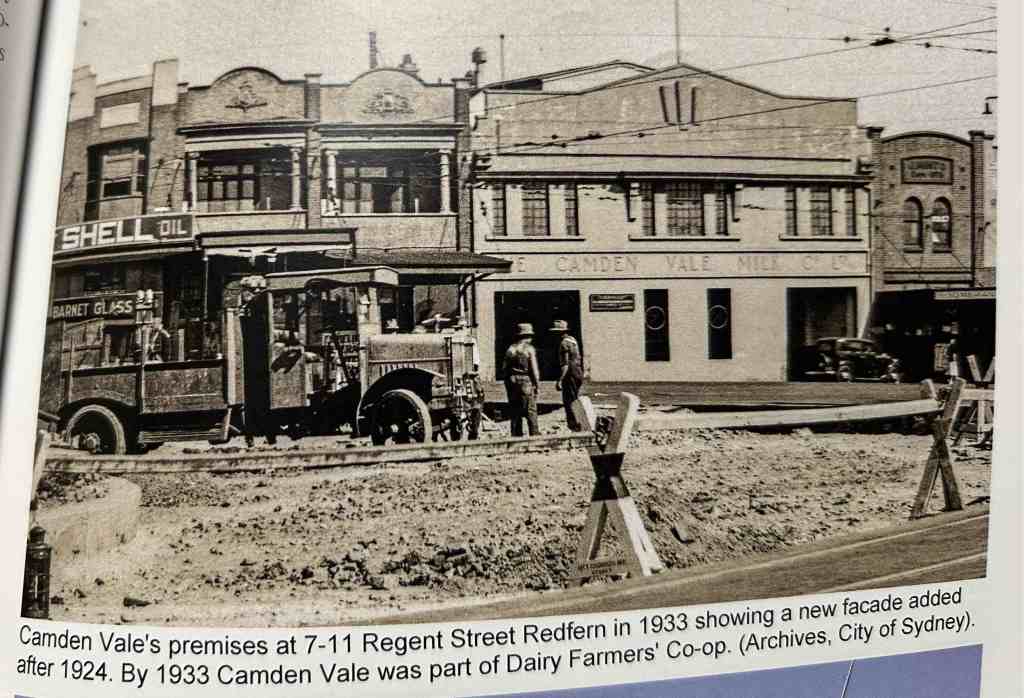
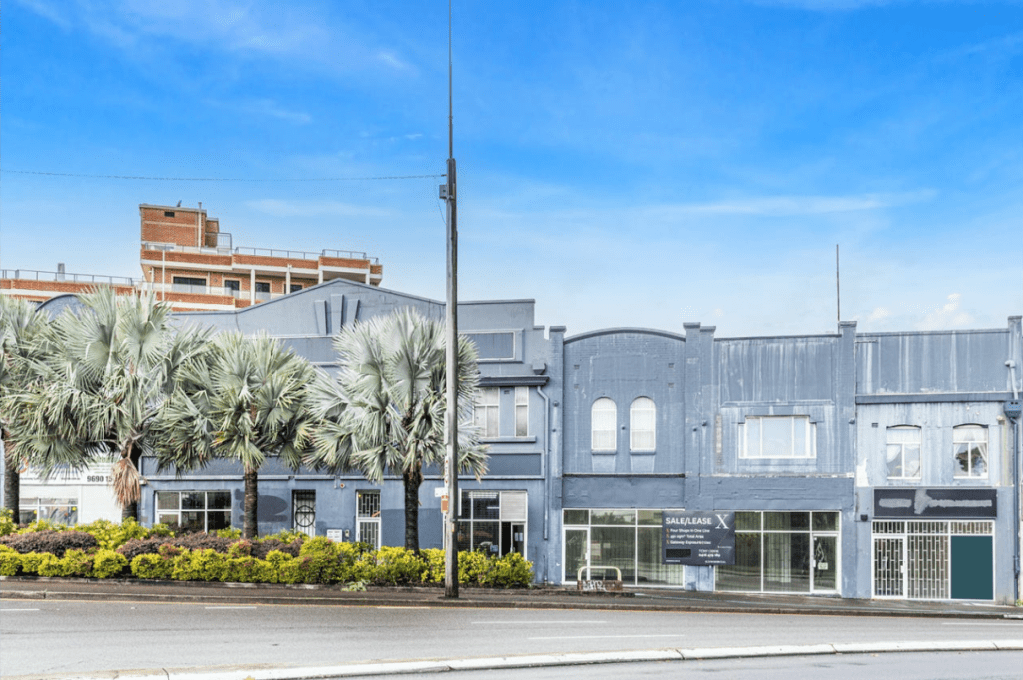
According to the Belgenny Farm website, Camden Vale special milk was sold in Sydney from 1926. The ‘special’ branding was allowed under the NSW Pure Foods Act, which required that ‘special milk’have a specified maximum bacterial count and a minimum butter fat content. (Belgenny Farm 2026) F. A. Macarthur-Onslow was the managing director, with the company becoming a co-operative in 1921 with 131 shareholders.
In 1921, a milk receiving depot was opened at the corner of Edwards and Argyle Streets. At its peak, the depot had a total of 162 milk suppliers and 289 cream suppliers, with milk being delivered daily to the factory as late as the 1940’s by horse and cart.
Camden Vale Milk Company merged with Dairy Farmers’ Co-operative in 1929 and ceased trading in 1934. Dairy Farmers sold Camden Special Milk as a separate product, produced in separate facilities. Processing of Special Milk ceased in 1973. (Walsh 2016)
Milk contamination and Camden Vale
Traditionally, milk was delivered from the dairy farm by the local dairyman in a horse-drawn cart. The milk buyer would get a dip of milk, probably a pint, and put it in their jug or billy can. The dairy cattle were not tested for disease, and the milk was not tested for contaminants.
Even from the 1870s, there was concern about the hygiene of Sydney dairies. Camden Cottage Hospital was founded after local dairy farms were quarantined for an outbreak of scarlet fever.
According to the Powerhouse Museum:
Potentially milk-borne illnesses included diphtheria, scarlet fever, brucellus abortus, polio and tuberculosis. Tuberculosis could be transmitted by breathing in or eating infected matter, including drinking milk that came from cows infected with bovine tuberculosis. At the Australasian Medical Congress in 1923, it was reported that more than a quarter of the children under four years of age admitted to the Children’s Hospital in Melbourne with tuberculosis were infected with the bovine type. (Sear 2000)
Milk as a health drink and Camden Vale
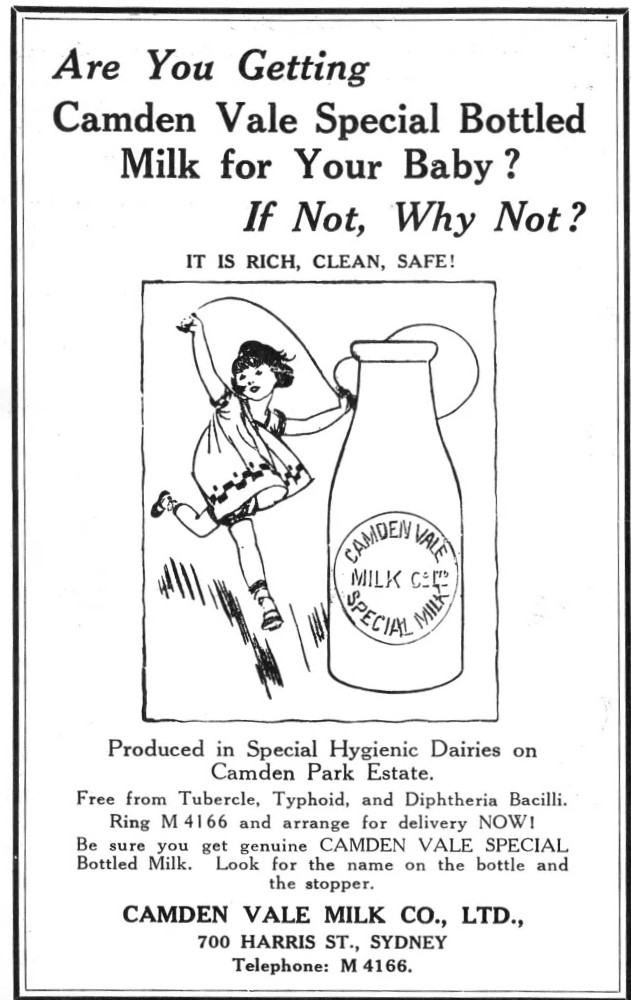
Camden Vale Special Milk was promoted in the 1930s for its health qualities.
Bottled milk and Camden Vale
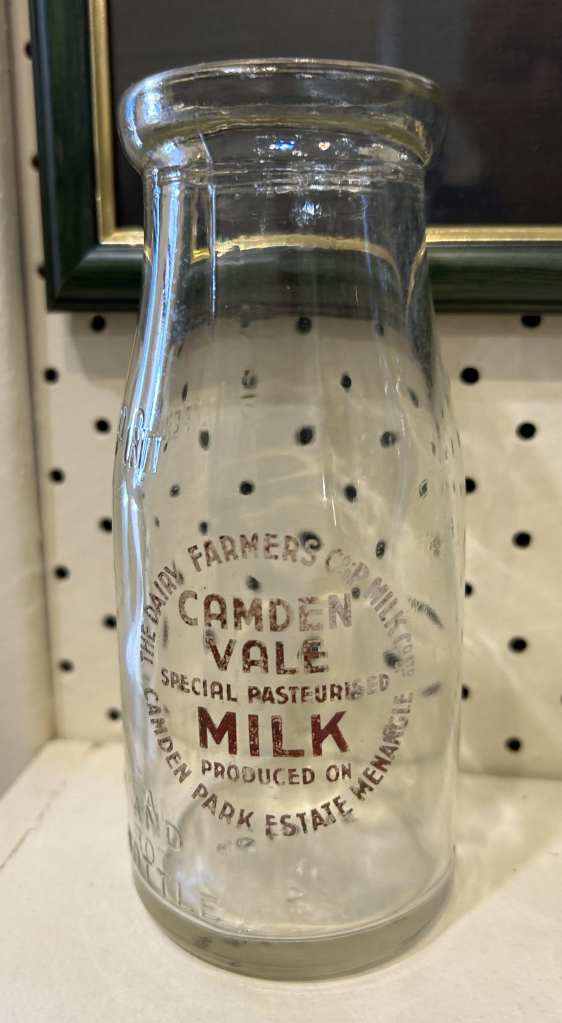
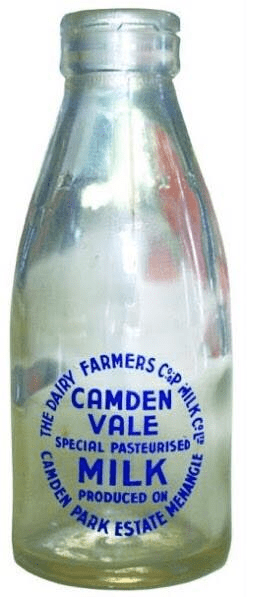
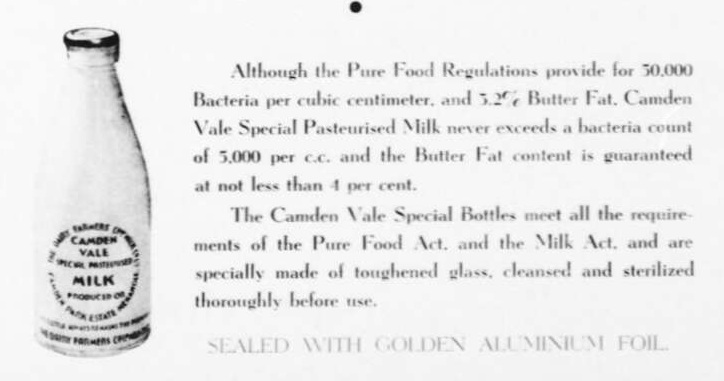
The milk bottle displayed in the advertisement is the wide-necked original type that was used by Camden Vale special milk before the company merged with Dairy Farmers Co-op in 1929.
In 1930, the price of milk was determined by the Metropolitan Milk Board of NSW across four grades: raw milk, pasteurised milk, special raw milk, and special pasteurised milk. The board was established in 1930 under the Metropolitan Milk Act 1929. ( ARDC 1926) Raw milk sold for 3/2 per gallon or 9½d per quart. Special pasteurised milk was sold for 4/- per gallon or 1/- per quart. (Sydney Morning Herald, 15 March 1930) Camden Vale was special pasteurised milk.
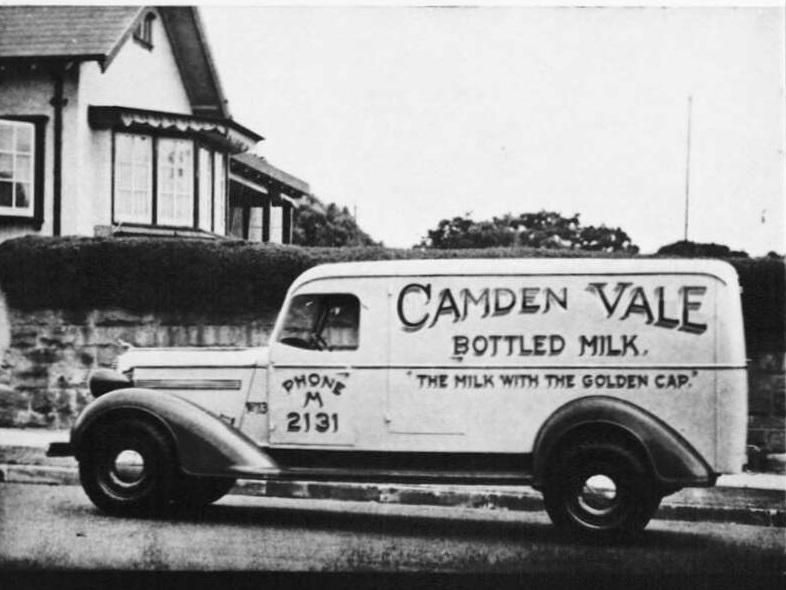
Camden Vale special milk delivery
Camden Vale Inn Milk Bar
The principals at Camden Park Estate Pty Ltd decided to promote Camden Vale special milk by constructing a milk bar on the Hume Highway south of the township of Camden.
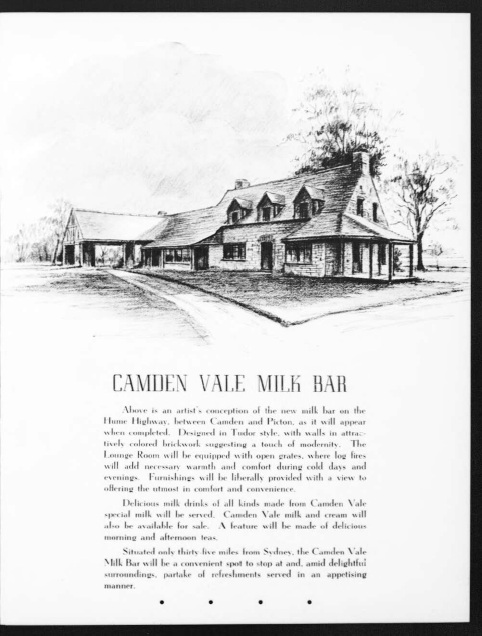
Transcript of page
Above is an artist’s conception of the new milk bar on the Hume Highway, between Camden and Picton, as it will appear when completed. Designed in Tudor style, with walls in attractively coloured brickwork suggesting a touch of modernity. The Lounge Room will be equipped with open grates, where log fires will add necessary warmth and comfort during cold days and evenings. Furnishings will be liberally provided with a view to offering the utmost in comfort and convenience.
Delicious milk drinks ol all kinds made from Camden Vale special milk will be served. Camden Vale milk and cream will also be available for sale. A feature will be made delicious morning and afternoon teas.
Situated only thirty-five miles from Sydney, the Camden Vale Milk Bar will be a convenient spot to stop at and, amid delightful surroundings, partake of refreshments served in an appetising manner. (Dairy Farmers Co-operative Milk Co. Ltd. 1938)
For a fuller discussion of Camden cafes and milk bars, see Willis 2016. Discover Camden’s Iconic Milk Bars and Cafes. CHN.
Reflection
The story of Camden Vale milk provides an important window into many aspects of local life and how that intersects with trends well beyond the local area. Camden Vale operated within and across the Sydney market and the local economy and was not isolated from transnational forces.
The story is an important narrative that intersects across several disciplines, including community history, local history, oral history, genealogy, medical humanities, business history, scientific research, agricultural modernism, veterinary science, public policy, public health, and a host of other areas.
The Camden Vale brand was a prominent part of the Sydney milk market for most of the first half of the 20th century. The brand was supported by scientific innovations and improvements in the management of the Camden Park dairy herds.
Milk was a common vector for human disease and pathogens when not pasteurised. Herd testing reduced disease incidence and enabled the brand to differentiate itself and sell at a premium. This was the premium that allowed the Camden Vale special milk to be sold as the highest-grade milk after price controls on the four milk grades were introduced in 1930.
The business history of the Camden Vale brand and the production company is an economic history of agricultural and dairy farming in the local area. Many have forgotten that disease and pathogens were part of milk production well into the 20th century, and the leading role the principals at Camden Park Estate Pty Ltd took in that medical story.
The legacy of Camden Vale is found in objects, artefacts, built heritage and cultural memories that are all around the local community. Whether it is the built heritage in the former Camden Vale milk depot, objects at the Camden Museum, artefacts and built heritage at historic sites like Belgenny Farm or articles in newspapers on Trove.
References
Atkinson, James. (1826) An Account of the State of Agriculture & Grazing in New South Wales. London: J. Cross.
Belgenny Farm 2026. Camden Vale Special Milk. Camden. Online at https://www.belgennyfarm.com.au/history/agriculture-at-camden-estate/dairying/camden-vale-special-milk Accessed 4/6/26
Dairy Farmers Co-operative Milk Co. Ltd. 1938, Camden Vale, special pasteurised milk : production and distribution. The Dairy Farmers Co-operative Milk Co Sydney https://nla.gov.au/nla.obj-3652661436
ARDC 1926. Metropolitan Milk Board, NSW Archives Collection. ARDC Research Data Australia. Online https://researchdata.edu.au/agy-549-metropolitan-milk-board/164650 Accessed 13/6/26
Sear, Martha 2000. Milk bottle cap, 1930s-1950s. Powerhouse Museum, Sydney. Online https://collection.powerhouse.com.au/object/10416 Accessed 9/6/26
Walsh, Brian 2016. Milk and the Macarthurs, the dairy history of Camden Park. Belgenny Farm Trust, Camden.
Willis, Ian 2016. Discover Camden’s Iconic Milk Bars and Cafes. Camden History Notes, 2 May. Online at https://camdenhistorynotes.com/2016/05/02/camden-cafes-and-milk-bars/
Discover more from Camden History Notes
Subscribe to get the latest posts sent to your email.

