
George Caley and his 1804 report
The “Vaccary Forest” was the term used by botanist and explorer George Caley (1770–1829) for the area famously known as the Cowpastures, a region near present-day Camden, New South Wales, where the wild cattle descended from the 1788 First Fleet were discovered thriving.
James Jervis wrote in the Journal of the Royal Australian Historical Society that George Caley journeyed to the Cowpastures in 1804 and wrote a report called “A journey to ascertain the Limits or Boundaries of Vaccary Forest” (1804).
Caley’s 1804 report was written for Governor Philip Gidley King. (Gutenberg.net.au. 2026)
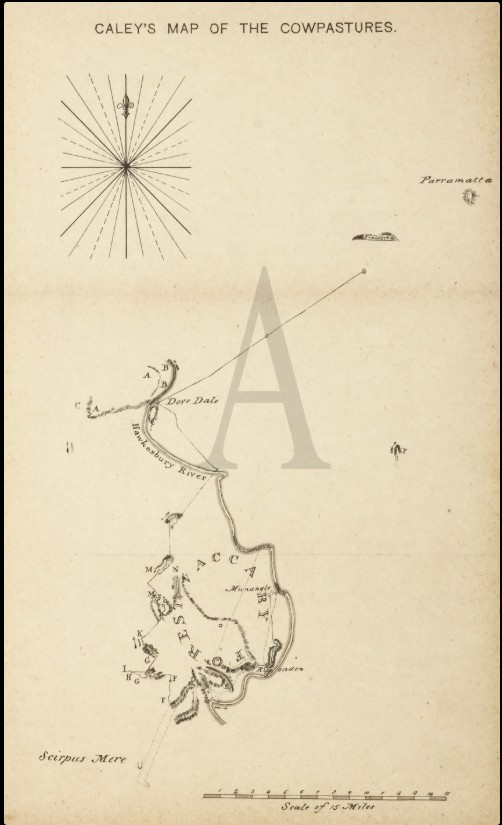
Caley considered that the name Governor Hunter gave the area in 1796, The Cow Pastures Plains, as unsuitable. He felt that Cow Forest or Vaccary Forest would be a better name for the hilly countryside and suggested converting the area into a royal forest. (Jervis 1935)
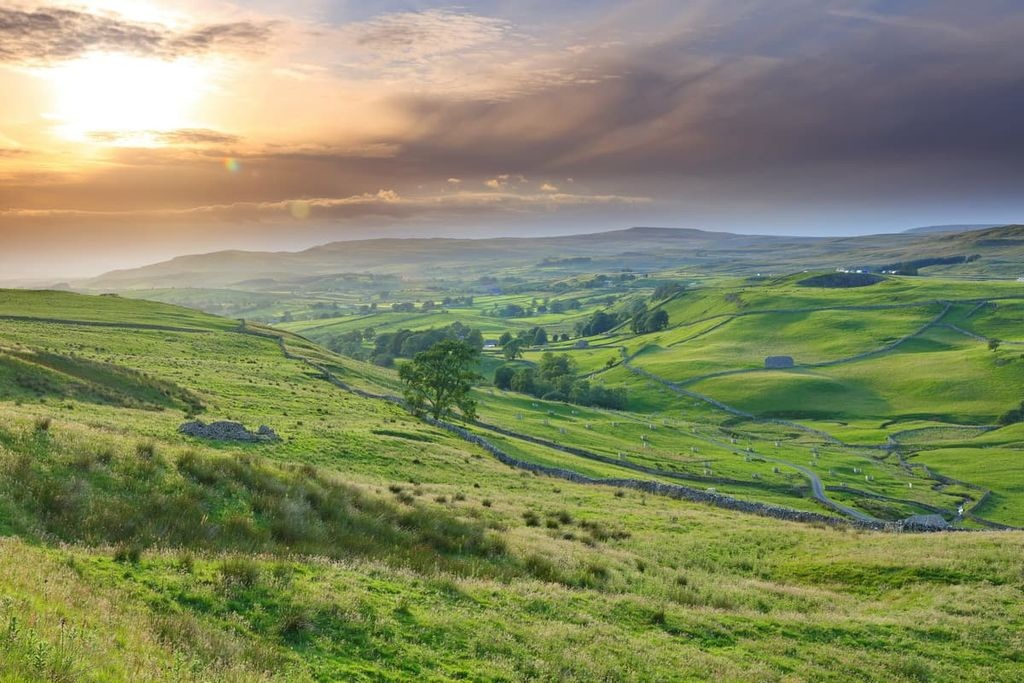
George Caley came from Craven in Yorkshire, in the north of England, the son of a horse dealer. (Else-Mitchell, R. 1966) He was familiar with the term “vaccary” from its common usage in the Middle Ages in northern England.
What was a vaccary?
“Vaccary” derives from the Latin vaccarius (relating to cows), making it a descriptive, albeit rarely used, term for a “cow pasture” or cow farm.
According to the Yorkshire Dictionary a vaccary is word from the 14th century for cattle farms which feudal landlords established in the Pennine uplands. It states that the term is now part of landscape historians’ vocabulary. (Yorkshire Historical Dictionary 2026)
According to David Taylor in a study called ‘The Vaccaries in the Forest of Trawden, A study of the cattle farms and their effect on the landscape in the post-medieval period’
Vaccaries or large cattle farms, often situated in medieval forests, were widespread across the North of England. The forests were made up of land protected as hunting reserves for the feudal overlords; in the case of the Forest of Trawden the de Lacys. Taking into account their legal status they should be more correctly referred to as chases except that the forest laws applied. Importantly the forests were also exploited for livestock production. A common feature of the mid-Pennine Forests was the presence of groups of vaccaries. These ranged in size from a farm to a small hamlet and were engaged in the breeding of cattle with the prime aim being the provision of oxen. (Taylor 2021)
These vaccaries have a long history and date to the mid-1100s, more commonly in the mid-1200s. (Taylor 2021)
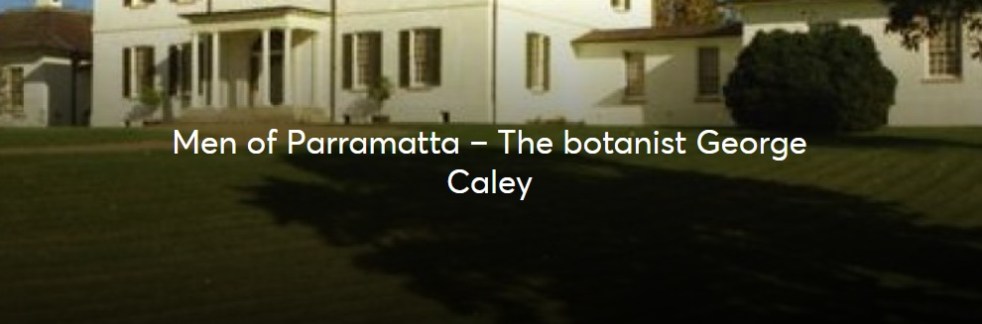
George Caley the man
The Parramatta History and Heritage website states
Caley arrived in New South Wales in April 1800 on the Speedy. Until his return to England in 1810 he spent the next ten years extensively exploring which included Jervis Bay, the Hunter River, Norfolk Island, Van Diemen’s Land, and in Sydney in 1804 the Vaccary Forest (Cowpastures), the Nepean and Camden, and an attempted crossing of the Blue Mountains. He also contributed to scientific work and collections and wrote extensive accounts of all the proceedings that he witnessed and wrote a substantial amount of letters. He also formed lasting friendships which included the famous Parramatta scientist George Suttor, but he also formed some fractious relationships which included Samuel Marsden the Minister of Parramatta’s St. Johns Cathedral. One of the most important relationships and enduring friendships of his life and career was formed whilst in Parramatta with the Darug boy Daniel Moowattin. (Finlay 2020)
Conclusion
George Caley came from northern England, where ‘vaccaries’ were common in the Middle Ages.
He was familiar with their meaning and felt that the cattle in the hills around the Cowpastures better fitted the term Vaccary than the term Cowpasture that Governor Hunter used.
The term “vaccary” was not in common use and disappeared from the record of early colonial NSW. The term Cowpastures prevailed in the local area.
References
Else-Mitchell, R. 1966. ‘Caley, George (1770–1829)’, Australian Dictionary of Biography, National Centre of Biography, Australian National University,https://adb.anu.edu.au/biography/caley-george-1866/text2175, published first in hardcopy 1966, accessed online 27 April 2026.
Gutenberg.net.au. (2026). George Caley. [online] Available at: https://gutenberg.net.au/pages/caley.html [Accessed 27 Apr. 2026].
Jervis, James 1935. ‘Camden and the Cowpastures’. Journal and Proceedings of the Royal Australian Historical Society, Vol. 21 Part. 4 (1935), pp. 240-256.
Finlay, Caroline 2020. Men of Parramatta, The botanist George Caley. Parramatta Heritage Centre, City of Parramatta. Online athttps://historyandheritage.cityofparramatta.nsw.gov.au/moving-image-collections/people-and-place/men-of-parramatta-botanist-george-caley Accessed 29/4/26
Taylor, David JA 2021. The Vaccaries in the Forest of Trawden, A study of the cattle farms and their effect on the landscape in the post-medieval period. The Friends of Pendle Heritage Archaeological Group. Online at https://www.academia.edu/143746430/The_Vaccaries_in_the_Forest_of_Trawden_A_study_of_the_cattle_farms_and_their_effect_on_the_landscape_in_the_post_medieval_period Accessed 28/4/26
Yorkshire Historical Dictionary 2026. Vaccary. University of York. Online at https://yorkshiredictionary.york.ac.uk/words/vaccary. Accessed 28/4/26
Discover more from Camden History Notes
Subscribe to get the latest posts sent to your email.

