
The man and the legend
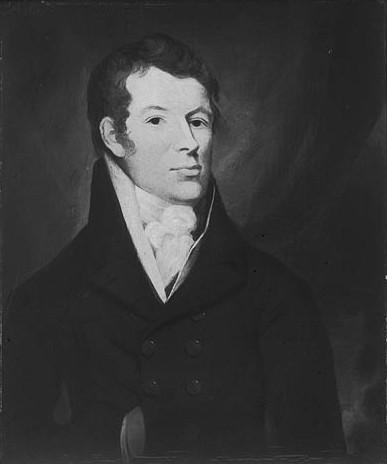
For decades, at least up until the 1960s, John Macarthur has been portrayed in school textbooks as the father of the Australian wool industry. Writers have maintained that his vision for New South Wales was for fine wool to become the staple industry of the state and the country.
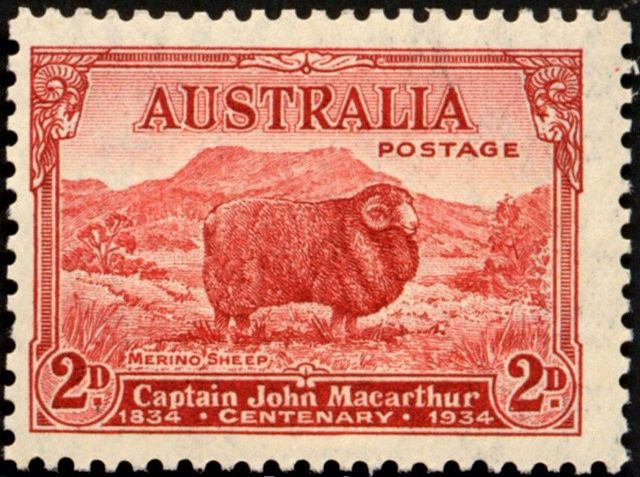
Postage stamps
On the anniversary of John Macarthur’s death in 1934 the Commonwealth Government’s Postmaster-General’s Department issued a special commemorative series of postage stamps to celebrate the his centenary of his death and his role, according to the Sydney press, ‘for being responsible for the introduction of the merino breed of sheep into Australia, and the consequent establishment of Australia as the greatest wool-producing country in the world’.
$2 Note
In 1966, John Macarthur’s image and the merino ram appeared on the first Australian $2 note. More than this, he is a character in Eleanor Dark’s semi-fictional Australian classic trilogy The Timeless Land (1941). John Macarthur is also featured in American writer Naomi Novik’s fantasy novel Tongues of Serpents (2010). In 1949, the Federal electoral Division of Macarthur, taking in Camden, was named in honour of John and Elizabeth Macarthur.

Festivals
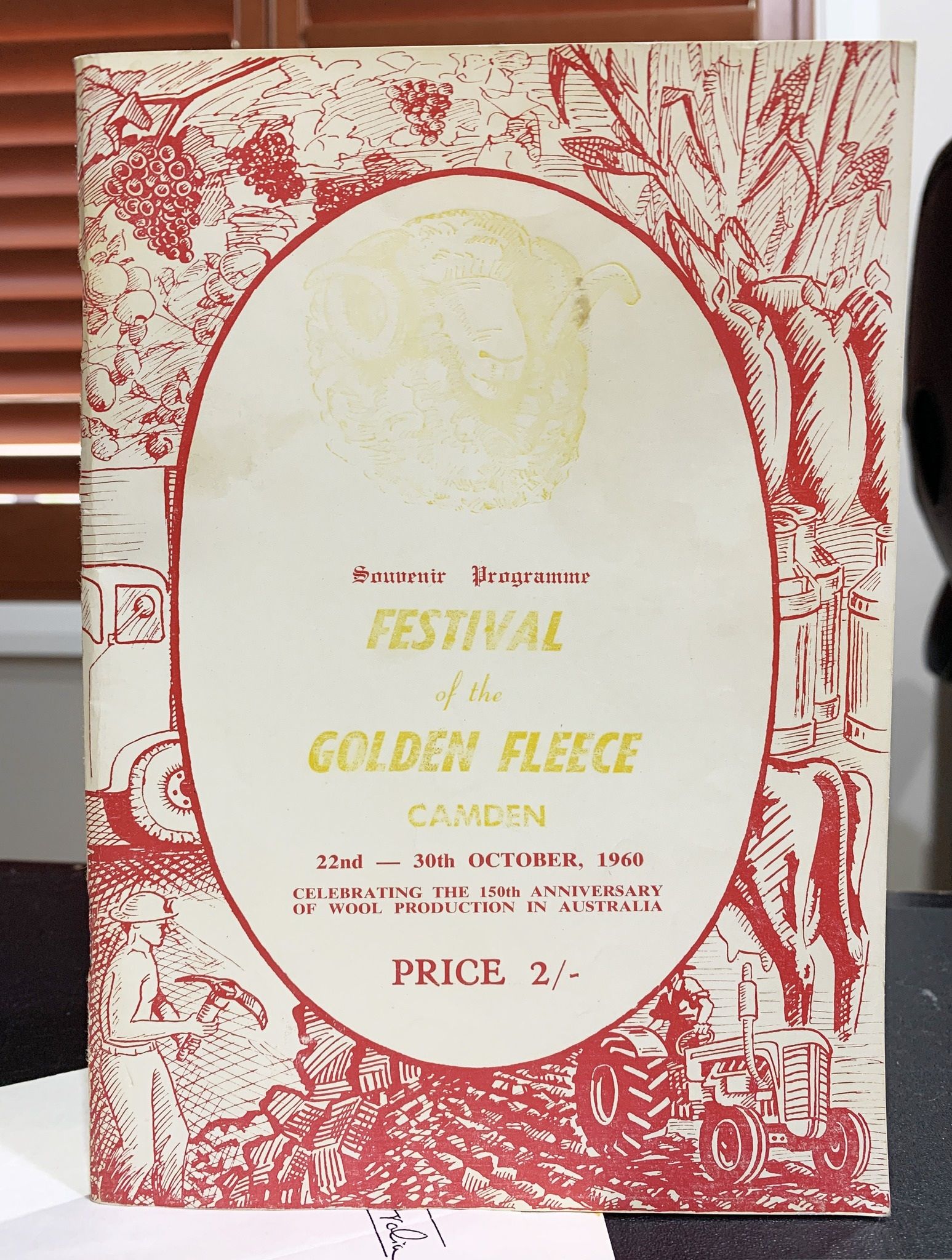
In 1960, Camden celebrated the legacy of John Macarthur with the 4-day Festival of the Golden Fleece (22-30 October), which also celebrated the 150th anniversary of wool production in Australia.
While John Macarthur was critical in importing Spanish merino sheep from South Africa and the early development of the Australian wool industry, he was not alone in this story. There are a host of other individuals in the story, including his wife, Elizabeth, and other wool producers like Reverend Samuel Marsden and William Cox and folk like Governor Hunter and Captains Waterhouse and Kent. However, for many, particularly in the early 20th century, John Macarthur single-handedly was responsible for the foundation of the wool industry at Camden Park.
The anniversary of John Macarthur’s death in 1934 was a time of reflection on his contribution to the story of farming in Australia. The country was looking for heroes and pioneer figures who conquered the colonial frontier, and John Macarthur fitted the bill. The enormous wealth generated by the wool industry in the 1920s and 1930s contributed to the feeding frenzy around the legend of John Macarthur.
Wool’s enormous wealth
The wool industry during the interwar period was of immense importance to Australia. By the mid-1920s, the United Kingdom had purchased about 50% of Australia’s total wool exports, accounting for about three-quarters of all pastoral export income. By the late 1920s, Australia’s 103 million sheep were 17% of the world’s sheep numbers, and Australia produced half of the world’s merino wool. In the 1930s, wool exports were 30% of the total value of Australia’s exports. (ABS)
Commemorative anniversary
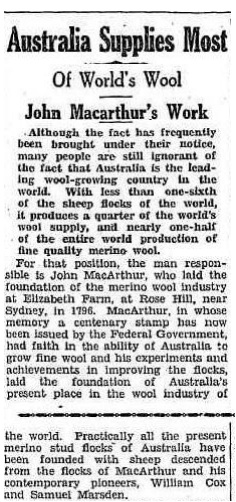
In 1934, the Dubbo Liberal and Macquarie Advocate claimed under a headline that ‘Australia supplies most of the World Wool’ with a sub-heading ‘John Macarthur’s Work’. It went on that John MacArthur ‘laid the foundation of the merino wool industry at Elizabeth Farm, at Rose Hill, near Sydney in 1796’. (The Dubbo Liberal and Macquarie Advocate, 27 October 1934, p10)
In a second article on ‘John Macarthur, Father of the Wool Industry’, the author wrote that ‘there were no band playing, no celebrations’ and ‘perhaps that is how he would have wished it. His great monument stands in the record wool return that has come to Australia this year; a record that has turned the tide of depression, which may yet come in the flood of prosperity fully restored’. The newspaper felt ‘it seems strange that a man who did so much to make the wealth of the country should be so little honoured’. The author felt that there had been ‘ a hundred years in silence – now a few stamps – how typical of the casual Australian’. (The Dubbo Liberal and Macquarie Advocate, 28 April 1934, p9)
The Braidwood Review and District Advocate ran a headline, ‘The Golden Fleece, Late John Macarthur’s Vision’. (The Braidwood Review and District Advocate, 24 April 1934, p5) Parramatta’s Cumberland Argus and Fruitgrowers Advocate in 1934 felt confident is stating that ‘Australia lives on the sheep’s back’. (The Cumberland Argus and Fruitgrowers Advocate, 3 May 1934) RAHS historian James Jervis wrote an article for the Argus called ‘John Macarthur – An Appreciation’ and said his memory ‘to all good Australians’. (The Cumberland Argus and Fruitgrowers Advocate, 9 April 1934)
Various members of the rural press reported on an address given by James Walker the president of the NSW Graziers’ Association which traced the history of the wool industry in Australia and Dr Roland Wilson, the economist of the Commonwealth Statistician Department, who dealt with the importance of the wool industry to Australia and the legacy of John Macarthur.
Father of the colony
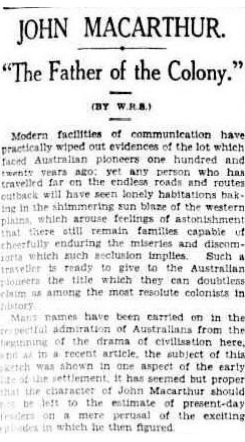
Earlier in 1931, the Sydney Morning Herald published an article written by WRS called ‘John Macarthur, the Father of the Colony’ claiming he came from ‘a warrior ancestry’ and should be remembered ‘in the respectful admirations of Australians from the beginning of the drama of civilisation here’. (The Sydney Morning Herald, 20 June 1931, p9)
Even from the early 20th century there was a recognition by some of the reality of Macarthur’s contribution. JHM Abbott acknowledged in The World’s News in Sydney in 1926 that Macarthur was the first to realise the potential of wool production in the colony, and he backed his opinion with his financial resources. Abbott states that ‘it is often erroneously stated that Macarthur introduced sheep to Australia, but that is not the case’. (The World’s News, 11 December 1926, p. 10)
In 1934, the Canberra Times reported on a symposium at the Australian Institute of Anatomy, a natural history museum in Canberra, featuring the president of the Royal Society of Australia, who spoke on the centenary of John Macarthur’s death. The keynote speaker was the renowned surgeon and philanthropist Sir Colin Mackenzie, who spoke in a celebratory manner about the role of John Macarthur as the “founder of the merino wool industry in Australia.” Sibella Macarthur Onslow attended the symposium, and the Canberra Times ran a significant supplement, complaining that the rest of the country ignored the occasion. (Canberra Times, 18 April 1934)
While John Macarthur’s role contributed to the foundation of the Australian wool industry today, we have a nuanced understanding of the important contributions made by many people to the story and Camden’s role in that story.
Read more
The Sydney Morning Herald (NSW : 1842 – 1954), Friday 12 October 1934, page 12 http://nla.gov.au/nla.news-article17119037
The Dubbo Liberal and Macquarie Advocate @ The Dubbo Liberal and Macquarie Advocate (NSW : 1894 – 1954), Saturday 27 October 1934, page 10 http://nla.gov.au/nla.news-article131580256 &
The Dubbo Liberal and Macquarie Advocate (NSW : 1894 – 1954), Saturday 28 April 1934, page 9 http://nla.gov.au/nla.news-article131582903
The Braidwood Review and District Advocate (NSW : 1915 – 1954), Tuesday 24 April 1934, page 5 http://nla.gov.au/nla.news-article119333871
The Cumberland Argus and Fruitgrowers Advocate (Parramatta, NSW : 1888 – 1950), Monday 9 April 1934, page @ http://nla.gov.au/nla.news-article104578328
The Cumberland Argus and Fruitgrowers Advocate (Parramatta, NSW : 1888 – 1950), Thursday 3 May 1934, @ http://nla.gov.au/nla.news-article104577152
The World’s News (Sydney, NSW : 1901 – 1955), Saturday 11 December 1926, page 10 @ http://nla.gov.au/nla.news-article131461348
The Sydney Morning Herald (NSW : 1842 – 1954), Saturday 20 June 1931, page 9 @ http://nla.gov.au/nla.news-article16787537
Updated 30 March 2025. Originally posted on 14 November 2014 as ‘John Macarthur the legend’.
Discover more from Camden History Notes
Subscribe to get the latest posts sent to your email.


6 thoughts on “John Macarthur, Father of Australia’s Wool Industry, fact or fiction”