
An exhibition celebrating fibro housing and mid-century modernism
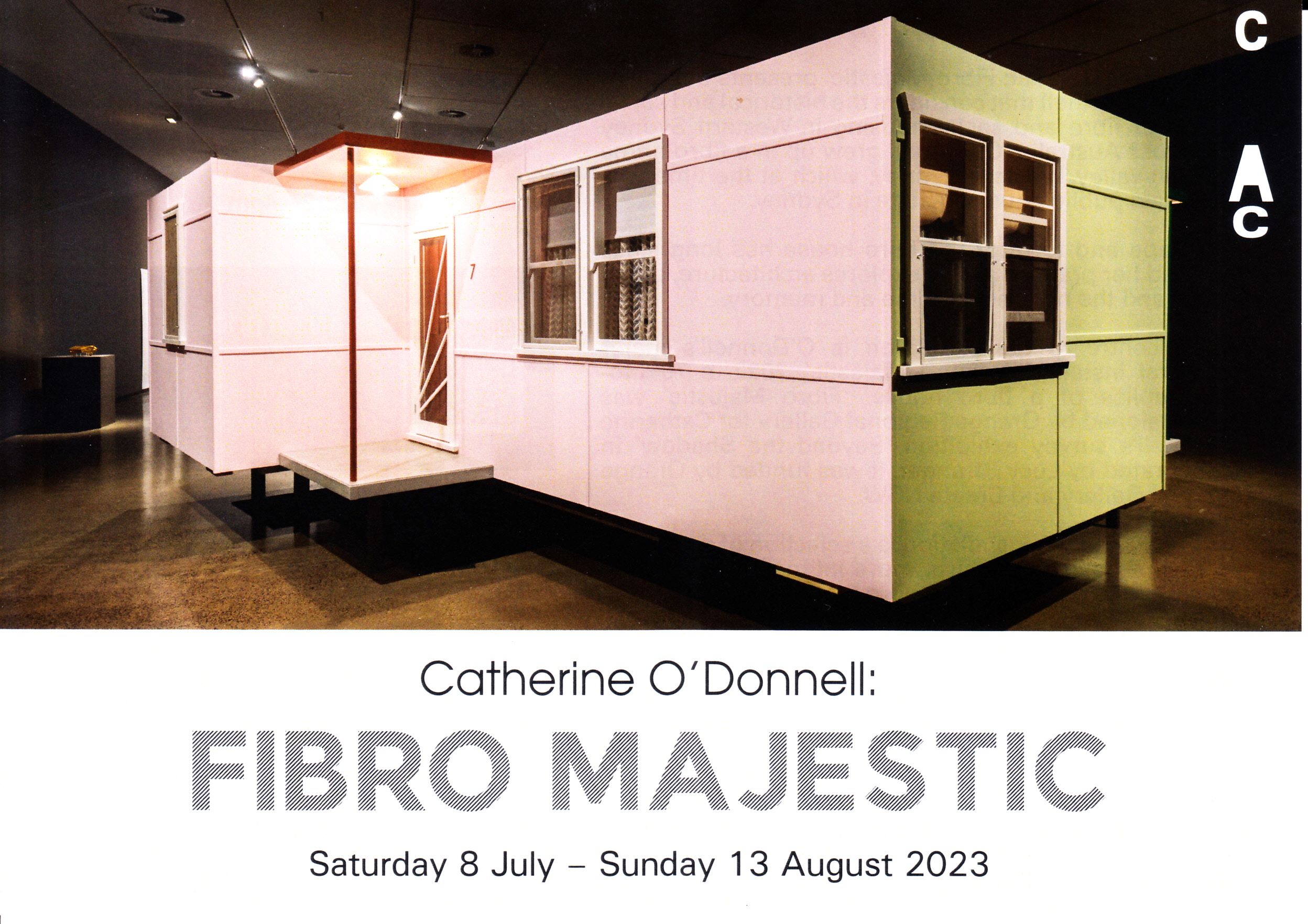
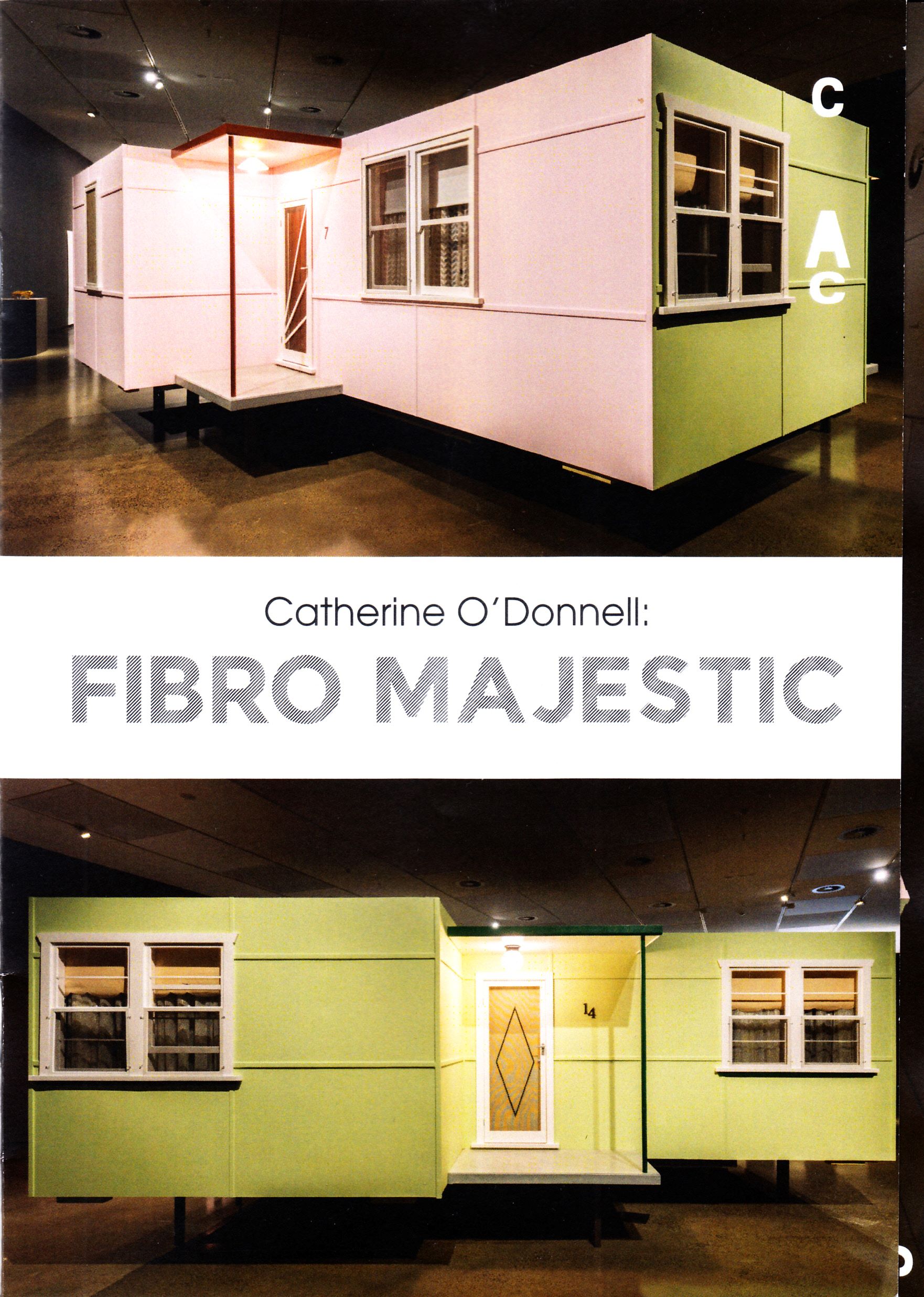
The simple fibro house is celebrated in a new exciting exhibition at the Campbelltown Arts Centre called Fibro Majestic by renowned Australian artist and sculptor Catherine O’Donnell.
The exhibition by artist Catharine O’Donnell ran from 8 July to 13 August 2023 with free entry.
A simple, cheap housing style
Post-war housing domestic architecture in Camden is typified by a simple, cheap, utilitarian building called the Camden fibro cottage.
This style of domestic architecture, the fibro cottage, can be found all over Australia and has provided a basic form of housing for thousands of families.
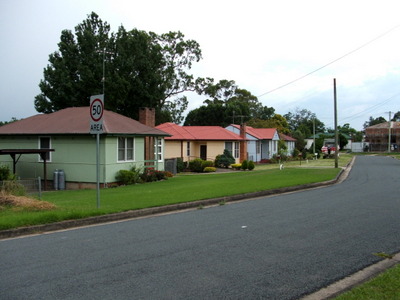
Yet it has been derided, rubbished, and scoffed at for decades after initially being heralded as the height of modernism in the early 20th century.
Fibro Majestic exhibition
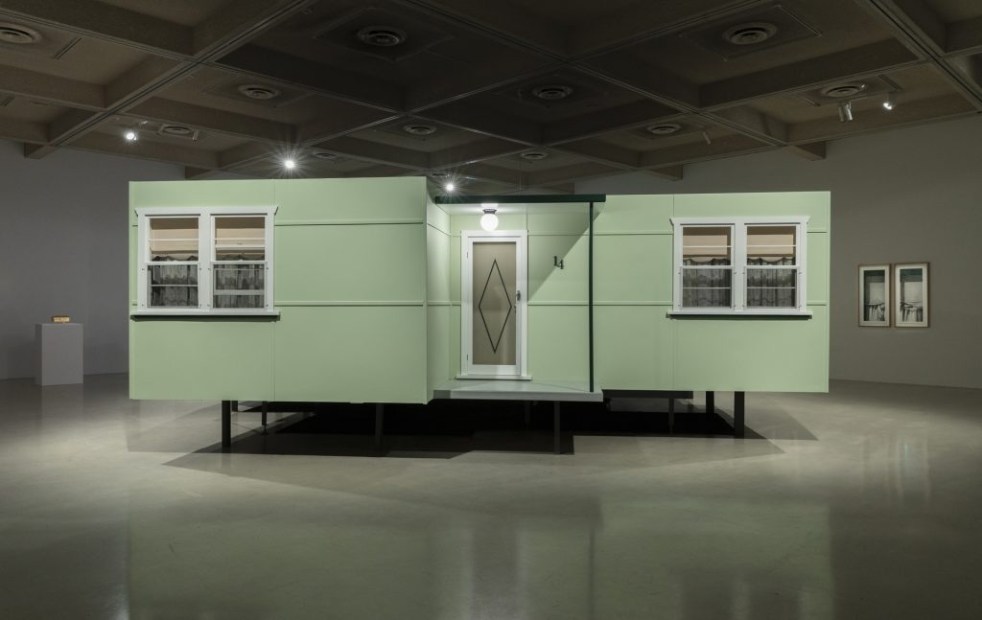
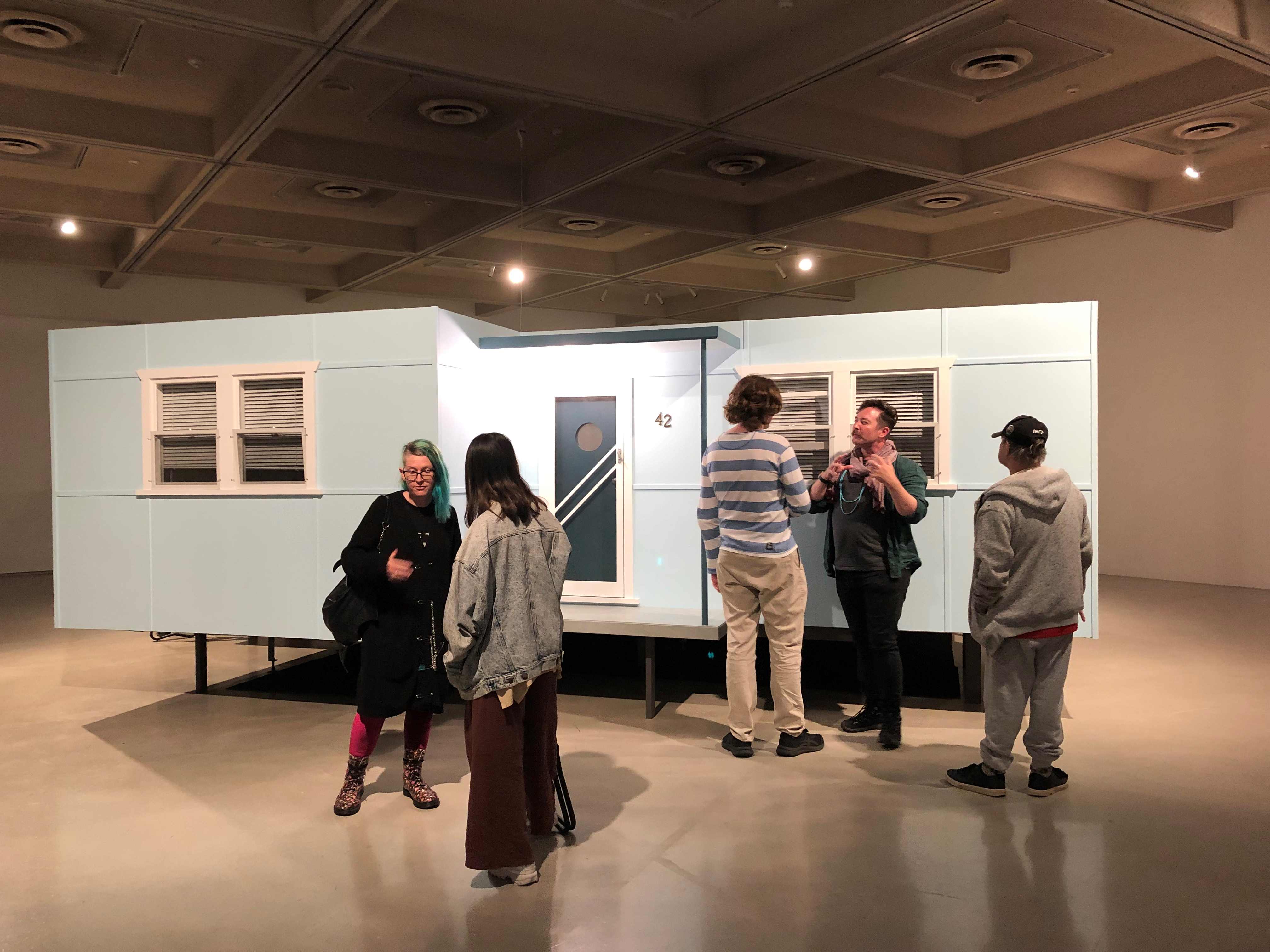
At the centre of the exhibition is the imposing spectacle of a 75%-scale replica of a fibro house.
The ‘Fibro Majestic’ exhibition was initially conceived for the artist’s survey exhibition ‘Beyond the Shadow’ at the Orange Regional Gallery in partnership with Grafton Regional Gallery, curated by art historian Lucy Stanger in 2022.
The exhibition promotion states:
‘Catherine O’Donnell: Fibro Majestic’ presents a body of work by O’Donnell that considers the historical and social context of fibro and social housing in Western Sydney and across Australia. O’Donnell grew up in a fibro home in Green Valley, Western Sydney, which at the time was the largest public housing estate in Sydney. The shape and form of the fibro house has long since informed her practice as she explores architecture, social history and the notions of home and memory.
Exhibition notes state that O’Donnell has taken the floor plans from the New South Wales Housing Commission around the mid-century. They are a type of modernism that has fallen out of favour with the government, the public and the building industry.
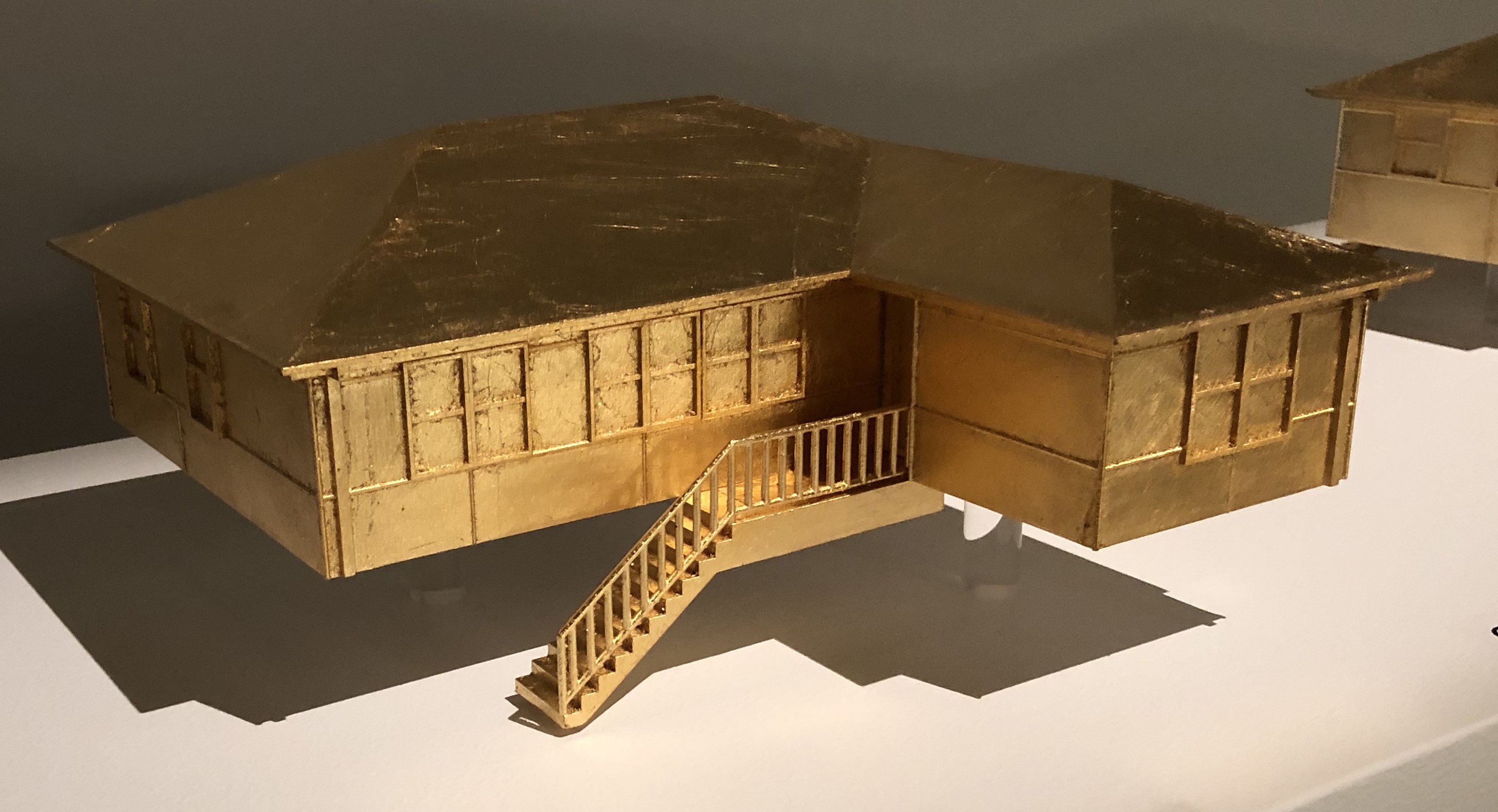
Catherine O’Donnell, ‘Gold leafed house 1’, 2022. Stereolithographic model and gold leaf 13x26x30cm. Campbelltown Arts Centre, Campbelltown. (I Willis, 2023)
Complementing the main sculptural installation is a range of small housing models and intimate drawings that evoke memories of living in a fibro house.

Campbelltown Arts Centre Fibro Majestic Exhibition 2023. (I Willis, 2023)
The fibro houses were more than just buildings. They sheltered people’s lives, provided a safe haven, and were a site of family celebrations, birthdays, marriages, anniversaries, and rituals. The curtains also hid many dark secrets, from domestic violence to poverty and unemployment. While there were many dysfunctional families and disrupted lives, there were many happy families with children who grew up and led successful lives.
One of the happy stories with many fond memories is the story of Fiona, who grew up in the Airds Housing Commission Estate in South Campbelltown. with its many fibro homes.
Living in Airds during the late 70s and early 80s, friendships were built, and people stuck together. It was the freedom of riding bikes with friends until the street lights came on, building makeshift cubbies and performing concerts for the neighbours.
I still remember the excitement of walking to the local shops with my sisters to buy a few groceries for Mum. The constant search for ‘bargains’ in the hope there would be twenty cents left over to buy some mixed lollies.
Ugly Australia
According to O’Donnell, fibro cottages ‘were compact, mass-produced, box-like structures’ built across Sydney’s western suburbs.
The simple fibro cottage has characterised Western Sydney and its lifestyle. The simplicity of the fibro cottage was its attraction and part of its downfall.
Typical of the urban fringe, the simple fibro cottage has been derided and ridiculed by those who are snobbish about Sydney’s outer suburbs.
The fibro cottage is typical of suburbia on the edge. The edge can be marginalised people, the urban fringe, or the perception that it is a type of housing that is unacceptable to some.
The fibro cottage represents a type of Otherness, an ugly Australia. These images have been reinforced by the Sydney press, which labelled Campbelltown an ‘ugly houso wasteland’ in 1975.
According to historian Ian Willis
The humble fibro cottage in Camden in the 1950s and 1960s has been integral to the town’s 20th-century history. The fibro house represents the baby-boomer era, when drive-ins, Holdens, Chiko rolls, black & white TV, rock & roll, and vinyl LPs were the norm. Fibro is evocative of long summer holidays by the beach, with adolescent love, boogie boards, zinc cream and paddle pops.
This is the essence of Fibro Majestic, a metaphor for mid-century Australia.
Optimism and hope in a compact box
The fibro cottage came to the rescue in the post-war years, when Sydney experienced a housing shortage due to the ‘baby boom’ and increased immigration.
The postwar years were a period of optimism and hope for a better lifestyle. These cottages were cheap and utilitarian and could be erected quickly.
Fibro, as a building materialz, was invented at the beginning of the 20th century and imported into Australia before the First World War. Wartime restrictions resulted in the product being manufactured in Australia by the war’s end.
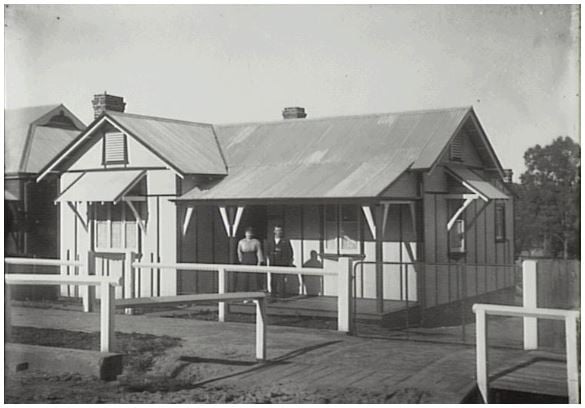
Leaked heat like a sieve
The fibro cottages of the 1950s leaked heat like a sieve and failed by today’s energy-efficient efficiency standards for housing. According to Lloyd Nicols from the Illawarra Flame retrofit project, these cottages can be made energy-efficient to make them sustainable, affordable, and attractive. The project, a joint venture between the University of Wollongong and Wollongong TAFE College, aims for kits to be able to retrofit existing fibro cottages to increase their thermal performance.
Nostalgia and memory
Nostalgia and memory are a big part of the exhibition. Artist Catherine O’Donnell states that the fibro cottage is the architecture of my childhood and an ‘everywhere-everyman example of mid-century developments across Australia’.
The simple fibro shacks littered along the Australian coastline are part of this nostalgia. Wendy Shaw and Lindsay Menday argue
The old beach shacks that dominated seaside fishing villages or isolated holiday surfing spots provided low-cost accommodation for holidaymakers in often remote and low-populated settings with few services. Some of these holiday houses were owner-occupied but remained vacant outside holiday times. Most were available for short-term holiday rental. All were relatively basic.
These fibro cottages straddled the class divide and were easily accessible by the motor car by mid-century. These were egalitarian holiday experiences for Australians.
In northern New South Wales, tropes of nature, community, and heritage [around fibro cottages] have been incorporated into a new beachside ‘town’ identity.
These fantasies of bygone days play out in the Fibro Majestic exhibition, which conjures up memories of beach holidays with long lazy days lounging in the sun in a mystical past. All viewed through rose-coloured glasses misty with nostalgia.
O’Donnell maintains that these memories are ‘synonymous with Australian identity’.
Flawed Plans, a commission
In addition to the main exhibition, The Campbelltown Arts Centre has commissioned a site-specific art installation on the stairs and front wall of the gallery amphitheatre called ‘Flawed Plans’.

‘Flawed Plans’, 2023. (Campbelltown Arts Centre Amphitheatre). Vinyl, dimensions variable. Commissioned by the CAC. (I Willis, 2023)
The artwork highlights the many layers to the story of the fibro cottage and how perceptions shift and twist.
Where once the fibro house was seen as a saviour as a cheap and effective form of housing, it has become a to be seen as an urban disaster by many.
The artist maintains that as the viewer climbs around the installation, their perception shifts and skews ‘as the viewer climbs, descends or orbits the work’.
Fibro Majestic, a reflection
Fibro Majestic reminds us all how perceptions and memories change over time. Fibro houses were once the height of modernism, yet in later decades, they were derided and rubbished.
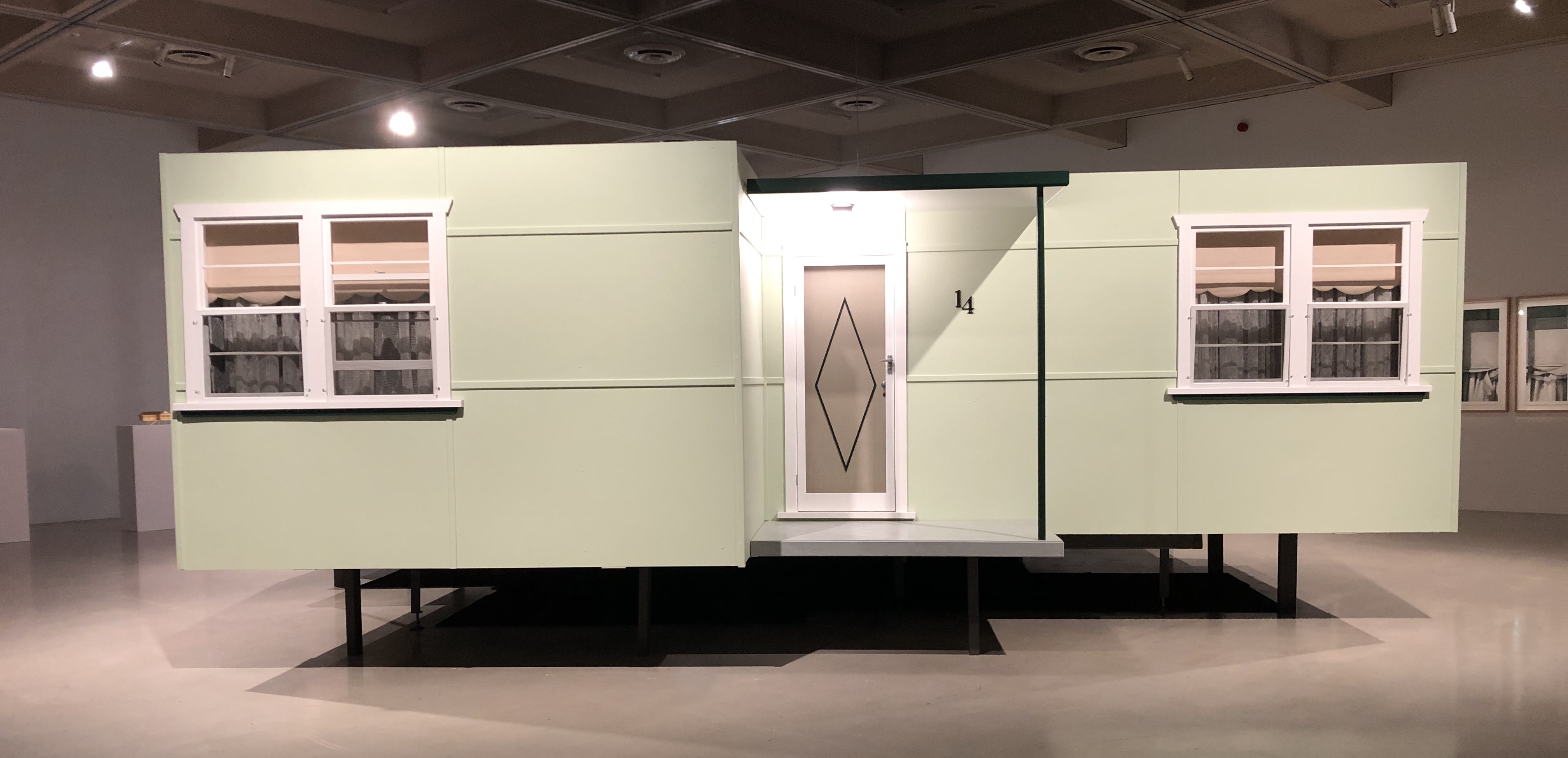
‘Fibro Majestic’, 2022. Mixed media, common household construction materials, 587x587x220cm. (I Willis, 2023)
The exhibition evokes the fibro heritage of affordable accommodation for the working man and his family in the postwar years when there was a housing shortage for ordinary people.
Fibro was a practical building material that, despite its dangers, could provide a model for the current housing crisis. The fibro cottage was a simple, effective housing solution that could be reborn again.
The exhibition Fibro Majestic has captured the essence of nostalgia around this housing style. Baby boomer memories are full of fibro houses and other mid-century Australian lifestyle icons.
The art installation encapsulates the essential elements of the architectural style and is evocative of the lives of those who lived in this utilitarian style of domestic architecture.
Conclusion
The exhibition brings together the artist’s intention of considering the ‘historical and social context of fibro and social housing in Western Sydney and across Australia’.
The “Fibro Majestic” exhibition at Campbelltown Arts Centre celebrates the historical significance of fibro housing in Australia, highlighting its role in post-war society.
Artist Catherine O’Donnell’s work reflects on the nostalgia, memories, and social contexts surrounding these humble structures, transforming perceptions of architecture once deemed unattractive.
More reading
Shaw, W. S., & Menday, L. (2013). Fibro Dreaming: Greenwashed Beach-house Development on Australia’s Coasts. Urban Studies, 50(14), 2940–2958. https://doi.org/10.1177/0042098013482507
Jenna Reed Burns 2015, ‘Shacking Up’, Green Magazine, Issue 43, May. https://greenmagazine.com.au/article/shacking-up/

Updated 14 February 2025. Originally posted on 22 July 2023 as ”Fibro Majestic’, a new exhibition at the Campbelltown Arts Centre, a review’.
Discover more from Camden History Notes
Subscribe to get the latest posts sent to your email.

