
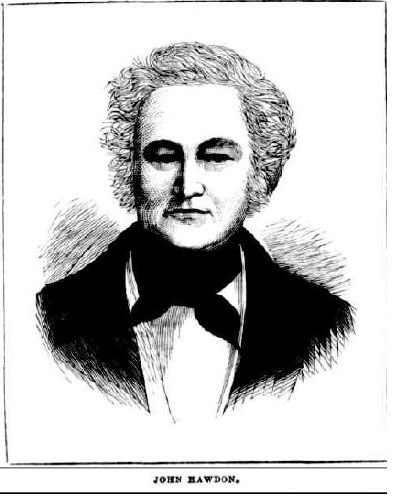
Englishman John Hawdon
In 1929, Mrs Madeline Buck, the granddaughter of an Elderslie pioneer, John Hawdon, published a series of his letters written in 1828 to friends in England. Hawdon had lived in the Elderslie area for five years from 1828.
Hawdon’s letters surfaced in England in 1929 amongst old family papers and provide many interesting insights into life in the colony’s early days.
Hawdon was concerned about freight costs between Sydney and the Cowpastures and, according to Atkinson, ‘could make a good profit only because his carriers were his own convicts, who cost him next to nothing. The journey to market and back took a week’ using a bullock team. Hawdon grew hay for the Sydney market, which was used to fatten cattle for the market, and by the 1830s, hay was more important than grain for the property owners in the Cowpastures. Hawdon’s convicts took the hay to the Sydney market and sold it for 6s8½d a hundredweight in 1832. He also grew a small amount of tobacco, which, according to Atkinson, was ‘very profitable’ for those who knew how to grow it.
At Elderslie, Hawdon leased the Elderslie estate and supported four convicts, his wife Margaret and his baby son. Alan Atkinson maintains that ‘Hawdon apparently tried to keep an English tone, with the slave-driving Botany Bay element at a minimum. He was a good master and even admired his convicts’. He did not take any convicts for punishment at the Cawdor Bench between 1825 and 1830. (Atkinson, p20)
Hawdon wrote to England of the Elderslie estate convicts that
‘he had a good many of what he almost always calls “Government men,” and said he always had great satisfaction from them.’
He continued that
‘I allow my men to have as much new milk as they can use. I feed them well, and work ttipm well, by which means I have very little trouble managing them.” (SMH, 26 October 1929)
Hawdon was one of many colonists who moved to southern New South Wales after living in the Cowpastures for a period. He was at the frontier of settler society, where clashes between Europeans and Aborigines were more common than not.
In 1879, a journalist for the Australian Town and Country Journal described Hawdon as
‘I am only doing justice to a good old colonist, and but expressing the general opinion by stating that Mr. Hawdon is about one of the finest representatives of the true British gentleman in the colony. Honour, hospitality, and generosity are the’ characteristics which have marked his long life’ of usefulness in working and opening out with a few other pioneers this rapidly peopling district.’
‘The gentleman whose portrait we present to our readers this week is one of our oldest colonists, and the record of his career is a typical one of the prosperity that in this country attends upon energy and perseverance.’
In his obituary in 1881, the writer maintained that:
‘With his we believe, passes away that last of the brave men who did so much, to open-up the-pastoral interest of Australia and to give her the name of the finest grazing country in the world.’
At Elderslie, he ran a dairy and cheese-making operation, and later, he owned a property at Bodalla. He contracted to supply provisions to the road gangs making the Great South Road.
Hawdon wrote about his journey out to New South Wales, and writing on October 26, 1828, he stated
“Our passage was tedious, but not unpleasant.In the cabin we carried ten people, and in the steerage I believe there were about 32. My cabin was a very comfortable one on deck. We carried on board eight dogs, about 40 sheep, pigs, and poultry In abundance, a cow, a goat with two kids, and a famous noise, I assure you, they made!”
He wrote in his diary
On the arrival of the small family In Sydney, he found the expenses about double what they would be in London, so “I thought it advisable to take a station, till I could get my affairs arranged, and our grant of land fixed upon.” Then follows what would surprise even a hustling American. He rode up to Camden on the 16th September (three days after landing), took Mr. Harrington’s place, Elderslie, rode back to Sydney on the 17th, and within a week they were established In their new home and working away as though they were old settlers.
He wrote further
“The Governor has been pleased at two dinner parties to express his sentiments of approbation on me, saying I had begun like one who is determined to do well, for I had not been eight days in the Colony before I had my ploughs going.”
Hawdon describes Elderslie as being
“a very good and very cheap place, 38 miles from Sydney, consisting of about 1700 acres of land, all fenced and divided Into paddocks, 400 acres being cleared and stumped. The cultivated land is capital, better than any I have seen in any part of the world. It is on the Nepean River. For about three or four miles the river parts Mr MacArthur’s land and mine. His house is on the opposite side of the river to mine. We have an excellent house and garden, and the conveniences of stables, arns, etc., are equal to almost any in England.”
Mrs Buck stated
‘The little railway siding of Elderslie shows the locality in which this old homestead once stood. I understand that the foundations and an underground room of the homestead remain, and that a cottage has been built upon the site, with the materials from the old house.’
Hawdon wrote of the social life at Elderslie, and Mrs Buck stated that the social life on the Cowpastures a hundred years ago was not as dull as one might think.
This is the very country for a young man,” he writes “Take the people as a body, they are pleasant, hospitable, and uncommonly gay. Where we live (about 40 miles from Sydney). It is as populous a neighbourhood as any country place in England. We have a great many neighbours. This part is thought to be the most respectable part of the country and we have been called upon by the gentry. Altogether it is very pleasant. This country has more the appearance of England than any foreign country. They are all English people, have English customs, and everything when I look around is almost the same as at home. Our sitting-room has the same furniture, the same servants wait on us that we have been accustomed to see, and even the climate is much like very fine weather in England. We see quite as much company as we like. A visitor here thinks very little of staying two or three days, which is very agreeable. The gentlemen are all well-bred men; indeed, a great many of the larger settlers have been officers either in the army or navy. We ore a long way from a church. I believe our church is eight or 10 miles off (Cobbitty), but we have not yet been there, as our gig has not come from Sydney. But I make a point of reading the church service and a sermon to my people, who all appear, clean and well dressed, on Sunday forenoons. (SMH 2 November 2029)
Hawdon’s views on Aborigines in the Elderslie area:
‘As for the natives, they are a most peaceable set of beings, They come to beg sugar and tobacco, of which they are fond. They sometimes come to borrow a gun, and I find powder and shot they give me half of what they kill. They are strictly honest and have excellent memories, for if they see a person once they never fail to remember him again, though many years have elapsed. But they are excessively idle.’
Hawdon was highly energetic and
‘While still holding Elderslie he took a place called Burra Burn (in Northumberland), or 6500 acres, from Archdeacon Scott for seven years. He says that though it was taken for seven years it was rent free.’
John Hawdon biography

John Hawdon was born June 29, 1801, in Wakefield, Durham and came out to New South Wales in 1828 on the Caroline with his wife and two children. His wife was Margaret Katherine Hawdon (born Potts), and he married her in 1827. One child, John, was born in 1827 and conceived out of wedlock; the second, Gilbert, was born at sea on the journey to New South Wales. There were two more children while they lived at Elderslie, and their 5th child, Ernest, was born at Narellan. John Hawdon died June 12, 1881, at Moruya, New South Wales, Australia. Mrs Buck reported in the Sydney Morning Herald that Hawdon’s youngest daughter, Mrs Annie Wilson, was still living at Mt Colah, north of Sydney, in 1929. Hawdon had seven sons.
Hawdon took up a grant of 2560 acres at Kiora in the Moruya area in 1831 and later formed a cattle station at Howlong near Albury. He marketed cattle in Melbourne and sold some of the first cattle in Adelaide from New South Wales. He encouraged his brother Joseph to emigrate, and together, they took up squatting interests in Victoria and southwestern New South Wales and contracted the overland mail run between Yass and Melbourne.
Hawdon was one of the young squatters who founded one of Melbourne’s oldest organisations, the Old Melbourne Club, a private social club, in 1838. The club is considered an enduring symbol of Australia’s British heritage and was founded by 23 British ‘gentlemen’. It is located in a London-style clubhouse designed by Leonard Terry in 1858.
Hawdon owned the stations of Kiora, Bergalia, Bodalla, Howlong, and one at Mildura in New South Wales and similar properties at Mt. Greenock and Dandenong Creek in Victoria, besides several smaller places.
Further reading
Image and Text:
Australian Town and Country Journal, 18 Jan 1879 http://trove.nla.gov.au/ndp/del/printArticlePdf/70934477
Letters
The Sydney Morning Herald, 26 October 1929 http://nla.gov.au/nla.news-article16596386
The Sydney Morning Herald, 2 November 1929 http://nla.gov.au/nla.news-article16598472
The Sydney Morning Herald, 9 November 1929 http://nla.gov.au/nla.news-article16600463
Obituary
The Sydney Morning Herald, 16 June 1881 http://nla.gov.au/nla.news-article13488341
Books
Atkinson, Alan. (1992). Camden : farm and village life in early New South Wales. Melbourne : Oxford University Press
Updated 14 October 2025. Originally posted 12 February 2016.
Discover more from Camden History Notes
Subscribe to get the latest posts sent to your email.


11 thoughts on “John Hawdon of Elderslie in a settler society”
Comments are closed.