
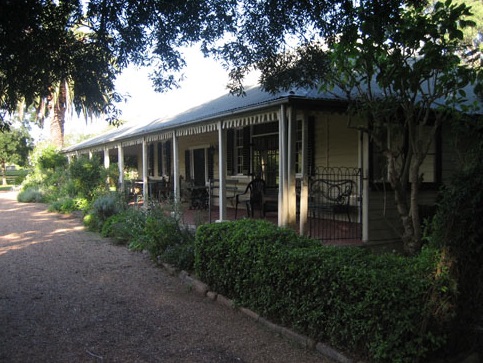
Moviemakers have always had an eye on the Camden district’s large country houses, rustic farm buildings, quaint villages and picturesque countryside for film locations.
From the 1920s, the area has been used by a series of filmmakers as a setting for their movies. This coincided with an increasing interest in the area’s Englishness from poets, journalists, and travel writers. They wrote stories of quaint English-style villages with a church on the hill, charming gentry estates down hedge-lined lanes, where the patriarch kept contented cows in ordered fields and virile stallions in magnificent stables. This did not go unnoticed in the film industry.

One of the first was the 1921 silent film Silks and Saddles, shot at Arthur Macarthur Onslow’s Macquarie Grove by American director John K Wells, about the world of horse racing. The film was set on the race track on Macquarie Grove. The script called for a race between an aeroplane and a racehorse. The movie showed a host of good-looking racing blood-stock.
According to Annette Onslow, there was much excitement when an aeroplane piloted by Edgar Percival, his Avro, landed on the race course used in the film and flew the heroine to Randwick to win the day. Arthur’s son Edward swung a flight in Percival’s plane, was hooked on flying for life, and later developed Camden Airfield at Macquarie Grove.
Camden film locations were sought in 1931 for director Ken G Hall’s 1932 Dad and Dave film On Our Selection, based on the characters and writings of Steele Rudd. It stars Bert Bailey as Dan Rudd and was released as Down on the Farm in the UK. It was one the most popular Australian movies of all time but it was eventually shot at Castlereagh near Penrith. The movie is based on Dan’s selection in south-west Queensland and is about a murder mystery.
Ken G Hall notes that of the 18 feature films he made between 1932 and 1946 his film company used the Camden area and the Nepean River valley and its beauty for location shooting. The films included On Our Selection (1936), Squatter’s Daughter (1933), Grandad Rudd (1934), Thoroughbred (1935), Orphan of the Wilderness (1936), It Isn’t Done (1936), Broken Melody (1938), Dad and Dave Come to Town (1938), Mr Chedworth Steps Out (1938), Gone to the Dogs (1939), Come Up Smiling (1939), Dad Rudd MP (1940), and Smith, The Story of Sir Charles Kingsford Smith (1946).

The Camden district was the location of two wartime action movies, The Power and The Glory (1941) and The Rats of Tobruk (1944). The Rats of Tobruk was directed by Charles Chauvel and starred actors Chips Rafferty, Peter Finch and Pauline Garrick. The story is about three men from a variety of backgrounds who become mates during the siege at Tobruk during the Second World War. The movie was run at Camden’s Paramount movie palace in February 1945. The location for parts of the movie were the bare paddocks of Narellan Vale and Currans Hill, where they were turned into a battleground to recreate the setting at Tobruk in November 1943.
There were concerns at the time that the exploding ammunition used in the movie would disturb the cows. Soldiers were supplied from the Narellan Military Camp, and tanks were modified to make them look like German panzers. RAAF Camden supplied six Vultee Vengeance aircraft from Camden Airfield, which were painted up to look like German Stuka bombers. The film location was later used for the Gayline Drive-In. Charles Chauvel’s daughter Susanne Carlsson, who was 13 years old at the time, reported that it was a ‘dramatic and interesting time’.
The second wartime movie was director Noel Monkman’s The Power and The Glory, starring Peter Finch and Katrin Rosselle. The movie was made at RAAF Camden with the cooperation of the RAAF. It is a spy drama about a Czech scientist who discovers a new poison gas and escapes to Australia rather than divulging the secret to the Nazis.
Part of the plot involved enemy infiltration of the coast near Bulli, where an enemy aircraft was sighted. Five Avro-Anson aircraft were directed to seek and bomb the submarine. The Wirraway aircraft from the RAAF Central Flying School acted as fighters, and it was reported that the pilots were ‘good-looking’ airmen from the base mess. There was a private screening at Camden’s Paramount movie theatre for the RAAF Central Flying School personnel.
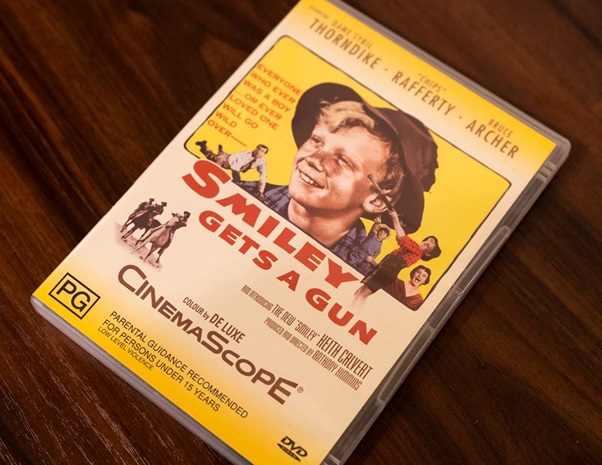
Camden Park was used as a set for the international series of Smiley films, which Smiley made in 1956, and in 1958, Smiley Gets a Gun in Cinemascope. The story is about a nine-year-old, a bit of a rascal, who grows up in a country town. They were based on books by Australian author Moore Raymond and filmed by Twentieth Century Fox and London Films. Raymond set his stories in a Queensland country town in the early 20th century, and there are horses and buggies and motor cars.
The town settings were constructed from scratch and shot at Camden Park under the management of Edward Macarthur Onslow. The movie stars included Australian Chips Rafferty and English actors John McCallum and Ralph Richardson. Many old-time locals have fond memories of being extras in the movies. Smiley was released in the United Kingdom and the United States.
In 1999 Camden airfield was used as a set for the television documentary The Last Plane Out of Berlin which was the story of Sidney Cotton. Actor Geoff Morrell played the role of Cotton, who went to England in 1916, became a pilot, and served with the Royal Naval Air Service during the First World War. He is regarded as the ‘father of aerial photography’ and in 1939 was requested to make flights over Nazi Germany in 1939. According to producer Jeff Watson, Camden Airfield was the ‘perfect location’ because of its ‘historic’ 1930s atmosphere.
In 2009, scenes from X-Men Origins: Wolverine were filmed at Camden and near Brownlow Hill.
In 2010, filmmaker Sandra Pyres of Why Documentaries produced several short films in association with the With The Best of Intentions exhibition at The Oaks Historical Society. The films were a montage of contemporary photographs, archival footage, and re-enactments by drama students of the stories of child migrants. The only voices were those of the child migrants, and many tears were shed as the films were screened at the launch of the exhibition.
In 2011, scenes from director Wayne Blair’s Vietnam wartime true story The Sapphires, starring Deborah Mailman, Jessica Mauboy, and Chris O’Dowd, were filmed at Brownlow Hill. The true story is about four young Aboriginal sisters who are discovered by a talent scout who organises a tour of American bases in Vietnam.
On Brownlow Hill, a large stage was placed in the middle of a cow paddock and draped with a sign that read ‘USC Show Committee presents the Sapphires’. Filming began around midnight. The cows were herded out of sight, and the crew had to be careful not to stand off any cowpats. Apparently, Sudanese refugees played the role of African American servicemen of the 19th Infantry Division.

The romantic house of Camelot, with its turrets, chimney stacks and gables, was built by racing identity James White and designed by Horbury Hunt. It was the scene of activity in 2006 and 2007 for filming scenes of Baz Luhrman’s Australia, starring Nicole Kidman and Hugh Jackman. The location shots were interior and exterior scenes which involved horse riding by Kidman and Jackman. The film is about an aristocratic woman who leaves England and follows her husband to Australia during the 1930s and lives through the Darwin bombing by the Japanese in the Second World War.
Camelot was a hive activity for filming the 1950s romantic television drama A Place to Call Home, produced by Channel 7 in 2012. Set in rural Australia, it is the story of a woman’s journey ‘to heal her soul’ and a wealthy family facing changes in the fictional country town of Inverness in the Bligh family estate of Ash Park. Starring Marta Dusseldorp as the mysterious Sarah and Noni Hazlehurst as the family matriarch Elizabeth, who has several powerful, independently wealthy women who paralleled her role in Camden in time past on their gentry estates.
The sweeping melodrama about hope and loss is set against the social changes in the 1950s and has close parallels to 1950s Camden. The ‘sumptuous’ 13-part drama series screened on television in 2013 and, according to its creator Bevin Lee, had a ‘large-scale narrative’ that had a ‘feature-film feel’. He maintained that it was ‘rural gothic’, set in a big house that had comparisons with the British television drama Downton Abbey.
The 55-room fairytale-like mansion and its formal gardens were a ‘captivating’ setting for A Place to Call Home, according to the Property Observer in 2013. Its initial screening was watched by 1.7 million viewers in April 2013. The show used a host of local spots for film sets, and one of the favourite points of conversation ‘around the water cooler’ for locals was the game ‘pick-the-place’.
By mid-2014, Channel 7 had decided to axe the series after the second series. There was a strong local reaction, and a petition circulated, which attracted 6,000 signatures to keep the show on the air. In the end, Foxtel Television produced a third series with the original cast, which screened in 2015.
Camden Airfield was in action again and used as a set for the Australian version of the British motoring television show Top Gear Australian in 2010. Part of the show is power laps in a ‘Bog Standard Car’ were recorded on parts of the runways and taxiways used as a test track.
Camden Showground became the set for Angelina Jolie’s Second World War drama Unbroken in 2013. The main characters Louis Zamperini, a former Olympic runner, and Onslow Park were used as part of the story of his early life as a Torrance High School track team member. The movie is about Zamperini’s story of survival after his plane was shot down during the Pacific campaign. The filming caused much excitement in the area, and the local press gave the story extensive coverage, with the showground chosen for its historic atmosphere. Camden mayor Lara Symkowiak hoped that the movie would boost local tourism, and the council was supportive of the area being used as a film set. The council had appointed a film contact officer to encourage greater use of the area for film locations.
Edwina Macarthur Stanham writes that Camden Park has been the filming location for several movies, advertisements and fashion shoots since the 1950s. They have included Smiley (1956), Smiley Gets a Gun (1958), Shadow of the Boomerang (1960) starring Jimmy Little, My Brilliant Career (1978) was filmed in Camden Park and its garden and surrounds, and The Empty Beach (1985) starring Bryan Brown, House Taken Over (1997) a short film was written and directed by Liz Hughes which used lots of scenes in the house. In the 21st century, Preservation (2003) describes a gothic horror movie starring Jacqueline Mackenzie, Jack Finsterer and Simon Bourke, which used a lot of the scenes filmed in the house.
In 2005, Danny De Vito visited Camden Park scouting for a location for a movie based on the book “The True Confessions of Charlotte Doyle”. Sleeping Beauty (2010), an Australian-funded film, was shot at Camden Park, and the short film La Finca (2012). In September 2014, Camden Park was used as a location in the film called “The Daughter” starring Geoffrey Rush. Extensive filming took place over 3 weeks, and members of the family, friends, and Camden locals played the role of extras.
In September 2014, Camden Park was used as a location in the film The Daughter, starring Geoffrey Rush. Extensive filming took place over three weeks, and members of the family, friends, and Camden locals played the roles of extras.

In 2015, the Camden Historical Society and filmmaker Wen Denaro combined forces to tell the story of the Chinese market gardeners who settled in Camden in the early twentieth century. The project will produce a short documentary about the Chinese market gardeners who established vegetable gardens along the river in Camden and supplied fresh products to the Macarthur and Sydney markets.
An episode of the Network Ten TV show The Bachelor Australia was filmed at Camden Park in August 2015. The episode showed scenes of the Bachelor Sam Wood taking one of the bachelorettes, Sarah, on a romantic date to the colonial mansion Camden Park. The pair were in a two-in-hand horse-drawn white carriage going up and down the driveway to the Camden Park cemetery on the hill overlooking the town.
There were scenes in the soft afternoon sunlight of the couple having a romantic high tea on the verandah of Camden Park house with champagne scones and cupcakes. In the evening, there were floodlit images of the front of Camden Park house from the front lawn, then scenes of the couple in the sitting room sitting on the leather sofa sharing wine, cheese and biscuits in front of an open fire and candles. Sarah is gobsmacked with the house and its setting and is ‘amazed’ by the house’s colonial interior.
In 2018 a children’s film Peter Rabbit was filmed in the Camden district. The movie is based on Beatrix Potter’s famous book series and her iconic characters. The special effects company Animal Logic spent two days on the shoot in Camden in January 2017. The first scene features the kidnap of the rabbit hero in a sack, throwing them off a bridge and into the river. For this scene, the Macquarie Grove Bridge over the Nepean River was used for the bridge in the movie.
According to a spokesman, the Camden area was used because it fit the needed criteria. The movie producers were looking for a location that screamed of its Englishness. Camden does that and a lot more, dating back to the 1820s. The movie is set in modern-day Windermere in the English Lakes District. The location did not have to have too many gum trees or other recognisable Australian plants. John and Elizabeth Macarthur would be proud of their legacy – African Olives and other goodies. The airport conveniently provided the location for a stunt scene using a bi-plane. The role of the animators is to make Australia look like England.
In August 2018, the colonial Cowpastures homestead of Denbigh at Cobbitty was the set for the popular Australian drama series Doctor Doctor. The series is about the Knight family farm and the show star is Roger Corser who plays Doctor Hugh Knight. He said, ‘
The homestead is a real star of the show. The front yard, the dam and barn brewery on the property are major sets – I don’t know what we would do without them.
The show follows the high-flying heart surgeon and is up to season three. Filming lasted three months, and the cast checked out the possibilities of the Camden town centre. Actor Ryan Johnson said that Denbigh ‘made the show’.
Denbigh homestead was originally built by Charles Hook in 1818 and extended by Thomas and Samuel Hassell in the 1820s.
In late 2018, the TV series Home and Away used the haunted house at Narellan, known as Studley Park, as a set for the program. The storyline follows three young characters going into the haunted house and staying overnight. They go into a tunnel, and a young female becomes trapped. Tension rises, and the local knock-about character comes to their rescue and is a hero. The use of the set by the TV series producers was noted by Macarthur locals on Facebook.
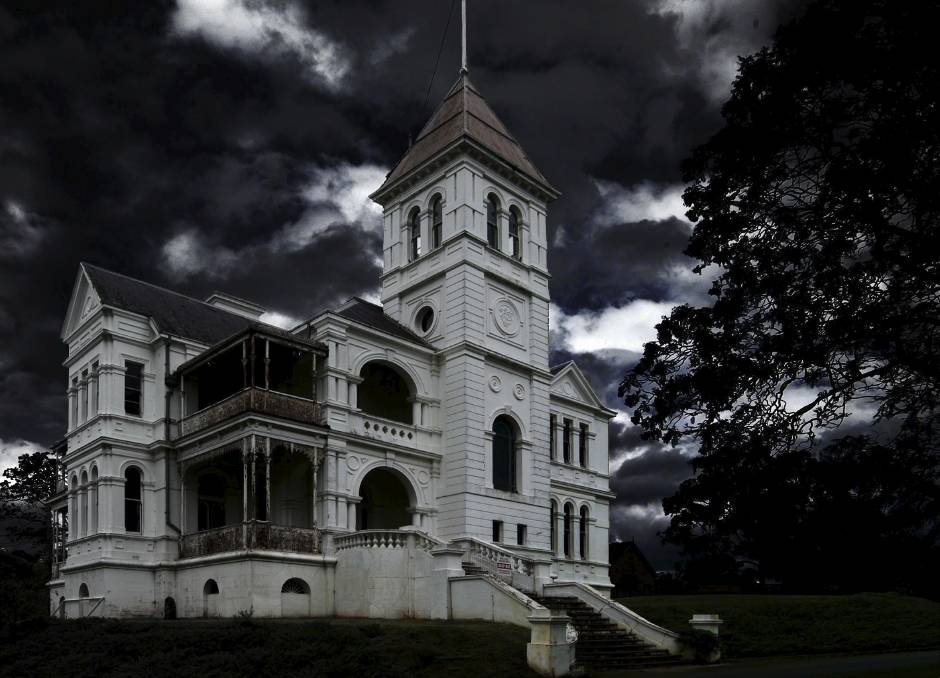
Studley Park has recently been written up in the Camden-Narellan Advertiser (4 August 2017) as one of the eight most haunted places in the Macarthur region. Journalist Ashleigh Tullis writes;
Studley Park House, Camden
This impressive house was originally built by grazier William Payne in 1889. The death of two children has earned the house its haunted reputation.
In 1909, 14-year-old Ray Blackstone drowned in a dam near the residence. His body is believed to have been kept at the house until it was buried.
The son of acclaimed business man Arthur Adolphus Gregory died at the house in 1939 from appendicitis. His body was kept in the theatrette.
In 2019, movie-making in the area continues with the 4th series of Doctor Doctor. Wikipedia states of the plotline:
Doctor Doctor (also known outside of Australasia as The Heart Guy[1]) is an Australian television drama that premiered on the Nine Network on 14 September 2016.[2] It follows the story of Hugh Knight, a rising heart surgeon who is gifted, charming and infallible. He is a hedonist who, due to his sheer talent, believes he can live outside the rules.
Camden was used as one location along with the historic colonial property of Denbigh. Mediaweek stated in 2016 (Sept 9):
The regional setting for the series has proven to be a benefit for narrative and practical production reasons. While all of the hospital scenes were filmed in a hospital in the Sydney inner-city suburb of Rozelle, exterior shooting took place in Mudgee, with filming of Knight’s home was shot in Camden. In addition to $100,000 worth of support from the Regional Filming Fund, the regional setting delivers a unique authenticity to the series that it would otherwise lack.
Sometimes, the local area is used as a set for an advertising campaign by a fashion label or other business. The owners of Camden Park House posted on Facebook in August 2019 that the house and garden were used as a set by the Country Road fashion brand.

In late 2019 the local press reported that streaming service Stan’s drama The Common was partially filmed in Camden. The spokesperson for Stan said
While no specific details about plotlines or particular actors were given away, the spokesman said the production was filming on August 7 at the Narellan Jets Football Club and Grounds, Narellan Sports Hub.
The 2020 movie release of Peter Rabbit 2 highlights part of our local area. Press reports state that the production team was impressed with the local area for Peter Rabbit and came back for the sequel. Visual effects supervisor Will Reichelt said the Macarthur region resembled an English country vista.
Updated 4 June 2024
Discover more from Camden History Notes
Subscribe to get the latest posts sent to your email.


One thought on “Movie making Camden style”
Comments are closed.