A sense of place and a contested narrative
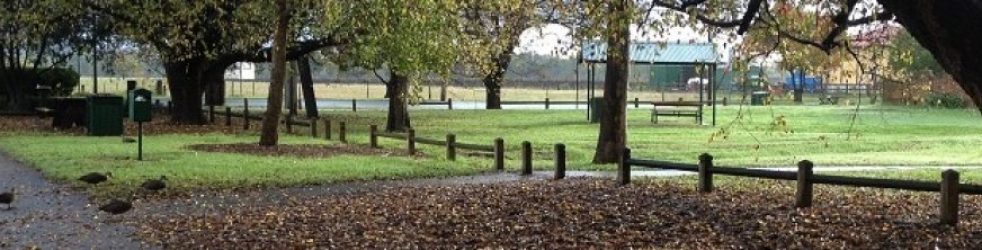
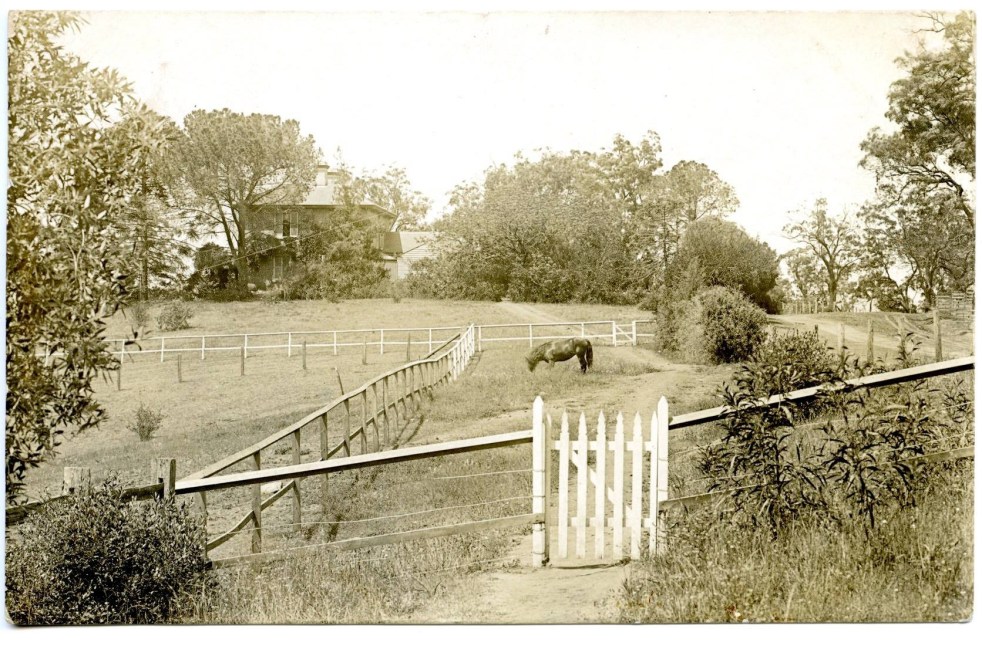
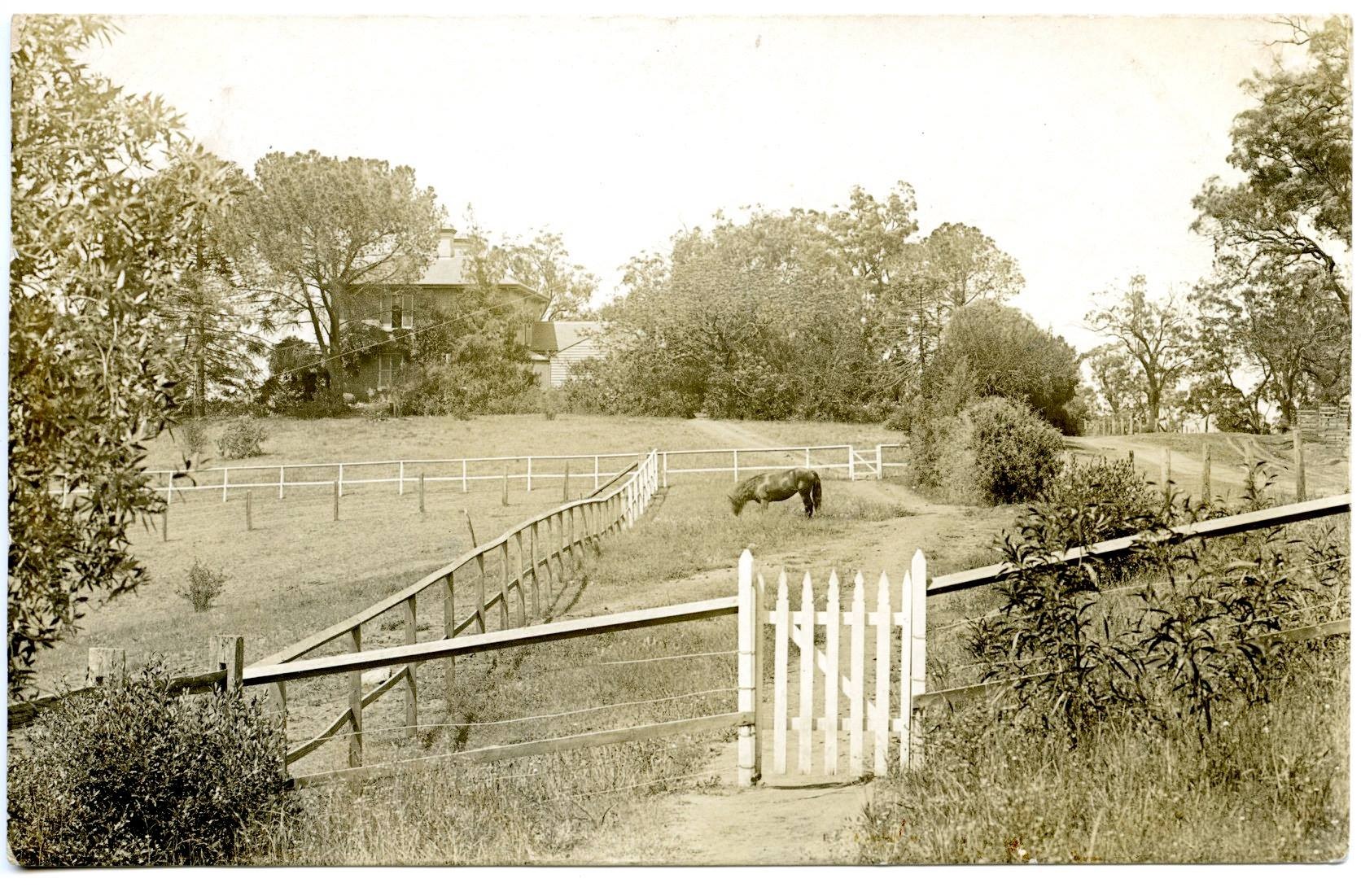
St John’s church is a contested site where there is competition around the ownership of the dominant narrative surrounding a former horse paddock. The paddock in question lies between St John’s Anglican Church and the former Rectory, all part of the St John’s Church precinct.
Church authorities want to sell the horse paddock to fund a new worship centre.
There has been a chorus of objections from some in the Camden community over the potential sale. Community angst has been expressed at public meetings, protests, placards, and in articles in the press.
The principal actors (stakeholders) who have taken up positions around the issue include churchgoers, non-churchgoers (residents, outsiders, ex-Camdenites, neighbours), the parish, local government, state government, and the Macarthur family.
The former horse paddock looks like an unassuming vacant block of land in central Camden. So why has there been so much community angst about its possible sale?

The simple answer is that the community ascribes representations of a church beyond the building being a place of worship. Yet this raises a paradox for the owners of these religious sites. Generally speaking, different faiths put worship and the spiritual interests of their followers ahead of their property portfolio.
This paradox has created angst in some communities when the owners of religious buildings and sites want to sell them, for example, in Tasmania in 2018 or other examples discussed by Graeme Davison.
Unraveling a paradox
Historian Graeme Davison, in his book The Use and Abuse of Australian History, has highlighted the different representations that communities have ascribed to local churches. They have included:
- a symbol of the continuity and community rather than a relic of their faith;
- a local shrine where the sense of family and local piety are given tangible form;
- ‘a metaphor of the postmodern condition’;
- a ‘kind of absent present, a site now unoccupied but irreplaceable and unable to be rebuilt;
- a transcendence and spiritual continuity in a post-Christian society. (pp. 146-161)
So the question here is, are any of Davison’s representations applicable to Camden’s St John’s Church?

Cultural landscape
St John’s church is the centre of Camden’s cultural landscape, its cultural heritage and the narrative around the Camden story. I wrote in the Sydney Journal in 2008 that
St John’s church is the basis of the town’s iconic imagery and rural mythology and remains the symbolic heart of Camden.
In 2012, I extended this and said that community icons, including St John’s,
have become metaphors for the continuity of values and traditions that are embedded in the landscapes of place.
In this dispute, the actors, as others have done,
have used history and heritage, assisted by geography and aesthetics, to produce a narrative that aims to preserve landscape identity.
The actors in the dispute want to preserve the landscape identity of the area by preserving the church precinct, including the horse paddock.
A world long gone
The church precinct is a metaphor for a world long gone, an example of the past in the present. In Davison’s eyes ‘a symbol of continuity and community’.
St John’s Anglican Church is part of an English-style landscape identity, that is, Camden’s Englishness. This is not new and was first recognised in 1828 by Englishman John Hawdon.
Hawdon saw a familiar landscape and called it a ‘little England’. A type of English exceptionalism.
The colonial oligarchs had re-created an English-style landscape in the Cowpastures that mirrored ‘home’ in England. The English took control of territory in a settler society.
The local Indigenous Dharawal people were dispossessed and displaced by the English through the allocation of land grants in the area.
The English subdued the frontier with violence as they did other parts of the imperial world.
The Hawdon allegory was present when the town was established by the Macarthur family as a private venture on Camden Park Estate in 1840. The construction and foundation of St John’s church was part of the process of the building of the new town.
The first pictorial representation of this was used in Andrew Garran’s 1886 Picturesque Atlas of Australasia, where there is
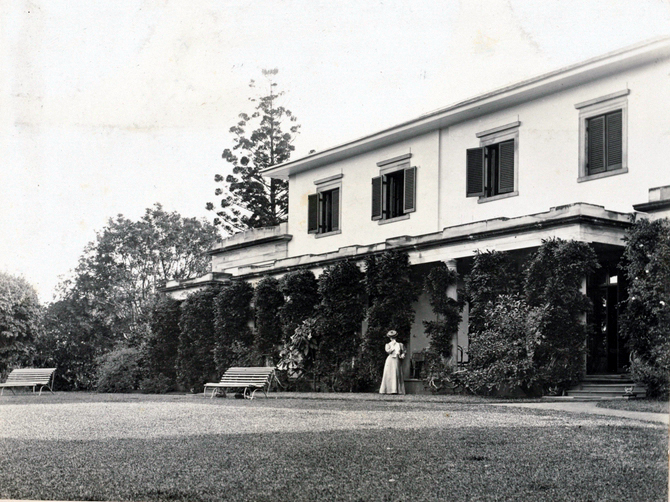
an enduring image within the socially constructed concept of Camden’s rurality has been the unparalleled vista of the Camden village from the Macarthur’s hilltop Georgian mansion. (Image below) The romantic image portrayed an idyllic English pastoral scene of an ordered farming landscape, a hive of industrious activity in a tamed wilderness which stressed the scientific and the poetic.

The hilltop location of the church was no accident. St John’s church is ‘the moral heart’ of English-style ‘idyllic representations as the
‘citadel on the hill’ at the centre of the ‘village’. It acts as a metaphor for order, stability, conservatism and a continuity of values of Camden’s Anglophile past. The Nepean River floodplain keeps Sydney’s rural-urban fringe at bay by being the ‘moat around the village’ which occasionally was the site of a torrent of floodwater.
The hilltop location has spiritual significance with Biblical references to love, peace and righteousness.
A sense of place
St John’s church has had a central role in the construction of place and community identity in the town.

The church and its hilltop location are an enduring colonial legacy and a representation of the power of the colonial gentry, particularly the position of Camden Park Estate and the Macarthur family within the narrative of the Camden story.
Many Camden folk feel a sense of belonging to the church expressed by memory, nostalgia, customs, commemorations, traditions, celebrations, values, beliefs and lifestyles.
The community feel that the church belongs to them as much as it belongs to the churchgoers within the church community.
Belonging is central to placeness. It is home and a site where there is a sense of acceptance, safety and security. Home as a place is an important source of stability.
An extension of this is the role of the church as a loved place in terms laid out by Peter Read in his book, Returning to Nothing, The Meaning of Lost Places. As Veronica Strang writes in Read’s book:
it plain that the feelings engendered by the loss of place can be equated with those experienced in the loss of a close relative, friend or partner. This straightforward analogy helps to make visible the symbolic role of place in enabling human beings to confront issues of mortality.
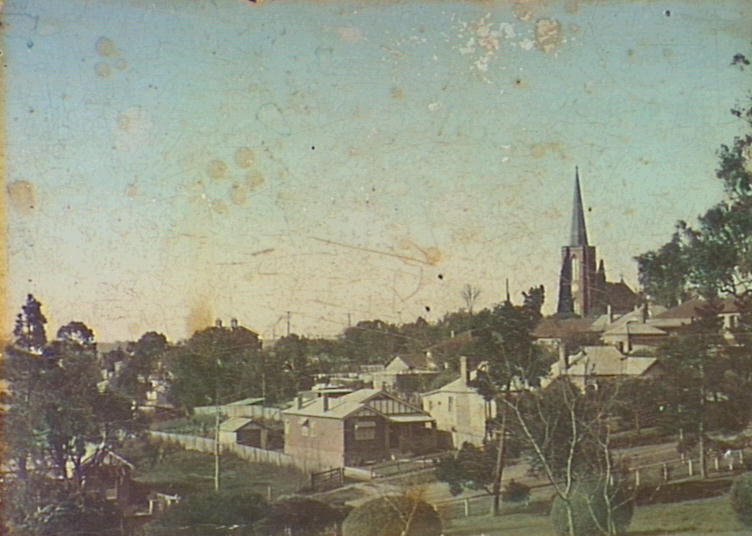
The church buildings and precinct are a shrine to a lost past and are considered by many to be sacred land. The sale of the former horse paddock has caused a degree of community grief over the potential loss of sacred land.
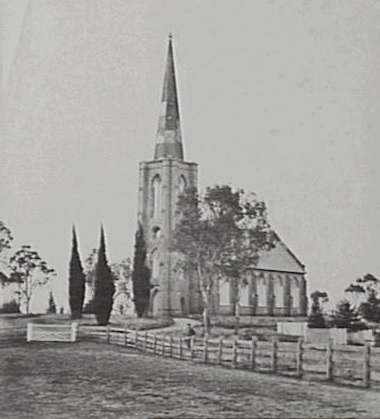
St John’s church is an important architectural statement in the town centre and is one of Australia’s earliest Gothic-style churches.
So what does all this mean?
The place of St John’s church in the Camden community is a complex one. The story has many layers and means different things to different people, both churchgoers and non-churchgoers.
The church is a much-loved place, and the threatened loss of part of the church precinct generates feelings of grief and loss by many in the community.
The legacy of the English landscape identity from the early 19th century and the establishment of the Cowpastures is very real and still has a strong presence in the community’s identity and sense of place. The English-style Gothic church is a metaphor for Hawdon’s ‘Little England’ allegory.
The Cowpastures was the fourth location of European settlement in Australia, and the local area still has a strong Anglo-demographic profile.
These factors contribute to re-enforcing the iconic imagery projected by St John’s church combined with the story of a settler society and its legacy in a contested landscape.
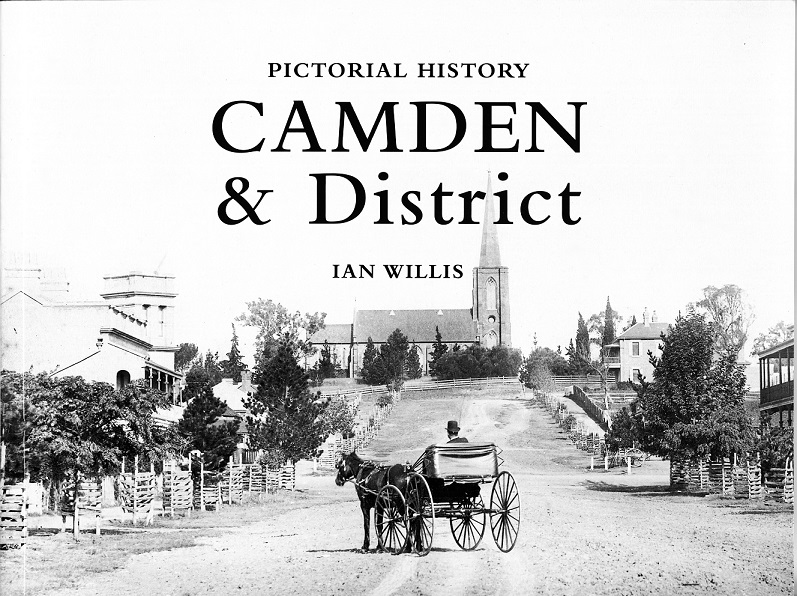
Check out this publication to read more about the Camden district.
Updated on 16 September 2023. Originally posted on 31 January 2019 as ‘A contested sacred site in the historic landscape of the Cowpastures’
Discover more from Camden History Notes
Subscribe to get the latest posts sent to your email.


4 thoughts on “St John’s Church, a contested sacred site in the historic landscape of the Cowpastures”
Comments are closed.