The importance of family histories
Ian Willis writes:
Personal and family stories that family historians and genealogists seek out provide a broader perspective on local histories and local studies of an area. They allow a person to take a look at themselves in the mirror from the past. Insights into our ancestors provide a greater understanding of ourselves in the present. The past informs the present through family and personal histories and places the present into context.
Family and personal histories allow us to see and understand that we are greater than just ourselves. We are all part of a continuum from the past. The present is only a transitory phase until tomorrow arrives.
Looking at the past through personal and family histories gives a context to our present location on the timeline within our own family. Our own family story is located within the larger story of our community. Personal and family stories remind us daily of our roots and our ancestors.
We all have a past, and it is good to be reminded of it occasionally. This is a job that is well done by thousands of enthusiastic family historians and genealogists and their creation of family trees and our connections to our ancestors.
We all need an appreciation of the stories from the past to understand how they affect and create the present. The past has shaped the present, and the present will reshape the future. Our ancestors created us and who we are, and we need to show them due respect. We, in turn, will create the future for our children and their offspring.
One local family were the Pattersons of Elderslie, and one of their descendants, Maree Patterson, seeking to fill out their story. She wants your assistance. Can you help?
The Patterson family of Elderslie
Maree Patterson writes:
I moved from Elderslie in 1999 to Brisbane, and I have tried unsuccessfully to find some history on the family.
I am writing this story as I have been trying to research some of my family histories on my father’s side of the family, and I feel sad that I never got to know a lot about his family.
My father, Laurence James Henry Patterson, was a well-known cricketer in the Camden district. He was an only child, and he didn’t really talk much about his aunts, uncles, and cousins.
My grandfather passed away when I was young. Back then, I was not into family history, and I’ve hit a stumbling block. I’m now in need of some assistance.
I would really like to find out some history on the Patterson family as I have no idea who I am related to on that side of my family, and I would like to pass any family history down.
Limited information
At the moment, I am seeking any help as the following is the only information that I have on the Patterson family.
H Patterson arrives in Elderslie
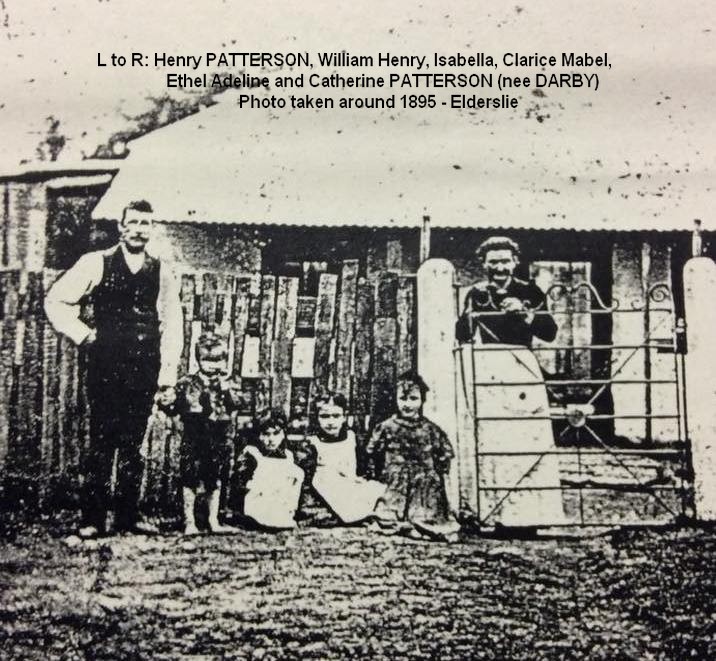
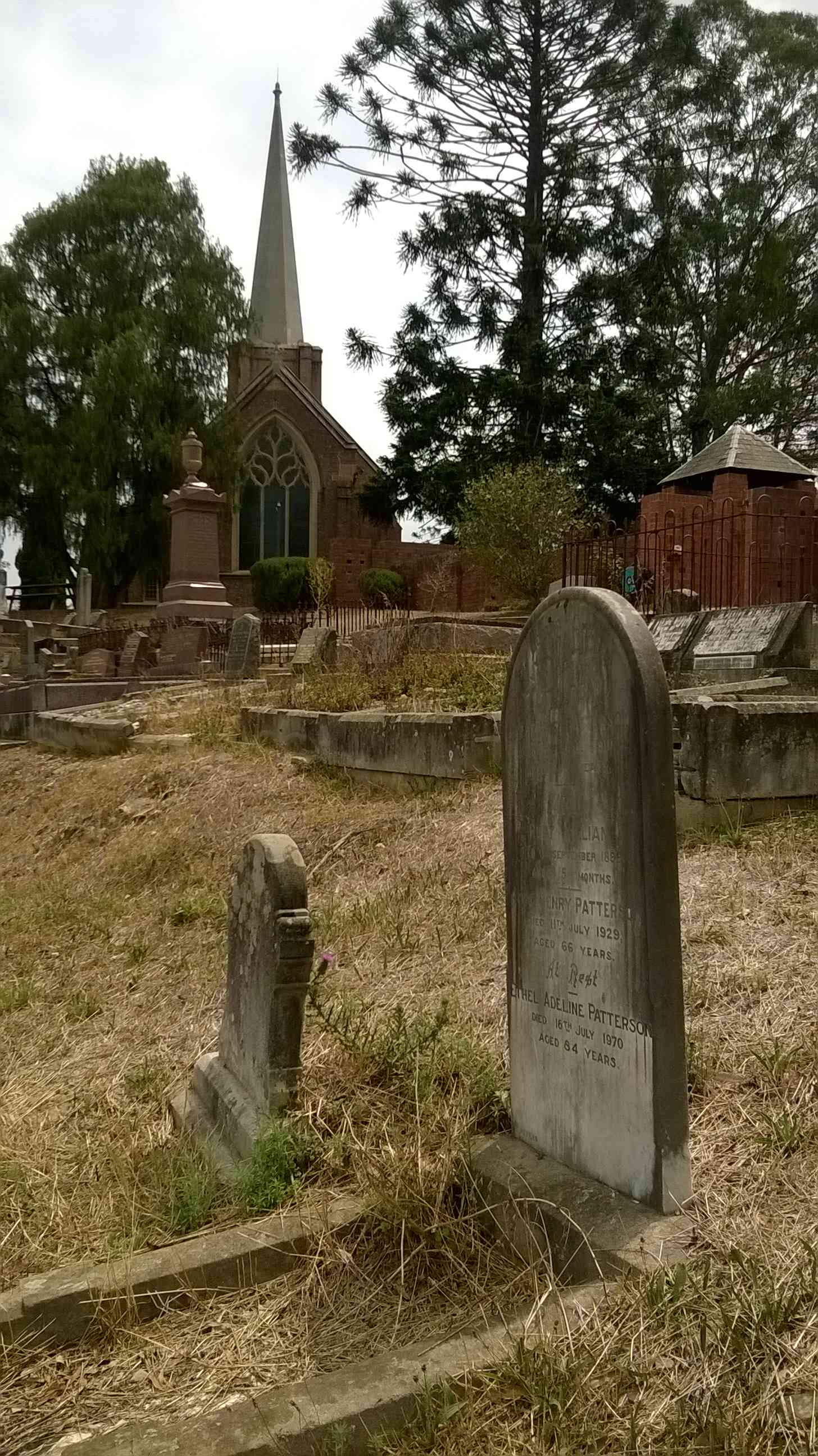
My great-grandfather was Henry Patterson (b. 16 July 1862, Kyneton, Victoria – d. 11th July 1919, Camden, NSW). Henry arrived in Elderslie from Victoria in the 1880s with his wife Catherine (nee Darby), and they became pioneers in the Camden district.
Henry Patterson was a carpenter by trade and worked around the Camden area for various businesses. He and his wife, Catherine, had 7 children, all of whom were born in Camden.
They were Ethel Adeline (b. 9 June 1886), Clarice Mabel (b. 14 May 1888), Isabella (b. 2nd June 1890), William Henry (b. 8 May 1892), Stanley Dudley (b. 5 October 1894), Ruby Lillian (b. 24 March 1899 and who passed away at 5 months of age) and Percy Colin (b. 13 January 1903). [Camden Pioneer Register 1800-1920, Camden Area Family History Society, 2001]

Henry’s wife dies
Henry sadly lost his wife Catherine in 1910 at only 47 years of age, which left him to raise six children.

Henry remarried in 1912 to Martha Osmond (nee Boxall) from Victoria.
Henry died on 11 July 1929 in Camden District Hospital after pneumonia set in following an operation. Martha, who was well-known and respected throughout the district, passed away on 18 May 1950 at the age of 86 years of age. She broke her leg and had become bedridden for some months.
Henry’s son goes to war
Henry and Catherine’s 5th child, Stanley Dudley Patterson, was a farmer in Elderslie. He enlisted in the 1/AIF on 18 July 1915 and was sent off to war on 2 November 1915. He was wounded, and as his health continued to decline, he was sent back to Australia in February 1917.

Voluntary Workers Association helps local digger
Upon Stanley Patterson’s return to Elderslie, a meeting was held by the Camden Branch of the Voluntary Workers’ Association.
They approved the building of a three-roomed weatherboard cottage with a wide verandah front and back to be built at 7 Purcell Street, Elderslie. He was married to Maud Alice Hazell.

Construction of VWA cottage
The land on which the cottage was to be built was donated by Dr. F.W. and Mrs. West. Once the cottage was completed, Stanley secured a mortgage to repay the costs of building the cottage. I believe that the construction of this cottage started in either late February or late March 1918.
Carpentering work had been carried out by Messrs. H.S. Woodhouse, A. McGregor, E. Corvan, and H. Patterson. The painters were Messrs. F.K. Brent, J. Grono, A.S. Huthnance. E. Smith, Rex May and A. May under the supervision of Mr. P.W. May. The fencing in front of the allotment was erected by Mr. Watson, assisted by Messrs. J. E. Veness, C. Cross, and J. Clissold. [Camden News]

Official handing over of VWA cottage
Stanley Patterson’s cottage in Elderslie, which was the first cottage built by the Voluntary Workers’ Association, was officially opened by Mr. J.C. Hunt, M.L.A., on Saturday, 15 June 1918.
The Camden News reported:
A procession consisting of the Camden Band, voluntary workers, and the general public, marched from the bank corner to the cottage, where a large number of people had gathered.
Mr. Hunt, who was well received, said he considered it a privilege and an honour to be invited to a ceremony of this kind, for when those who had fought for us needed help it was our duty to give that help, for they had fought for us needed help it was our duty to give that help, for they had sacrificed so much for us. Although Private Patterson had returned from active service, he had offered his life for us. Mr. Hunt congratulated Pte. Patterson on responding to the call of duty; soldiers did not look for praise, the knowledge of having done their duty to their country was all they required. He hoped that Pte. and Mrs. Patterson would live long to enjoy the comforts of the home provided for them by the people of Camden.
Camden News, 20 June 1918
Appeal for photographs of VWA cottage by CE Coleman
CE Coleman took a few photos of the VWA cottage and handed them over to Pte. Patterson. These included: one in the course of construction; the official opening; the gathering that had assembled on the day; and a photo of Pte. Patterson. To date, I have searched high and low for these photos but to no avail. The only photo of a cottage built by the Voluntary Workers’ Association is a cottage at 49 Broughton Street, Camden, for returned soldier Pt. B. Chesham. [Camden Images Past and Present] [Camden News, Thursday, 20 June 1918, page 4]
VWA cottage is a model farm for other returning soldiers

The Camden News reported:
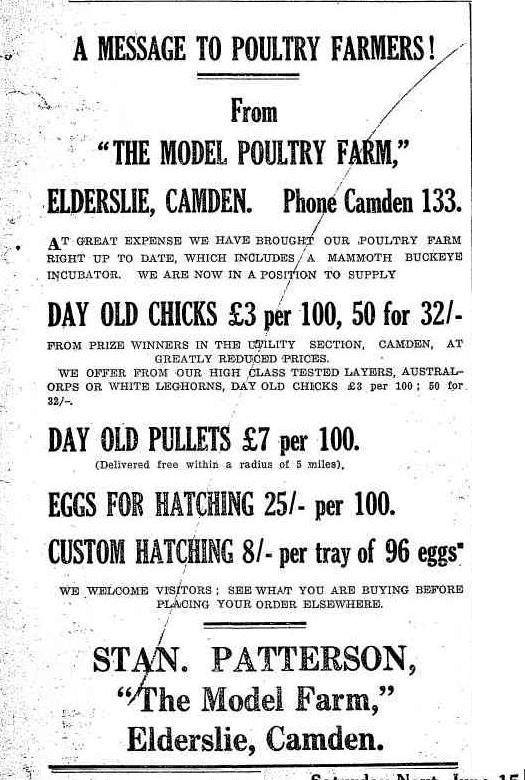
MODEL POULTRY FARM
Stanley Patterson settled down in his new cottage on 1¼ acres and was determined to make good and earn a livelihood and cultivated the land and planting a small apple and citrus orchard and a vineyard. It wasn’t long before he purchased an adjoining piece of land of another 1¼ acres and within a few more years added another block, giving him 3 ¾ acres.
By 1935, Stanley Patterson owned 14 acres in the vicinity of Elderslie. With his apple and citrus orchard and vineyard, Stanley went into poultry farming as well with particular attention given to the production of good and profitable fowls and he had over 1,000 birds, mainly White Leghorns and Australorps with an extra run of the finest standard Minorca.
In 1935, the progeny test of Stanley Patterson’s birds held a record of 250 eggs and over and the distinctive productivity of these is in the fact that he collects eggs in an off period equal to numbers in flush periods. The marketing value is therefore enhanced. The pens are well divided into different sections, the buildings being on the semi-intensive system each with its own separate run. The brooder house is fitted with the Buckeye principle brooders, also has run for young chicks. The incubator house is a separate identity fitted with a Buckeye incubator of 2,000 eggs capacity, hot air is distributed by means of an electric fan. Feed storage and preparation shed and packing room are conveniently attached and the model poultry farm is one that stands out only to the credit to the industrious owner, but to the district in which it is worked.
In 1935, day-old chicks were sold for 3 Pounds per 100 or 50 for 32/-. Day-old Pullets were sold for 7 Pounds per 100, eggs for hatching were sold for 25/- per 100 and Custom hatching was 8/- per tray of 96 eggs.
Camden News, 20 June 1935
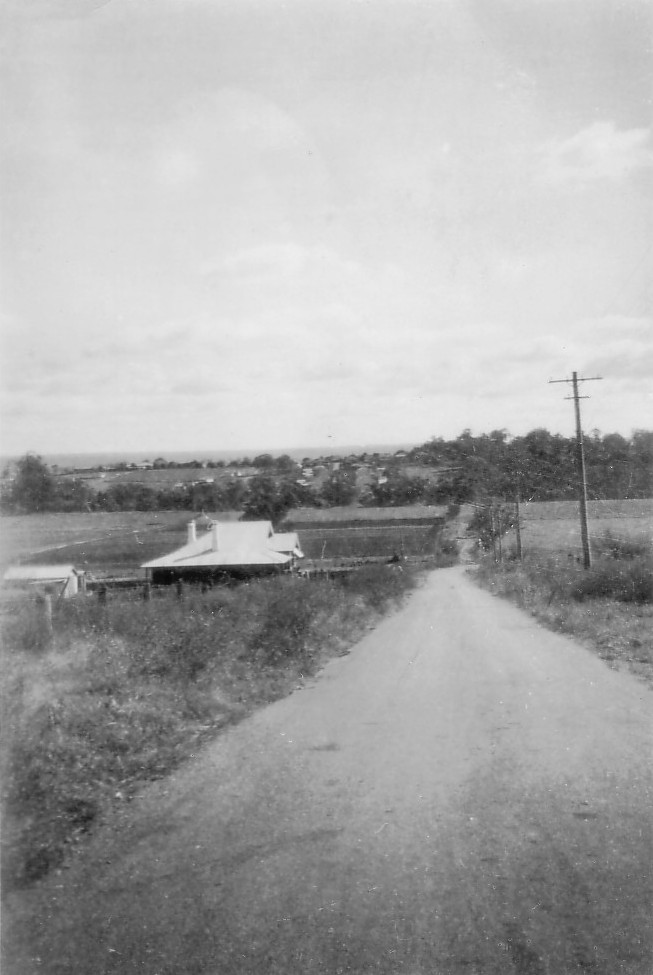
My grandfather, WH Patterson
My grandfather was William Henry Patterson, the 4th child born to Henry and Catherine Patterson. He was a carpenter like his father, and following his marriage to Ruby Muriel Kennedy in 1918, he purchased some acreage in River Road, Elderslie. He had a vineyard, flower beds, fruit trees and other crops on a small farm.
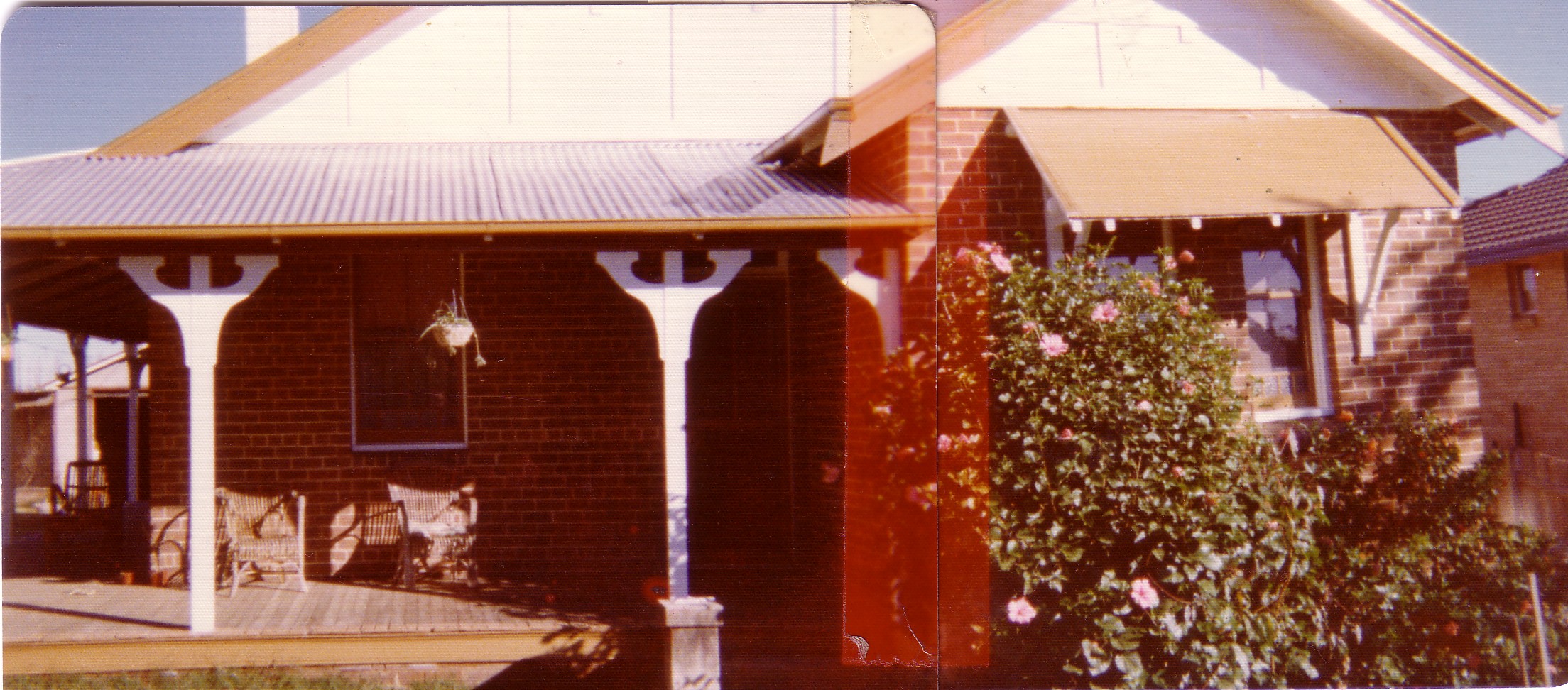
William built his own home at 34 River Road, Elderslie, in the early 1920s with some assistance from another builder. The home was a double brick home with a tin roof and consisted of two bedrooms, a bathroom, a lounge room, a kitchen, laundry and a verandah around 3 sides.
Inside the home, there was a lot of decorative timber, and William had also made some furniture for his new home. This home has since gone under some extensive renovations, but the front of the home still remains the same today and recently sold for $1.9 million.
As a carpenter, William worked locally in the Camden district and, on several occasions, worked at Camelot. Unfortunately, I have no other information on William.

Contemporary developments at 34 River Road, Elderslie
Jane reports she is the current owner of 34 River Road Elderslie and has loved finding out about the history of the house. She purchased the house two years ago (2018) and is currently renovating the house’s interior.
Jane says:
I have been working with Nathan Caines from Fernleigh Drafting & Melanie Redman Designs for the interior, coming up with some beautiful concepts. The original exterior of the house will not be changed, but there will be some amazing changes out the back.
PC Patterson
Percy Colin Patterson, the 7th child born to Henry and Catherine Patterson, married Christina N Larkin in 1932. In the early 1920s, Percy was a porter at Menangle Railway Station for about 5 months before he was transferred to Sydney Station.
Maree’s search continues
Maree Patterson concludes her story by asking:
I am particularly interested in information on the Camden Branch of the Voluntary Workers’ Association, which was formed in 1918.
The WVA built the first cottage at 7 Purcell Street, Elderslie, for returned World War 1 soldier Pte. Stanley Dudley Patterson, who was my great uncle.
The house still stands today but has had some modifications, and I lived in this cottage for a few years after I was born with my parents.
I am particularly interested in trying to obtain copies of these photos if they exist somewhere. Any assistance you can offer would be greatly appreciated, or perhaps point me in the right direction to find these photos.
Maree Patterson can be contacted by email: reesrebels@yahoo.com
The mysteries of a house history
Revealing the layers of the past
For those who are interested in finding out the history of their house, one author who has recently published her account is Caylie Jeffrey’s in her book Under the Lino The Mystery The History The Community.
Caylie writes that she had no idea of what she and her husband, David Jeffrey, would find when they decided to renovate the worst house on the busiest terrace in Milton, a Brisbane suburb. She says that they had no idea of the treasures they would find ‘secreted inside the house’.
Caylie writes:
A curious online community of amateur sleuths began a relentless quest for answers. As more clues were revealed, the ghosts of Old Brisbane started to rise from the depths of people’s memories.
Read more about Caylie’s story here
Updated on 12 September 2023. Originally posted on 11 January 2020 as ‘The value of family and personal histories’
Discover more from Camden History Notes
Subscribe to get the latest posts sent to your email.


One thought on “The Patterson family of Elderslie, the value of family histories”
Comments are closed.