The Camden Museum has a variety of displays of objects and artefacts across a number of themes. The objects and artefacts are of various periods in the history of the area, and all contribute to the Camden story
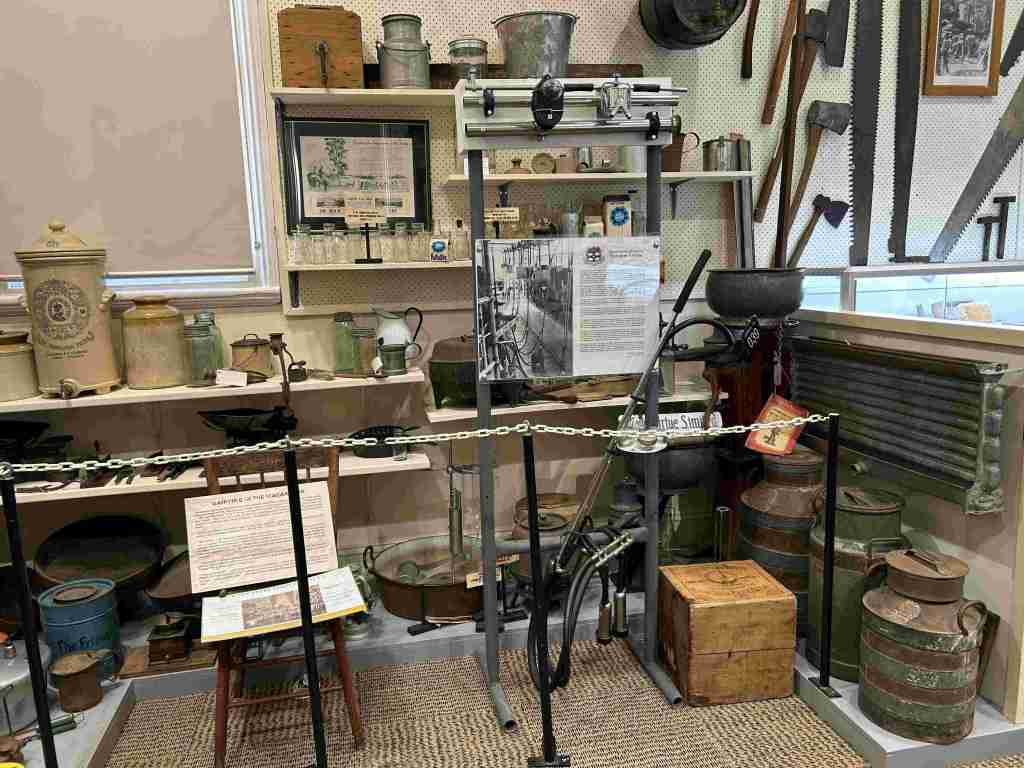
As you wander upstairs at the Camden Museum, you will move around the Nixon Room and pass a small dairy display tucked away in a corner. The mystery of the local dairy farm starts to reveal itself to the visitor in a unique way. The dairy industry has mostly disappeared from local farms, and the casual observer would be hard-pressed to find a dairy cow in the local area. The display includes various artefacts showcasing both smallholder and industrial dairy operations, including the Camden Vale brand from the once-mighty Camden Park Estate.
The dairy corner is full of interesting stuff. The objects and artefacts illustrate a farming type that is long gone. Local dairy farms were once very common. Finding an active dairy farm in the area can be a challenge. The objects represent the smallholder dairyman, who predominated across the district, and the large industrial-scale dairy farm, which was vertically integrated from production to manufacturing, distribution, and marketing. The objects are dated from the 1890s, when the dairy revolution began, to the 1970s, when dairy farms started to disappear from the district. Dairying started to dominate the local economy from the 1890s as the Yerranderie silver mines were worked out, until the 1950s when the wealth from the Burragorang coalfields became the most important part of the local economy. (I Willis 2026)
The Camden Museum features a dairy corner display that highlights the history of local dairying from the 1890s to the 1970s. Once a vital industry, dairy farming has all but vanished, with only a few active farms remaining. The display includes various artefacts, showcasing both smallholder and industrial dairy operations, including the Camden Vale brand from the once mighty Camden Park Estate.
The display caught my attention and has prompted me to try to tell some of the stories of the local dairy industry.
Storyboards
These storyboards were organised by John and Julie Wrigley in the early 2000s.
The Dairy
The Dairy storyboard briefly outlines the growth and development of the Camden dairy industry from the dairy revolution of the 1880s to its decline in the 1960s. (I Willis 2026)
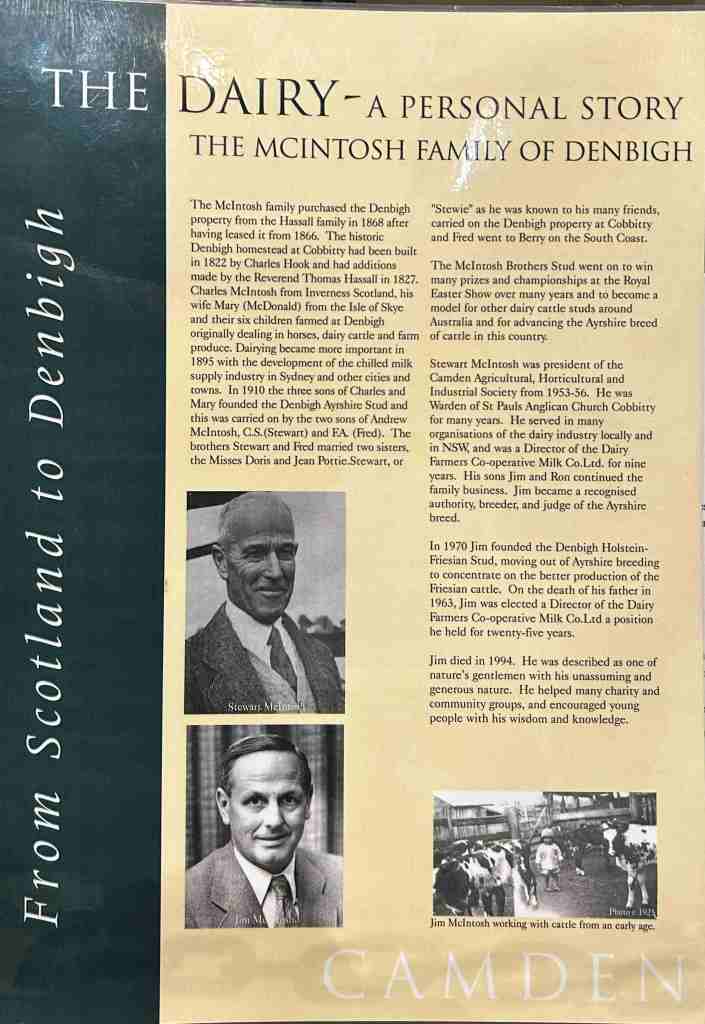
The Dairy – A Personal Story – The McIntosh Family of Denbigh
The storyboard of Denbigh and the McIntosh family who bought the property off the Hassall family in 1868. The McIntoshes turned the property into a dairy farm around 1910 and established the Denbigh Ayrshire Stud, winning awards at the RAS Royal Easter Show. In 1970 the family turned the property into a Holstein-Friesian Stud. (I Willis 2026)
Advertising Poster
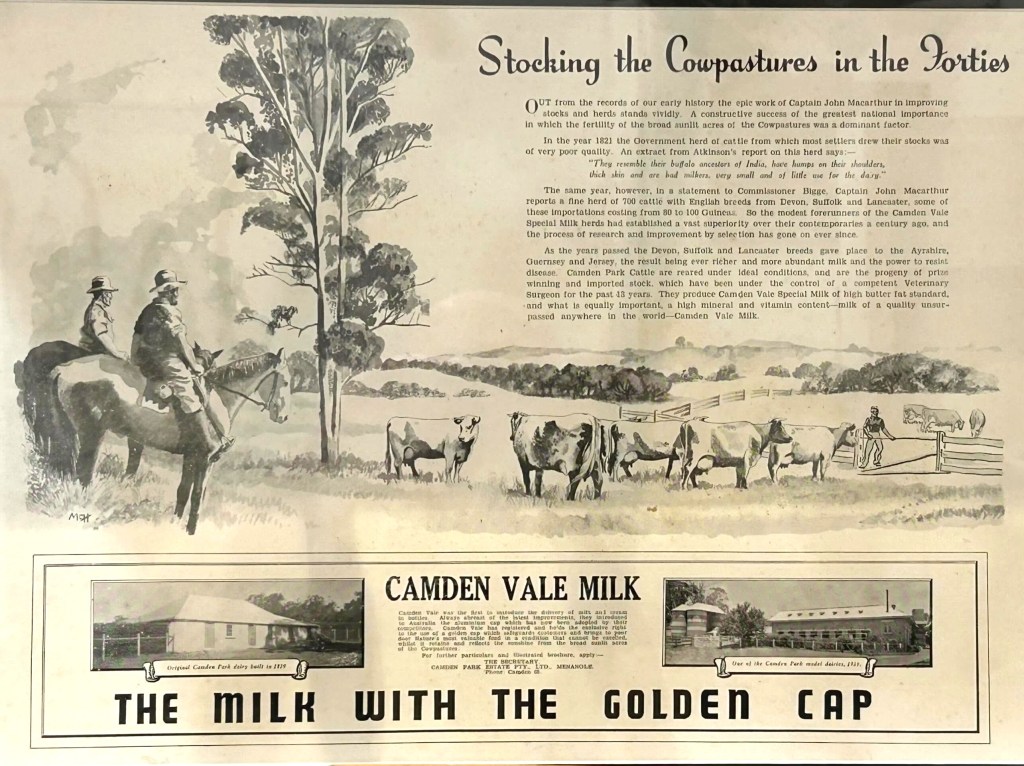
Hanging on the wall at the back of the display is a promotional poster for Camden Vale Special Milk, c1938, produced by Dairy Farmers Cooperative for their specialist milk brand from the Camden Park Estate dairy herd. The poster fascinated me, and I have written up a blog post in response that details the story of Camden Vale Special Milk. The poster was donated to the Camden Museum by Sandra and Ray Brown, the owners of the Camden Valley Inn, in the 1970s. (I Willis 2026)
The display is an eclectic collection of objects that cover a range of aspects of dairying from production and manufacturing to distribution and marketing. Bottles, separators, milk cans and sundry other dairy paraphernalia.
Butter churn and butter pats
A butter churn and butter pats are used together sequentially in the traditional butter-making process. The churn turns cream into solid butter, and the pats are used immediately afterwards to scoop, wash, shape, and squeeze excess liquid from the butter.
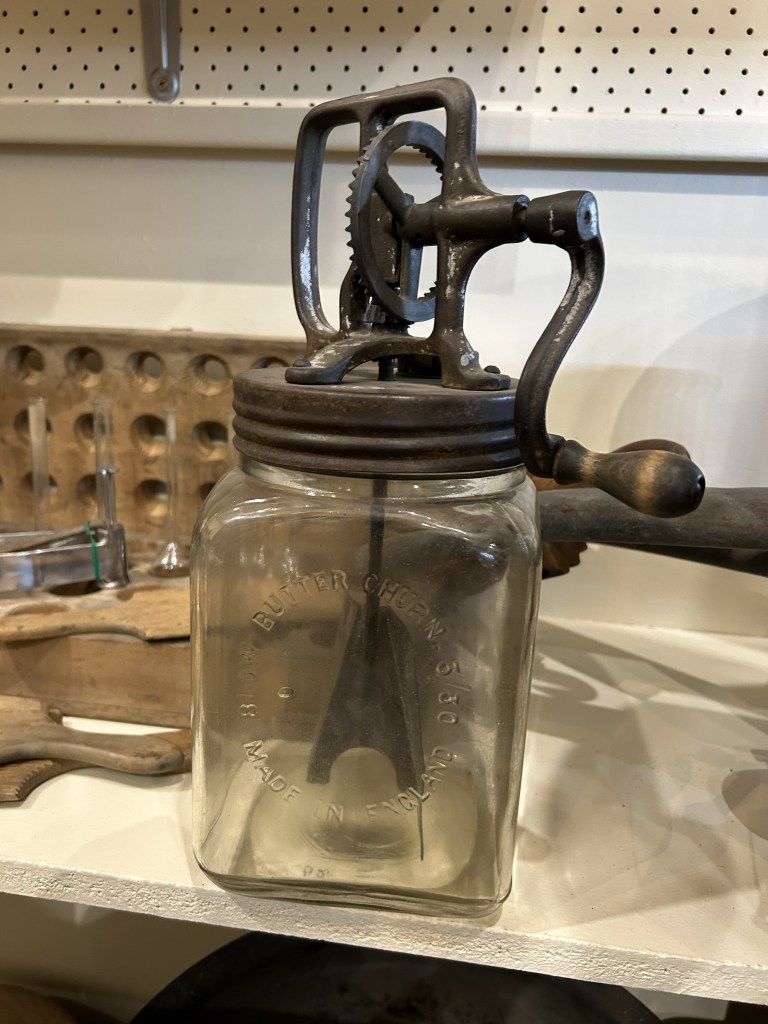
On the central shelf, tucked away behind the Uni of Sydney dairy machine mock-up, is an English-made hand-cranked butter churn with a glass jar base. Glass jar with metal screw-top lid. A wooden handle on top of the lid works a cog wheel and a smaller cog and pinion nut, which together turn a metal rod projecting down into the jar. Metal flanges attached to the rod rotate when the handle is turned, mixing the contents of the jar. This 3-quart churn was made by J.J. Blow Ltd., which produced the popular glass-jar and hand-cranked “Blow” butter churns in London and Chesterfield, Derbyshire, during the late 19th and early 20th centuries. By turning a handle, a ratchet on the lid rotated wooden slats inside the jar, similar to a box churn. Milk was “separated” to retrieve the cream, which was then beaten to make butter. It takes lots of milk to make butter. The cream from 25 litres of milk is needed to make 1kg of butter. (I Willis 2026; Boileau 2008; Simpson 2014)
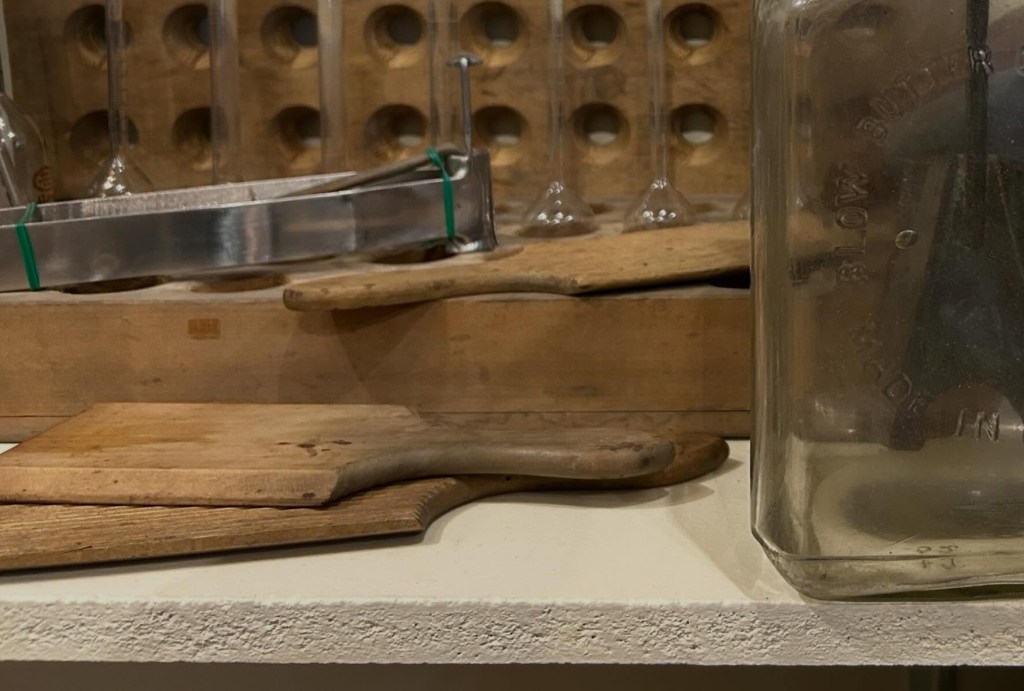
Immediately adjacent to the butter churn are three butter pats that were used in conjunction with the churn when making butter. A wooden butter pat has a rounded handle flowing to a rectangular spatula. The spatula is rounded on the upper side and flat on the underside, the working surface. The wooden paddles are used to help remove the butter from the churn, then shape the butter and squeeze out any leftover watery buttermilk. After soaking in water to stop sticking, the pats were used in pairs to gently slap, roll or slide the butter between the paddles to form classic shapes like rectangular blocks, small decorative balls or medallions. (I Willis 2026; Boileau 2008)
Objects are drawn from a range of dairy sources, including Camden Park and Denbigh
Milk bottle
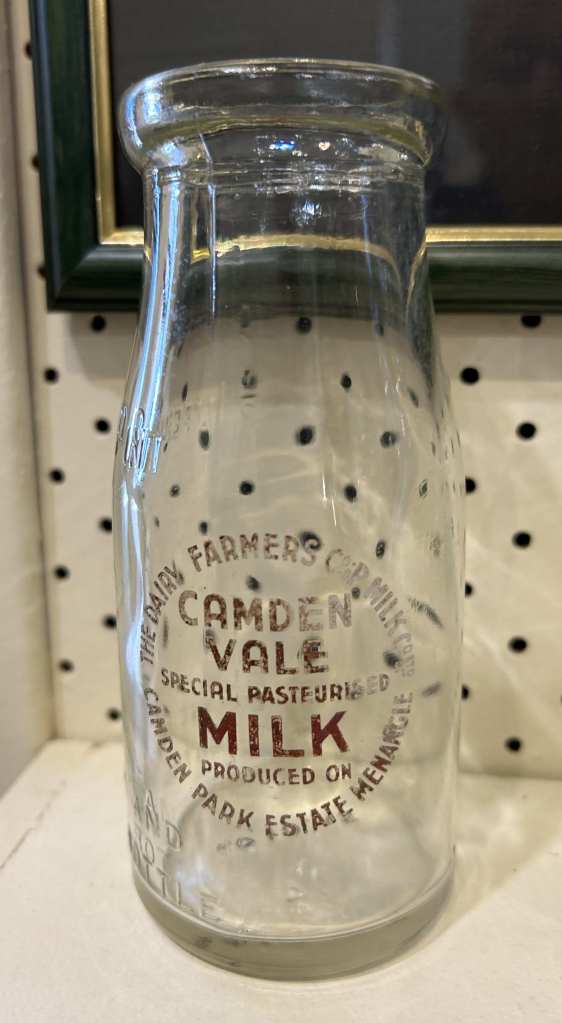
Located on the second shelf is a collection of milk bottles. This original one-pint milk bottle was used by Camden Vale from 1926. Milk was first sold in bottles in the Sydney market in 1925 by Dairy Farmers’ Co-op. These milk bottles had a heavy cardboard disc or ‘wad’ that sat inside the rim. If the bottles were tipped or shaken, the cardboard top could soak up milk and become unhygienic. (I Willis 2026; Walsh 2016)
Butter Box
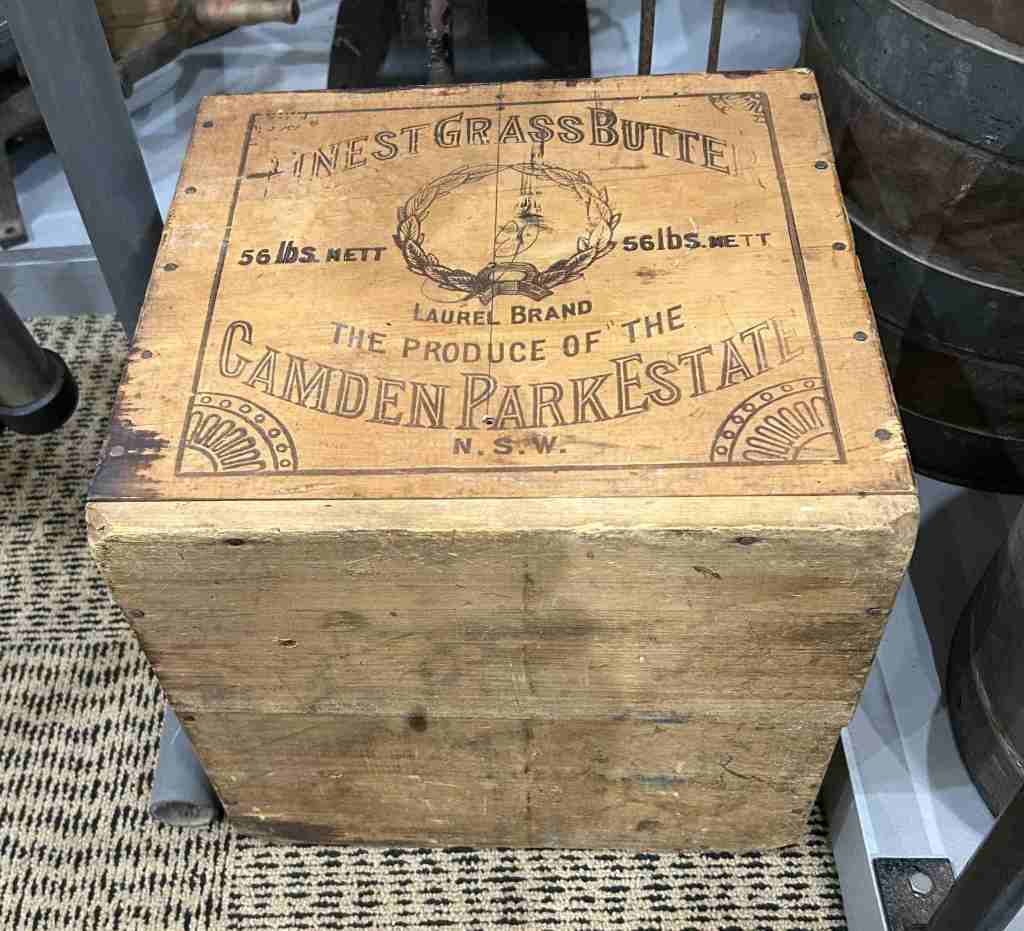
This butter box from Camden Park illustrates the industrial scale of butter production on the estate and the size of the dairy industry in the Camden economy. Camden Park Estate was a vertically integrated farming operation from the 1890s in terms of production, manufacturing, distribution, and marketing. Laurel Butter was produced by Camden Park until the Menangle Central Creamery closed in 1948. According to Brian Walsh, the Laurel brand was used by Camden Park as early as the 1840s. The laurel wreath was part of the Macarthur coat of arms. The Laurel Butter was the top grade made by the estate and was sold in 56-pound boxes and exported to Great Britain. The estate’s butter production at Camden and Menangle from the 1890s was made possible by the introduction of refrigeration, and in 1896 the estate opened the Camden Refrigerating, Butter Making and Bacon Curing Works close to the Camden railway station. (I Willis 2026; Walsh 2016)
Information cards provide some basic facts and storyboards give more details about the dairying story.
Storyboard
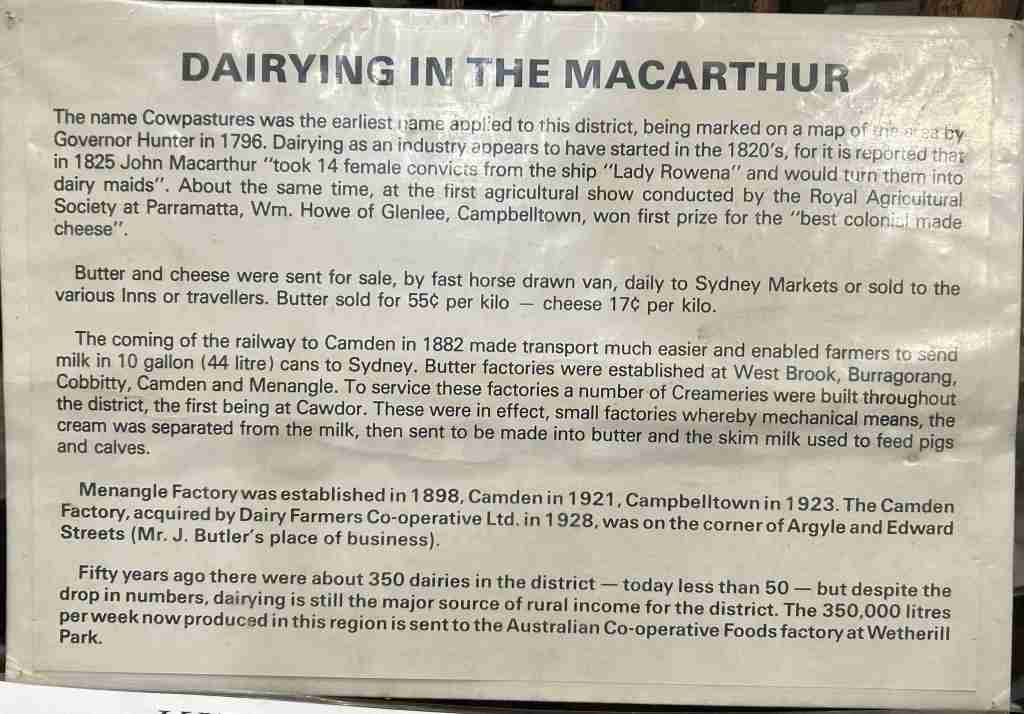
A simple storyboard located amongst the objects tells some of the history of dairying in the Camden district. It probably dates from around the 1970s. The author is unknown. (I Willis 2026)
The milking machine mock-up from the University of Sydney is the most modern piece of equipment.
Milking stand model
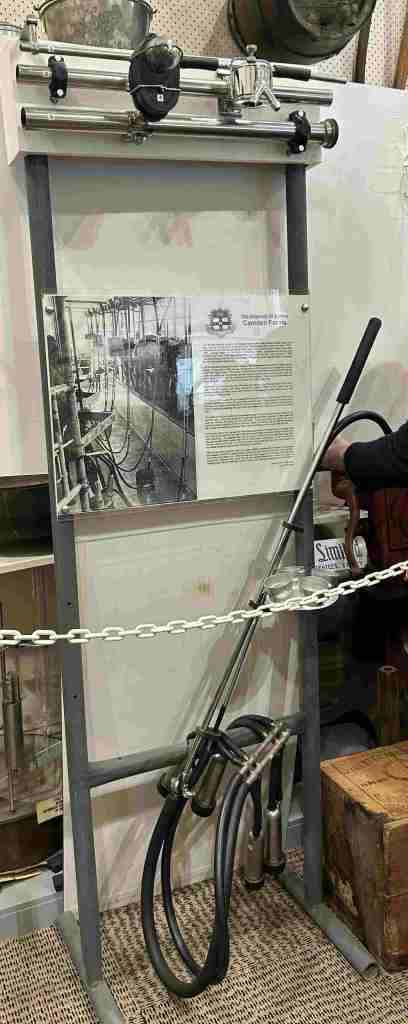
The milking stand model from the University of Sydney, Camden Farms, Cobbitty. The mechanical cups can be seen in the lower part of the image. Milk is supplied to the line at the top of the display and moved into a refrigerated stainless steel tank awaiting a pick-up by the dairy company tanker truck. (I Willis 2026)
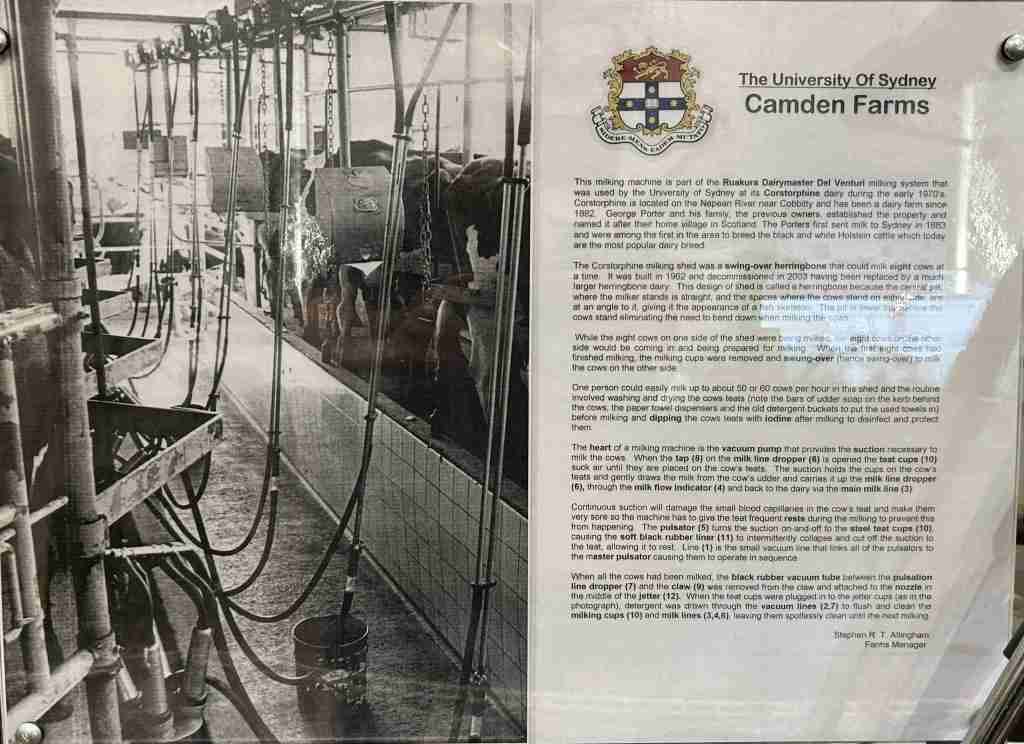
The storyboard for the milking stand model from the University of Sydney, Camden Farms, Cobbitty on the Corstorphine dairy farm. The model represents the herringbone milking system that operated on the University farms from 1962 to 2003. The heart of the machine is the vacuum pump that provides the suction to milk the cows. The suction holds the cup on the cow’s teat and gently draws milk from the cow’s udder (I Willis 2026).
Reflection on dairying in Camden
The Camden Museum’s dairy corner display showcases the history of dairying in the Camden area from the 1890s to the 1970s. Featuring artefacts from both smallholder and industrial dairy operations, including the renowned Camden Vale brand, it reflects a once-thriving industry that has largely vanished, with only a few active farms remaining. The collection includes various tools and equipment, such as butter churns and milk bottles, illustrating the evolution of dairy farming and production methods, highlighting its significant role in the local economy.
Dairying started in the Camden area in the 1820s, with small mixed herds at Camden Park and, to a lesser extent, Glenlee from the 1840s.
The dairy industry dominated the Camden economy from the 1890s until the 1950s, and largely disappeared from the area by the 1990s. The dairy industry is book-ended by mining, initially silver, then coal.
In the early part of this period, the smallholder dairyman was the most common type of farm, and in 1900 there were over 700 individual dairy farms. On the other hand, the largest industrial-scale dairy farm was Camden Park Estate; in the 1930s it was one of the largest in New South Wales, only challenged by Kameruka Estate on the South Coast (near Candelo).
Camden Park Estate was vertically integrated from production to manufacturing, then distribution and marketing. The farm was innovative, and its milk brand, Camden Vale Special Milk, remained on the market from 1920, was merged with Dairy Farmers in 1929, and continued to be sold under the Camden Vale brand until the estate was sold in 1973.
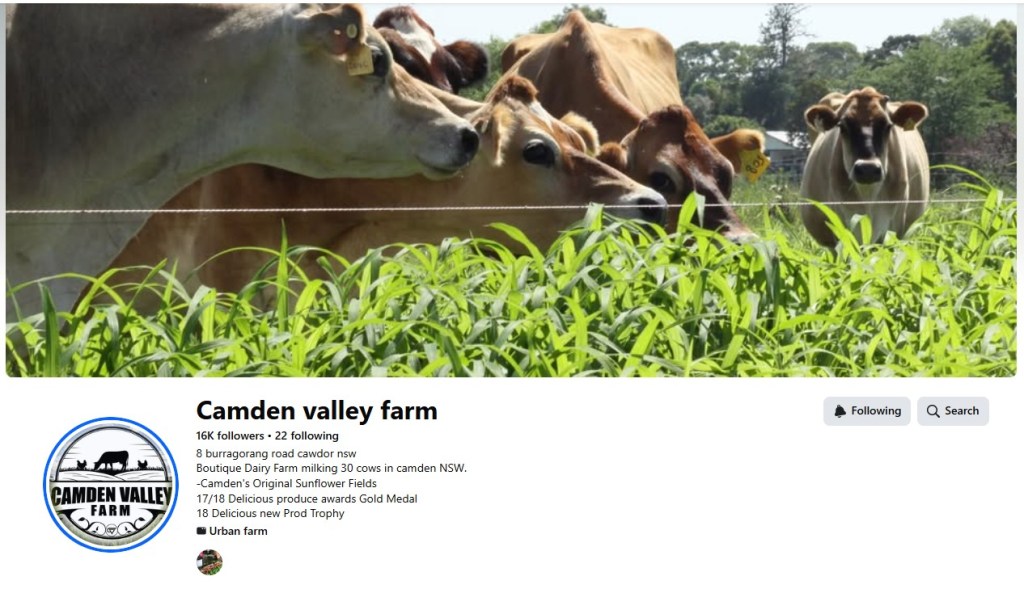
There are only two dairy farms left in the area, the family-operated Camden Valley Farm at Cawdor, and the University of Sydney herd at Corstorphine Farm at Cobbitty.